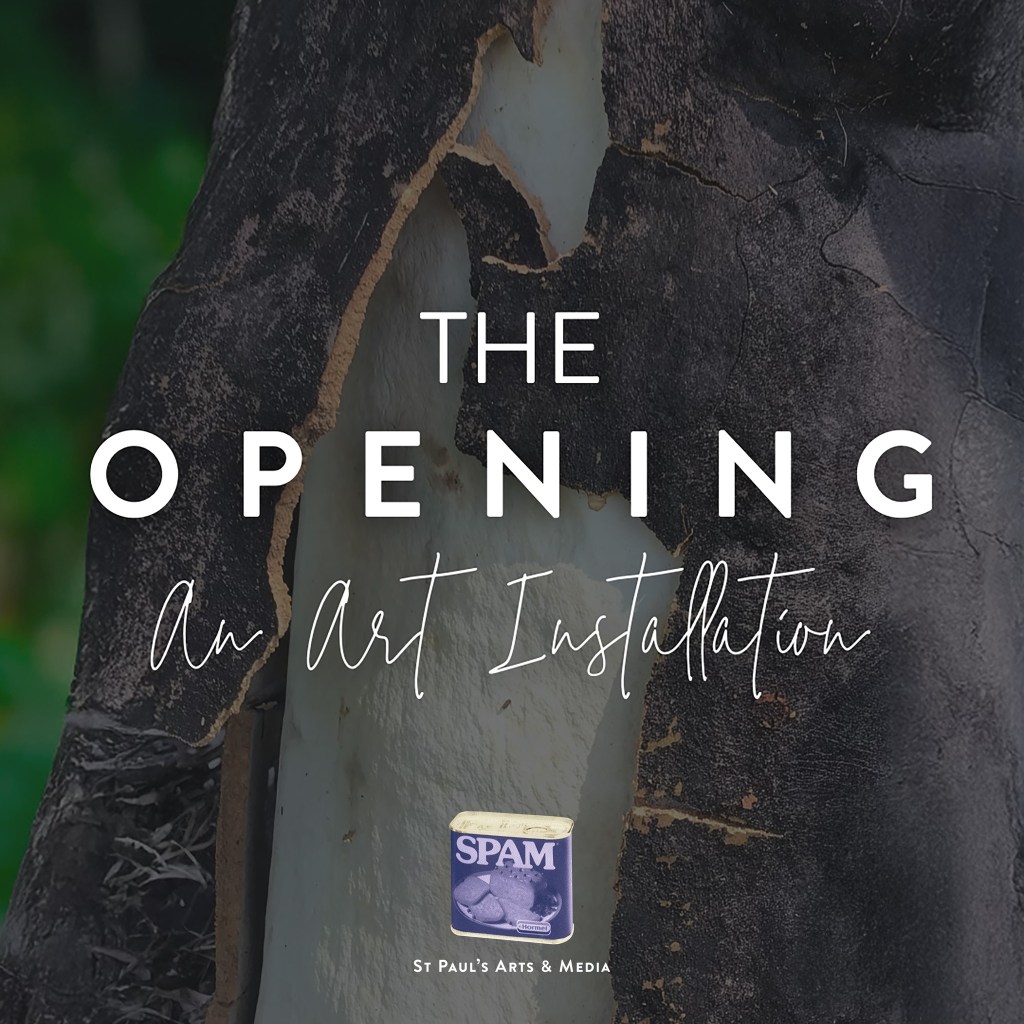
Through Lent and Good Friday, the High Altar of St Paul’s in Auckland held something rare: an artwork that does not announce itself, but waits. Titled The Opening, conceived and created by Karen Sewell under the auspices of SPAM (St Paul’s Arts & Media), is a site-responsive installation that takes as its starting point one of the most arresting images in the Passion narrative: the tearing of the temple veil. At the moment of Christ’s death, a curtain that had divided the holy of holies from ordinary worshippers for centuries was torn … from above. The Opening holds that moment and asks what it might mean for us now. What might it mean, too, to imagine that “Christ did not point to the opening but rather is the opening?
Rather than illustrating the biblical event, Sewell works with material and sensory registers – painted linen, bark, hand-formed earth, scent, and poetry – to create what she calls a “quiet threshold.” Visitors are not directed toward a conclusion but invited to linger, to bring what they carry, and to rest.
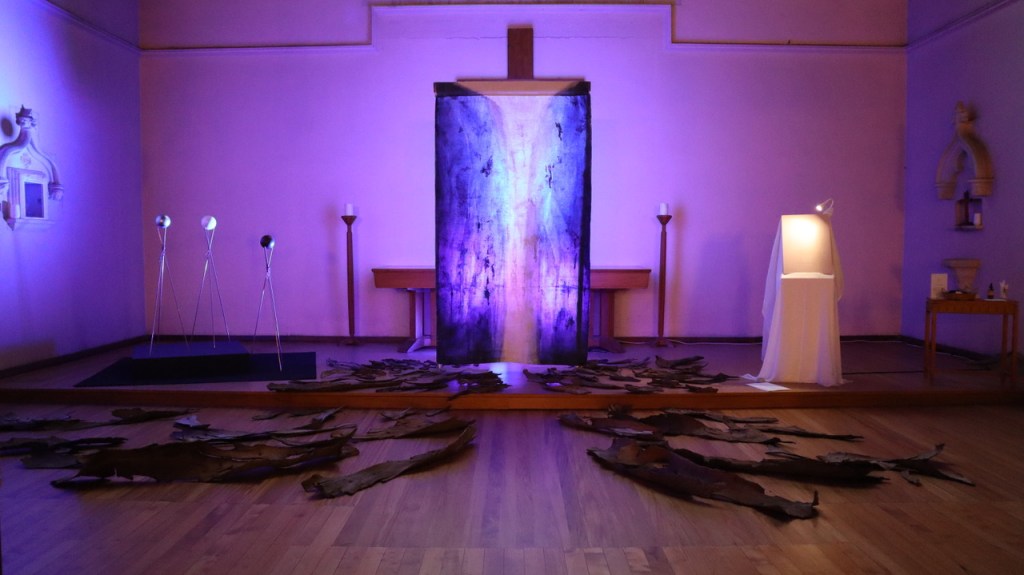
Four elements, one threshold
The installation operates as an integrated whole, each element carrying its own weight while contributing to a cumulative atmosphere of contemplative attention. Together they form what Sewell describes as “a place to pause, pray, and listen.”
I. The Opening – The Veil. A large painted linen veil, the installation’s central image, holds memory, fragility, and light. It alludes to the temple curtain while remaining resolutely its own thing: worn, painted, suffused with the marks of making.
II. Bark Work – Shedding. Bark, shed naturally by trees as new growth arrives, covers the floor, speaking of shedding and release. The material is at once beautiful and in the process of becoming something else.
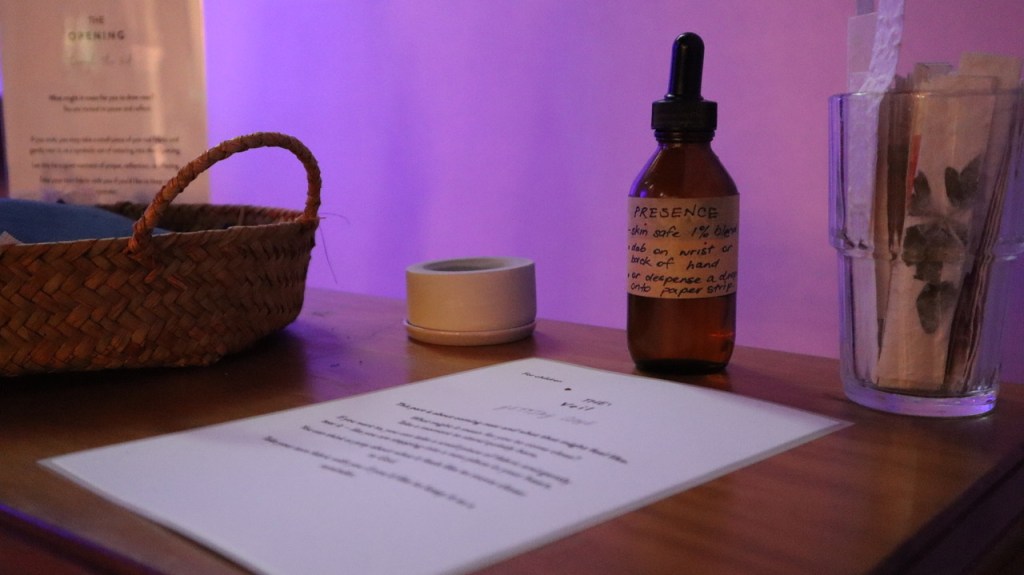
III. Scent – Presence. A bespoke ambient scent, Presence, moves through the space unseen. Intangible and enveloping, it evokes Spirit: present even when invisible, echoing God’s quiet abiding within the material world.
IV. Earth Spheres – The Light Within Matter. Hand-formed earth spheres made from soil, sand, and water carry traces of place, time, and touch. Sewell calls them “the light within matter,” forms of quiet transformation, the hidden work of God in ordinary life.
In addition to these “response invitations,” as she calls them, Sewell offers two poems, “What Opened” and “Through the Torn Place,” which give language to what cannot quite be shown. They function not as explanation but as another material layer of the work.
Space for what cannot be answered
What distinguishes The Opening from much church-commissioned art is its refusal to be didactic. The installation does not tell visitors what to think or feel about Good Friday. It makes space for encounter, which is both harder to achieve and, perhaps, more theologically honest.
Sewell’s background in contemplative practice informs every decision. The scent is there for those who notice it and not for those who don’t. The response stations, fabric to tear, paper to write on, a moment to pause over the earth spheres, are invitations rather than instructions. Participation is entirely at the visitor’s own pace and depth.
“Rather than offering answers, The Opening creates space for contemplative attention: a place to reflect on the love that heals separation and restores communion.”
The bark floor work is particularly striking in this regard. Bark shed by a living tree is neither dead nor alive in the ordinary sense. It is released material, the evidence of a living system continuing to grow. That it covers the floor beneath the veil and the earth spheres gives the work a groundedness that prevents it from becoming merely atmospheric. There is substance here, as well as suggestion.
The installation asks visitors to hold together things that resist resolution: rupture and reconciliation, absence and nearness, loss and hope. These are not contradictions to be dissolved but tensions to be inhabited.
The exhibition is open on Sundays (0900–1300) or by appointment.

 Art/s and Theology Australia