No painting can be adjudged, can reveal its true meanings, can expose the deeper insights and sensitivities of the artist, unless one physically confronts and breathes in the paint. The message is in the medium. All that I am able to do is run my eye attentively over computer images of the successive panels of Kyrie Eleison, draw attention to one or two more obvious themes, and supplement my a priori reading of the paintings by inferences drawn from my many years of friendship with Michael Galovic.
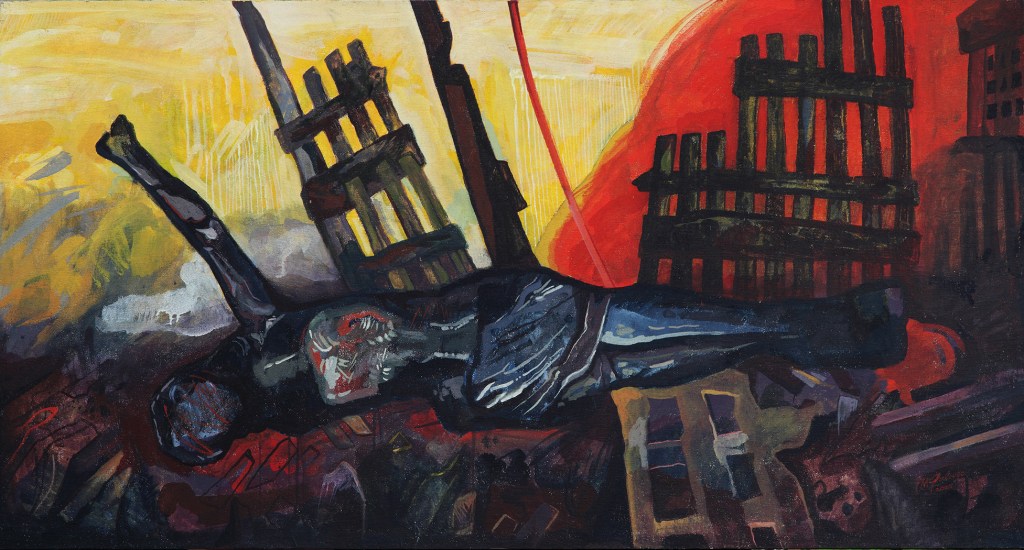
Inspired by the unforgettable photographic images of the Twin Towers, Michael was moved to give iconographic expression to his meditations around the catastrophic event in the form of a series of eight interconnected, moving, and challenging panels. Drawing on living water from the well of Eastern Orthodox iconography, each successive panel links images of the devastated World Trade Centre to the Gospel narrative of Christ’s passion and resurrection, episode by episode. Michael’s conviction clearly was that it is only through the salvific Paschal Mystery that spiritual meaning can be ascribed to the otherwise totally meaningless incident.
But, as with Holy Scripture, one needs to delve deeper into the narrative to expose the sensus plenior, the fuller sense, that lies beneath the surface of the imagery. Unless I am much mistaken, what lies beneath the surface is a vision of “things-to-come” that Michael shares with countless Christians around the globe. To reduce this vision to its barest bones, it is that of an impending (in fact, it has actually started) worldwide catastrophic collapse of cultures and institutions, ecclesiastical as well as secular, accompanied by massive extinction of biological species, and the ravaging, or even the extreme elimination, of entire human populations. But this widely shared vision is not one of despair but of hope; not hope in the “but there is still time” with which climate scientists seem to feel it their duty, even if contrary to their convictions, to conclude their dire warnings, but hope, of faith, that a new universal order will emerge amongst a remnant humanity.
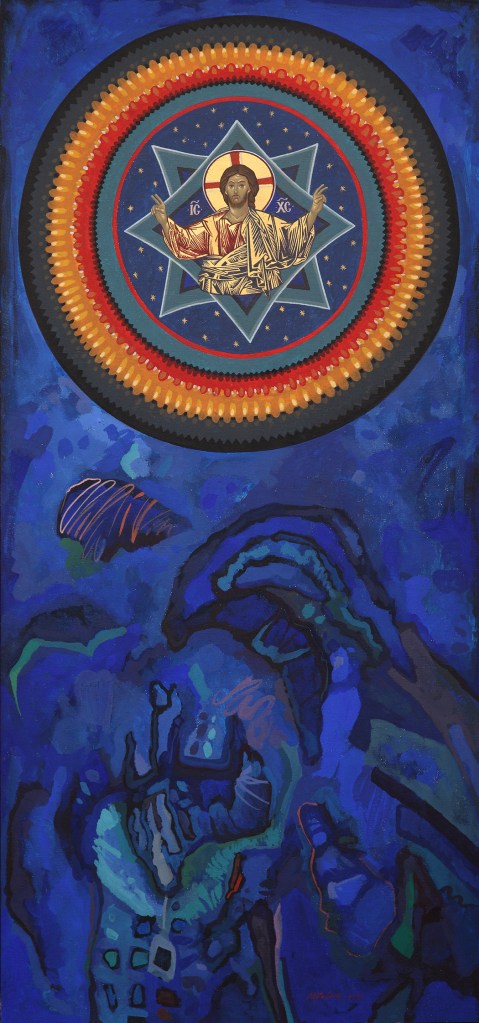
In its Christian form, it is the conviction that the New Jerusalem will be centred on the Cosmic Christ, through whom, in the power of the Divine Breath, the Holy Spirit has drawn people to himself from the beginning of the Homo sapiens story. The eternal Logos, the Word,and the Incarnate Christ, Jesus of Nazareth, are one and the same, but the Word has come to the hearts of countless millions of seekers before the Incarnation and amongst those who have heard nothing of the gospel, even today. The cosmic Christ is the universal Christ, the saviour for all. The age of the cosmic Christ, to those who share this vision, will not be long coming.
Galovic’s Kyrie Eleison series is defined by the first and last panels, from the fall of the towers to the icon of the cosmic Christ. Each of the intervening six panels is centred on a cluster of symbols that invite the viewer to meditate on Galovic’s apocalyptic vision, first from one angle, then from another. Obviously, the symbols were selected and grouped because, for Galovic, each symbol has a particular meaning. But symbols are polysemous, and indeed frequently carry opposite connotations. This means that each panel, in its unique way, can simultaneously convey or connect with the meanings of both horror and doom, and with the promise of a new order arising from a devastated world.
But why, one might ask, does Galovic ground the whole series in the destruction of the World Trade Centre on 9/11? Galovic’s Kyrie, though he constantly refers back to 9/11, is not about 9/11 per se. He simply uses 9/11 as a type (in the biblical sense) of catastrophic events with worldwide consequences in general. He could, to take a couple of examples, equally have chosen the nuclear holocaust of the people of Hiroshima and Nagasaki in 1945, or the ongoing genocide of the Palestinians of Gaza, to anchor the series. The obvious answer to the question is that it was the impact, and by no means does that exclude aesthetic impact, of those unforgettable photos of the destroyed Twin Towers that gripped his attention. It was indeed those naked, silvery pinnacles of steel rising from the sea of wreckage that were to haunt Galovic and led to a series of 9/11 paintings that predate Kyrie.
Even the view from in front of a computer screen is more than sufficient to tell one that Galovic’s Kyrie Eleison is a work with a desperately urgent message for our times. In my opinion, it is both a triumph for Galovic as an iconographer and for the flexibility of the Serbian iconographic tradition, which has been his mentor since childhood, that has enabled him to interpret the apocalyptic signs of our times in a brilliant sequence of iconographic images of the unfolding heart-rendering stages of the paschal mystery.
℘℘℘℘
Guy Freeland, a lecturer at St Andrew’s Greek Orthodox Theological College, Sydney, lives and works on the lands of the Dharug people.

 Art/s and Theology Australia