Every successful person follows their dreams, takes risks others would not dare, and accepts the sacrifices they may have to make along the way.
As a poet, I do not concern myself with my immediate surroundings, the local literary environment or the marketable products that environment demands. Literary thinking here is local, not global.
It is no coincidence that Azerbaijanis are known as a nation of poets, or that the Gazakh region, where I live, is called a land of poets. Yet no poets here think globally. They are content when mediocre singers set their poems to music, and they delight in hearing wedding hosts recite them. Those with strong public-speaking skills may even become wedding hosts themselves. They squander their talent entertaining the masses.
Worse still, they seek respect by flattering those in power.
In short, they turn Pegasus, the famous winged horse, into a beast of burden for the masses and the authorities. Instead of letting Pegasus soar toward the moon, they turn the horse into a mule, a creature incapable of reproducing. In doing so, they render their talent sterile.
But my path, my way of thinking and even the season I inhabit are different.
Their subjects are longing, unfulfilled love, praise of the homeland, and of the poet themselves.
Even eighty-year-old men with grandchildren and great-grandchildren write dreadful poems about some unfulfilled love. The hair, lips, and eyes of the beautiful in these poems are made to rhyme through similes inherited from the Middle Ages.
Let me add this: these poets have written so much about hair that not even all the world’s hairdressers have read as much about it. They have written so much about eyes that not even all the world’s ophthalmologists have read so many books on the subject. They have written so much about lips that not even all the world’s cosmetic surgeons have read as much about them. And so it goes.
One of our renowned poets wrote a famous line:
‘Once again, O poet, your imagination is among the heavens!’
Yes, their imagination is in the heavens. They either fail to see the problems on the ground or choose not to see them.
But my imagination is on the ground.
I create literature out of problems.
My subject is the poor person’s refrigerator, kitchen, and clothing. My subject is the educated crowd that has nevertheless become robotic. My subject is the torments of hell experienced in this world. My subject is the inequality between a villa and a shack. My subject is the use of the law in the service of lawlessness.
This, in my view, is precisely how spirituality should be understood. My poetry leaves no room for grandiloquence.
Because my literary thinking is global, I can give these problems global significance.
In short, I am not interested in the problems of literature; I am interested in the literature of problems.
℘℘℘℘
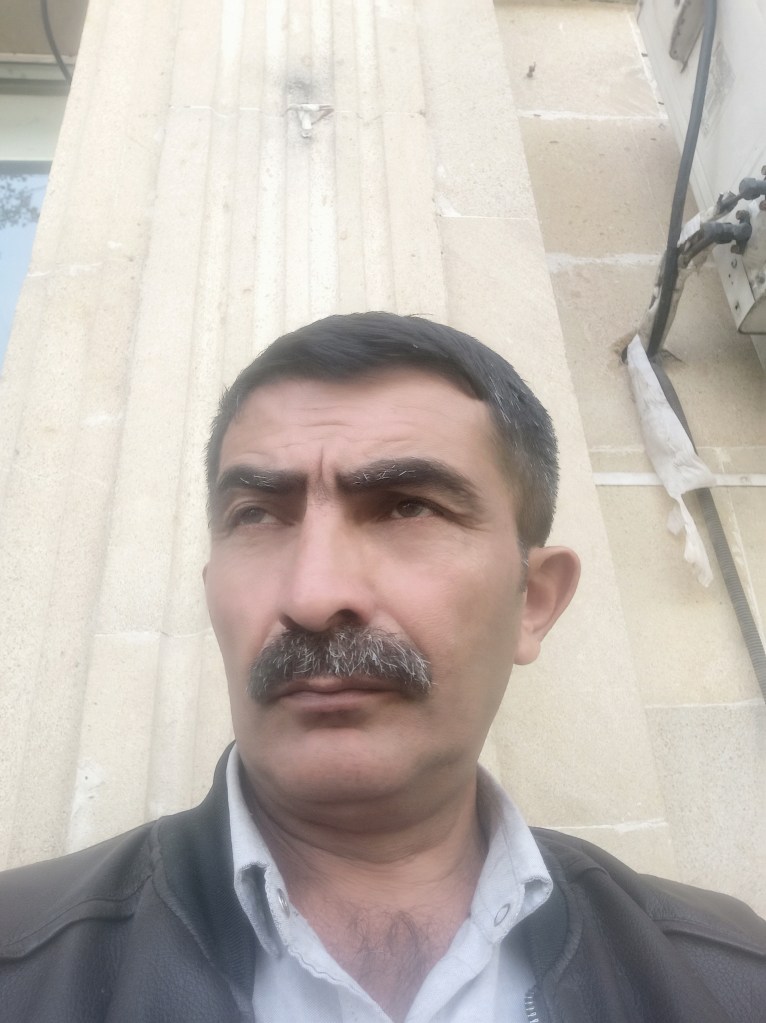
Bahtiyar Hidayet is an Azerbaijani poet, educator, and former political prisoner whose work combines lyrical reflection with sharp social and political observation. Born in 1974 and trained as a history teacher, he has written several poetry collections, and his poems often explore memory, injustice, human resilience, and everyday life in contemporary Azerbaijan. The poem above is titled “Under The Silk Blanket.”
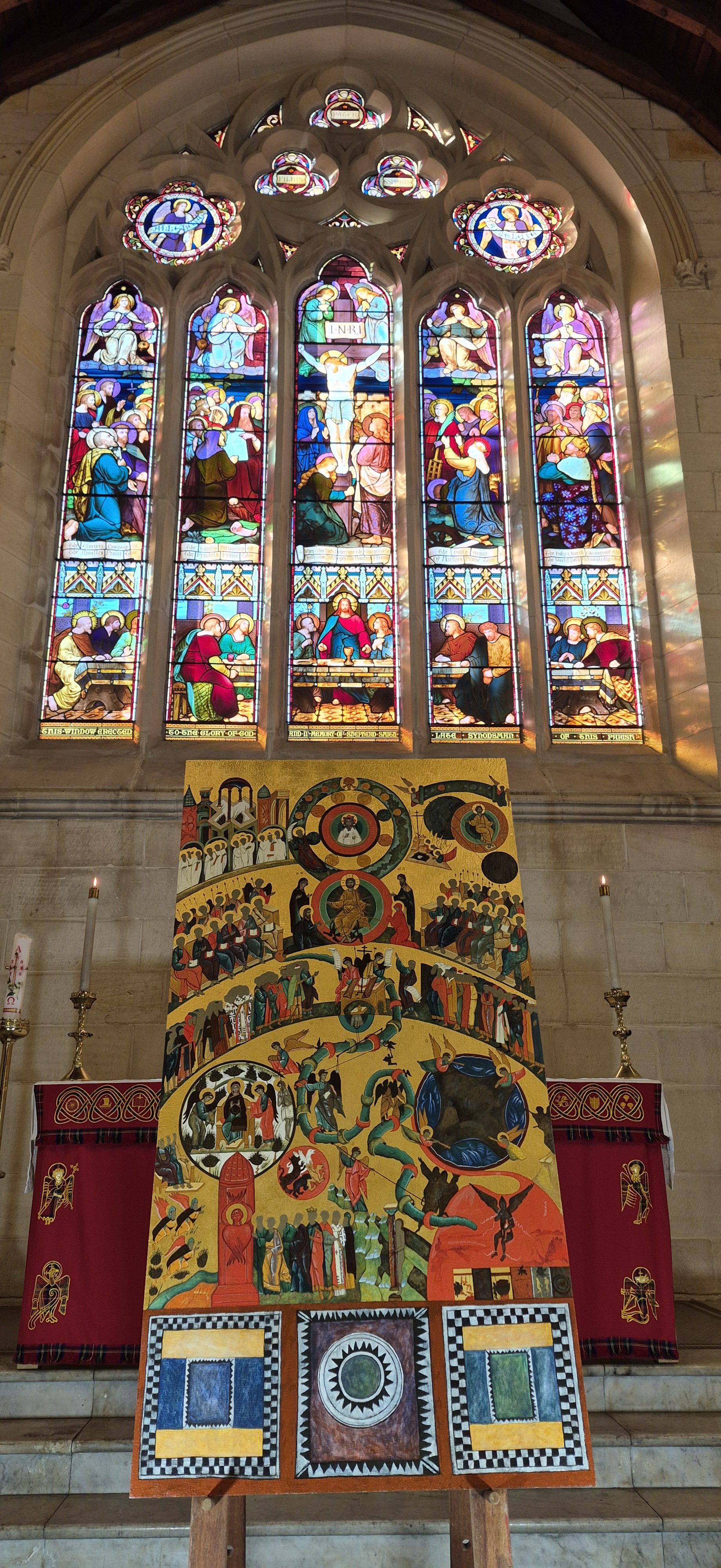
The monumental icon of the Last Judgement, written by Michael Galovic, is a visually commanding work containing multiple iconographic references and subsidiary scenes. It can be approached in manifold ways. I suggest that the most fruitful approach is to interpret it within its religious, scriptural, and liturgical context.
In Australia and New Zealand, we have little experience of Last Judgement scenes. If anything, our art and preaching have downplayed the apocalyptic, the judgemental, and the punitive. The mediaeval West and the Russian East produced great frescoes and icons on this theme from the thirteenth to the seventeenth century. Michelangelo’s enormous fresco above the altar in the Sistine Chapel and Giotto’s fresco above the altar in the Arena Chapel are among the best-known examples today. Perhaps one reason such works are rarely produced today is the sheer scope and difficulty of their creation, which requires decades of prior experience.
Context is especially important to interpretation, and the settings of these two famous Last Judgement scenes suggest the liturgical and architectural context Galovic would have envisaged for his artwork.
Last Judgement scenes were commonly monumental images in churches, especially on entrance walls, façades, and vaults, though they also appeared in altarpieces and portable icons. Galovic appears to have conceived his monumental icon as an altarpiece. His work is 150 × 80 cm, and despite being a portable panel, it retains the monumental logic of a church wall. This helps explain why it contains so many otherwise independent iconographic subjects.
An altarpiece is a painted or sculpted work designed to stand on or behind an altar and to provide its principal visual and devotional focus. Looking at Galovic’s icon, I imagine it positioned before a congregation celebrating the Eucharist, particularly during the elevation of the host in the Eucharistic Prayer. The ecclesial Body of Christ, the congregation, stands before the priest as the priest repeats the words of Jesus, ‘This is my body’, all focusing on the real presence of Christ in the Eucharist. Behind the host, the icon, through its recurring circular motif, echoes and interprets that presence.
The congregation would encounter the icon repeatedly within the celebration of the Eucharist. They would be drawn into its complexity and gain different insights from every encounter. The icon would be present in liturgical time, within the cycle of the church’s celebration of feasts, telling a different story in Eastertide from that told in Ordinary Time. The believer contemplating the icon would come from daily life but would be invited to contemplate eternity.
In the Lord’s Prayer, Christians pray for ‘our daily bread’ and often understand this as a petition for what we need for the day at hand. However, biblical scholars have long puzzled over the Greek word usually translated as ‘daily’ in that prayer in the Gospels of Matthew and Luke: epiousios. The interpretive difficulty is that the word is extraordinarily rare; it occurs only in these passages and in the version of the Lord’s Prayer found in the Didache.
The three major interpretations are:
the bread we need now;
the Bread of Life;
the bread of the Day that is coming.
Galovic’s icon can be read as an elaboration of the third interpretation. He presents visually the meaning and significance of the Day that is coming, the Day of Judgement, with particular focus on the end-time Judge.
The sun and moon were created on the fourth day of creation (Gen. 1.14–19). The prophet Isaiah describes what will happen when the Lord Yahweh delivers judgment: ‘The heavens shall be rolled up like a scroll and all their host shall wither away’ (Isa. 34.4a). The Book of Revelation takes up this imagery when the slain Lamb opens the sixth seal: ‘Then the sky disappeared as if it were a scroll being rolled up’ (Rev. 6.14a). Iconographers make this cosmic event visible by depicting angels rolling up the heavens, an element that appears in the upper-right corner of Galovic’s icon. By portraying the sun, moon, and stars on the scroll itself, Galovic connects this scene with the signs of the coming of the Son of Man. As St Luke writes:
There will be signs in the sun, the moon, and the stars and on the earth distress among nations confused by the roaring of the sea and the waves. People will faint from fear and foreboding of what is coming upon the world, for the powers of the heavens will be shaken. Then they will see ‘the Son of Man coming in a cloud’ with power and great glory. (21.25–27)
Beneath the scroll being rolled up, we see Christ coming from heaven in glory. Behind him are angels who fight on his behalf and gather his faithful from the ends of the earth.
A small Calvary scene reminds us that the sun and moon went dark at the death of the Lord (Matt. 27.45).
In the upper-left corner of the icon is the heavenly Jerusalem, with the white-robed martyrs and angels at each gate (cf. Rev. 21.10–12).
At the upper centre of the icon is a figure, also in white garments, representing God the Father depicted as the Ancient of Days, creating the universe and revealing himself through the prophets. The box at the very top may perhaps represent the Ark of the Covenant.
This imagery again refers to Old Testament prophecy and apocalyptic tradition. Daniel 7 recounts the vision of the four beasts, or four doomed kingdoms: a winged lion, a bear, a four-headed, four-winged leopard, and a terrifying fourth beast. These monstrous political powers arise from evil but will collapse before the coming of the kingdom of God. They are shown in a red circle in the lower-left portion of Galovic’s icon.
The key passage is Daniel 7.13–14:
As I watched in the night visions, I saw one like a human being coming with the clouds of heaven. And he came to the Ancient One and was presented before him. To him was given dominion and glory and kingship, that all peoples, nations, and languages should serve him. His dominion is an everlasting dominion that shall not pass away, and his kingship is one that shall never be destroyed.
In the Gospels, Jesus often refers to himself as the ‘Son of Man’, an enigmatic title that may initially appear modest. Yet according to the Gospel of Matthew, Jesus declares:
When the Son of Man comes in his glory and all the angels with him, then he will sit on the throne of his glory. All the nations will be gathered before him, and he will separate people one from another as a shepherd separates the sheep from the goats … (25.31–32)
The enthroned Christ appears in the great central red mandorla. The cherubim and rainbow throne are alluded to. The Lord, arrayed in gold and shining with glory, gazes out at us and all creation. The letters in the cruciform halo affirm, ‘I am who am’: the existing one, the God revealed to Moses in the burning bush, and the Son who makes known the Father, making the invisible God visible. This is Christ as the Son of Man, come in judgement of the world.
Standing beside Christ and interceding for us are his mother, the God-bearer, and John the Baptist, the Forerunner. Kneeling below them are Adam and Eve, connecting us back to creation. On twelve thrones sit the twelve apostles, with the books of the Scriptures. An angelic army stands behind them.
Below him is the Prepared Throne (Hetoimasia), occupied by the cross and the book of the Gospels. These are the criteria by which we are to be judged. This recalls the Matthew 25 text about feeding, welcoming, and visiting: when you did it, ‘You did it to me’. The criterion is astonishingly christological. Saints, patriarchs, kings, and scriptural authors stand on either side. Below the throne is the hand of God the Father, holding the balance beam on which the souls of humanity are weighed under the direction of the Archangel Michael.
Then there is the path of disintegration, linked by the ‘serpent of tribulations’. The head of the serpent bites at Adam’s heel (cf. Gen. 3.15), and the serpent winds a crooked path through the lower part of the image, coiling and looping back on itself, with its tail in the fires of hell.
In a circle on the right, as angels blow trumpets to summon all creation, the sea gives up its dead. As the Book of Revelation puts it:
And I saw the dead, great and small, standing before the throne, and books were opened. Also another book was opened, the book of life. And the dead were judged according to their works, as recorded in the books. And the sea gave up the dead who were in it, Death and Hades gave up the dead who were in them, and all were judged according to what they had done. Then Death and Hades were thrown into the lake of fire. This is the second death, the lake of fire, and anyone whose name was not found written in the book of life was thrown into the lake of fire. (20.12–15)
The pool of fire appears at the bottom right, with panels representing the torments of the damned. Satan, in chains, is enthroned here with Judas in his lap. Judas is identifiable by the bag of silver he holds. Damnation is as christological as is salvation. Judgement is determined by one’s relationship with Jesus. Christian art has given Judas a prominent place in hell because of what Jesus said at the Last Supper:
For the Son of Man goes as it is written of him, but woe to that one by whom the Son of Man is betrayed! It would have been better for that one not to have been born. (Mark 14.21)
Galovic does not overemphasise hell in his Judgement scene. Heaven receives considerably greater attention. A cherub guards the gate of paradise, at which there is a queue to enter. The three holy patriarchs, Abraham, Isaac, and Jacob, are enthroned together on the left. Heaven itself is shown as an enclosed garden, with Mary, the mother of Jesus, enthroned in the centre.
She is the holiest representative of humanity; by contrast, one who might be considered among the least holy is also present. The figure with a cross to her right is the Good Thief from Calvary, of whom Jesus said, ‘This day you will be with me in paradise’ (Luke 23.43).
This concern for a merciful judgement is echoed by Galovic’s inclusion of an element from Russian legend – the milostivyi bludnik, the ‘charitable adulterer’, the naked man tied to a pillar between heaven and hell. The story comes from the Prologue, a Slavonic collection of saints’ lives and edifying readings. The entry for 12 August contains a tale concerning a wealthy man who practised remarkable generosity toward the poor but persisted unrepentantly in sexual immorality.
After the man’s sudden death, there was uncertainty about his fate. According to the story, Patriarch Germanus ordered that prayers be offered so that God might disclose what had become of him. A hermit was granted a vision:
I spent the whole night in prayer, and I saw a certain place. On the right was Paradise, filled with indescribable blessings; on the left was a lake of fire, whose flame rose as high as the clouds. And between blessed Paradise and the terrible flame, the dead man stood bound, groaning grievously. He frequently looked towards Paradise and wept bitterly. And I saw a radiant angel approach him and say: ‘Why do you groan in vain, O man? Behold, because of your almsgiving you have been delivered from torment; but because you did not abandon your shameful adultery, you have been deprived of blessed Paradise’.
Dogmatic theology allows for no eternal state other than heaven or hell, but Galovic and the Russian icon tradition challenge us to consider the mixed state of the human soul. None of us is entirely good or entirely evil. Only the Almighty’s wisdom can sort the wheat from the chaff.
The congregation that worships in the presence of this icon can draw innumerable lessons from it. Its members will be reminded of the deeds and teachings of the Son of Man and of his concern for all creation. Each time they gaze upon this icon, they might even taste eternity.
℘℘℘℘
Mervyn Duffy is the current Provincial of the New Zealand Province of the Society of Mary. Before being elected to that position, he was Dean and Lecturer in Theology at Te Kupenga Catholic Theological College in Auckland.
I. Everything Flows You step into the shallow river, your feet enjoying the cool water. You feel the sun-warmed wind, your body drenched with delight. You walk forward and back, your mind developing memories.
You return here another time, your favorite spot washed away. You sense changes in your body, your brain telling you otherwise. You try to remember the past feeling, your hopes not the same as before.
II. Everything Moves You are dead when you are born, your grip on life tenuous and fleeting. You withstand your own screaming, your impulses not overwhelming. You try to open your eyes to see anything, your surroundings giving you purpose.
You learn how to crawl and walk, your body impervious to resistance. You discover up and down are the same, your fluctuations merely delusions. You find strength in your routines, your motions estranged from failure.
III. Everything Is Empty or Everything Is Vanity You stand just beyond the Garden of Eden, your hand trying to reach for some fruit. You hear a voice say to not pursue earthly delights, your mouth craving food more than God. You are told to not attempt to cross the border, your body unable to breach the passage.
You are pulled toward the darkening cosmos, your soul quickly flying among infinity. You glide through galaxies and black holes, your destination a burgeoning protostar. You decide to live in this heavenly world, your previous life nothing but a dream.
℘℘℘℘
Christopher Stolle wears many hats – partner, uncle, son, music devotee, baseball enthusiast, and, on occasion, writer. His work has appeared with Indiana University Press, the Cincinnati Symphony Orchestra, Coaches Choice, Tipton Poetry Journal, Flying Island, and the Plath Poetry Project, among numerous other outlets. He lives in Richmond, Indiana, USA.
As a young person, I read a short story About a detective Who solved a crime, Discovering it was he, The detective himself, Sleepwalking at night – Committing transgressions; I wonder if God sleepwalks
When crime is glorified, And criminals rule, Books are banned, And religion – A hate propagating tool, When the poor are preyed upon And the disabled mocked; I wonder if God sleepwalks
Is life a cruel joke, And everybody burdened By their own yoke? We’ve come so far – Out of the forest, Into the fire, it seems, But we can all get along And talk when it’s deemed, Still, I wonder if God sleepwalks
Is the secret to peace, Happiness, and love Squirreled away, Buried deep in a chasmic safe Free of oxygenating green trees, Where universal keys Have turned cosmic locks? When so they be illusive, When joy slips away, I wonder if God sleepwalks.
℘℘℘℘
David Cleofas Avila is a former Peer Support Specialist with a BA in Psychology from Sonoma State University. Having experienced psychosis as a teen, and later diagnosed with schizophrenia, he writes and makes art and music to better square away the sequelae of life. His art is held in the Susan Fleming family collection, curated by L. Marx, and has been recognized by the National Arts and Disability Center at UCLA. His visual and written work appears in Peatsmoke Journal, Gabby & Min, NUNUM, Harpur Palate, Oddball Magazine, eMerge Magazine, The Poetry Cove, Flora Fiction, Breath & Shadow, Poetry for Mental Health, and Braver Collective, with his music featured in Wordgathering.
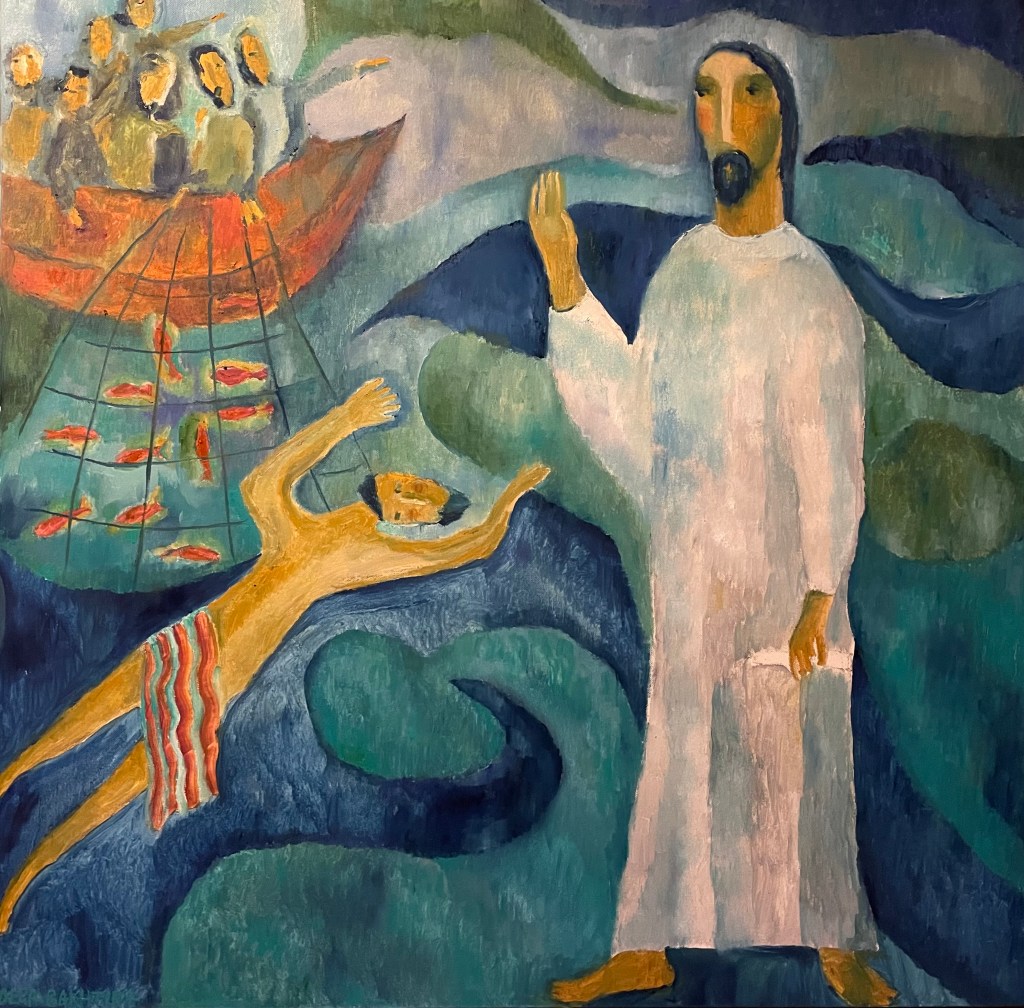
Olga Bakhtina, Mysterious Fishing, 2025. Oil on canvas, 90 x 90 cm.
Olga Bakhtina returns in 2026 with Mercy, a luminous new exhibition hosted at St John’s Anglican Cathedral, Brisbane, running from 1 July to 19 August.
One of the most significant elements of the exhibition is Bakhtina’s new series on St Francis of Assisi, created to mark the 800th anniversary of his death. These pieces do not simply commemorate Francis; they reinterpret his witness through colour, gesture, and the artist’s characteristic attention to the human face. They sit alongside fresh engagements with gospel narratives, each rendered with Bakhtina’s unmistakable blend of narrative immediacy and contemplative stillness.
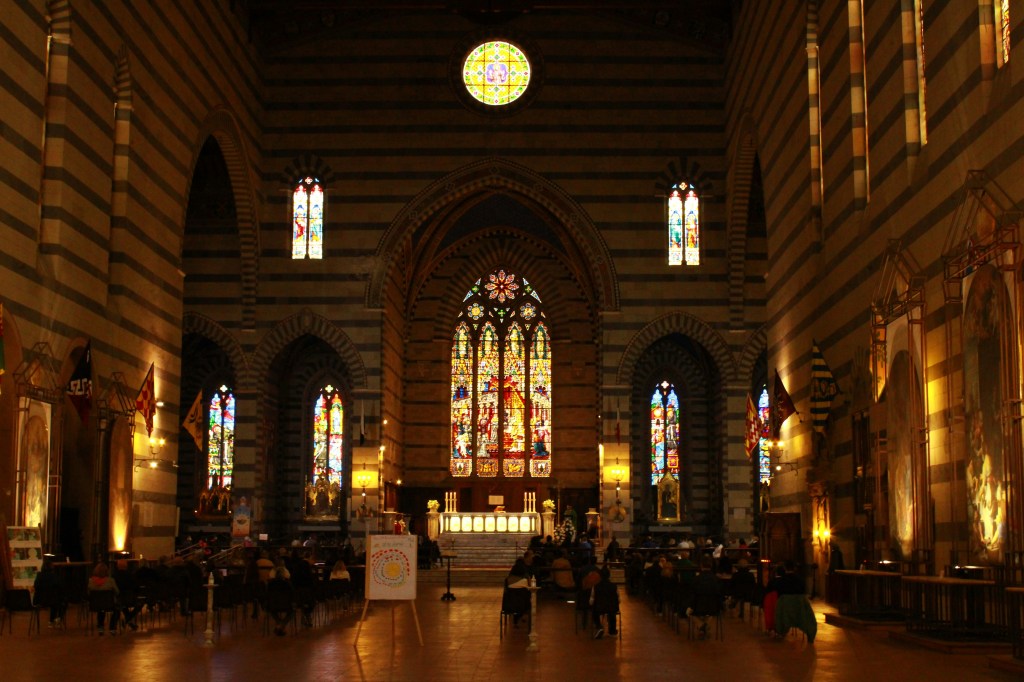
Visitors to St John’s will find an exhibition that is both spiritually resonant and visually arresting. The cathedral setting amplifies the work’s themes – light, mercy, vulnerability, and hope – creating a dialogue between art and architecture that rewards slow looking.
If you’re in Brisbane this winter, Mercy is well worth experiencing. More information here.
Candles yearn and flutter in the sacred gloom stained glass glows like coals and cobalt yesterday’s incense ghosts into your nostrils. Two pews down an elegant woman is summoned by the phone below her steepled fingers its pale oblong awakes to interrupt her prayers or answer them. The dead the lost and those close by are calling wanting and wanted summoned and summoning close as the touch screen or the pale wax of the tapers – some newly lit and long, others slim stubs held in the sand of the bowl. The one I lit for you has half its life to go.
℘℘℘℘
Chris Ringrose is a poet and fiction writer living in Melbourne, Australia. His latest poetry collection is Palmistry (ICoE Press, 2019). Creative Lives, a collection of interviews with South Asian Writers, was published by Columbia UP in 2021.
standing in Divine assembly each tree with its own connections its own message its own role its own journey through life
so too, we humans stand in Divine assembly each of us with our own connections our own story our own journey through life
no matter where we stand grief will find us
Agamemnon charges us to tell the story of grief and Jewish tradition calls out to us to live the story of our grief it begins with aninut – from death to burial when we bear no responsibility to G?d outside of grieving to shiva – seven days of the community coming to us to shloshim – thirty days of living differently out in the world and then eleven months of saying Kaddish every day and always, always, four times a year together with everyone else remembering out loud our grief until we no longer walk this earth
and every single one of these times standing together standing in Divine assembly
no matter how joyous an occasion a pause to remember the dead allowing grief acknowledging grief with words that say nothing of loss but which praise G?d in ancient Aramaic a reminder with Agamemnon of the everpresence of grief and that our experience is nothing new yet acknowledging that on the level of G!d [Elie Weisel] some experiences of life and grief perhaps not our own everyperson kind of experiences but some forever remain the most disturbing of mysteries [Elie Weisel]
and for the trees what does it mean that we are upending life on planet Earth what does it mean to the Divine assembly where G?d judges what does it mean to us what does it mean to the oak and the willow the bumblebee and the ant the buffalo and the rose the rhinoceros what does it mean to Agamemnon what does it mean to G?d
does this level of grief about the injustice of who is suffering most about families forced to migrate to stay alive about innocent people disappeared or thrown into concentration camps about the loss of so much so very much that is beloved about the fear that is stoked sending otherwise reasonable people into rabidly defending their little corner of this precious planet
can we possibly honor, hold, and experience this level of grief or will it on the level of human, redwood, bear and daisy mountain laurel, spider, wasp and fly clover, mountain brook and pebble be simply too much to bear too vast to comprehend too complicated to express even as it grows more intense and remain forever a most disturbing of mysteries
℘℘℘℘
Katy Z. Allen is a poet and a devoted lover of the more‑than‑human world. A retired rabbi of an outdoor congregation, she has also served as a healthcare chaplain, co‑founded a Jewish climate organisation, and works as an eco‑chaplain. She is a member of the LGBTQ community and has been writing in one form or another throughout her life. Her poetry has appeared or is forthcoming in Amethyst Review, The Bluebird Word, and Art on the Trails: Number 9, among other venues. Her book, A Tree of Life: A Story in Word, Image, and Text, was published by Strong Voices.
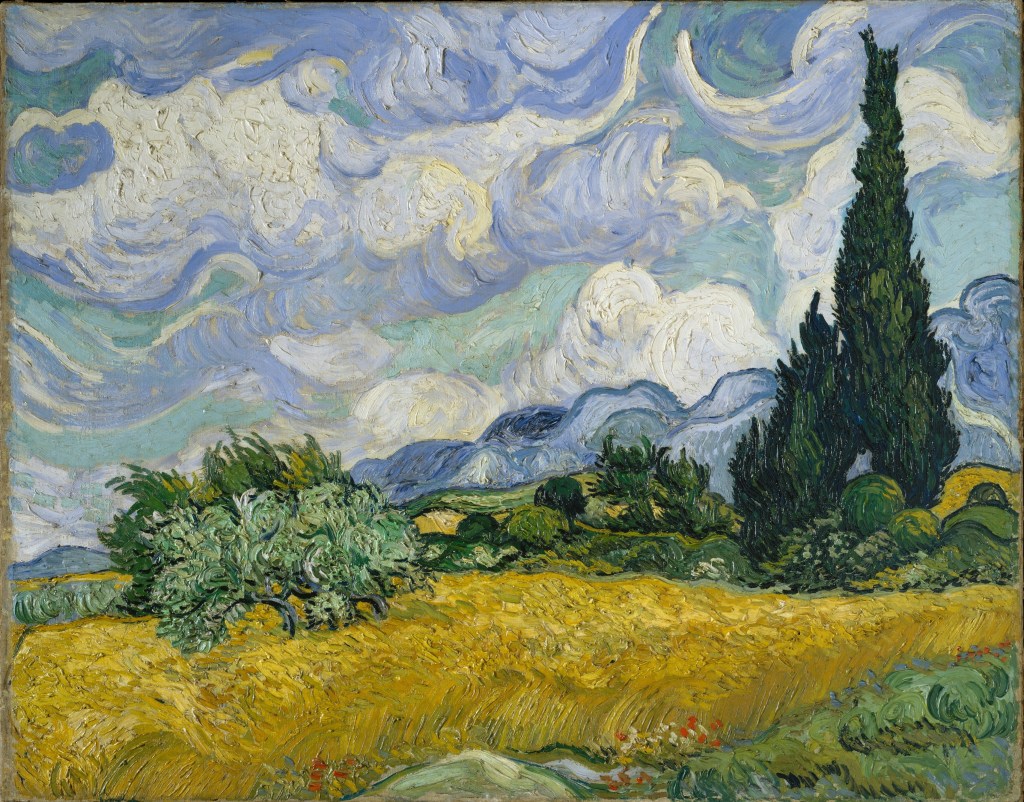
Vincent van Gogh, A Wheatfield with Cypresses, 1889. Oil on canvas, 73 x 93.4 cm. Metropolitan Museum of Art, New York, USA.
Across the swaying yellow fields, Vincent is startled by the stunted olive trees That stretch outwards, upwards Buffeted by the West wind, Yearning to seize The scudding restless clouds.
How they envy their lone companion: A cypress standing apart, alert, Such strength in its dark purpose, While they are chained to their parched quest.
How short the spooned-out time Vincent has left To trap this pointless struggle, while the wheat-heads Shift and hiss their ripe displeasure At his presence.
They are vipers.
Last night, he dreamt That his thighs, suddenly muscular, Propelled him upwards, effortless, To perch upon the cumulus and cirrus, And then he awoke in sadness, Unkempt, imprisoned, his head tolling Like a cracked church bell.
That seductive memory will not leave.
Vipers are curled beneath his feet.
So now, with Mustard stained fingers, He stabs at the canvas again, again, again, His sword a coarse hog hair paintbrush. He shivers with desire, for another absinthe, For someone to ease his lone journey Of escape, to join him behind the lowering sky.
The olive trees, the cypress, all murmur That Vincent, whimpering, Will never see them flower, That his trembling torment Will never be grasped and set aside by The fleeting, fleeing clouds.
The vipers strike.
℘℘℘℘
David Allard is a London‑based writer enjoying retirement while continuing a lifelong engagement with the written word. His work includes numerous poems and short stories published over several decades, as well as a crime novel, The Last Resort, released under the pseudonym David Strauss.
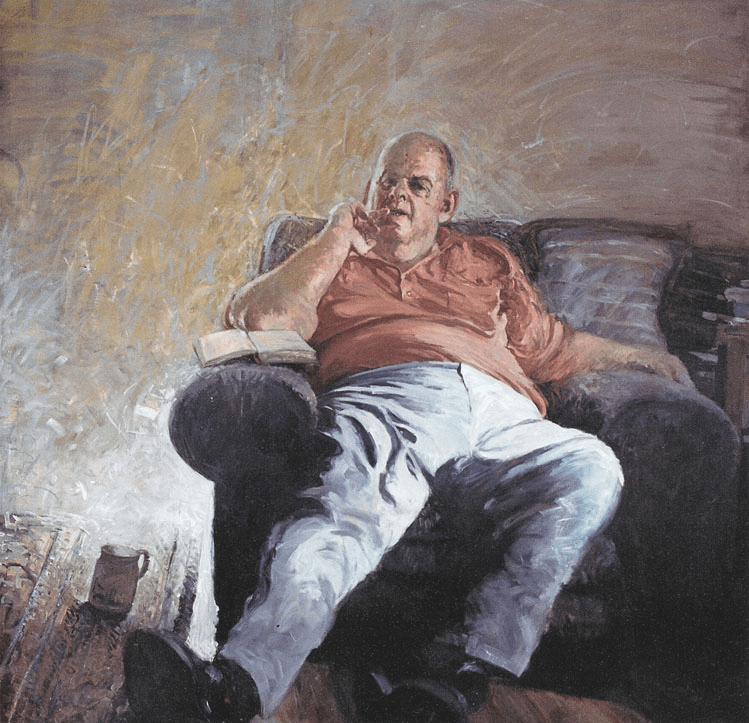
David Naseby, Les Murray, 1995. Oil on canvas, 179.5 x 184.5 cm. National Portrait Gallery, Canberra.
The recent death of David Malouf, aged 92, has left many readers grieving the loss of a writer whose prose was marked by unostentatious care, quiet precision, and a deep humaneness. Malouf had a rare gift for tracing the places where the material meets the immaterial, where the ordinary world thins and something luminous shows through. In an age when algorithms increasingly choose our words for us, his painstaking craftsmanship feels all the more precious.
That same attentiveness to mystery and meaning shaped the work of Les Murray, another of Australia’s most distinctive and resilient poetic voices. Murray never wrote a cliché. His poems –gossamer, surprising, and often startlingly tender – stood in contrast to his rough, laconic exterior. Behind that exterior was a man shaped by a lonely and traumatic childhood, one who spent his career descending into the darker places of human experience and returning with light.
Murray refused easy certitude. He resisted the tyranny of the mob. He wrote with a spiritual clarity that was never sentimental. In his poem on the death of his father, Cecil, he offers a line that still startles with its fierce love and defiance: “Fuck them. I wish you God.”
This is Murray at his most distilled – a poet of hope, not optimism. Hope, for him, was not a mood but a posture: a way of standing in the world that acknowledged suffering without surrendering to it.
If you’d like to experience something of that spirituality– its toughness, its radiance, its refusal to look away – you are warmly invited to Michael McGirr’s talk, ‘Les Less Miserable: The Poetic Journey of Les Murray’, next Wednesday, 13 May, at 6pm at St Peter’s Eastern Hill in Melbourne.
Michael will explore Murray’s life, his craft, and the strange, grace-filled places where his poetry continues to speak. It promises to be an evening of depth, humour, and insight, very much in the spirit of Murray himself.
And if Malouf’s passing has stirred something in you, you may also appreciate Michael’s recent tribute to David Malouf in Eureka Street, a beautiful reflection on a life spent enlarging the imaginative world of this country.
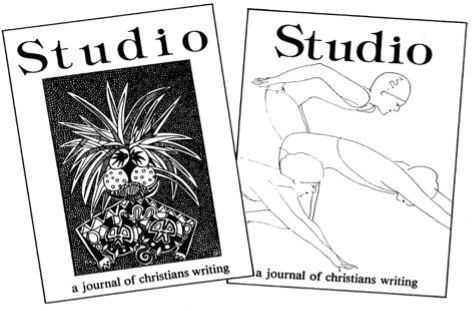
Studiois a book-length journal publishing poetry and short fiction of literary merit, offering a venue for established, new, and aspiring writers.Studio also publishes literary articles, essays, news, and reviews of writing, writers, and events of interest to members.Studio was first published in 1980, and is published three times each year.
Membership of Studio puts you in touch with:
quality writing from Australia and around the world
avenues for publishing and writing in Australia and internationally
news of conferences and festivals of interest to writers
details of competitions for prose and poetry
other arts organisations, significant books, and valuable publications
informed comment and responses to literary ideas
a wide variety of writers and artists in Australia and around the world
Inside Studio A studio is a special place for the artist. It is a space where creative work is crafted, shared, and presented for others to enjoy. In the studio, we experiment and display our best work for others to appreciate. Studio is a non-profit book-length journal produced by an Australian editorial team, with consultant editors around Australia. Studio seeks to serve its members by publishing quality poetry, short fiction, essays, and reviews, sponsoring competitions, and announcing events of interest to members. Studio also publishes a range of special edition books and coffee-table publications. Back catalogue editions of Studio and special Studio books are available on request. Studio grows as members share their work and generously support a quality literary journal serving writers and readers of poetry, short fiction, and the literary arts from around Australia and across the world.