One of the pressing questions for the Church is how we see Christology being renewed in the face of climate change and the potential for the quality of life on this planet to decline. Who is Jesus for us in the midst of the profound changes that are occurring to the earth, water, and air of our world? It is clearly not just a question about theological language as it is more material and global in scope, calling us to transcend our liturgical customs, our cultural allegiances, and our national identities. Is Jesus part of our future as we dare to imagine what that future will be?
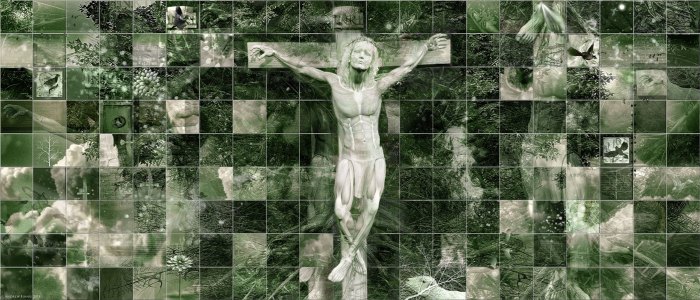
Andrew Finnie’s image The Body of Christ, The Tree of Life is an attempt to re-imagine the figure of Christ in conversation with the earth and the networks that sustain human life in all its thriving beauty. Here, the traditional figure of the cross has become entwined in the roots of the tree, a tree of life that is giving form to the variety and beauty of the natural world.
Andrew Finnie, an artist from Newcastle, Australia, is well known for his paintings of rich colour that express the sensual delight of the local beach-side landscape. Alongside this practice, Finnie is also a skilled digital artist, who is able to transform images into new forms with unexpected relationships. Here in this complex large-scale digital image we have a multitude of visual fragments that work to express the complex significance of the cross for this time in history.
Finnie has placed the cross not in the position favoured in former centuries, high in the sky in glory, but deep into the shadows and roots of a large green tree. He explains: ‘This is the Tree of Life – this apparently jumbled mass of branches we see behind Christ. Inscribed in the bark of the tree are prayers and biblical texts. These prayers gather at the trunk of the tree, and make their way through the branches and transpire through the leaves, heading off towards heaven. So the Tree of Life’s story in this image is that it is a channel for our prayers’.
What strikes me most profoundly about this image is its insistence that my eye keeps returning to the earth, the ground. It reminds me that life is here and now and that God is incarnational, taking on human flesh. It also echoes the idea that the grace of God flows in and through creation; it is, therefore, an eco-theological insight for our times. We are invited to love the earth as God’s beautiful creation. In this regard, one is reminded of the medieval theologian, scientist, musician, and visionary Hildegard of Bingen who talked about ‘viriditas’, the greening force which is God’s gift and energy in creation. As Hildegard writes: ‘Christ brings lush greenness to shrivelled and wilted people’. The vibrant green of this work is the thing that pulses throughout all its branches and the tiny unfolding details that draw you down into its tendrils and roots.
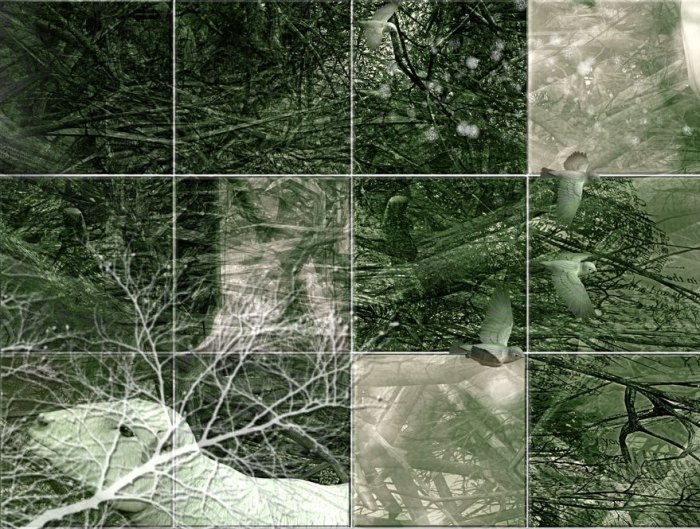
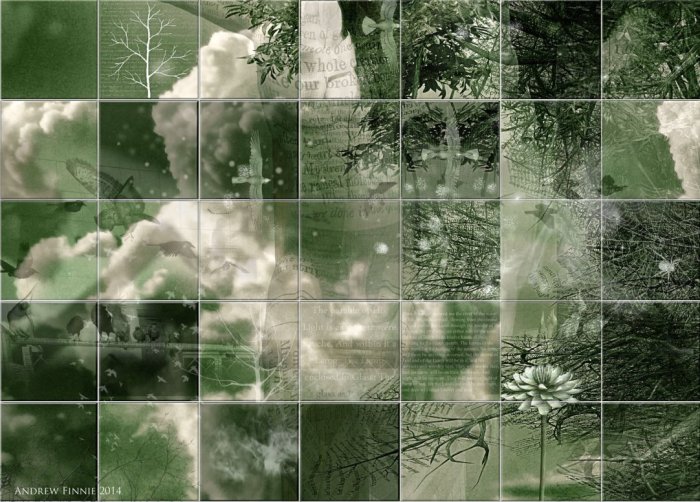
One of the devices used by the artist is the surface of repeated square divisions, which provides distinct pictures of engagement as worlds in themselves. The digital process has allowed Finnie to enhance the eye’s engagement through the fine details of cobwebs, insects, and flowers, as well as text that sounds out the words of Psalm 23, ‘The Lord is my Shepherd’. The fulness of engagement found in this work is at this level of detail, where one’s eyes are found wandering among the fragments, networks and connections. An apprehension of the whole is the awareness of an interconnected network of myriad details. An appreciation of the work builds through encountering these small meditations of looking into these tiny windows of intricate detail.
Arising out of these fragments and networks is the figure of the Christ crucified. The figure has been constructed from a found image used in a medical text, and is without skin and flesh. This emphasises the muscular structure and allows the figure to take on a more androgynous likeness, in turn allowing for the possible representation of both the male and female form. If this view is correct, then a maternal figure may draw us even closer to those earthly connections, where grace is found in human love and connection.
Does this figure represent a crucified and risen Christ who can embrace this world and respond to the travail of climate change and environmental stress? Who is God for us in this moment in our world history? How can we connect what we know about the cross, the redemption and resurrection, and apply it to God’s purpose for all creation? Andrew Finnie offers us a refreshingly hopeful opportunity to think about Christ and God’s purpose for human existence, embedded as we are in God’s creation, sharing its travail and looking for its redemption.
Reposted from ArtWay.
℘℘℘℘
ROD PATTENDEN IS AN ARTIST, ART HISTORIAN, AND THEOLOGIAN INTERESTED IN THE POWER OF IMAGES. HE LIVES AND WORKS ON AWABAKAL LAND.
 The Centre for Music, Liturgy and the Arts (a Ministry Centre of the South Australian Synod of the Uniting Church in Australia) is running a conversational event over three days offering the opportunity to talk, explore, and think deeply and widely about why and how we worship in our churches and communities now and into the future.
 Art/s and Theology Australia