Advent: But then … they appear

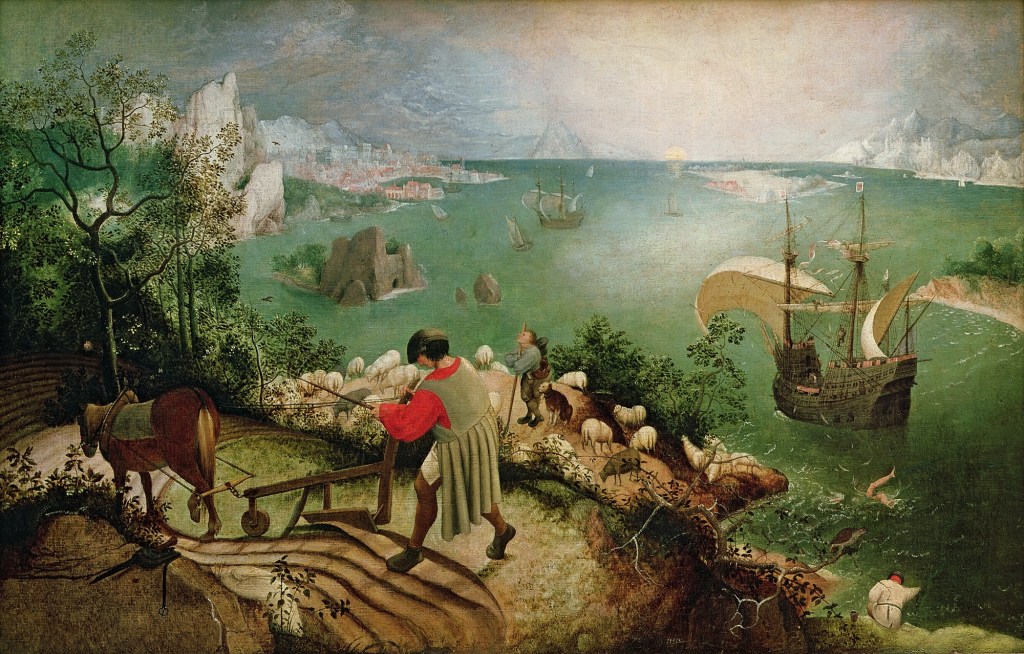
Pieter Brueghel the Elder, Landscape with the Fall of Icarus, c. 1558. Oil on canvas, mounted on wood, 73.5 x 112 cm. Royal Museums of Fine Arts of Belgium, Brussels, Belgium.

After W. H. Auden had visited the Musées Royaux des Beaux-Arts de Belgique in Brussels, and seen Pieter Brueghel the Elder’s Landscape with the Fall of Icarus, he went away and penned the following words:

About suffering they were never wrong,
The Old Masters; how well, they understood
Its human position; how it takes place
While someone else is eating or opening a window or just walking dully along;
How, when the aged are reverently, passionately waiting
For the miraculous birth, there always must be
Children who did not specially want it to happen, skating
On a pond at the edge of the wood:
They never forgot
That even the dreadful martyrdom must run its course
Anyhow in a corner, some untidy spot
Where the dogs go on with their doggy life and the torturer’s horse
Scratches its innocent behind on a tree.
In Breughel’s Icarus, for instance: how everything turns away
Quite leisurely from the disaster; the ploughman may
Have heard the splash, the forsaken cry,
But for him it was not an important failure; the sun shone
As it had to on the white legs disappearing into the green
Water; and the expensive delicate ship that must have seen
Something amazing, a boy falling out of the sky,
had somewhere to get to and sailed calmly on.

The American theologian William Willimon recalls Brueghel’s painting, and Auden’s poem, in his book On a Wild and Windy Mountain (Abingdon Press, 1984), wherein he observes that we trudge past bleeding crosses with a shrug of the shoulders, that Good Fridays are so commonplace among us as to be unnoteworthy, and that tragedy achieves nobility only in the theater. ‘Everydayness and ordinariness’, he writes, ‘become our best defenses, the most effective relativizers of the tragic in our midst. Some young Icarus falls from the sky every day, so one had best get on with the business at hand until the extraordinary comes. For now, go to work, eat, make friends, make money, make love, mind your business – that’s the best way to cope, for the time being, with the expectedness of the tragic. The old masters knew best’ (p. 15).

Pieter Bruegel the Elder, The Numbering at Bethlehem, 1566. Oil on panel, 116 × 164.5 cm. Royal Museums of Fine Arts of Belgium, Brussels, Belgium.

Willimon proceeds to compare Landscape with the Fall of Icarus with another of the Dutch masters’ works: Numbering at Bethlehem. He notes the ordinariness of the depiction, a day mundane and unpromising – in its highlights at least – and nothing beyond the expected.

But then … they appear.

They appear. ‘An inconspicuous, thoroughly ordinary young woman on a little donkey led by a stoop-shouldered, bearded peasant who carries a saw. Here is Mary, with Joseph the carpenter, come to town to be counted. They are so easily overlooked in the midst of ordinariness. Old masters like Brueghel’, Willimon suggests (and we might add Rembrandt, for example), ‘were never wrong’. Rather, they understood, and bore witness to in their work, the truth of Emmanuel, the scandal of the unostentatious God living – and dying – with us, of God stained with the sweat of human bondage and soaked – baptised – in the blood of human violence, of God incognito. ‘They understood our blindness not only to the tragic but also to the triumphant in our midst … In life, the Presence goes unnoted as we thumb through the evening paper. And so we wait, sitting in the darkness of the everyday until something extraordinary breaks in. Someday God may break into this world, we say. But for the time being, it is best to work, eat, make love, pay taxes, fill out government forms, and mind our business. The old masters knew it best’ (p. 16).

I have posted elsewhere on the pseudonymous activity of God, suggesting that ‘in the economy of holy love, the locus of greatest clarity equates to the point of greatest incongruity and surprise’. It is precisely that we may see what Willimon so beautifully refers to as ‘the triumphant in our midst’ that we are graced, and that we might witness to the day when good will triumph over all, certain that the grace of holy love will win at last because it did not fail to win at its most decisive time. In the meantime, such seeing typically requires what is another great advent theme: waiting, or what R. S. Thomas, in his poem ‘Kneeling’, referred to as ‘moments of great calm’:

Moments of great calm,
Kneeling before an altar
Of wood in a stone church
In summer, waiting for the God
To speak; the air a staircase
For silence; the sun’s light
Ringing me, as though I acted
A great role. And the audiences
Still; all that close throng
Of spirits waiting, as I,
For the message.
Prompt me, God;
But not yet. When I speak,
Though it be you who speak
Through me, something is lost.
The meaning is in the waiting.

– R. S. Thomas, ‘Kneeling’, in Not that He Brought Flowers (London: Rupert Hart-Davis, 1968), 32.

℘℘℘℘

JASON GORONCY IS A THEOLOGIAN, ARTIST, AND FOLK FESTIVAL TRAGIC WHO LIVES AND PLAYS ON WURUNDJERI LAND.

The Blake Poetry Prize 

The Blake Poetry Prize challenges Australian poets of varied styles and religious and spiritual allegiances to explore the wider experience of spirituality, religion, and/or belief in a new work of 100 lines or less. Entries close on 15 November 2021. More details here.

How To Be Alone

It all begins with knowing
nothing lasts forever,
so you might as well start packing now.
In the meantime,
practice being alive.

There will be a party
where you’ll feel like
nobody’s paying you attention.
And there will be a party
where attention’s all you’ll get.
What you need to do
is to remember
to talk to yourself
between these parties.

And,
again,
there will be a day,
– a decade –
where you won’t
fit in with your body
even though you’re in
the only body you’re in.

You need to control
your habit of forgetting
to breathe.

Remember when you were younger
and you practiced kissing on your arm?
You were on to something then.
Sometimes harm knows its own healing
Comfort knows its own intelligence.
Kindness too.
It needs no reason.

There is a you
telling you another story of you.
Listen to her.

Where do you feel
anxiety in your body?
The chest? The fist? The dream before waking?
The head that feels like it’s at the top of the swing
or the clutch of gut like falling
& falling & falling and falling
It knows something: you’re dying.
Try to stay alive.

For now, touch yourself.
I’m serious.

Touch your
self.
Take your hand
and place your hand
some place
upon your body.
And listen
to the community of madness
that
you are.
You are
such an
interesting conversation.

You belong
here.

– Pádraig Ó Tuama, ‘How To Be Alone’. Dumbo Feather.

Poem by Pádraig Ó Tuama. Illustration & Animation by Leo G. Franchi. Sound by Chris Heagle. Music by Gautum Srikishan.

Sources: Dumbo Feather; On Being; The On Being Project.

Theology

pawel-czerwinski-wZHDa7cD7Ps-unsplash

Before beginning the theological task please remove any and all parts of the self currently deemed unacceptable. If suitable replacement parts are available, attach and use these. Please note, these replacement parts must remain hidden at all times. Only socially sanctioned theological tools may be used. Until current guidelines for theological engagement are met, the preferred method of communication is silence.

All theology must be submitted in writing.

What was it for you?
Which parts of yourself did you
willingly slice off so they would let you do this?

You never get those parts back.

All you can ever do
is point to the place
they used to be
in an attempt to warn others
about making the same mistake.

But it rarely works
we all sacrifice ourselves on this altar

But sometimes
as our hand, poised, ready to remove
that very last piece
we hear the still small voice
whisper

stop

And the knife
slick with our own blood
slips through our fingers

and we see the Lamb

– Stacey Wilson, ‘Theology’. In God’s Image 40 (2021): 55.

Photo by Pawel Czerwinski via Unsplash.

℘℘℘℘

Stacey Wilson (usually) spends many hours at her local café glaring at her laptop as she attempts to put the pondering of her heart into words. Through her roles at intergen, CBM australia, and Surrender Co., she provides resources, training, and mentoring to support people in their intergenerational ministry journey. SHE LIVES AND PLAYS ON WURUNDJERI LAND.

Dappled Shadows Underfoot

It’s been a difficult year my friends.
So I do the only thing I know how to do,
Like a stubborn frustrated buddha,
I sat. I knelt. I prayed.
And as always, I cut.
Quickly I became aware of two things:
Pain
And time.
Two things that translate strangely to the screen.
Knowing, I’ll forget the pain: the cold floor, the bruises, and the way my legs screamed
‘be here’.

And I’ll forget the hours I sat,
now condensed to minutes.
Seconds depicting moments.
Leaping into the future
Fitting tightly into the screen.
I have been thinking about time a lot.
How people say, in hindsight, it took me 10 years to really know what that period of my life was about. And how
that simple sentence erases seconds of self doubt, minutes of struggle, and hours of tears.
I’ve been doubting, and struggling, and crying. A lot.

I know why I cut paper, it helps me find my edges.
It hedges me in when I start to leak out
I just cut away what isn’t there.
The stuff that isn’t ‘the thing’.
Until only ‘the thing’ is left.
And yet,
I will always know the perimeter of what has been discarded than the evidence that has been left behind.

Mostly,
I cut in silence.
A quiet prayer. An emptying. A time of no self.
As I mark out the thoughts, broken lines of poetry, and old traumas.
I thought about the word ‘present’ and the word ‘present’ being all a game of inflection and yet how differently
they speak to the world.
Because I know I can present well, it is a safety net that has gotten me through the last difficult long year.
But I also know that someone that presents well, can present as present.
And how I can only get better at the latter as I let go of the former.

So here I am,
And I’m thinking about Moses now.
And I’m thinking about this burning bush that I am carving.
Be here. Be here.
I am,
I am.
I am that I am.
I’m always thinking about God.
And the way I am entranced by a tree branch as much as the light that filters through
And the dappled shadows cast underfoot.

℘℘℘℘

Pearl Taylor is a Melbourne-based visual artist, art therapist and Uniting Church youth facilitator, invested in the ways faith forms our personal narrative. Pearl’s art practice is informed by a pinch contemplative traditions, a healthy dose of the radically-inclusive, and a touch of humour. As she dabbles in theological spaces, it is through creativity that she expresses, connects, and invites others in. She lives on Wurundjeri land.

Paul’s Thorn Illuminated

Rembrandt Harmenszoon van Rijn, The Apostle Paul, c. 1657. Oil on canvas, 131.5 x 104.4 cm. National Gallery of Art, Washington, DC, USA.


It is disorienting how a space so beautiful and lovingly fragrant
has the life-indwelling potential for such a magnitude of pain.
Like summer days sitting in the shadow of a wild rose,
pressing one’s nose into the sun-kissed petals of smooth velvet.

Covered in the yellow grains of life-producing possibilities
the closeness brings visceral reminders that home, like roses
bring pain to those who have been so near and then pull away.

Thorns break into flesh when your presence is left.
Time with you appeared to have no end, the young were confident in this.
Years passed, service, mission, duty, and love beckoned us to foreign lands
requiring an unperceived and misunderstood sacrifice as we tread a well worn path.

Why must these woody cells with pointed intentions persist?
Year after year they’ve remained comfortably under the folds of our skin
obstinate towards the desires for forgetfulness.

Scar tissue envelopes their presence, covering over reminders of what once was.
Slight pressure applied by a seemingly insignificant force
ushers in once more aching pain that consumes the senses,
disorientating the best laid plans.

Can one not walk away from the enjoyment of your presence without consequence?
Does a thorn ever complete its task; reminding one of the beauty journeyed from?
‘Absence makes the heart grow fonder’ is a wretched truth.

To behold home once more as the memories insist upon being true
is an impossibility brought by the metamorphosis of time.
Returning overlays the deepest of memories overtop unknown changes,
conjuring up moments of confusion and feelings of foreign.

And yet we yearn again for a moment with the fragrance, presence
and place, if only for fleeting and hurried relief from the ache.
All the while knowing that the time will come when
we must pull away, left with another thorn in the flesh.

–––––––––––––––––––––––––––

The poem found above has been something in the works for over the past three months and is most likely a guttural reaction to the strong lockdown Melbourne has had to endure. Being an expat for over fifteen years, I and others like myself have often struggled with the strange heart reaction of homesickness that ebbs and flows with the passage of time and events. Recently, I’ve been wondering about Paul’s thorn and whether it could have been something as often overlooked as homesickness. We like to assume that Paul’s thorn was persecution or perhaps some bodily ailment as that is perhaps a more holy possibility. But what if it was something as simple as his longing for home? Perhaps he was wrestling with the pulls to go home and the calling to go elsewhere, working within the broader church family? Maybe it is a bit arrogant to presume that someone called by God for such an important task as Paul’s could share something in common with me? I don’t know for sure but I like to wonder.

What I do know is that many of us expats are struggling with the affliction of homesickness in the current Australian climate due to being told that visiting home is not an option. The latest news from the Prime Minister is that the Australian borders most likely won’t reopen to many SARS COV2 infected countries until 2022. That seems like forever away and is hard to accept when our family had plans for a visit in the next eight months. I have found in my experience that many whose roots have never shifted from their homeland do not understand the difficulties around homesickness or the lingering pain that home imbeds within the hearts of those who uproot. This is something I try to shed light on in Paul’s Thorn Illuminated.

This poem intentionally does not end in hope. There are moments when answers should not be hurried and instead we need to acknowledge that the emotions of the present conflict are real and difficult. After a time, we can move on from that recognition of pain towards the hope that God provides in God’s Word. For the expat, that hope is found in our eternal citizenship and home. Texts like Psalm 68.5–6a (‘Father of the fatherless and protector of widows is God in his holy habitation. God settles the solitary in a home’) and Philippians 3.20 (‘But our citizenship is in heaven, and from it we await a Saviour, the Lord Jesus Christ’) remind us that God understands the need for home and belonging. God cares for the lonely by providing a home. God reminds us that God is making one for us where we are the citizens. In our eternal home, there will be no ‘rings of steel’, curfews, or border restrictions. Presently, we may feel the physical pain and loneliness of earthly separation, but we can find comfort in knowing that even now God is thinking of our need for belonging and rootedness by providing us with church family when our biological families are beyond reach and the promise of an eternal home to come.

℘℘℘℘

MEGAN FISHER SERVES AS A MANAGER IN THE MCKINNON REFORMED PRESBYTERIAN CHURCH, HOMESCHOOLS FOUR OF THEIR FIVE CHILDREN, AND TEACHES ENGLISH AND CITIZENSHIP CLASSES FOR WOMEN IN THE MELBOURNE AFGHAN COMMUNITY. SOMETIMES SHE IS SUCCESSFUL AT FINDING JUST ENOUGH SILENCE TO CREATE THE ART THAT IS RUMBLING AROUND IN HER HEAD. SHE LIVES AND WORKS ON WURUNDJERI LAND.

Voices

gabe-pierce-UW4cSsajDTM-unsplash.jpg

In memory of George Floyd (1973–2020)

voices from our lungs
have sound
vibration
colour
and life

they
laugh
sing
shout
exclaim
sigh
whine
wail
scream
play
..imitate
surprise
affirm
disapprove
dismiss
disgust
disappoint
question
scare
hesitate
annoy
yawn
moan
groan
roar
whistle
whisper
wonder
call
declare
cheer
adore
bless

every note
in high or low pitch
up or down accent
silence or noise
composed into a melody
in an ever-flowing river
of life

until
choked on the ground
smothered by the mask
crushed by Houston and Chengdu
suffocated by the pandemics
slaughtered in the home kitchen

and every moment since Eden

all we need
is to
BREATHE

[Image: Gabe Pierce]

℘℘℘℘

XIAOLI YANG IS A THEOLOGIAN, POET, AND SPIRITUAL DIRECTOR. SHE LIVES AND PLAYS ON WURUNDJERI LAND AND IN THE MIDDLE KINGDOM.

A Year of Jubilee

Breeze.JPG
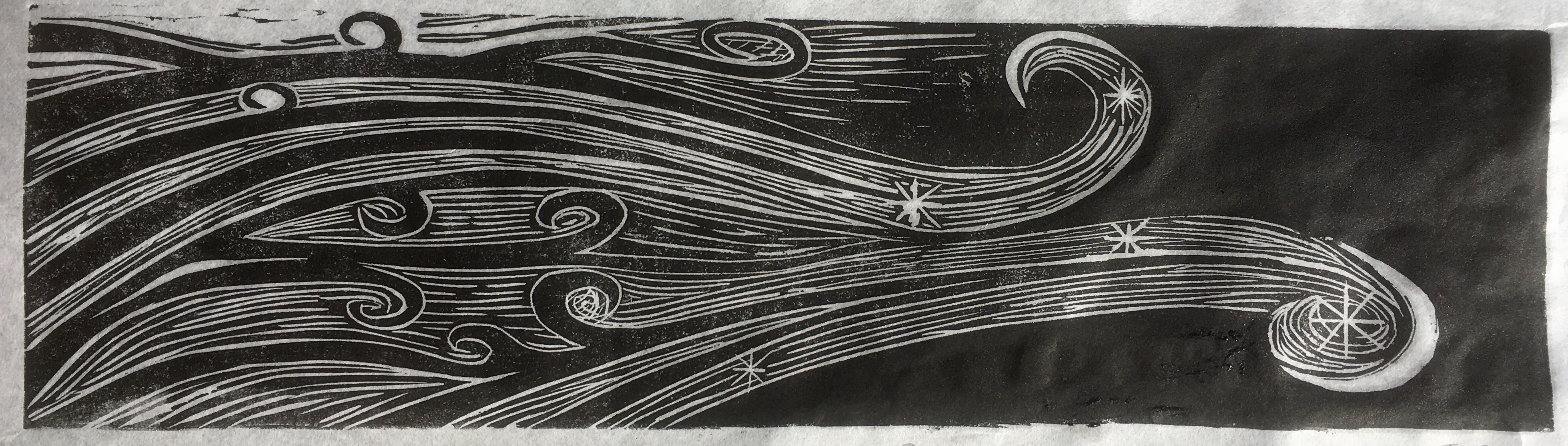
Megan Fisher, That You Shine Like Stars In The World, 2020. Ink on paper, relief print, 32 x 8cm. Artist’s collection, Melbourne.

Gentle stirrings of chimes herald in a purifying breeze
reminding the caretakers of the world how careless they’ve been.
The starry nights obscured to the watcher’s eye by the wasting of the land,
isolation edicts are an unanticipated jubilee from the Maker’s hand.

Hear the chimes, ‘people of the land submit!’, rippling through
singing a contemplative melody as the asphyxiating smog unknits,
The quickened pace from then to now left Sayers dismayed, of stockings
thrown into decay after one shift, opportunities to change our ways. Will we?

Decimation to the soil has brought groans across a withered land
whispering chimes gather strength as our mandatory solitude continues by,
providence. Bringing the land a Sabbath from the ancient ways
has not been on the minds of caretakers today.

‘Behold!’ the starry nights sing a promise to the generations.
The Father that placed these radiant stars left impressions
of a long-awaited covenant. Can we see? when we smother them with our greed?

‘A rest, please rest’, sighs the breeze as it sweeps through urban spaces
‘come wonder and be still beneath a shimmering celestial glow’
whispering peacefully to the caretakers, for to them this great gift was bestowed.

℘℘℘℘

Megan Fisher serves as a manager in the McKinnon Reformed Presbyterian Church, homeschools four of their five children, and teaches English and citizenship classes for women in the Melbourne Afghan community. Sometimes she is successful at finding just enough silence to create the art that is rumbling around in her head. She lives and works on Wurundjeri Land.

The Rawest Cry (for the caring professionals)

When I hold your hand
on the crisp white sheet,
I pray with all my heart
for you – deep peace.

When I’m at home,
there’s no one’s hand
holding mine,
and mostly I’m just fine –

but maybe – maybe –
maybe I’m too strong
for my own good?

When I catch your tears
in frothy coffee remnants,
I pray with all my heart
for you – new hope.

When I close the door,
I pour my own wine
to catch my falling tears,
and most days, that’s just fine –

but maybe – maybe –
maybe I’m too strong
for my own good?

When black dogs and monsters
cast clouds across the sun,
I pray with all my heart
for you – be well.

Then, at last, my dog wakes,
pulls me into the shadows;
and no one hears the rawest cry
that I am far from fine –

and maybe – maybe –
maybe I am too strong,
too strong for my own good?

℘℘℘℘

SARAH AGNEW IS A STORYTELLER, POET, AND UNITING CHURCH MINISTER CURRENTLY IN PLACEMENT WITH CANBERRA CENTRAL PARISH. HER POETRY AND LITURGY APPEAR IN WILD GOOSE PUBLICATIONS AS STAND-ALONE E-LITURGIES, AND IN EDITED ANTHOLOGIES AS WEEKLY PRAYER-POEMS AT PRAY THE STORY. HER MOST RECENT PUBLISHED POETRY COLLECTION IS HOLD THEM CLOSE (RESOURCE PUBLICATIONS, 2018). SHE LIVES AND WORKS ON NGUNNAWAL COUNTRY.

A Collective Silent Space: creative words in the chatroom following a Zoom meeting during COVID-19

after the ocean wave of silence
colourful shells on the sand
form these musical lines:

entering the fire
dancing in the heart of flames
beating the drum with rhythms
immersed in the liquid love of the Spirit
soaring above the clouds
the shelter of each other where we live
infilling
……….detaching
……….……….uplifting
……….……….……….outworking

harness of God
energy of love
healing of all creation
sacred ground of truth
and mystery

let yeast permeate the dough of our reality
enliven our hearts to reach out
Christ takes shape among us
a new way of being
a unified space
enfolding each other in the Presence
sheer blessings

birds calling
ripples on a pond
go in peace
……….go with justice
……….……….go in love

℘℘℘℘

XIAOLI YANG IS A THEOLOGIAN, POET, AND SPIRITUAL DIRECTOR. SHE LIVES AND PLAYS ON WURUNDJERI LAND AND IN THE MIDDLE KINGDOM.