On Maundy Thursday, Good Friday’s Victim “placed Himself in the order of signs.”[1] By this gesture, Jesus is understood to have handed himself over, traditioned himself, into the human economy of meaning and signification, and so into the realm of human art. So resplendent with meaning was the Sign he gave, that its radiance generated, within mere centuries, the essential form and complexity of the Latin Rite.[2]
In both the original gesture, which is the still point of the Canon that lies at the heart the Rite, and in the fullness of the Rite in its most elaborate expression, the meaning of the Sign could never be separated or dissociated from the medium that sustains it and accomplishes it. The Tridentine conviction that in the liturgy “nothing is superfluous” points precisely to this radiance of the whole of the liturgical gesture, and not to the narrow neo-scholastic minimalism of sacramental “validity.”[3] Like any work of great human art, the beauty of the liturgy—the Sign traditioned through history—is sustained within an indissoluble unity of form and content; the kernel and the husk are here one.
What is most surprising as regards the liturgy is what is at same time most obvious: the sheer humanness of the manner of this communication. As a rational animal who learns through his sense, who reasons from the world he touches and tastes, the human being is among the beings of the world uniquely “sacramental” and “ritualistic.” He is, as the Welsh-English poet David Jones used to say, “sacrament at every turn and all levels of the ‘profane’ and ‘sacred,’ in the trivial and in the profound, no escape from sacrament.”[4] The Council Fathers at Trent were keenly aware of this when they justified the un-bloody sacrifice of the Mass as a thing “the nature of man demands.”[5]
The human being lives and moves in signs; and at the highest reaches of his life and experience, these signs radiate a meaningfulness beyond what can be abstracted from the sign that signifies. The human is a being of media and mediation.
In our epoch, after the double explosion of the electronic age and the digital revolution, the human is in a paradoxical situation. Humans have never been so saturated by the fact of media in the form of a plethora of competing media and rival significations, while at the same time, the sign of the mystery of being, the medium of his own destiny and the Sign of the God-Man handed over to him on Holy Thursday, has never been so difficult to discern, so abstract and so seemingly irrelevant to his media world.
This is due to at least two factors. On the one hand the relentless competition of media vying for human attention hits the human mind with a dizzying experience of being “Distracted from distraction by distraction.”[6] Concentration and silence lead, in our culture, less to contemplation of being and more the anxious vertigo of despair of significant meaning.
While on the other, the nature of digital media, with its hyper-virtuality, tends, at least in the first instance and on the surface, to hide the mediating character of media itself, so much so that “content” is paradoxically experienced as without any real relation to form. The message exists as if it is indifferent to its media.
The reproductions, multiplications, and endless variations in the field of media have, in this sense, achieved the alienation of the human being, not so much from God, but from the significant meaning of his own humanity. From the point of view of the Christian religion, this alienation of the human being from the significance of his being is yet more disastrous than alienation from the question of God. This is because it is estrangement from the medium God himself chose when he became Incarnate and left to us the work of propagating his memory in the fleshy art of the liturgy that grows and is sustained from his original traditioning.
All I have said so far has been gesturing to the diagnosis of Marshal McLuhan, whom I consider not only a great Catholic thinker, but one of the key voices through which we can come to better understand the digital age in which we now live.
McLuhan, of course, wrote long before the invention of the internet and digital technology. He diagnosed what he called the “electronic age”—the age of the television, the movie, the telephone, and radio. His insight is well summed up in his famous adage: the “medium is the message.” In his 1964 work Understanding Media McLuhan argues that the social impact of communication, its power to radically transform culture and human life, never lies in the inputs of new messages or ideas, but rather overwhelmingly in the introduction of new media. This is the case, according to McLuhan, because media is what fashions and determines “the scale and form of human association and action” (Understanding Media, 9). Here we could say that media has the power both to “enframe” and to “expand” our experience of being.
McLuhan takes film as an example that shows how a unique medium reconstrues the human experience of reality:
The movie, by sheer speeding up of the mechanical, carried us from the world of sequence and connections into the world of creative configuration and structure. The message of the movie medium is that of transition from lineal connections to configurations (12–13).
This realignment of the human experience of time, from the sense of historical and narrative connection to a situation of punctiliar juxtaposition of configurations, is one way the electronic age reconceives our humanity.
To understand the real depth of this impact, it is crucial to grasp how, for McLuhan, every media is an extension of the human nervous system, a portal of transportation both in space and time. So that, ultimately, what new media introduce, in each case, is a new experience of scale, temporal and spatial. This is the real message of the medium: the way that roads reduced the scale of distance between towns and the invention of the car accelerated this; so the television introduces us into the simultaneous spatially collapsed world of, what McLuhan called, the “global village”; or how the internet now has introduced us to the pure presence of virtual identity and connection, devoid of the significance of our carnality and geography.
But even as new media extend the human nervous system, this extension of human experience collapses not only the lineal connection of life into configuration, but overwhelmingly the carnal connection of persons. In other words, our new media, which are generated from the sacramental possibility of the human creature itself, now become the very means of the concealment of this most human fact of being.
The more the world becomes pure presence from Beijing to Buenos Aires, from New York to Johannesburg, the more the absence of the carnal other becomes unremarkable since we remain virtually connected, while its concrete presence becomes an irrelevance, apart from the inconvenience its presence poses to my use of my digital media that mediates the world to me.
McLuhan helps us clarify how this is so, since for him it is not merely the fact that the medium is the message, but more: the “‘content’ of any medium is always another medium” (8). McLuhan illuminates this claim with the example of light generated from a light bulb, which is “pure information” precisely because it is “a medium without a message” (Ibid.). The light bulb has no “content” the way a book has “content”; yet, as a medium, its impact is radical: the light bulb enables the human being to create spaces in times of the day and in places in which it would have been impossible, and so creates “an environment by its mere presence” (Ibid.) an environment which allows for other media.
The extension of the human nervous system in the electronic age—the age of airplanes and television, radio, and telephones—becomes a global transportation system deconstructive of human scales of mediation: the old media of city and marketplace, sidewalk and local shop, house and porch, which mediated human life on a more human scale, now become obstacles. If we can already see the deconstructive character of the electronic age, the digital age represents a radicalization of the transportation system, which McLuhan perhaps anticipated but could never have fully imagined.
The smartphone and the internet represent the total collapse of the human encounter into the virtual, since these forms of communication travel faster even than the speed of the human central nervous system. Now even the airplane and the television, the highway and the radio are too incarnate to keep pace with the spatialized speed of the digital transportation system. At this point our own bodies, our physical communities and our next of kin, become increasingly irrelevant to our sense of life.
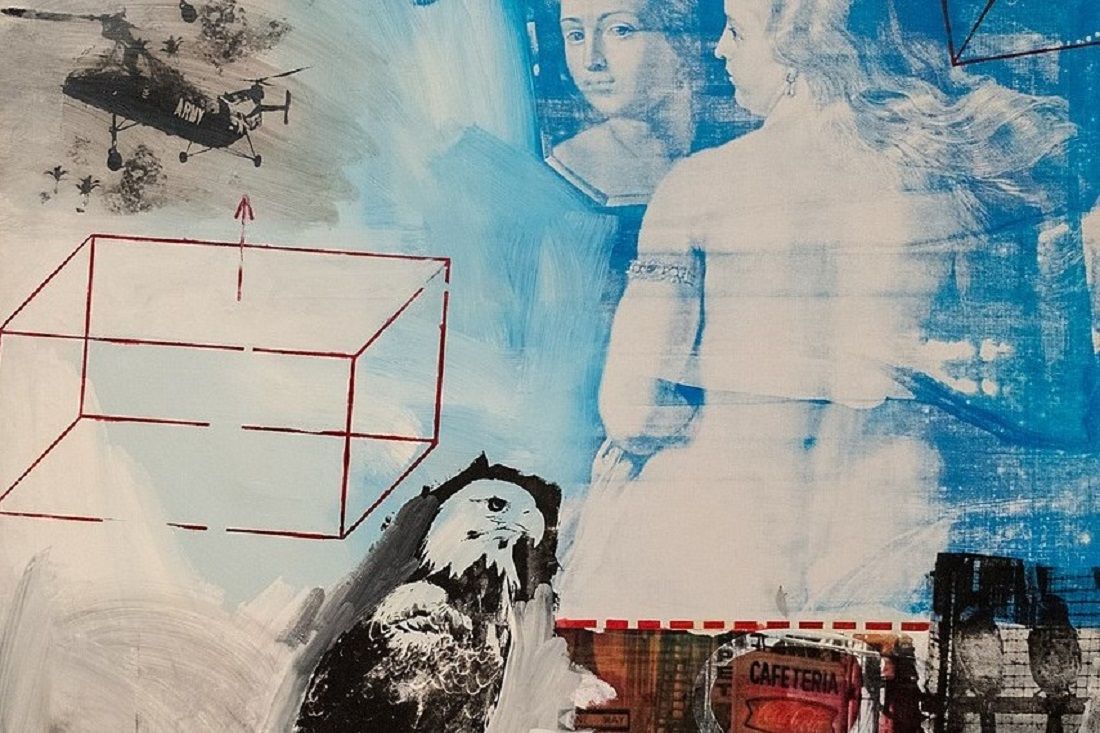
For McLuhan the aesthetic announcement of his thesis and its distortive consequence was given by the Cubist movement in art:
[C]ubism, by giving the inside and outside, the top, bottom, back, and front and the rest, in two dimensions, drops the illusion of perspective in favor of instant sensory awareness of the whole (13).
This sensation of “instant sensory awareness of the whole” is perhaps related to Heidegger’s experience of “enframement,” the technological paradigm of thought “the gathering together of that setting-upon which sets upon man, [and so] challenges him forth, to reveal the real, in the mode of ordering, as standing-reserve.”[7]
It is also very close to what Catherine Pickstock, in her seminal book After Writing, diagnosed as the “spacialization” of being. Pickstock defines this spacialization of being as the result of “a textual calculus of the real” ruled by “protocols of division and manipulation” that function “independent of time and space” and thus work to suppress “embodiment and temporality.”[8] While for her the roots of this spacialization lie in the univocal conception of being associated with the figure of John Duns Scotus, the philosophical apogee comes for her with Descartes, and what she understands as his “subject” frozen in space, which is predicated on the collapse of time into space. For Pickstock, on the level of culture, the impact of digital technology carries this process to its logical and most radical conclusion.
But if aesthetically, for McLuhan, specialization is understood as evidenced in the figures of Cubism, in Cubism there is still a complexity. Furthermore, McLuhan discerns in Cubism also a moment of discovery. He writes: “Cubism, by seizing on instant total awareness, suddenly announced that the medium is the message.” (Understanding Media, 13). This announcement is the discovery, for McLuhan, of the electronic age, before which this fact of human being and communication was not yet obvious because not yet problematic (Ibid., 13–14). The electronic age, for McLuhan, not only saturates the human being with media in a way that alienates him from both the height and depth of the Sign’s meaningfulness, it is also a portal of discovery, and so holds within in the promise of recovery of a genuinely human gaze on the real. And in this way McLuhan links up with the ultimate wager of Heidegger’s “The Question Concerning Technology,” which is not merely a critique of technology but a search for a way beyond the trap of the technological paradigm.[9]
Now, if the essence of technology for Heidegger is the “destining of revealing,” then technology in the originary sense is bound up, paradoxically, with unconcealing, that is, with bringing-forth, even if it ends up doing the opposite.[10] Drawing on Aristotles’s account of the four causes, Heidegger argues that both physis and poiesis are ways of unconcealing. It is not just nature that brings forth being; art does this too.
Thus, the encounter with being as such (physis) and the act of making signs (poiesis) both involve aletheia: truth as unconcealment rather than capture. And herein lies, for Heidegger, is the origin of “technology,” which derives from techne, which according to him at one time also meant “the bringing-forth of the true into the beautiful.” Techne in its originary sense thus is bound to—and convertible with—poiesis, human art, and the discovery of beauty.
In this light we can perhaps see that the technological paradigm, the electronic age, and the digital revolution all bring us to the brink of discovery: to the Cubist moment. The hyper inhumanity of our dislocation that forces an encounter with the truth of human being. The Italian philosopher Emanuele Severino once remarked: “the gaze that notices the desert does not belong to the desert.”[11] In a similar way McLuhan notes the irony of “a culture like ours, long accustomed to splitting and dividing all things as a means of control,” comes now to discover, through the contradiction of its own production, that “in operational and practical fact, the medium is the message” (Understanding Media, 7). The question then becomes: where is the medium that saves the meaningfulness of our own humanity?
From a Catholic point of view all of this points back at Holy Thursday, when Good Friday’s Victim “placed Himself into the order of signs.” The wager of the Christian claim is that, in that moment, the divine Mystery took the form of human art and made of it a perfect communication of our salvation. The meaningfulness of the Mystery become flesh is not a human achievement or ingenuity, it neither conquers being nor divine meaning, but is rather the work of divinity imitating human nature, as it were, to disclose the divine brilliance and destiny of the human being.
In traditioning himself into the human economy of meaning as the Sign of salvation, Good Friday’s Victim made himself the medium even of the salivation of the digital age since he is now the medium of a perfect message, not in the sense of a lightbulb that generates “pure information” because it is “a medium without a message,” but in the sense of a medium that is coterminous with its message. In Jesus Christ the human nervous system is extended into communion with the whole for which it was made.
All of the forgoing in this light points to a need for a renewed and contemplative attentiveness to the liturgical gesture traditioned at the heart of the Church’s life. In the Cenacle, when Jesus handed himself over, he established the Sign to which alone all meaning and depth adheres.
“I have given you a sign (ὑπόδειγμα)” (Jn 13:15). Jesus does not give a discourse or doctrine, a moral teaching or gnosis. He gives an indication, a showing, a gesture, a Sign. In fact this is the method Jesus used throughout his mission: “believe the works, that you may know and understand that the Father is in me and I am in the Father” (Jn 10:39); “Go and tell John what you have seen and heard” (Lk 7:22). Jesus does not ask for mere adherence to what he says, he entrusts the evidence of his being to the hearts of those who have seen him, and thus activates their capacity to judge the signs he gives of his being.[12]
The artistic fruitfulness of Jesus’s last Sign, the Eucharist, is an original fullness of splendor hidden in evident poverty. The graceful poverty of the great splendor of this gesture is the basis of the formal elegance and beauty of the mature liturgy, which sustains the original medium of Jesus’s self-traditioning; Sign precisely in the wholeness of the rite, in which the medium is the message.
The radiance of the liturgical gesture is beheld by the astonished eyes of faith, which awaken thereby to the glory of the divine presence in the indissoluble unity of form and content the Sign requires. That the liturgy grew so quickly into a cathedral of ritual postures, elegant formal speech, rubrics, set music and architecture, plays of light and shadow, verifies and confirms the conviction of the original gesture: only human art can be the medium of the human memoria of Jesus’s un-utterable self-gift pro nobis.
As veritatis splendor, the liturgy, in the sublimity of its expression, is truly the glory of God made flesh and blood here and now, a present fact of our own human history; and therefore it grows in time. The liturgy grows (it is not made) because it is not only a memory of the past, but a gathering together of the past towards the Destiny to which all human life strains, especially when it sees the desert. The Christian task in our moment, in the human desert of the digital age, is the same as it was at the beginning: “Do this in memory of me.”
[1] Maurice de la Taille, as quoted in David Jones, “Art and Sacrament,” in Epoch and Artist (London: Faber and Faber, 1959), 143–179, at 179.
[2] Cf. Joseph Jungmann, S.J., The Mass of the Roman Rite: Its Origins and Development, 2 vols. trans. Francis Brunner (New York: Benziger, 1951), vol. 1, 49–60.
[3] Cf. Council of Trent, “Decree on the Sacraments,” canon 4 (DS 1604).
[4] Jones, “Art and Sacrament,” 217.
[5] Council of Trent, “Doctrine and Canons on the Sacrifice of the Mass,” chapter 1 (DS 1740).
[6] T. S. Eliot, “Burnt Norton,” III, 12, Four Quartets in The Poems of T. S. Eliot, Vol. 1. Collected and Uncollected Poems, ed. Cristopher Ricks and Jim McCue (London: Faber and Faber, 2015), 182.
[7] Martin Heidegger, “The Question Concerning Technology,” in The Question Concerning Technology and Other Essays, trans. William Lovitt (New York: Garland Publishing, Inc., 1977), 3–35, at 20.
[8] Catherine Pickstock, After Writing: On the Liturgical Consummation of Philosophy (Oxford: Blackwell, 1998), 3 and see 47–100.
[9] The way he puts it at the beginning of his essay is that he seeks a “free” relationship to technology, that “opens our human existence to the essence of technology.” (Heidegger, “The Question Concerning Technology,” 3)
[10] Heidegger, “The Question Concerning Technology,” 34–5.
[11] Emanuele Severino, Téchne: La radici della violenza (Milan: Rizzoli, 2002), 301. Quoted in Alberto Savorana, The Life of Luigi Giussani, trans. Mariangela C. Sullivan and Christopher Bacich (Montreal & Kingston: McGill-Queen’s University Press, 2018), 789.
[12] Cf. Julián Carrón ¿Dónde está Dios? La fe cristiana en tiempos de la gran incertidumbre (Madrid: Encuentro, 2017), 94–95.
Reposted from Church Life Journal.
℘℘℘℘


 Every generation throws up popular reflection on how best to live. Much of it comes from within religious traditions. It is designed to help people reflect on their lives by building bridges between religious traditions and the world in which the reader lives. It is instructive to note how its style and emphases vary with changes in the religious and broader culture.
 Art/s and Theology Australia
.jpg)