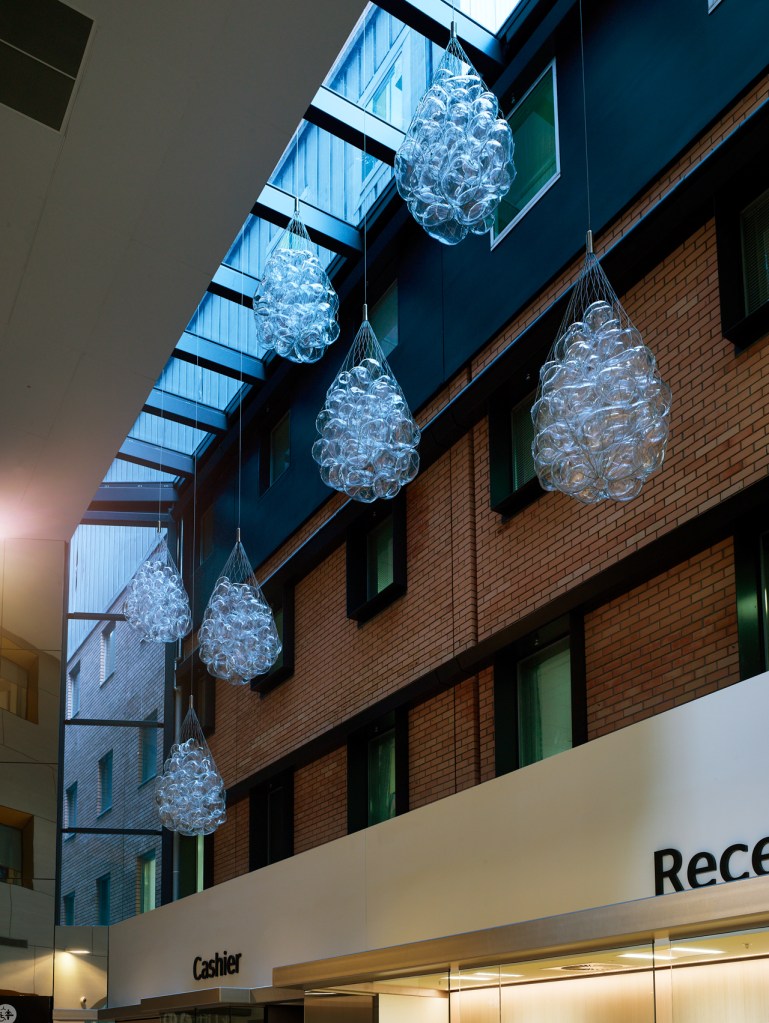
Those entering the Royal Hobart Hospital each day do so with a variety of reasons that range from the mundane to the more pressing issues of life or death. It is an entranceway marked by fear and anxiety, as well as by compassion, kindness, and love. Perched high above these anxious concerns in the vast space of the atrium are seven large nets containing what seem like bubbles or spherical glass balls, floating as if on an invisible sea or cloud of air. This installation is the work of glass artist Keith Dougall, who has worked with hundreds of staff, patients, and a team of technical assistants to create a work – Catching Your Breath – that invites an instant sense of compassion and empathy. Installed in 2020, this public art project engages the viewer with a profound sense of delight and playfulness. Set within this vast entry lobby, its clear sense of wonder is enough to take your breath away.
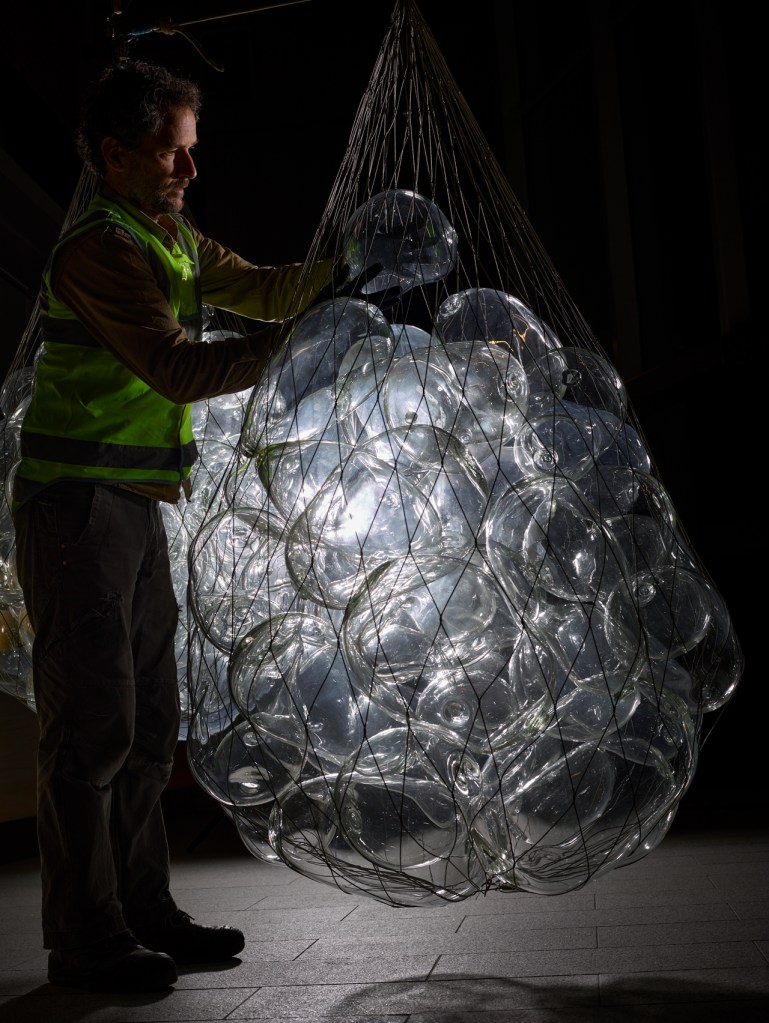
The work has an immediate impact and lifts the eyes of the viewer up into the space to consider its construction and to foster curiosity about its meaning. Dougall is an experienced glass artist with a considerable body of work, from individual art glass pieces to major public commissions. As a glass blower who uses his own breath to form work out of molten glass, he has extended his practice to incorporate the breath of others as the basic metaphor explored by this work. When each glass bubble was formed in the studio, they were provided with a small entry hole, where later, patients, family members, and staff were invited to supply their own breath, when the work was then finally sealed up. The overall installation consists of containers for this gift of life, inspiring, expiring, in the rhythm of life-giving breath.

The artist explains: ‘The work symbolises the fragility and resilience of breath and life. The suspension of the work is a metaphor for the support and care that staff and family provide the patient, lifting them up in their time of need’. Behind the stunning presentation of the work high above the heads of those who enter the hospital lies a complex process of manufacture and preparation that amplifies the work’s achievement as a community arts project. As people filled each vessel with their breath, many of their stories were recorded on video and became part of the documentation of the work through a dedicated website. One, therefore, takes in the work and the history of its formation as a part of a whole process based in compassion and understanding that gives life to people. Here is a representation of the nets of connection that surround individuals as they come into the hospital environment, where every breath, and every heartbeat, is closely monitored.
The breath of life is a metaphor strongly present in the Christian tradition. We remember that God forms creation through the agency of breath, and in turn breathes life into the clay of creatures, including the creation of human beings. This fundamental connection was clearly in the mind of the artist who works each day breathing life into inert glass forms that became vessels of delicate fragility and profound beauty. Perhaps this is the role some artists are energised by, through breathing life into material things, through imagination and transformation remaking the world into a habitation for wonder and human kindness. This work is one of embodied spirituality and community connection that successfully celebrates the role of a health care institution and the fundamental human values of love and compassion that lie at the heart of all healing and wholeness.
[A version of this piece appeared in Artway.]
℘℘℘℘
 Art/s and Theology Australia