Marisa Stratton, Zoom Class, 2021. Around 2.54 x 5.08 cm each. Private collection. Used with permission.
their smells are distinctive on this zoom conference one Catholic, advocating the Pope’s universal love for the creation one Protestant, speaking of the gospel’s power for all people their eloquence and passion point to unity and faith
still they smell different
their voices, tones, looks, manners postures and positions give unique smells as herbs display themselves in a tea house for visitors of the Zoom
after steeping them in water – reflections, Q&A, more reflections aroma rising from their words
after tasting which tea are you going to buy or simply walk out?
℘℘℘℘
XIAOLI YANG IS A THEOLOGIAN, POET, AND SPIRITUAL DIRECTOR. SHE LIVES AND PLAYS ON WURUNDJERI LAND AND IN THE MIDDLE KINGDOM.
for too long I’ve watched my Beauty crawling over the words soaring above the sky dancing between the silent spaces
for too long I’ve waited for my Beauty getting up from her desk walking to the pantry picking up my favourite bone for a good afternoon chew
for too long I’ve been locked with my Beauty in this house down in the garden observing rosellas fleeting and resting on gum branches gazing on shooting stars of the galaxy and the yellow Moon in the night sky
for too long I’ve dreamed of the day with my Beauty climbing mountains smelling fragrances of millions of flowers chasing every hint of animals tasting salt of every lake and leaving my historic marks on every passing pole
Still nothing is too long as long as I am with my Beauty
although sometimes I think I am the Beauty when she accompanies me on my royal parade and I draw the attention and admiration of all when she is busy cooking in the kitchen and I sit on the sofa watching TV when she cleans muck from my eyes or mops the floor of my fur when she hugs me tightly till I ‘purr’ or sticks her face on mine till I look aside
who cares who is whom? We are a happy family in the castle of Beauty and the Beast
℘℘℘℘
XIAOLI YANG IS A THEOLOGIAN, POET, AND SPIRITUAL DIRECTOR. SHE LIVES AND PLAYS ON WURUNDJERI LAND AND IN THE MIDDLE KINGDOM. This poem was written during Melbourne’s sixth lockdown.
There is always pleasure in looking. Things catch our eye. They lure us in and awaken memory, and in turn arouse desire. Looking at art is not just an exercise of intellect and imagination but it also activates our sense of embodiment, our connection with other physical things. This is especially so with works of sculpture that intersect with social spaces marked by human habitation and meaning. Sculpture has a long social history in providing gestures of past grandeur, markers of civic pride and powerful emblems of future hope. In more recent times, sculpture has activated the realm of both architecture and landscape to shape and understand the human imagination as embedded in the natural environment. Such artistic gestures help us touch the world through our eyes and grasp a sense of belonging in the world we inhabit.
Braddon Snape’s work demonstrates a knowing confidence in dealing with the tradition of an artist working in three dimensions. In his case, it involves a somewhat gruelling physical and mental rigour in turning materials into things that resonate in our visual imagination. Since 2014, Snape has been working with a unique approach involving the welding of steel sheets together and inflating them into a variety of forms with compressed air. These works literally express the process of inspiration, with the breath of a pneumatic pump giving them a unique presence and personality. Imitating puffed-up pillows, paper bags, wine bladders, that are leaned, strung, and manipulated in ways that work against the expectations of minimalist sculpture to be true to form and materials, these works are poetic, inferential, and incite the peripheral imagination.
Working with these same materials, this new body of work provides an exciting if not visually exhilarating turn. The liquid and refractive surfaces of these new works serves to blur and destabilise their orientation towards the viewer. They seem to be literally unzipping the firm signs of their manufacture as steel sheets and appear to be spilling out into the surrounding space articulating both the light and the air. Not just mirrors, but a transformation of the movement of air and light particles into a liquid dance. This is like a moment of rapture, or even rupture, where things that have been held in, come spilling out in an ecstatic release. Breathing bodies understand such states as the rhythm of expiration and inspiration, the slow release of breath. It is the state also of wonder, where clear boundaries are transcended, not as an idea, but as a felt sense of delight!
Braddon Snape, Allusive Object (3 Chamber Strip), 2021. Welded and mirror-polished inflated stainless steel with accompanying acrylic rectangle wall painting, 38 x 110cm \ 150 x 30 x 27cm.
There is great pleasure, mixed with a measure of anxiety, in looking at these works. I want to measure, categorise, establish boundaries, define understanding, while all the time the work is moving in the other direction, spilling out in excess. And then I remember what it is like to hover in the in-between spaces of existence, like hovering on a threshold or on the brink of a discovery. It is the fluid space of negotiating the collapse of edges, and the rush and ecstatic joy of letting go and finding release. Here, I want to reach for the geographies of the spiritual to explain this moment of ecstatic potential; the empty space between the fingers of Michelangelo’s God and Adam on the Sistine Chapel ceiling, or the tension of edge and centre in the shining white stone of a Zen Garden, or the stark light and dark shadow on a walk around the water-worn edges of Uluru. In these works, boundaries are let loose, no longer seeking definition, but allowing for the excess of freedom and visual ecstasy.
Art has long carried this alchemical impulse to apprehend moments of transformation and change, like observing the moment when ice turns into water, and then setting out to turn lead into gold. The dance of particles that surround the liquid surfaces of these mirrored steel pieces allow for such imagining. Surface and depth merge, inside turns out, and the proper boundaries of definition and classification are left aside for the liquid transformations where art spills out into life.
Mary spent about three months with Elizabeth. – Luke 1.56
If you have ever had visitors stay with you, you know that a three-week visit is huge. A lot can happen in three weeks. For Mary to stay with Elizabeth for three months, while both were pregnant (by the grace of God), has to be very significant for both. Just as the movements of particles and planets cause resonances that last billions of years, so the long stay of Mary with Elizabeth, traditionally named ‘The Visitation’, has had a ripple effect that can be detected in the Gospels, and beyond.
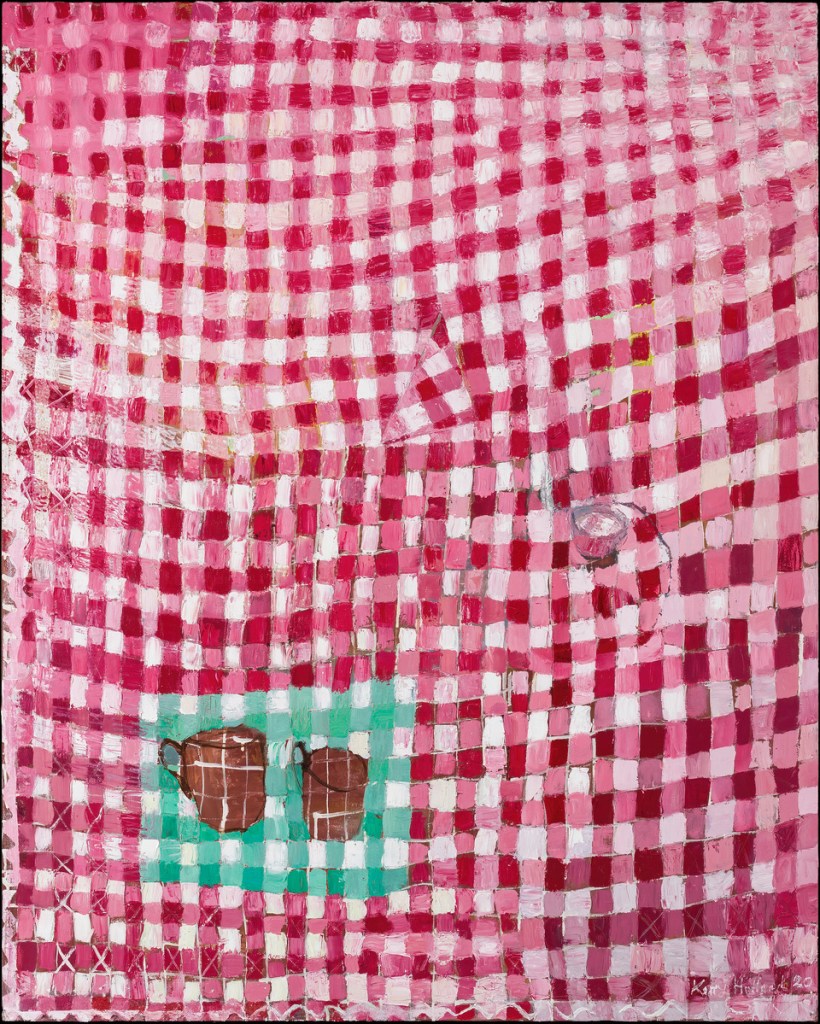
For four years, I pondered how I might fulfil a commission by a family at Christ Church, Anglican Church, Bundaberg to do a painting about ‘The Visitation’. In my searches, most artworks I could find on the theme were figurative – of Elizabeth’s greeting or of Mary’s Magnificat. I wanted to find a connection with the theme and express it in a contemporary manner.
I can’t remember when my focus became the many weeks Mary spent with Elizabeth, and their ordinary activities together while their pregnancies progressed. What was the detail of this prolonged experience only touched on in one sentence? Mary might have talked about it later in life.
Conversation was always going to be my starting point with the work. A red and white check, well-used tablecloth, inherited from my mother, lent me the structure for the painting. Many pivotal conversations are experienced over coffee or lunch. Mary and Elizabeth would have sat and eaten together daily and talked. They would have shared much, and deeply, making sense of their experiences, of their pregnancies, and of their encounters with God. As I considered this, I painted every inch of the painting with as much variation and nuance as I could manage, hoping that the parish might accept such a simply-structured work. I loved painting it, right down to the brushing on of the rickrack edging. This work is now happily installed in the church in Bundaberg.
Kerry Holland, The Visitation, 2021. Oil on canvas, 150 x 120 cm. Artist’s collection.
The ideas kept flowing and with it has evolved a series, ideas sifting through multiple drafts as the paintings take shape.
As I thought about what they might eat, I drew on a memory of my grandmother coming from wheatbelt country, Western Australia, to stay with us at Christmas time. She would seat herself at the bench in the kitchen saying, ‘Give me the beans’. Then while slicing them finely for the pot, she and my mother would be catching up on all their stories, and sometimes there would be tears. Three paintings in The Visitation series are called Tears on the Beans, as I imagined Mary and Elizabeth with pots of beans and the tears flowing as they talked. By this time, I was layering with spray can and oil paints.
Kerry Holland, Tears on the Beans II, 2021. Spray can and oil on canvas, 90 x 74 cm. Artist’s collection.
Some years ago, the Art Gallery in Western Australia acquired the Stanley Spencer Christ in the Wilderness paintings. I have always been intrigued by the way Spencer referenced scripture that is not directly related to the wilderness passages. He makes it work. Recalling this, opened possibilities for me. I could draw on other passages of scripture.
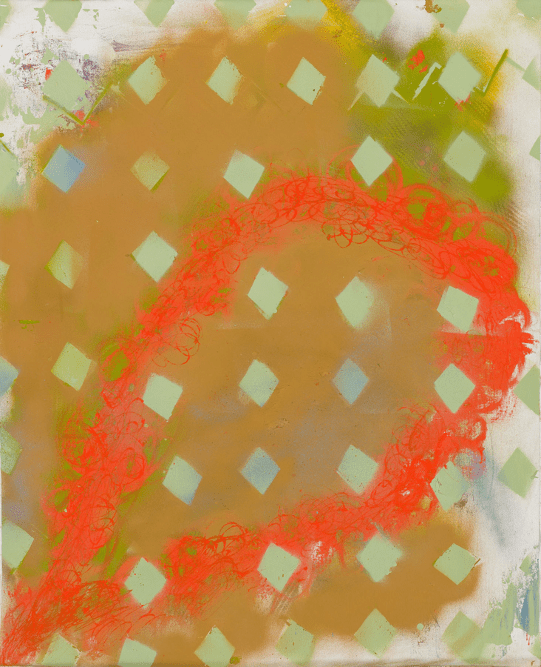
I considered how Mary and Elizabeth probably walked through the fields and talked, their hearts burning and bellies expanding as they considered God’s action in their lives. I saw a connection with the road to Emmaus passages and my own experience of heart burning in conversations. A painting of Juan Miro entitled The Lark’s Wing, Encircled with Golden Blue, Rejoins the Heart of the Poppy Sleeping on a Diamond-Studded Meadow (1967) came to mind. A long title for a minimal painting that moves me deeply. I noticed a diamond-patterned tea towel over the oven door. All these things, and more, fed into the ideas for my painting Hearts Burning in a Field of Diamonds.
Kerry Holland, Hearts Burning in a Field of Diamonds, 2021. Oil and spray can paint on canvas, 91 x 74 cm. Artist’s collection.
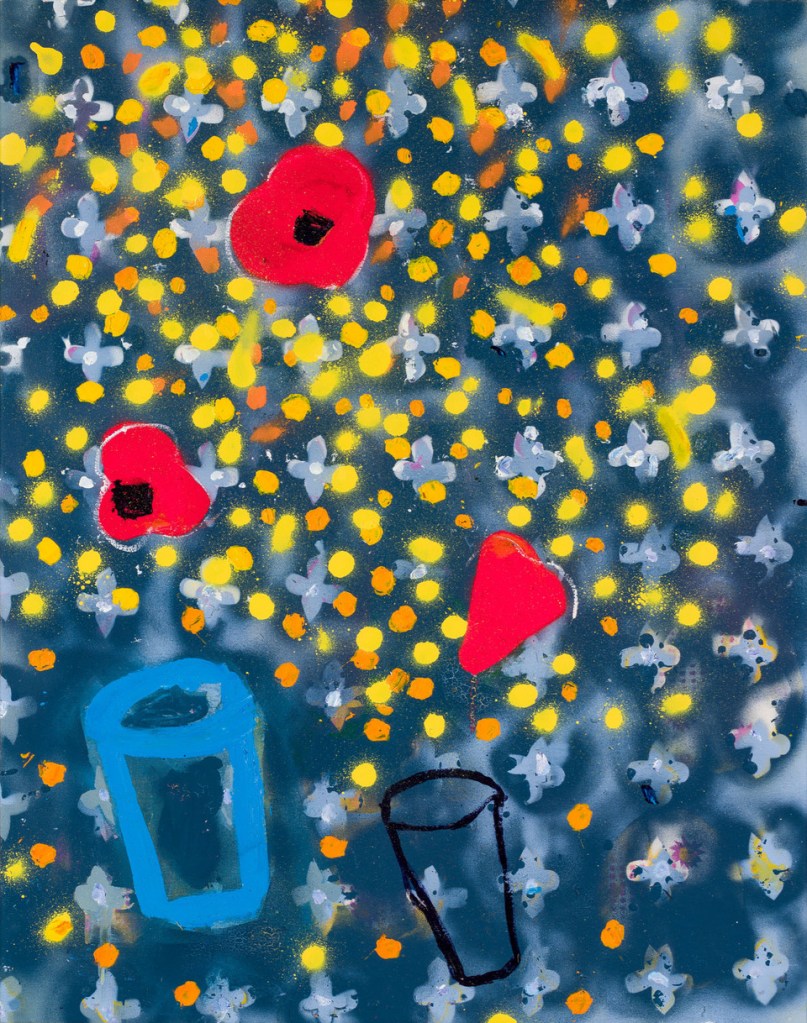
Everything is connected. A dear friend lent me her mother’s tablecloth with poppies on it. My own mother had shared with me her love of wildflowers. I am convinced that Jesus was aware of the lilies of the field because of his mother. Perhaps Mary and Elizabeth picnicked among the brightly-coloured wildflowers as they contemplated the future for themselves and their babies. A time of peaceful, abundant hospitality spread in the face of potential trouble.
Kerry Holland, Contemplating the Wildflowers, 2021. Oil and spray can paint on canvas, 94 x 74 cm. Artist’s collection.
There are nine paintings in the series, and more to come. I intend to also include ceramics.
The Visitation exhibition is currently showing at the Chapel of the Holy Spirit, St Francis College, Queensland, where it will stay throughout December. It is a part of the Art and Justice project for Milton Anglican Parish.
℘℘℘℘
Kerry Holland lives on Meanjin country and is a Brisbane-based artist working with paint and ceramics exploring narrative, imperfection, and tenderness. She coordinates the Art and Justice Project for Milton Anglican in Brisbane, and gives Ignatian Spiritual Exercises with the Faber JISA Centre.
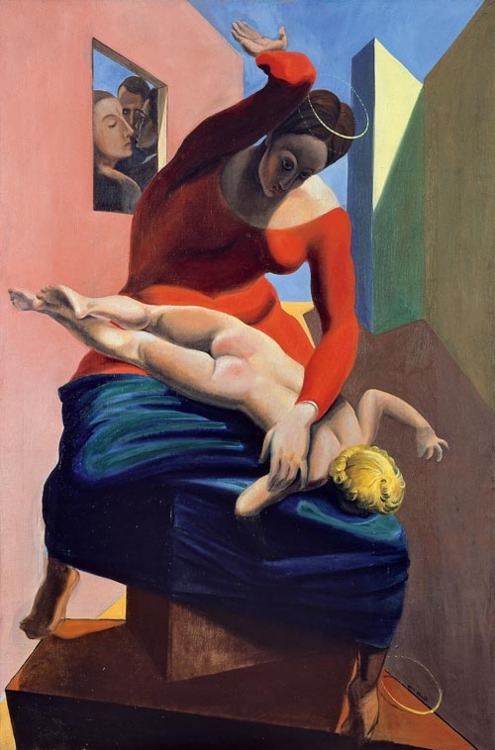
Max Ernst, The Virgin Spanking the Christ Child before Three Witnesses: André Breton, Paul Éluard, and the Painter, 1926. Oil on canvas, 196 x 130 cm. Museum Ludwig, Cologne, Germany.
It appears that to bear the weight of mum’s judgement means not only a sore bum but also a dropped halo. It appears that the Aryan half-pint might have again stolen her favourite manicure set from the middle drawer of the bathroom cabinet while he was supposed to be tidying his sister’s bedroom. It does not yet appear that in this act of descending freedom, of vacating a head that others might gild mockingly with thorns, the embarrassing shape of kenotic love is taking costly form. And it’s not as if
there is chaste indulgence here; this act of discipline reminiscent of Michelangelo’s Sistine Christ, this act of judgement upon cobalt and rubicund outlining her own contorted arm and deepening her own overtaxed gaze. A foretaste of arms bearing sin-gnarled stock and hers, those eyes that again will grieve as arms not her own are brought to bear upon her bare first-born, this unexpected fruit in whom her future and that of all shall find shape. And an open roof. Did it fly off with upswing arm so that one who sees everything could weep?
It has been some time too since Paul and Vincent came over, and now this other Paul, and André and Max; seemingly unsedated risk now transformed into dispassion. Was Gala really the benchmark of our friendship, our means of communication, our shared wife? What kind of love did we make to each other in her? And what of love once promised now turned, love now come to assault me? A naked face turned away in a sensuous spell.
℘℘℘℘
JASON GORONCY IS A THEOLOGIAN, ARTIST, AND FOLK FESTIVAL TRAGIC WHO LIVES AND PLAYS ON WURUNDJERI LAND.
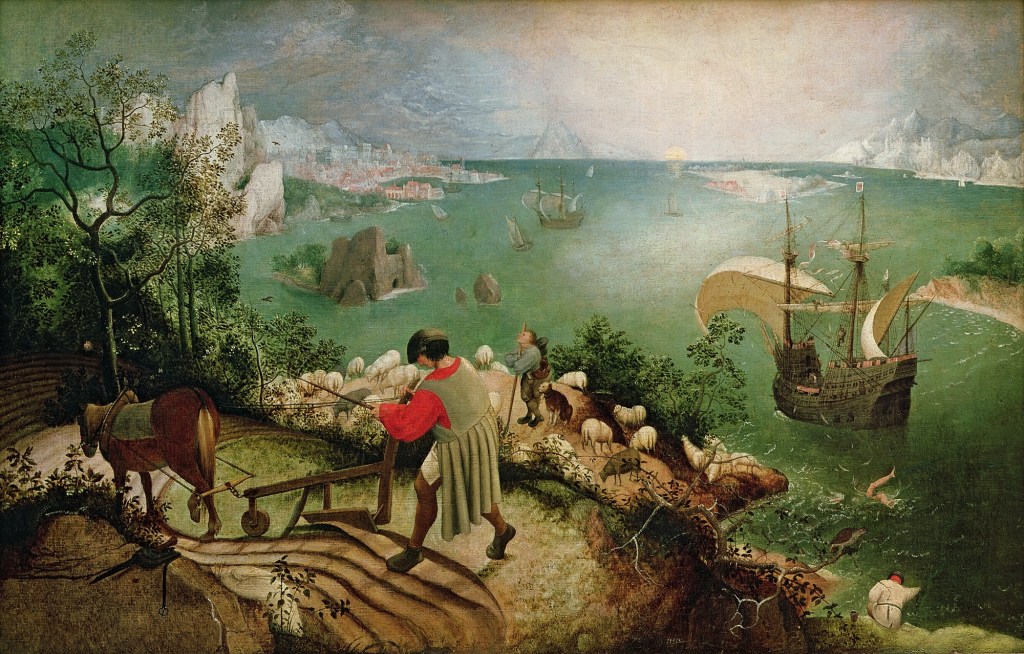
Pieter Brueghel the Elder, Landscape with the Fall of Icarus, c. 1558. Oil on canvas, mounted on wood, 73.5 x 112 cm. Royal Museums of Fine Arts of Belgium, Brussels, Belgium.
After W. H. Auden had visited the Musées Royaux des Beaux-Arts de Belgique in Brussels, and seen Pieter Brueghel the Elder’s Landscape with the Fall of Icarus, he went away and penned the following words:
About suffering they were never wrong, The Old Masters; how well, they understood Its human position; how it takes place While someone else is eating or opening a window or just walking dully along; How, when the aged are reverently, passionately waiting For the miraculous birth, there always must be Children who did not specially want it to happen, skating On a pond at the edge of the wood: They never forgot That even the dreadful martyrdom must run its course Anyhow in a corner, some untidy spot Where the dogs go on with their doggy life and the torturer’s horse Scratches its innocent behind on a tree. In Breughel’s Icarus, for instance: how everything turns away Quite leisurely from the disaster; the ploughman may Have heard the splash, the forsaken cry, But for him it was not an important failure; the sun shone As it had to on the white legs disappearing into the green Water; and the expensive delicate ship that must have seen Something amazing, a boy falling out of the sky, had somewhere to get to and sailed calmly on.
The American theologian William Willimon recalls Brueghel’s painting, and Auden’s poem, in his book On a Wild and Windy Mountain (Abingdon Press, 1984), wherein he observes that we trudge past bleeding crosses with a shrug of the shoulders, that Good Fridays are so commonplace among us as to be unnoteworthy, and that tragedy achieves nobility only in the theater. ‘Everydayness and ordinariness’, he writes, ‘become our best defenses, the most effective relativizers of the tragic in our midst. Some young Icarus falls from the sky every day, so one had best get on with the business at hand until the extraordinary comes. For now, go to work, eat, make friends, make money, make love, mind your business – that’s the best way to cope, for the time being, with the expectedness of the tragic. The old masters knew best’ (p. 15).
Pieter Bruegel the Elder, The Numbering at Bethlehem, 1566. Oil on panel, 116 × 164.5 cm. Royal Museums of Fine Arts of Belgium, Brussels, Belgium.
Willimon proceeds to compare Landscape with the Fall of Icarus with another of the Dutch masters’ works: Numbering at Bethlehem. He notes the ordinariness of the depiction, a day mundane and unpromising – in its highlights at least – and nothing beyond the expected.
But then … they appear.
They appear. ‘An inconspicuous, thoroughly ordinary young woman on a little donkey led by a stoop-shouldered, bearded peasant who carries a saw. Here is Mary, with Joseph the carpenter, come to town to be counted. They are so easily overlooked in the midst of ordinariness. Old masters like Brueghel’, Willimon suggests (and we might add Rembrandt, for example), ‘were never wrong’. Rather, they understood, and bore witness to in their work, the truth of Emmanuel, the scandal of the unostentatious God living – and dying – with us, of God stained with the sweat of human bondage and soaked – baptised – in the blood of human violence, of God incognito. ‘They understood our blindness not only to the tragic but also to the triumphant in our midst … In life, the Presence goes unnoted as we thumb through the evening paper. And so we wait, sitting in the darkness of the everyday until something extraordinary breaks in. Someday God may break into this world, we say. But for the time being, it is best to work, eat, make love, pay taxes, fill out government forms, and mind our business. The old masters knew it best’ (p. 16).
I have posted elsewhere on the pseudonymous activity of God, suggesting that ‘in the economy of holy love, the locus of greatest clarity equates to the point of greatest incongruity and surprise’. It is precisely that we may see what Willimon so beautifully refers to as ‘the triumphant in our midst’ that we are graced, and that we might witness to the day when good will triumph over all, certain that the grace of holy love will win at last because it did not fail to win at its most decisive time. In the meantime, such seeing typically requires what is another great advent theme: waiting, or what R. S. Thomas, in his poem ‘Kneeling’, referred to as ‘moments of great calm’:
Moments of great calm, Kneeling before an altar Of wood in a stone church In summer, waiting for the God To speak; the air a staircase For silence; the sun’s light Ringing me, as though I acted A great role. And the audiences Still; all that close throng Of spirits waiting, as I, For the message. Prompt me, God; But not yet. When I speak, Though it be you who speak Through me, something is lost. The meaning is in the waiting.
– R. S. Thomas, ‘Kneeling’, in Not that He Brought Flowers (London: Rupert Hart-Davis, 1968), 32.
℘℘℘℘
JASON GORONCY IS A THEOLOGIAN, ARTIST, AND FOLK FESTIVAL TRAGIC WHO LIVES AND PLAYS ON WURUNDJERI LAND.




 Art/s and Theology Australia