Three Poems: Jezebel, Makeda, Esther

As a woman, I gravitate to the stories of women in the scriptures. Women balance multiple gender roles and identity tensions. Their stories are often hinted at or mentioned in passing. We get glimpses rather than full narratives. Nevertheless, they are there, often unnamed or in the shadows. Unlike many of the other women, these women are named. They are queens who had highly vulnerable political positions.

Lucia Lukas, Queen, 2021. Markers, oil, photographs, acrylic, and fabric on canvas. 81.7 x 107.5 cm. Artist’s collection.

Jezebel (from Her Foreign Majesties)

Reflected in the mirror, I wonder at my crown.
Who placed it there upon my maiden brow?
A princess of Phoenicia, so foreign to this Land
How can I live authentically in this state?

O Jezebel, how came you here?
What will you do?
What have you done?
Begone!

I did not choose to come here – sold by my tribe for peace…
I come as token gesture – a prize to be displayed
Today I’m claimed as Ahab’s queen, to mother his offspring
My body – chattel of the state – is not for me to own.

O Jezebel, who are you here?
Are you considered human?
Of are you simply of another
Man?

Makeda – Queen of Sheba

Love? No – maybe it was more of a curiosity …
A fascination with a legend.
I have had presented chiefs and princes …
The finest warriors and generals,
the richest men with the greatest lands.

I have no need to search,
But my interest has been aroused
by the tales of Wisdom.
What man is really wise?
Is there such a beast?
If so, might he be worthy of my attentions?

These days, I could be bored,
for my wealth is unsurpassed,
My lands are peaceful,
My realm is stable.

What more could a girl ask for?
I seek adventure … to travel to exotic places,
To meet interesting people …
To see this Temple of wonder
Being built for a single God!

Perhaps I will find more than sights to see?
Perhaps I will find a King worthy of a Queen?

Esther

Reflected in a mirror, I see my exiled face
Who gave me over to become a wife?
A Queen my Master made me – to people not my own
While mine are slaves and foreign to this place

O Esther, how came you here?
What will you do?
What have you done?
Beware!

I did not choose to be here – taken from my people – dispossessed …
I am prize of warfare – a prize to be displayed
Today I’m Queen of Persia – but silent is my role
Do I dare disobey the boundaries of my life?

O Esther, who are you here?
Can you be given voice before your King?
Do you have words
from another Lord?

℘℘℘℘
Amelia Koh-Butler is Minister, Eastwood Uniting Church, and is currently living on Wallamategal and Barramattegal Country of the Darug-speaking peoples.

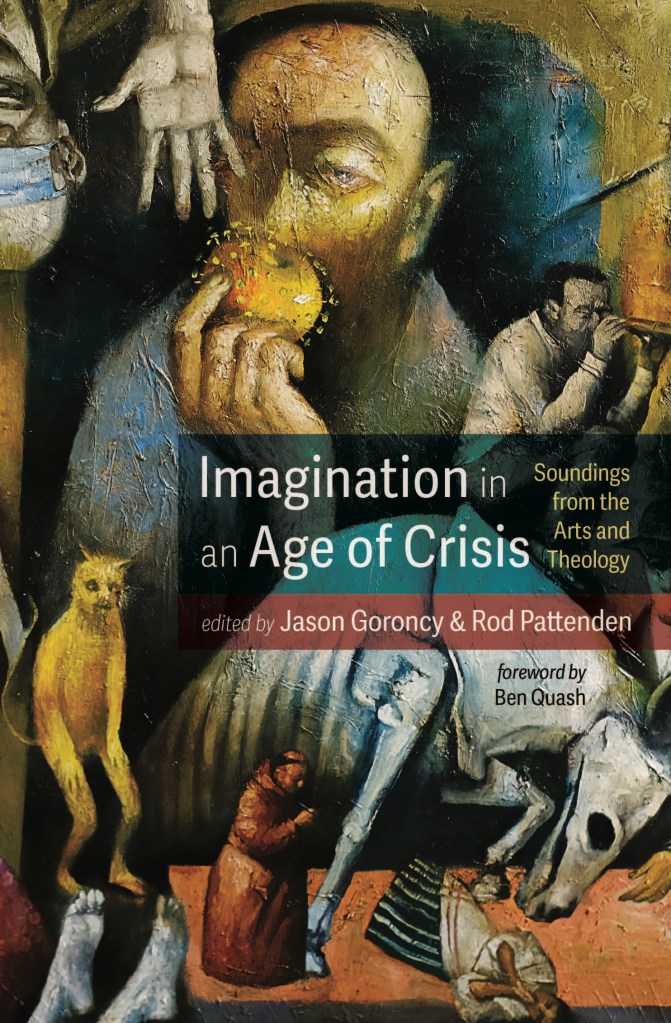
Imagination in an Age of Crisis

Jason Goroncy and Rod Pattenden – this site’s editors – are thrilled to announce that they have a new book out.

Imagination in an Age of Crisis: Soundings from the Arts and Theology explores the vital role of the imagination in today’s complex climates – cultural, environmental, political, racial, religious, spiritual, intellectual, etc. It asks: What contribution do the arts make in a world facing the impacts of globalism, climate change, pandemics, and losses of culture? What wisdom and insight, and orientation for birthing hope and action in the world, do the arts offer to religious faith and to theological reflection?

These essays, poems, and short reflections – written by art practitioners and academics from a diversity of cultures and religious traditions – demonstrate the complex cross-cultural nature of this conversation, examining critical questions in dialogue with various art forms and practices, and offering a way of better understanding how the human imagination is formed, sustained, employed, and expanded.

The book has been well received, with Professor Jeremy Begbie (Duke University) describing it as an ‘extraordinarily energetic and imaginative collection’, while Professor Stephen Pickard (Australian Centre for Christianity and Culture) calls it a ‘remarkable collection of reflections on the power of the imagination to instil hope and meaning in disturbing times. … [A] breath of fresh air’.

The book has a strong range of contributions from the Australian context, as well as those from the Pacific, Asia, the United Kingdom, and the USA. It is an international collection with a common concern to celebrate and prize imagination for these times. A video review is provided by Rev Dr Jane Foulcher (Senior Lecturer, Charles Sturt University), along with an introduction by the editors:

Through 35 individual contributions, the book weaves its many conversations around the capacity of the imagination, and the arts in particular, to provide a means of cultural resilience, protest, questioning, and critique. It explores the work of a wide range of writers, playwrights, poets, musicians, and visual artists, to provide imaginative resources to articulate the challenges and the choices facing human beings in a world both drawn close and made distant through networks of disease, conflict, commerce, and culture.

The book is richly illustrated in colour with 39 images, including a stunning cover image by Filipino artist Emmanuel Garibay that graphically expresses the cultural collisions of our time. Another strong creative feature of the collection is the engagement provided by poets, including Petra White, Kevin Hart, Christian Wiman, Jordie Albiston, Pádraig Ó Tuama, and Michael Symmons Roberts. The result is a volume marked by beauty and wonder, as well as incisive critique. It is a unique collection that brings unexpected voices into a global conversation about imagining human futures.

Imagination in an Age of Crisis is available now at a special introductory price of 40% off. Use the code “Crisis40” at checkout through Wipf & Stock, or through customer service by phone (1-541-344-1528), or via email.