We’ve Misplaced Jesus’ Jewishness

We’ve misplaced Jesus’ Jewishness.
(It’s a bit embarrassing)

I knew we left it somewhere
Around the farm or in the yard
Between the 2nd temple and the Archbishop of Canterbury.
Lost the Messianic in the messy-attic;
We Turned the wrong tables and spilled hope of the Mosaic, everywhere.

So I guess it’s no wonder that we found other pieces

filled in the blanks with what made sense at the time and turned the free salvific into a cost-less grace.
Understand, not, ‘make a stand’.
It’s a gentler salve for an aching heart and we can say it from wherever we sit.

But what would the cows think
out there grazing on the
blessed bounty of the earth?

Do they think that what they die for is more important than their own muchness?

At least someone’s helping to search the top paddock … even as the rains come …

And with all those pieces in puddles
and no Moses to muscle the Reed Sea,
We filled in the picture with culture and reason and it’s no wonder that the hand became its center.

That hand
pointing …

before long we had painted so many pictures that we forgot it was ever a mosaic hope.
… no wonder that here
I AM: confused

But I found a bit today

Back, behind the stove
Behind the boiler and
manufacturing machine,
amidst the tear Gas

and passionate web of solidarity …

And if you fit it in just right you can almost see a new humanity.
The precious darker shades bring out the definition

a picture more gracious in a higher resolution.

So hope? … We are. Aren’t we?
(Eschatological)

Here and now in this new human future.

And somewhere I’m sure,
A bush is still burning.

—————-

(Who’d have thought
we could just say
‘yes’?)

℘℘℘

P. J. BANKS IS AN ASPIRING WRITER AND POET, AND A CANDIDATE FOR PASTORAL MINISTRY WITH THE UNITING CHURCH. HE IS PASSIONATE ABOUT THE ARTS AND THEOLOGY, AND THEIR PURSUIT AND UNDERSTANDING OF CONSCIOUSNESS, MEANING, AND THE NATURE OF REALITY. HE LIVES AND WORKS ON DJA DJA WURRUNG AND TAUNGURUNG LAND.

Dying alone in the age of COVID-19

christopher-campbell-Cp-LUHPRpWM-unsplash

From her garden glowing with autumn colours, a neighbour tells me news from kin who work in emergency healthcare. The triaging will be grim. Another friend who is a hospital chaplain tells me that even now families cannot gather around dying relatives in ICU. This isolation extends beyond Coronavirus patients. Enforced absence strikes deep. Removing the capacity to be present, to accompany, to say farewell, is an unmaking of the fabric of our lives.

Daniel Burke writes for CNN, ‘Coronavirus preys on what terrifies us: dying alone’. He describes as a primal instinct ‘the impulse to be close to people we love when they are suffering and near death’. In the context of COVID-19 he says, ‘It is a painful irony, the very thing we need in moments of fear and anxiety could also kill us’. It may well remove us from the possibility of bearing witness to the death of people we love.

This is a painful and difficult truth. It is hard to know what to do in the face of it.

I ask my neighbour over the garden fence, ‘How could people prepare for this possibility? How could you ease the pain and guilt for your family if you were the one dying?’ My neighbour is experienced in death. She says, ‘I would write a letter to my daughter. I would tell her I understood the necessity of absence. I would tell her not to feel guilty, that I would be alright’.

The simplicity and courage of this response strikes me to the bone. I know a written message from a loved one can carry huge weight in a crisis. In what seems like a different universe, my 94-year-old mother died in January following a major stroke. Her Advanced Care Plan (ACP) was the thing I could hold onto.

A question appears at the base of the ACP form: ‘What would you hope for most when you are near the end of your life?’ My mother’s words on the page read: ‘I would want my family to know that I am not afraid of dying’. She went on to say that she would want them to come and be with her ‘if they wanted to and were able to’. I wonder how she would have phrased that if she knew what we know now.

Back in January, when I saw her lying on a stretcher in Emergency, I wondered if my mother really was unafraid of dying. She was unable to speak and there was a haunted look in her eyes. Of course I don’t know how she felt, but all her instructions suggested she was more afraid of a living death. In the instance of a stroke she wanted no surgery, no intervention, no feeding, only pain relief.

In those last eight days my mother needed only minimal pain relief. And when she died, her fast breathing simply slowed to long spaces between breaths and then stopped. Would it have mattered to her if I was not there? I am not sure that it would. It mattered to me, it helped me to accompany her and to bear witness, but I think my mother was already bent on the business of leaving.

Daniel Burke quotes hospice chaplains who remark on the frequency of people dying in the moments that their vigil-keeping families briefly leave the room. Dying is, after all, something you have to do on your own.

There’s a difference between dying alone and dying without love. Hospice chaplain Kerry Egan says, ‘In a certain sense we all die alone, even if we are surrounded by people we love. Often, as we die, our bodies are breaking down so our minds are elsewhere. The conscious experience of death, is, by nature, solitary’.

I remember when my children were small, they came to me to show me a dead bird in our garden. The older child spoke the question I could see in the eyes of his sister as well. ‘Mummy, when the bird dies, is it all by itself?’

A colleague and friend who is a psychologist tells me the pattern that follows a death by suicide. ‘People will go back over the details of the death, step by step. It is as if they are trying, in retrospect, to place themselves so they can accompany the person they have lost, so they can be with them, so they won’t have to be alone. On the anniversary they will often take themselves to the place the suicide happened. We are wired to accompany each other’.

So how can people prepare for the profoundly upsetting possibility that this primal urge to accompany cannot happen? My neighbour’s instinct is to prepare by writing to her family, releasing and reassuring them against their potential distress. And there is another thing we can still do – we can accompany the bereaved.

Leigh Sales’ remarkable book, Any Ordinary Day, is subtitled ‘blindsides, resilience and what happens after the worst day of your life’. Her interviews and research highlight the significance of standing beside – of accompanying people who have experienced the kind of losses that leave us aghast. In this age of COVID-19, every loss is magnified and has its own degree of heightened fear.

We cannot stand in the same close proximity we associate with solidarity but we can still acknowledge and make room for others in sorrow. In some ways it takes us back to an earlier era. I see in my own neighbourhood exchanges of care: home-garden flowers arranged in a bottle on a doorstep, a jar of soup, a loaf of sourdough bread, cards delivered through the mail, miniature care packages that include candles and poetry.

We cannot do anything grandiose in this moment. It is time for the small acts of kindness to inhabit the space.

Poet Seamus Heaney died unexpectedly in 2013. At the funeral his son Michael reported that his father’s last words were in a text message sent to his wife minutes before he died. He used his beloved Latin: ‘Noli timere’ – don’t be afraid.

[Image: Christopher Campbell via Unsplash]

[Ed. In second semester 2020, Jason Goroncy will be teaching an online unit on Death, offered through the University of Divinity. This can be taken for credit or audited. Further details here.]

℘℘℘

JULIE PERRIN IS A MELBOURNE WRITER, ORAL STORYTELLER, AND ASSOCIATE TEACHER AT PILGRIM THEOLOGICAL COLLEGE, UNIVERSITY OF DIVINITY. SHE KEEPS A WEBSITE, AND HER MOST RECENT BOOK IS TENDER. SHE LIVES AND WORKS ON WURUNDJERI LAND.
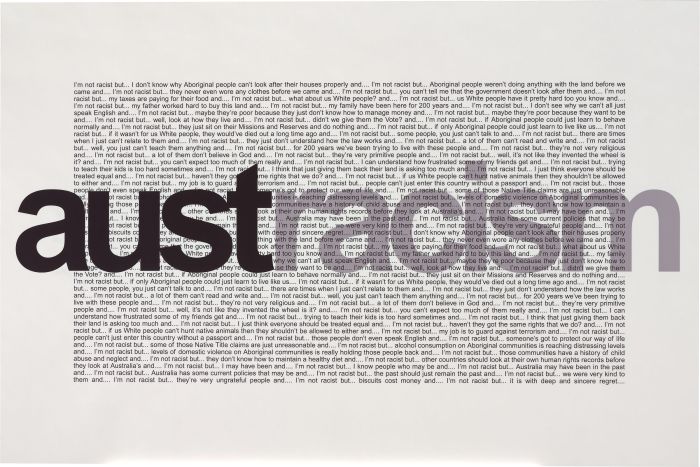
Austracism

Vernon Ah Kee, 'Austracism', 2003. Prints, digital print, printed in colour inks, from digital file, 120.0 x 180.0 cm. National Gallery of Australia, Canberra
Vernon Ah Kee, Austracism, 2003. Prints, digital print, printed in colour inks, from digital file, 120 x 180 cm. National Gallery of Australia, Canberra.

My Journey

Secure within my comfort zone,
protected from besieging germ,
I thank good fortune I am well,
and pray I won’t become infirm.

For of the knowledge tree I ate,
filled my pantry, stayed at home,
spent time apart from kith and kin,
immersed myself in Zoom and tome.

And now, in isolation, I
have time to contemplate and rest,
but find reflections weigh me down,
confuse my mind, put me to test.

For others suffer worse than me
amidst lost jobs, elusive hope.
‘Is it my role’, I ask myself,
‘to risk my health to help them cope?’

Then naked in God’s sight I hide,
distance myself from Micah’s call
to humbly walk and kindness love,
and justice do to those who fall.

But as I sit this crisis out,
observing from retirement’s womb
the stresses neighbours now endure,
I ponder on an empty tomb.

For on a cross forgiveness sang,
not silenced by a cruel fate,
not blaming me for selfish act,
but helping me my fears abate.

This fortress offers me some space
to trust the paradox of faith,
that in the midst of death … is life,
and there I find a place that’s safe.

God clothes me well with Eden’s skins
to help me learn to live Shalom
amidst Creation’s groaning sighs:
Your Kingdom Come adorns my home.

––––––––

Inspired by Genesis 3, Psalm 46, and Micah 6.8.

I write poetry to explore the ineffability of faith, almost paradoxically using words to cast light on faith’s mysteries, ambiguities, and challenges as humanity engages in a restless quest to understand the Divine.

‘My Journey’ is the third poem in an unplanned trilogy (following ‘Sophia’s Lament’ and ‘Gaia’s Revenge?’) written in response to 2020’s catastrophic start – bushfires, floods, COVID-19, and economic collapse. Where and how do we find God in these events? The divine, earth, and human perspectives unfolded as I put pen to paper.

Knowledge … home … distance … love … justice … neighbour … faith … safe … Eden … Shalom. How do we interpret these words and give effect to them in our lives as we face crises? Psalm 46, on which Luther’s hymn ‘A Mighty Fortress is Our God’ is based, provides some insights.

℘℘℘℘

CHRIS DALTON IS A RETIRED PUBLIC AFFAIRS ANALYST, WITH A PASSION FOR PUBLIC THEOLOGY, PARTICULARLY WITH REGARD TO THE ENVIRONMENT. AUTHOR OF REIMAGINING LAND IN AUSTRALIA: FROM TERRA NULLIUS TO BELOVED COMPANION, HE FINDS POETRY A REWARDING WAY TO EXPLORE ‘WICKED’ PROBLEMS. HE LIVES ON BUNURONG/BOONWURRUNG AND YUIN LANDS.

‘Great!’

George Gittoes - The Scream
George Gittoes, Great, 2017–19. Oil on canvas, 92 x 76 cms, collection of the artist.

Artist George Gittoes has spent considerable time working as a filmmaker in poor urban communities in the USA. Over the last few days, he has been sharing with me by email and phone his responses to what is happening in the USA this week. He has sent me the text below where he distils his response in a painting he completed in 2019. – Rod Pattenden

I met Elliot Lovett in Baghdad in 2003. He had just come in from a combat mission and joined in the freestyle rap competition called the Bull Ring, beside the pool of what had been Uday Hussain’s Palace. Elliot’s rhyming verses began to sculpt images in my mind with the genius of a Picasso re-configuring form to match images evoked by the bombing of Guernica. Instantly, I felt protective of Elliot’s genius and said, ‘Let me talk to your officers and have you excused from frontline duties – your talent is too great to be risked’. Elliot laughed back, and said, ‘George, it is more dangerous in Brown-sub Miami where I come from. I joined the army because it is safer’.

I followed Elliot back to Miami to make my film Rampage, which would test this challenging statement. Sadly, Elliot’s even-more-talented-poet-brother Marcus was shot and killed while we were making the film. Elliot asked me to come back again in 2017 to be with his community while they campaigned to oppose Donald Trump’s election. Elliot said: ‘We need to make a video clip and call it ‘Ya all don’t hear me’. He wanted the rap musicians to wear white clown masks and perform in front of a huge street mural depicting Trump with his face painted like Batman’s Joker, taking a knife to the Statue of Liberty.

All the rappers crammed into a hotel room to watch the election results with Hellen Rose (my partner) and I. They could not believe that Trump had won and would be their new President. Elliot commented: ‘He will say anything because he is crowd-pleaser, like a clown’.

As well as poetry, Elliot sees bodybuilding as an art form and uses his amazing physique to make symbolic poses that are art. He explained that the following day he wanted to take one of the clown masks out onto the street and ‘show what it means to a black person hearing the slogan “Make America Great Again”‘.

His performance, which I drew and photographed, was like a scream and I did one painting called that – The Scream – but for Elliot the most powerful image he wanted to evoke was standing with empty hands outstretched and looking down at them through the white clown mask and saying ‘Great!’ Saying it Elliot’s way, the word took on the opposite meaning; like when you have had a bad day and both tyres of your car have been punctured on the side of a highway in heavy rain and you reach for your mobile phone to call for help and discover the battery is flat and you say, ‘Great!’

Elliot has the double disadvantage of being an artist and black. In our society artists are discriminated against for being different. Growing up as an artist in conformist Australia helps me to understand the suffering of African-Americans and Indigenous people. Our film White Light gives a voice to the people of segregated Southside Chicago – a community which, literally, has a church on every corner and every one of them is full on every Sunday. The uplifting voices of Gospel singers can be heard, evoking the suffering and prayers of a people who have been victimised since slave days. To see Trump holding up a Bible to these truly-spiritual people was the deepest of all insults, at this time of crying out for change ‘at last’.

In the first four minutes of White Light, the police are seen approaching Harith Augustus, a much-loved hairdresser and barber as he peacefully walks up to his shop. Within seconds they have shot him dead on the road. The police never gave an explanation and were never punished. If it was possible to fly to the US, Hellen and I would be on the next plane to be with our friends, out protesting for change and an end to such injustice.

(George Gittoes’ recent film White Light features this song ‘Off the Chain’. In many ways, it provides the soundtrack for understanding the current unrest in the USA.)

℘℘℘℘

George Gittoes AM is a highly-recognised Australian artist, who for more than four decades has documented some of the world’s most serious conflicts. He has been recognised for his humanitarian and peacemaking efforts and has been awarded an Order of Australia (AM) as well as the prestigious Sydney Peace Prize 2015. A painter and printmaker, Gittoes is also an award-winning documentary filmmaker who has worked in places such as Afghanistan, Iraq, Pakistan, and, more recently, the suburbs of Chicago. He is the recipient of several major art awards and his work is included in public collections nationally and internationally. George Gittoes lives and works on the land of the Wodi Wodi people, of the Dharawal nation.

Spiritus Short Film Prize

The renamed biennial national 2020 Spiritus Short Film Prize aims to contribute to a vision of hope and the common good for Australia:

  • An expert panel of four judges will award up to six prizes in three categories based on five criteria
  • Entries opened Monday 3 February and close Tuesday 30 June, with winners announced in September
  • Entries are open for the biennial national 2020 Spiritus Short Film Prize, an initiative of the Australian Centre for Christianity and Culture (ACC&C) at Charles Sturt University.

There are six prizes in three categories, and entrants can enter their film in more than one category and can receive more than one prize.

The categories are:

  • Spiritus Short Film Prize – Regional Australia Prize (open to entries outside an Australian Capital city). Cost to enter $5
  • Spiritus Short Film Prize – School Category (This is open to entries from school students (under 18 years of age) who attend a school in Australia. Cost to enter $10.
  • Spiritus Short Film Prize – Open to all. Cost to Enter $20.

There is $5000 in cash and prizes available, donated by Clive and Lynlea Rodger. The judges award the prizes, but they do not have to award all prizes:

  • Regional Australia Prize for entries outside a capital city – $500
    School category (for school students only in Australia) for equipment for school to value of $1000
  • Spiritus Short Film Prize – Winner $2000
  • Spiritus Short Film Prize – Highly Commended $750
  • Spiritus Short Film Prize – Commended $500
  • Spiritus Short Film Prize – People’s Choice $250 (Awarded on the night)

More information about the 2020 Spiritus Short Film Prize ‘Conditions and Criteria’ can be found here.

Imaginative Hope: Why Art Matters In Times Of Crisis

Ben Quash, Professor of Christianity and the Arts at King’s College London, gave an online lecture this week titled ‘Imaginative Hope: Why Art Matters In Times Of Crisis’. Now the good folk over at Morphe Arts, who sponsored the event, have made it available.

My God is an Open Book

My heart is an open door and you’re all it took,
You’re all it took,
And I’m sore and shallow and sorry somewhere
And it seems she’s taking steps
To remind me she’s taking steps
to remind me she’s talking
like a whisper …

Like a whisper that changes seasons
That concurs demons
That breaks all reason
Till we’re bruised and bleeding
Till we’re raw
and true
And our spirits screaming
Till our hearts are beating, again
… and In some
still
quiet
place, We’re sane …

And the love…
and lovers that we once sought
Are more than just our loves in name.

She whispers
and He whispers
and They whisper your story Open
And dare you to stand
Dare you to run
to laugh, to play, to weep those tears till your body is soft
to dance this dance
Till your being is lost …

Till all your breaking
Is found in its cost.

My God is an open book.
My God is an open Heart
and you’re all it took.

You’re all it took.

℘℘℘

P. J. Banks is an aspiring writer and poet, and a candidate for pastoral ministry with the Uniting Church. He is passionate about the arts and theology, and their pursuit and understanding of consciousness, meaning, and the nature of reality. He lives and works on Dja Dja Wurrung and Taungurung Land.

Telling Aurelia

stella-tzertzeveli-xKc1T37KMHQ-unsplash

In the week following my mother’s funeral I wake up knowing I need to begin cooking again. For all of January my mother’s death has been my whole world. But now the gifts of home-made food have slowed. It is time to come out of the cocoon I have wound around keeping vigil and arranging the funeral. In the small hiatus between the bushfires and the Coronavirus lockdown, we’ve had the privilege of a communal farewell. Now I need to enter the world beyond my door. It takes me until lunchtime to coax myself out from under the doona. I will walk up to the local shops for bread and vegetables.

The Italian fruit and veggie shop has an open storefront facing the street. I recognise Aurelia as she stands in the aisle, lightly stacking gleaming fruit. She has worked here for as long as I can remember, though she only appears to be in her early 40s. She wears a navy-blue uniform stitched with lime green highlights. It bears the names of the brothers who own the business.

As I approach her in the narrow aisle, Aurelia is deftly placing plums. Her coral pink fingernails flash amidst the dark purple. She turns towards me with a bird-like quickness in the movement of her head. Her hair is full of impish drama, the top sticks straight up, the sides are close cut. When Aurelia cocks her head to one side, her bright eyes meet my gaze. I realise I’ve felt on my guard coming out into the world again, but here is curiosity and kindness. Aurelia’s eyes are alive and alert, undimmed by years of customer interactions.

The colour and sheen of the shop are open to the street and the weather. I have been feeling hidden, but Aurelia’s presence welcomes me back. Her face is mobile, attentive, there is no risk her strong make-up will mask her loveliness. The clean lines of her eyebrows, cheekbones and lips are accented and clear. ‘Hello’, she says, ‘how are you?’ Aurelia stands back and rocks on her heels as she says this, then grounds her two feet slightly apart. Her ready stance tells me she means the question.

I realise I want her to know that my mother died. I don’t need her to do anything, just know. I tell her Mum had a good death at the end of a long life. There is a pause that marks that this is a new absence. Aurelia is perfectly tuned. Her eyes rest on me as she asks, ‘Are you OK?’

Standing next to the fruit stack, Aurelia tells me about her grandfather’s death in Italy. She had visited him there many times but could not be there when he was dying. She rang while the family were gathered. Someone held the phone to his ear. He said her name. ‘Aurelia’. And then he said, ‘Goodbye Aurelia’. Later she learned these were the only words he spoke in the last weeks of his life.

‘You take care now’, she says as she gently straightens my collar.

The evening Mum died, when it was finally time to leave the hospital, I stood in the corridor, outside her room. A nurse came to farewell me. She held a clipboard in one hand but with the other she reached up and patted down my crooked collar. Sometimes this would feel patronising, but not in these moments. I am one of the motherless now, the gesture is instinctively soothing.

When I am about to leave the shop, I look for Aurelia to give her a wave, but she’s gone out the back. It doesn’t matter. The transaction is complete. Something important in each of our lives is known to the other. Aurelia’s shining listening and quiet telling have allowed me to re-enter the world. In returning to ordinary life I don’t need to feel I am betraying or ignoring what has happened. One person in this shopping strip knows my truth.

I step out into the street, my collar neatly arranged, salad veggies and ciabatta loaf swinging in my shoulder bag.

[Image: Stella Tzertzeveli, via Unsplash]

℘℘℘

JULIE PERRIN IS A MELBOURNE WRITER, ORAL STORYTELLER, AND ASSOCIATE TEACHER AT PILGRIM THEOLOGICAL COLLEGE, UNIVERSITY OF DIVINITY. SHE KEEPS A WEBSITE, AND HER MOST RECENT BOOK IS TENDER. SHE LIVES AND WORKS ON WURUNDJERI LAND.
Gaia’s Revenge?

Gaia watches from a vale of sorrow,
her life abundant used to serve and feed
visions seeded with a bright tomorrow,
but dreamt by a voracious, fertile breed.
Weakened by a population growing,
polluted by exhausted seas and land,
hostage to consumption overflowing
she struggles to survive excess demand.
Few heed the warnings of her urgent sighs,
seduced by prospects of a better life,
tho’ Eden soon may wake to plaintive cries
interweaved with apocalyptic strife.
Bushfires and pandemics scourge the nation:
Gaia’s revenge, or human creation?

James Lovelock conceived the Gaia hypothesis, named after the Greek goddess of Earth, in 1965. Through it, Lovelock popularised the idea of the whole earth as one giant self-regulating ecosystem, describing his scientific journey as a quest in search of evidence for the idea that the earth is alive. The Gaia hypothesis attracted the attention of eminent theologians such as Rosemary Radford Ruether, and seemed to cohere with New Age spirituality.

In exploring this concept I was influenced by Judith Wright’s poem ‘Australia 1970’, where the final verse reads:

I praise the scoring drought, the flying dust,
the drying creek, the furious animal,
that they oppose us still;
that we are ruined by the thing we kill.

This casts Land as a protagonist where we might be wary of, in Ruether’s words, ‘”Mother Earth” rising up like a chthonic Jehovah to topple human empires and return earth to pre-civilised simplicity … a justified revenge of “nature” against “civilisation”’.

℘℘℘℘

Chris Dalton is a retired public affairs analyst, with a passion for public theology, particularly with regard to the environment. Author of Reimagining Land in Australia: From Terra Nullius to Beloved Companion, he finds poetry a rewarding way to explore ‘wicked’ problems. He lives on Bunurong/Boonwurrung and Yuin Lands.