65,000 Years: A Short History of Australian Art

What comes to mind when you think of Australian art? Maybe Arthur Boyd or the Heidelberg School. Perhaps Albert Namatjira?

Just as Indigenous history has been hidden, misrepresented or denied, so has the art movement within this talented community. Indigenous art has been overlooked or suffered appropriation as dot paintings have appeared on everything from sun hats to stubby holders.

To see authentic and incredible works by indigenous artists over centuries, enjoy the free exhibition at the Potter Museum of Art at the University of Melbourne.

With more than 400 artworks and cultural objects, the exhibition was curated by Professor Marcia Langton AO, Judith Ryan AM, and Shanysa McConville.

When I attended on a gloomy Melbourne winter day, Professor Langton was just conducting a tour for a group of young Indigenous artists. Apart from her intimate knowledge of the exhibition, she detailed the history of the Indigenous art ‘movement’. From bark paintings to sketches on paper to multimedia, and from traditional to contemporary artistic styles, all were represented. Along the way, the ‘incarceration’ art confronts, as do many of the more recent pieces addressing the continued white colonialisation. What a joy to hear indigenous languages being spoken by these visitors as we contemplated the pain and continuing lack of recognition of First Nations people.

The multimedia presentations showcased the talent of mostly young artists, exploring traditional practices, the intersectionality with transgender issues, and the cruel irony of young indigenous students on a mission singing a version of ‘This Land is Your Land, This Land is My Land’, back in the 1950s or 60s.

Most confronting is the third floor, where the dark history of the Eugenics movement is displayed, including the part played by the University of Melbourne’s School of Medicine. Young medical students from country areas were encouraged to search for Indigenous skeletons to add to the collection. These remains cannot be accurately returned to Country because their original locations were not recorded.

Beautiful, confronting, and educational, this exhibition is not to be missed.

℘℘℘℘

Kaye Cameron

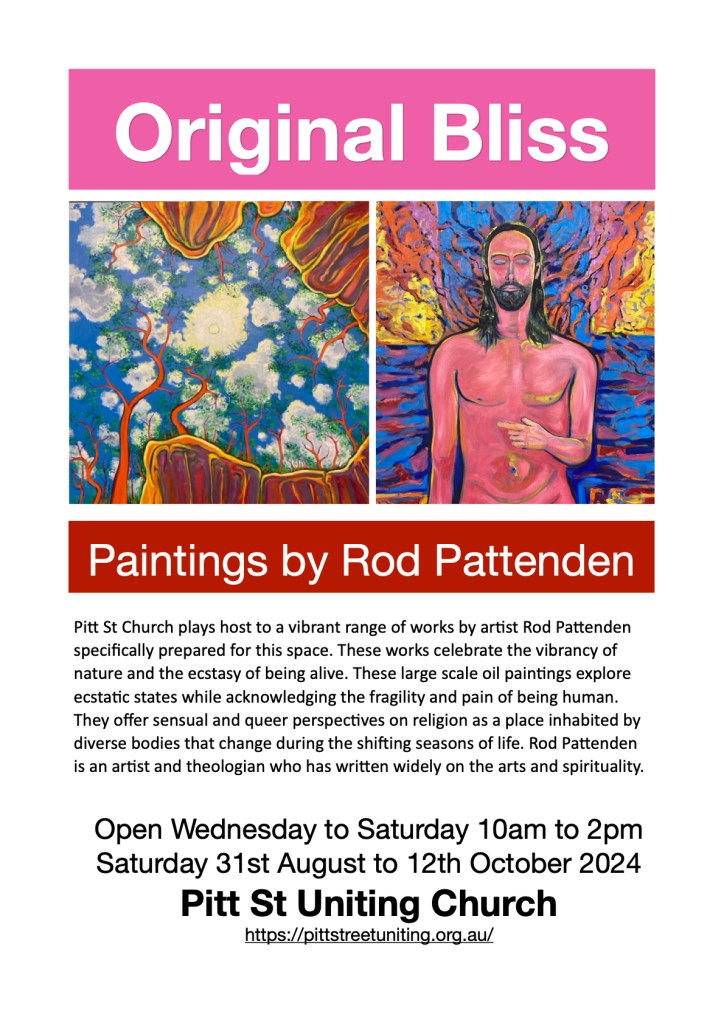
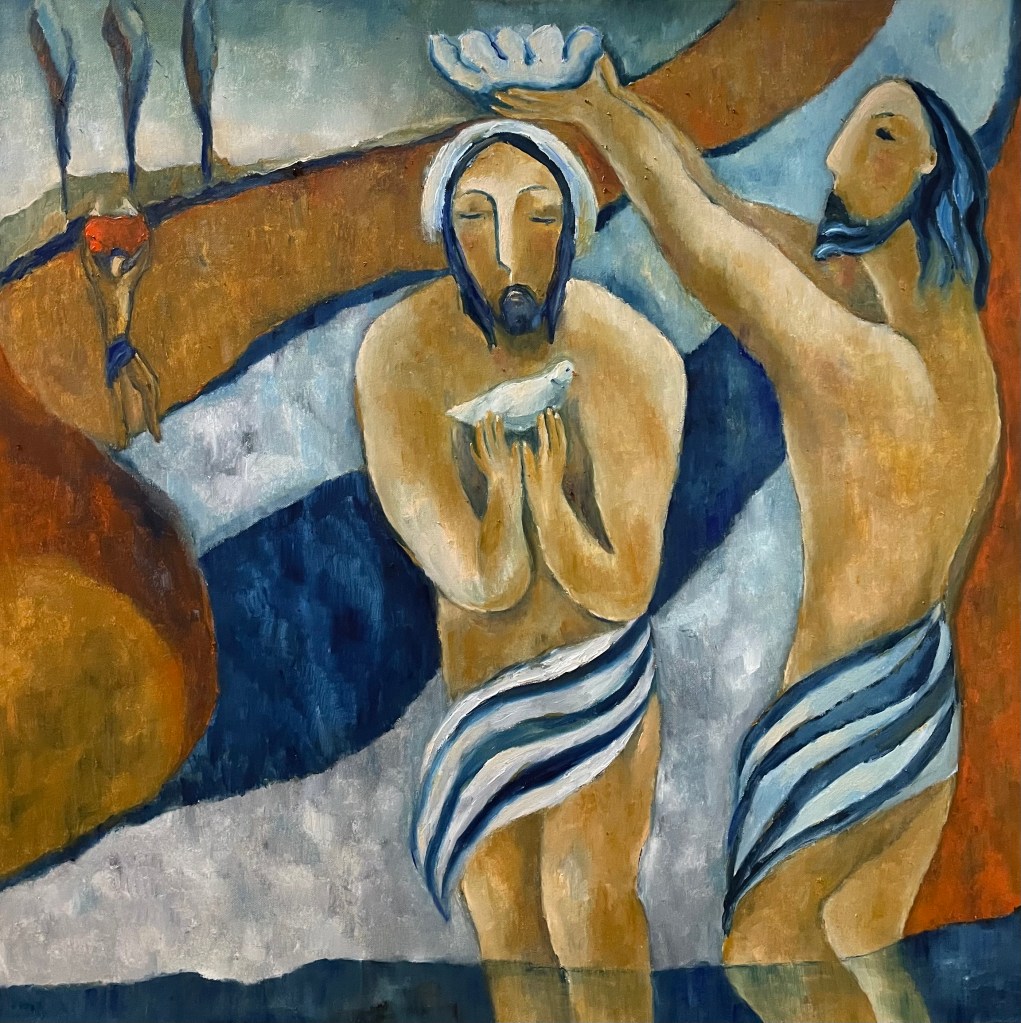
Original Bliss: Paintings by Rod Pattenden

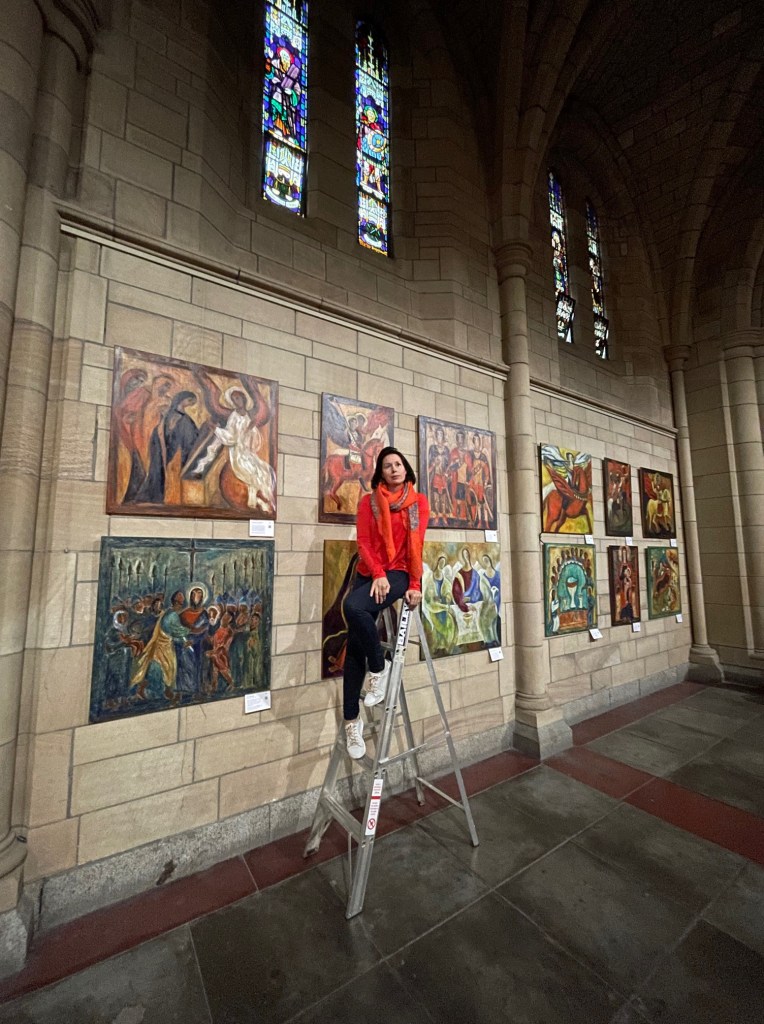
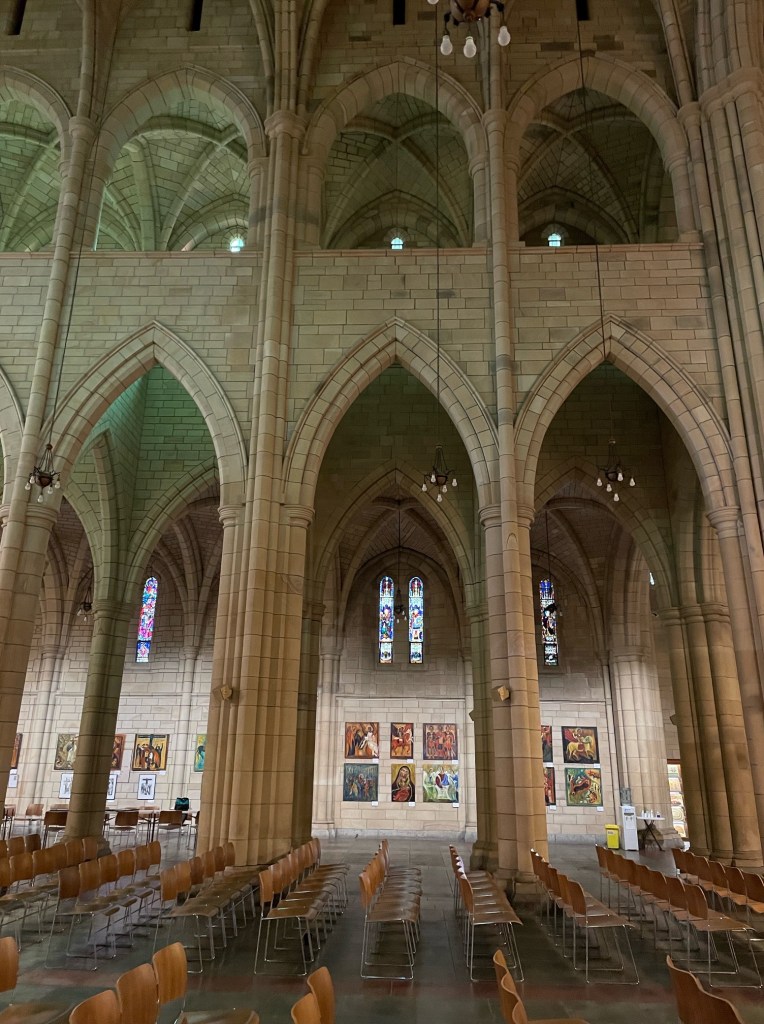
Sailing to Byzantium: an exhibition of work by Olga Bakhtina

Dates: 29 June – 13 August

Where: St John’s Anglican Cathedral, 373 Ann St, Brisbane City, Queensland

Opening: Thursday 11 July, 6.30–8.30pm. The opening night will feature classical music performances by Amalia Safonov (vocalist and flautist) and Artemii Safonov (pianist and composer).

RSVP: 0410 197 946

Sailing to Byzantium is an exhibition that blends the sacred art of the Early Renaissance and Byzantine periods with themes from William Butler Yeats’ poem. Hosted at historic St John’s Anglican Cathedral in Brisbane, this collection of recent paintings and sketches invites you on a journey through faith, history, and artistic expression. 

The exhibition’s title comes from W. B. Yeats’ poem, ‘Sailing to Byzantium’, which speaks of the quest for eternal beauty and spiritual transcendence. In the poem, Byzantium symbolizes an ideal world of artistic and intellectual perfection, a place where the soul finds peace beyond the physical. This idea connects deeply with the spiritual essence of early Christian art, where every detail holds profound religious meaning. 

As someone who has been studying the history of art extensively, I am captivated by the intricate, aspiring abstract designs and joyful colours of this historical period. The luminous golds, vibrant blues, and rich reds are not just decorative but symbolize divine light and the heavenly realm. Each piece in this exhibition is a modern tribute to the craftsmanship and spiritual depth of ancient iconographers and Renaissance masters, aiming to inspire faith and devotion. 

Through this collection, I hope to bridge the past and present and invite you to reflect on the enduring power of sacred art. By reimagining these traditional motifs, I aim to create a dialogue between the ancient and the modern, much like Yeats’ poetic journey to Byzantium. 

The exhibition invites you to embark on your own voyage of discovery and contemplation. I hope you will enjoy it! 

If you’d like to know more about my Christianity-inspired paintings, check out this article.

℘℘℘℘

OLGA BAKHTINA IS AN ARTIST WHO LIVES AND PAINTS ON JAGERA AND TURBAL COUNTRY.

Icon Exhibition

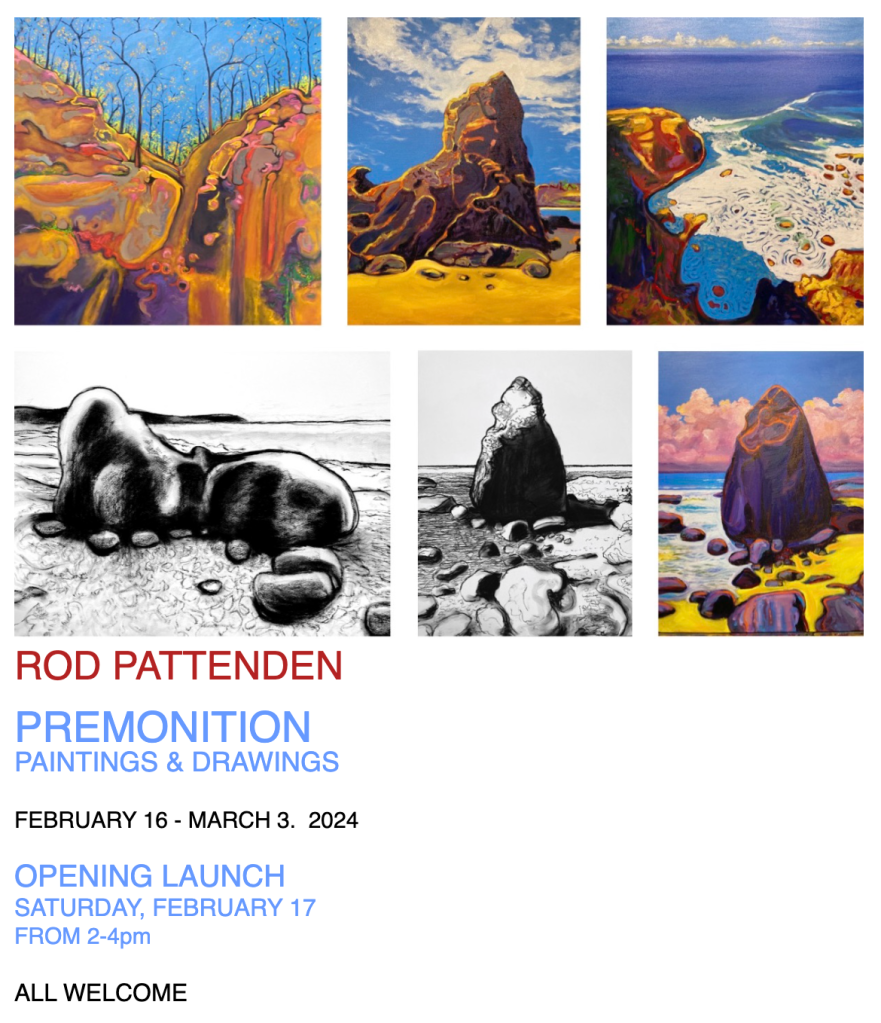
Premonition: Paintings and Drawings

Join us for the Opening Launch of Premonition, by Rod Pattenden on Saturday 17 February, from 2 pm.

This is Rod Pattenden’s second solo exhibition at ASW and promises to be another celebration of sensuous colour and form. Pattenden describes this new body of work as:

New paintings and drawings with a vivid presence and an uncertain future breaking in. Works in vibrant colour, small to large scale  with a range of stark large scale charcoal drawings.

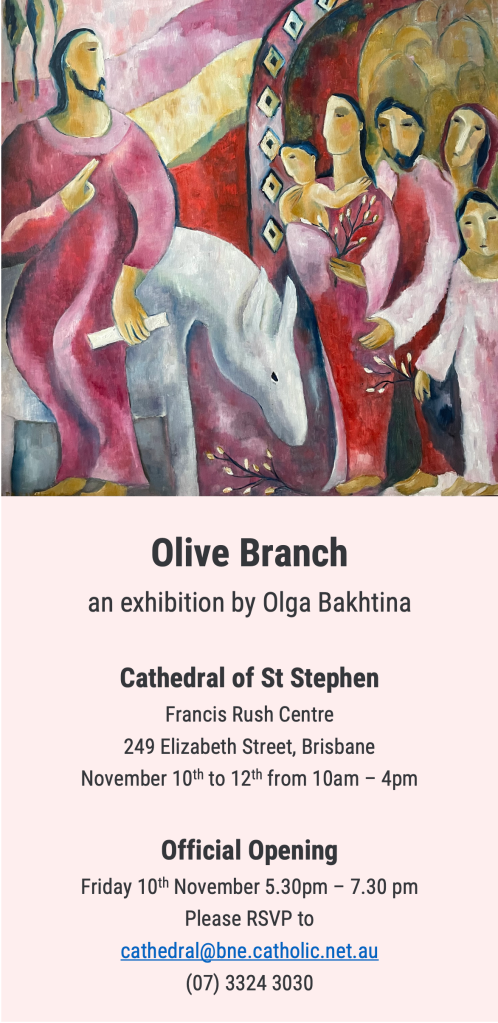
Olive Branch: An exhibition by Olga Bakhtina

Olga Bakhtina is a Queensland-based artist working in oil and charcoal. She studied painting 15 years ago in the Sultanate of Oman while living there with her family for 4 years. Currently, she studies the history of art at the University of Queensland. Olga has a passion for Early Renaissance art, in which she finds serenity and inspiration.

Since her first solo exhibition in 2012 in Oman, Olga has been exhibiting regularly across Australia. Her recent solo exhibition, ‘Good Samaritan and other Biblical Stories’, showed in St John’s Anglican Cathedral, Brisbane, in July 2023. Olga has been the finalist and winner of a number of Australian Art awards, including the COSSAG (Cathedral of Saint Stephen Art Group) Award in 2016 and 2018.

Olga’s artworks are in the collections of the Archdiocese of Brisbane, the Australian Catholic University, Rosebank College, and St Anselm Abbey, New Hampshire, USA. Her work also hangs in various private international collections.

Olga’s work has been published in various publications worldwide, most recently in The Double: Identity and Difference in Art since 1900 (National Gallery of Art, 2022).

In 2022, the Archdiocese of Brisbane created a video series titled Art Aficionados, in which Olga’s Good Samaritan painting featured:

Olga writes:

I’m often asked why I paint Bible scenes. There are several reasons, but the most important one is that my paintings are not just about the Bible. They are about humanity and what comes with it – the beautiful things in life, like love, unexpected kindness, devotion, and sacrifice. But humanity also brings pain and tragedy – betrayal, greed, cruelty, and war. Has anything really changed since the Bible was written? 

Nowadays it seems that the world is collapsing back to biblical times, as if there is a crack in civilisation. On one hand, there is humanism and advanced technologies, which Joshua, who stopped the sun in the Old Testament, did not dream of. On the other hand, there remains a lot of hate and barbarism, which sadly we continue to see around the world way too frequently. Sometimes, it feels like we’re flipping through the Bible and checking it with our reality.  

I think we can all relate to the biblical stories and lessons, in one way or another. The Bible has lots of answers. My biblical paintings are my attempts to find them, to process what is happening in the world, and in my own life. They are my prayers, too. Someone said that art is the highest form of hope.

Olga is having an exhibition as a part of the 150th Anniversary celebration programme of the Cathedral of St Stephen, in Brisbane. The exhibition opens this Friday evening. RSVP to cathedral@bne.catholic.net.au or (07) 3324 3030.

℘℘℘℘

Olga Bakhtina is an artist who lives and paints on Jagera and Turbal country.

What Comes to Light

Loud Sky is an exhibition of works by five artists who have responded to engagement with survivors of institutional child sexual abuse. This engagement has included direct conversations, the recounting of stories of survival, the sharing of treasured objects, and, in some cases, the direct involvement of survivors in the making of the final artwork. The lives of survivors are made visible and imprinted in and through the works commissioned especially for this exhibition. Loud Sky is a term borrowed in part from the Loud Fence movement, which began in Ballarat in 2016 and has now gone around the world, where ribbons have been tied on church fences as a form of memory making, protest, of visualising loss, and also a celebration of human life. Loud Sky seeks to visualise the story of those impacted in the Hunter Region, honouring their courage, resilience, and instincts for survival. Institutional child sexual abuse has had a profound and far-reaching impact on this region and has directly affected the lives of many thousands of people. This exhibition gives expression to these human stories, giving them a voice and a form of visual presence. Despite the horror of abuse, these works visualise courage, containing elements of profound and great beauty.

Clare Weeks, notes to self, #07, #08, #09, #11, #13, #14, #19, #23, 2023. Digital inkjet print from scanned silver gelatin photographs, 79.5 x 59.5 cm each panel. Photograph by Ben Adams.

This sense of imprinting is found in the strategy developed by Clare Weeks, where she invited survivors to take a sheet of plain paper and imagine themselves writing a word that expresses their sense of resilience and hope. She invited respondents to fold or crease this paper into an enfolded form. Each of these was then documented through a process of numbering, unfolding, and photographing their surface and then refolding them to their original condition. Each scanned surface reveals unique, idiosyncratic, and textured features. Thirty-two members of the survivor community responded to this invitation, and each is treated with reverence and importance as objects that contain memories of great significance. They each carry a fragile delicacy and beauty. Each fold is unique and particular. This record of the physical process of remembering reminds us of the manner in which we fold up what is most precious to us. We carefully enfold our hopes as precious possessions, keeping them safe, tucked neatly below our rib cage. Clare Weeks draws attention to the manner in which human memories are transferred to objects, things we hold dear that become relics or tokens of hope that empower a sense of resilience. These are delicate and beautiful objects that reveal, as through a veil, a remarkable expression of hope.

Damien Linnane, Bob (dominos), 2022. Graphite on paper, 420 x 297 cm. Photograph by Ben Adams.

Objects that serve as vessels for memory are evidenced in an even more distilled form through the eloquently rendered drawings of Damien Linnane. Inviting survivors to share a treasured object, the artist calls for our sympathetic engagement with objects that carry a form of empowerment that aids survival. These are objects alive with resonant significance that amplify human hopes, ambitions, and pleasure. They represent relationships of love, playfulness and achievement. These are objects of power. When so much else has been taken away from survivors in their childhood, these objects operate as rudders for hope to be touched, held, and found in the present moment as a tangible form of resilience. Linnane’s drawing technique gives these objects a striking visual presence as each surface is delicately observed so that the light seems to emanate from within. These are lovingly rendered, and we sense the delight, interest, and commitment of the artist as we follow with our own eye each mark and gesture that gives life and presence to otherwise inanimate objects – these things that are alive with memory. It is a privilege for the viewer to be given intimate access to this treasured relic and its capacity for hope.

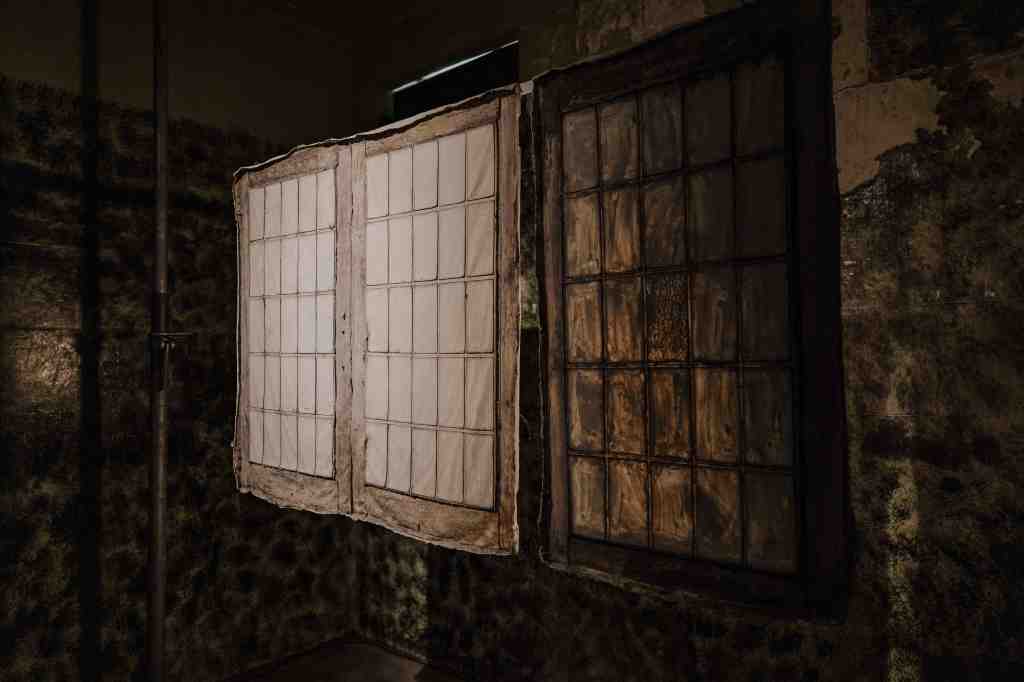
Fiona Lee, Why Bother?, 2023. Latex and acrylic paint, 98 x 167 cm. Photograph by Ben Adams.

Fiona Lee’s work presents the softly lit form of three casement windows. The viewer is placed in a stance of both looking out and looking in. This is a space of hovering decision-making about where to focus one’s attention. The particular form of the work came as a response to a question the artist asked survivors about what motivated them to begin their day, which more deeply frames questions about life’s purpose, and finding the energy for action. Honest, straightforward answers included the choice to stay in bed, or to reach towards relationships of love, or the mundane responsibilities that accompany being in community. The material of the window is a latex mould. It is like a skin, or a print, of a lead-lined casement window. It materialises the question we face at the beginning of every day – every plan, every hope, and every action – of whether it will be worth the effort to engage this day, this opportunity. To open this window involves risk, the potential for change and loss, and also the fresh air of new possibilities. Every window has this quality of beckoning the imagination. Their frames of tight geometry play out a matrix of fear and expectations, or they provide escape, freedom, or hope without restraint. This particular window holds us in the moment of decision-making, with the question of where this day might lead.

Peter Gardiner, The Fire, 2023. Oil on 300gsm Arches paper, 250 x 550 cm. Photograph by Ben Adams.

Peter Gardiner brings us into the searing presence of light and heat. The fire is a metaphor for danger and catastrophe that appears out of the darkness with the lighting of one match. This is the wildfires ignited by the Royal Commission that resulted in over 8,000 recorded testimonies of institutional abuse. There was smoke, as things were rumoured, that now appear in the light for all to see. However, the full force of this grand scene is held in check. We can observe the impact of the fire from a safe distance and begin to see that within the fire, there is the possibility of survival, renewal, and a new order of things. Fire not only destroys; it also brings new life to the environment; it purifies, transforms, and renews; it turns from red into gold. Gardiner’s work carries both horror and hope. We are in the presence of some immense catastrophe that will change how we live well into the future so that this does not happen again. It is an active vigilance towards justice that arises from a community having been confronted with the truth. No longer is there a tolerance for darkness, as there can only be light, even if it threatens to burn.

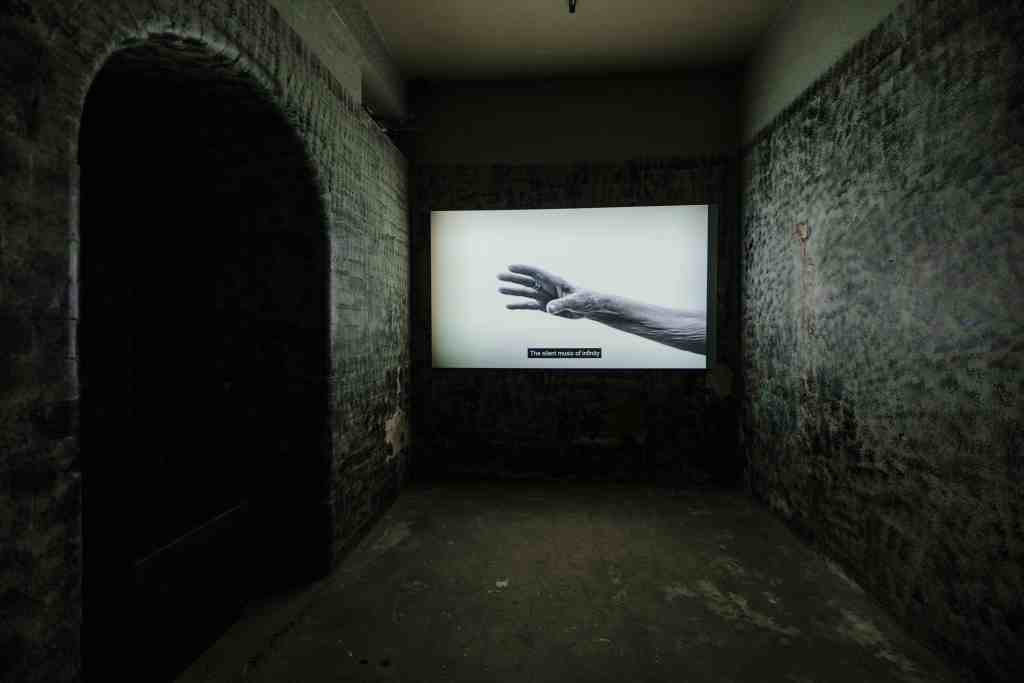
Lottie Consalvo, Silent Film, 2023. Single-channel video, 4 min 1 sec. Photograph by Ben Adams.

Lottie Consalvo’s work is a collaboration with a survivor, and his wife, around the question of what has sustained their lives. It offers a meditative exploration through silence and slow-moving gestural forms. The video-based work carries a grainy texture like paint, slowing our looking towards a more considered and contemplative place. We are in the presence of a human life, but one where each gesture becomes magnificent, primal, and beautiful. There are passages where an arm reaches out in ritual-like action, perhaps reaching for something, and then, at other times, a gesture of letting go. Without a narrative structure, the viewer has to put together this work in their own imagination as we follow the subtle shifts of gesture and the phrases of text that evoke states of silence. The artist invites us to be present as viewers of the simple beauty of silence at the heart of human existence. This is the invitation to be still and to be quiet, to have nothing, and to have everything, all at the same time. This is a space beyond fear, manipulation, and anxiety, where a human being might thrive in and through the small gestures of living. This is finding a life worth living and being grateful for that because it is enough. The silence of this work speaks with eloquence. It amplifies the beauty of being human.

This exhibition includes a timeline that lays out the history of the emerging public awareness of the abuse as well as television footage of these events as they unfolded. Words by family members of survivors that record the impact on their lives are also included, as well as a series of school photos of victims, not all of whom have survived. Against this dark and difficult reality, the work of the five artists commissioned for this exhibition offers something tangibly beautiful about the nature of being human. What comes to light is the courage and resilience of victims and survivors.

Christ Church Anglican Cathedral Newcastle installation view, ribbon flowers and bamboo. Photograph by Ben Adams.

A final expression of the exhibition’s aims was the installation of around 7,000 ribbon flowers on the grounds of both the Catholic and Anglican Cathedrals in Newcastle. Made by survivors, friends and family, and community and church members, they are an act of remembering victims and survivors. They express a desire for truth-telling and community healing. Art provides the resources to approach experiences of horror and disintegration in a manner that brings deeper understanding, shared compassion, and the possibility of a more hopeful future.

Loud Sky is on exhibition at The Lock Up Contemporary Art Space in Newcastle until 21 May.

℘℘℘℘

REV DR ROD PATTENDEN IS AN ART HISTORIAN AND THEOLOGIAN FROM AUSTRALIA. HE HAS WRITTEN WIDELY ON THE ARTS AND CREATIVITY. HE LIVES AND WORKS ON AWABAKAL LAND.

Being Among Trees

When words fail me, being in the studio helps me make sense of the world.

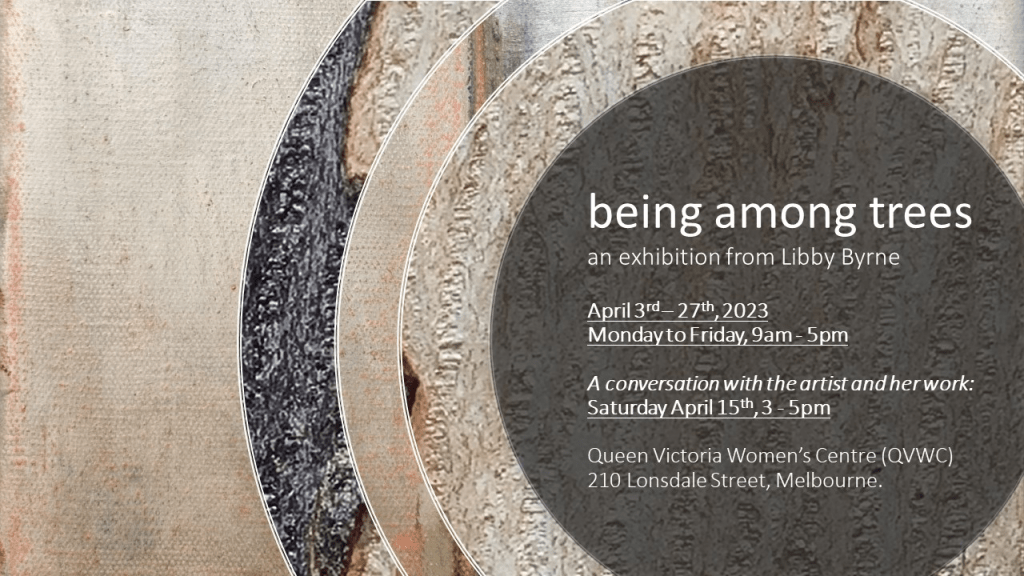
This new body of work emerges from several years of attending more deeply to the life of the trees that surround and companion me every day. For many years, I have walked routinely along a path that follows a local creek, appreciating how the trees continue to hold space for me. Even as the weather changes and shapes them, we both endure. But in late 2021, I watched my neighbour excavating the land nearby and, by doing so, undermining the existence of a healthy gum tree. As the roots of this tree were laid bare, I went into the studio to paint the grief that I felt and understand the depth of my response to the inevitable loss of this tree.

It seems that in choosing to live among trees, we live within a nexus of risk and power. In being among the trees surrounding my studio as I make this work, I am becoming more deeply aware of the interdependence that shapes our life with trees. Trees welcome the CO2 that I cannot bear and, in turn, offer me life in the form of oxygen. As I learn to see how trees live interdependently with one another, I see a healthy exchange between risk and power, shaping how I can choose to live with others. I am learning to see trees in the way I see people, and I am wondering what it is like to be a being among trees.

Over the past year or so, I have been working towards developing a new exhibition set to be hung in April 2023.

Being Among Trees will hang in the Queen Victoria Women’s Centre between 3–27 April. Rather than an opening night, I have scheduled an afternoon for a conversation with the artwork and me. Further details are below:

℘℘℘℘

LIBBY BYRNE LIVES WORKS AND PLAYS OF WURUNDJERI LAND. SHE WORKS AS AN ARTIST, ART THERAPIST, AND THEOLOGIAN FOLLOWING THE INVITATION AND DISCOVERY OF ART INTO NEW WAYS OF BEING WITH PEOPLE IN LIMINAL SPACES. WITHIN HER STUDIO PRACTICE LIBBY WORKS WITH IDEAS, IMAGES, AND EXPERIENCES TO EXTEND THE WAY WE THINK, PERCEIVE, AND RESPOND TO QUESTIONS OF MEANING AND EXISTENCE.

Rituals of Embodied Knowing

Sarah Tomasetti, Rivus (detail). Fresco, pigment, muslin, and encaustic wax. From the Birrarungbanner series, 2022–23. Photo: Emma Byrnes.

The exhibition Rituals of Embodied Knowing brings together ten established artists with diverse forms of practice that engage plants, video, sound, movement, painting, drawing, and installation. These artists have been working together with an academic group on the project ‘Spiritual Understanding in a Secular Age: Engaging Art as Religious Ritual’, funded by the Templeton Religion Trust.

The project conceptualises art-making as a form of knowledge or understanding that aims to make contact with various aspects of reality such as the natural world, human history, and our individual selves, thus considering how art-making practices in a secular context might, when seen in this way, share similarities with religious ritual.

Academics from a variety of fields such as history, anthropology, psychology, sociology and theology, have identified how key dimensions of each of these practices – movement, time, media, subtraction, invention, and attention – are also leveraged in religious rituals to make contact with reality.

The project calls on us to see art-making in a new way, and has also challenged academics to see aspects of reality in new ways through engaging art-making itself as a means of knowing and understanding. This exhibition invites viewers to consider whether and how the works included could be thought about as ritual-like in their unique ways of employing embodied experience.

This exhibition also launches the new CBONE Gallery, combining the previous Eastgate Gallery and Chapman and Bailey project space into one entity that will show a range of contemporary visual art.

Joining the project artists, Heather Hesterman, Adam Lee, Louise Weaver, Dominic Redfern, Harry Nankin, Chris Bond, Peter Ellis, Mark Newbound, Live Particle, and Sarah Tomasetti, are Yolngu artist Djirrirra Wunnumarra and emerging artist Uma Christensen.

An edited volume of essays emerging from the project will be published in 2024.

Exhibition Dates: 18 February – 18 March 2023.

Where: CBONE Gallery, 1C Marine Parade, Abbotsford, Melbourne.

Live Particle (Angela Clarke and Camilla Maling) will be presenting a series of Soma Scores using their unique sensory objects to generate embodied experience on Saturday 11 March.

There will be a discussion panel and closing event on Saturday 18 March.

Wes Campbell: Disturbing Illusions of Peace

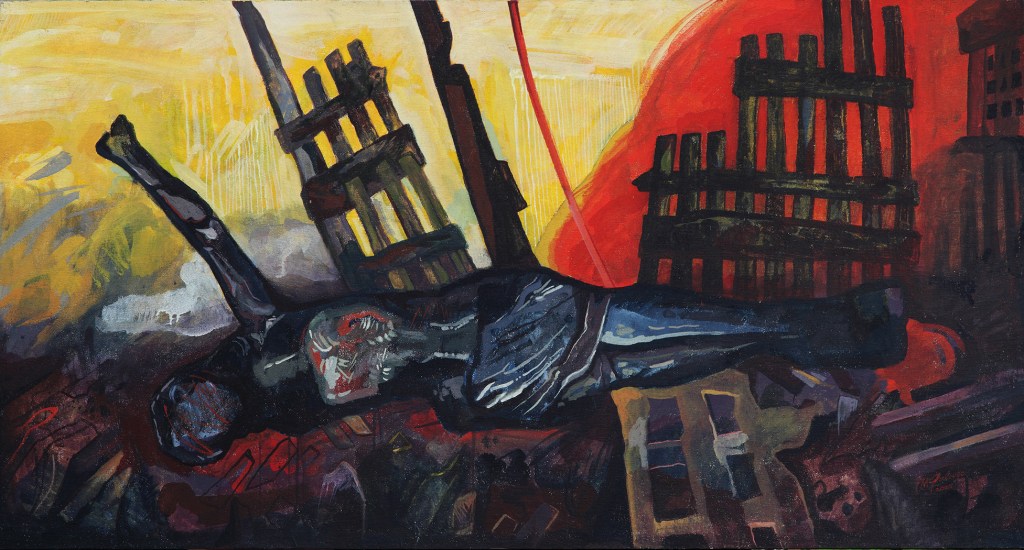
Wes Campbell, Silence II, nd.

Last month, Jason Goroncy spoke at the opening of an exhibition of Wes Campbell’s artwork. Wes is a theologian, artist, and (retired) Minister of the Word in the Uniting Church in Australia. An edited version of his talk is now available on the ABC’s Religion and Ethics portal.