The monumental icon of the Last Judgement, written by Michael Galovic, is a visually commanding work containing multiple iconographic references and subsidiary scenes. It can be approached in manifold ways. I suggest that the most fruitful approach is to interpret it within its religious, scriptural, and liturgical context.
In Australia and New Zealand, we have little experience of Last Judgement scenes. If anything, our art and preaching have downplayed the apocalyptic, the judgemental, and the punitive. The mediaeval West and the Russian East produced great frescoes and icons on this theme from the thirteenth to the seventeenth century. Michelangelo’s enormous fresco above the altar in the Sistine Chapel and Giotto’s fresco above the altar in the Arena Chapel are among the best-known examples today. Perhaps one reason such works are rarely produced today is the sheer scope and difficulty of their creation, which requires decades of prior experience.
Context is especially important to interpretation, and the settings of these two famous Last Judgement scenes suggest the liturgical and architectural context Galovic would have envisaged for his artwork.
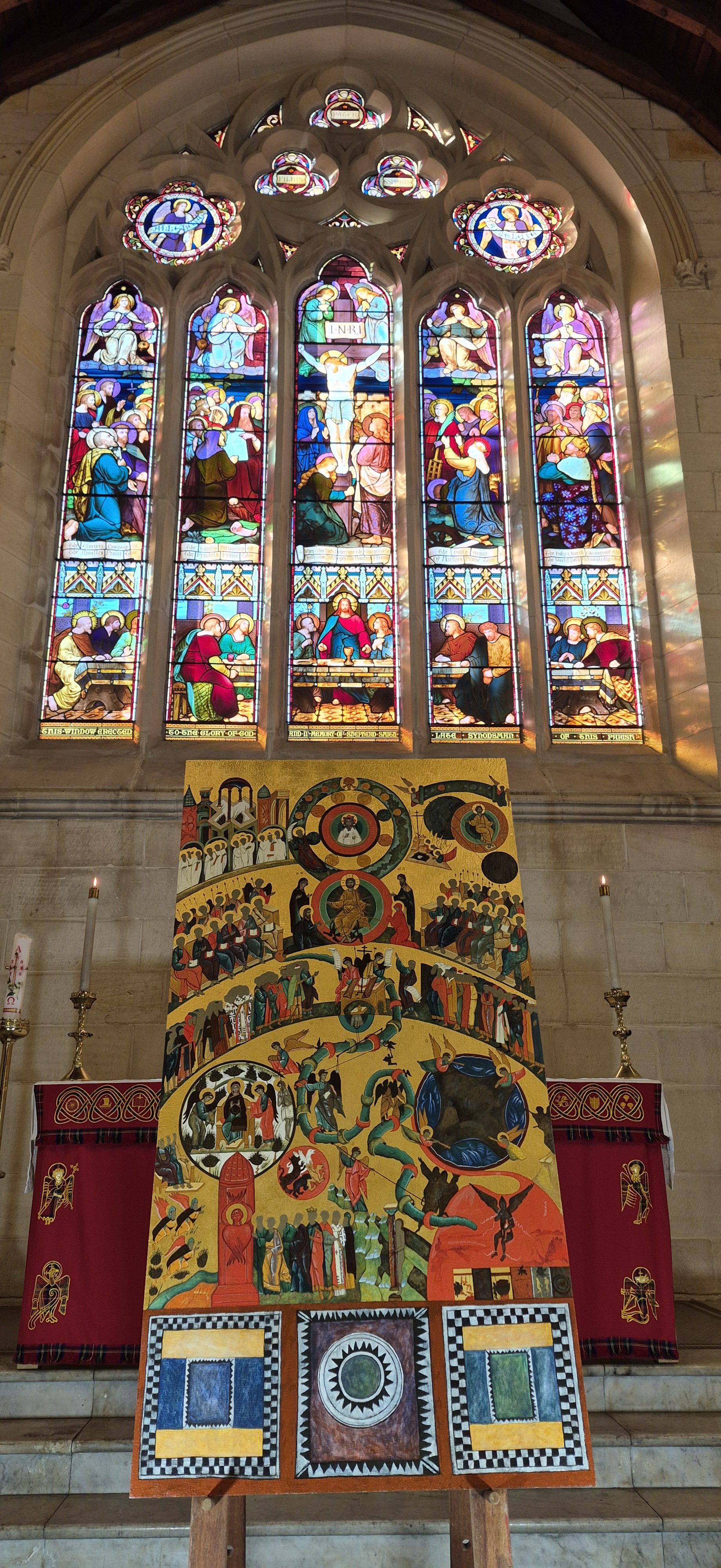
Last Judgement scenes were commonly monumental images in churches, especially on entrance walls, façades, and vaults, though they also appeared in altarpieces and portable icons. Galovic appears to have conceived his monumental icon as an altarpiece. His work is 150 × 80 cm, and despite being a portable panel, it retains the monumental logic of a church wall. This helps explain why it contains so many otherwise independent iconographic subjects.
An altarpiece is a painted or sculpted work designed to stand on or behind an altar and to provide its principal visual and devotional focus. Looking at Galovic’s icon, I imagine it positioned before a congregation celebrating the Eucharist, particularly during the elevation of the host in the Eucharistic Prayer. The ecclesial Body of Christ, the congregation, stands before the priest as the priest repeats the words of Jesus, ‘This is my body’, all focusing on the real presence of Christ in the Eucharist. Behind the host, the icon, through its recurring circular motif, echoes and interprets that presence.
The congregation would encounter the icon repeatedly within the celebration of the Eucharist. They would be drawn into its complexity and gain different insights from every encounter. The icon would be present in liturgical time, within the cycle of the church’s celebration of feasts, telling a different story in Eastertide from that told in Ordinary Time. The believer contemplating the icon would come from daily life but would be invited to contemplate eternity.
In the Lord’s Prayer, Christians pray for ‘our daily bread’ and often understand this as a petition for what we need for the day at hand. However, biblical scholars have long puzzled over the Greek word usually translated as ‘daily’ in that prayer in the Gospels of Matthew and Luke: epiousios. The interpretive difficulty is that the word is extraordinarily rare; it occurs only in these passages and in the version of the Lord’s Prayer found in the Didache.
The three major interpretations are:
- the bread we need now;
- the Bread of Life;
- the bread of the Day that is coming.
Galovic’s icon can be read as an elaboration of the third interpretation. He presents visually the meaning and significance of the Day that is coming, the Day of Judgement, with particular focus on the end-time Judge.
The sun and moon were created on the fourth day of creation (Gen. 1.14–19). The prophet Isaiah describes what will happen when the Lord Yahweh delivers judgment: ‘The heavens shall be rolled up like a scroll and all their host shall wither away’ (Isa. 34.4a). The Book of Revelation takes up this imagery when the slain Lamb opens the sixth seal: ‘Then the sky disappeared as if it were a scroll being rolled up’ (Rev. 6.14a). Iconographers make this cosmic event visible by depicting angels rolling up the heavens, an element that appears in the upper-right corner of Galovic’s icon. By portraying the sun, moon, and stars on the scroll itself, Galovic connects this scene with the signs of the coming of the Son of Man. As St Luke writes:
There will be signs in the sun, the moon, and the stars and on the earth distress among nations confused by the roaring of the sea and the waves. People will faint from fear and foreboding of what is coming upon the world, for the powers of the heavens will be shaken. Then they will see ‘the Son of Man coming in a cloud’ with power and great glory. (21.25–27)
Beneath the scroll being rolled up, we see Christ coming from heaven in glory. Behind him are angels who fight on his behalf and gather his faithful from the ends of the earth.
A small Calvary scene reminds us that the sun and moon went dark at the death of the Lord (Matt. 27.45).
In the upper-left corner of the icon is the heavenly Jerusalem, with the white-robed martyrs and angels at each gate (cf. Rev. 21.10–12).
At the upper centre of the icon is a figure, also in white garments, representing God the Father depicted as the Ancient of Days, creating the universe and revealing himself through the prophets. The box at the very top may perhaps represent the Ark of the Covenant.
This imagery again refers to Old Testament prophecy and apocalyptic tradition. Daniel 7 recounts the vision of the four beasts, or four doomed kingdoms: a winged lion, a bear, a four-headed, four-winged leopard, and a terrifying fourth beast. These monstrous political powers arise from evil but will collapse before the coming of the kingdom of God. They are shown in a red circle in the lower-left portion of Galovic’s icon.
The key passage is Daniel 7.13–14:
As I watched in the night visions, I saw one like a human being coming with the clouds of heaven. And he came to the Ancient One and was presented before him. To him was given dominion and glory and kingship, that all peoples, nations, and languages should serve him. His dominion is an everlasting dominion that shall not pass away, and his kingship is one that shall never be destroyed.
In the Gospels, Jesus often refers to himself as the ‘Son of Man’, an enigmatic title that may initially appear modest. Yet according to the Gospel of Matthew, Jesus declares:
When the Son of Man comes in his glory and all the angels with him, then he will sit on the throne of his glory. All the nations will be gathered before him, and he will separate people one from another as a shepherd separates the sheep from the goats … (25.31–32)
The enthroned Christ appears in the great central red mandorla. The cherubim and rainbow throne are alluded to. The Lord, arrayed in gold and shining with glory, gazes out at us and all creation. The letters in the cruciform halo affirm, ‘I am who am’: the existing one, the God revealed to Moses in the burning bush, and the Son who makes known the Father, making the invisible God visible. This is Christ as the Son of Man, come in judgement of the world.
Standing beside Christ and interceding for us are his mother, the God-bearer, and John the Baptist, the Forerunner. Kneeling below them are Adam and Eve, connecting us back to creation. On twelve thrones sit the twelve apostles, with the books of the Scriptures. An angelic army stands behind them.
Below him is the Prepared Throne (Hetoimasia), occupied by the cross and the book of the Gospels. These are the criteria by which we are to be judged. This recalls the Matthew 25 text about feeding, welcoming, and visiting: when you did it, ‘You did it to me’. The criterion is astonishingly christological. Saints, patriarchs, kings, and scriptural authors stand on either side. Below the throne is the hand of God the Father, holding the balance beam on which the souls of humanity are weighed under the direction of the Archangel Michael.
Then there is the path of disintegration, linked by the ‘serpent of tribulations’. The head of the serpent bites at Adam’s heel (cf. Gen. 3.15), and the serpent winds a crooked path through the lower part of the image, coiling and looping back on itself, with its tail in the fires of hell.
In a circle on the right, as angels blow trumpets to summon all creation, the sea gives up its dead. As the Book of Revelation puts it:
And I saw the dead, great and small, standing before the throne, and books were opened. Also another book was opened, the book of life. And the dead were judged according to their works, as recorded in the books. And the sea gave up the dead who were in it, Death and Hades gave up the dead who were in them, and all were judged according to what they had done. Then Death and Hades were thrown into the lake of fire. This is the second death, the lake of fire, and anyone whose name was not found written in the book of life was thrown into the lake of fire. (20.12–15)
The pool of fire appears at the bottom right, with panels representing the torments of the damned. Satan, in chains, is enthroned here with Judas in his lap. Judas is identifiable by the bag of silver he holds. Damnation is as christological as is salvation. Judgement is determined by one’s relationship with Jesus. Christian art has given Judas a prominent place in hell because of what Jesus said at the Last Supper:
For the Son of Man goes as it is written of him, but woe to that one by whom the Son of Man is betrayed! It would have been better for that one not to have been born. (Mark 14.21)
Galovic does not overemphasise hell in his Judgement scene. Heaven receives considerably greater attention. A cherub guards the gate of paradise, at which there is a queue to enter. The three holy patriarchs, Abraham, Isaac, and Jacob, are enthroned together on the left. Heaven itself is shown as an enclosed garden, with Mary, the mother of Jesus, enthroned in the centre.
She is the holiest representative of humanity; by contrast, one who might be considered among the least holy is also present. The figure with a cross to her right is the Good Thief from Calvary, of whom Jesus said, ‘This day you will be with me in paradise’ (Luke 23.43).
This concern for a merciful judgement is echoed by Galovic’s inclusion of an element from Russian legend – the milostivyi bludnik, the ‘charitable adulterer’, the naked man tied to a pillar between heaven and hell. The story comes from the Prologue, a Slavonic collection of saints’ lives and edifying readings. The entry for 12 August contains a tale concerning a wealthy man who practised remarkable generosity toward the poor but persisted unrepentantly in sexual immorality.
After the man’s sudden death, there was uncertainty about his fate. According to the story, Patriarch Germanus ordered that prayers be offered so that God might disclose what had become of him. A hermit was granted a vision:
I spent the whole night in prayer, and I saw a certain place. On the right was Paradise, filled with indescribable blessings; on the left was a lake of fire, whose flame rose as high as the clouds. And between blessed Paradise and the terrible flame, the dead man stood bound, groaning grievously. He frequently looked towards Paradise and wept bitterly. And I saw a radiant angel approach him and say: ‘Why do you groan in vain, O man? Behold, because of your almsgiving you have been delivered from torment; but because you did not abandon your shameful adultery, you have been deprived of blessed Paradise’.
Dogmatic theology allows for no eternal state other than heaven or hell, but Galovic and the Russian icon tradition challenge us to consider the mixed state of the human soul. None of us is entirely good or entirely evil. Only the Almighty’s wisdom can sort the wheat from the chaff.
The congregation that worships in the presence of this icon can draw innumerable lessons from it. Its members will be reminded of the deeds and teachings of the Son of Man and of his concern for all creation. Each time they gaze upon this icon, they might even taste eternity.
℘℘℘℘
Mervyn Duffy is the current Provincial of the New Zealand Province of the Society of Mary. Before being elected to that position, he was Dean and Lecturer in Theology at Te Kupenga Catholic Theological College in Auckland.


