Articles

Lost Time: Dementia, Theology, and the Arts

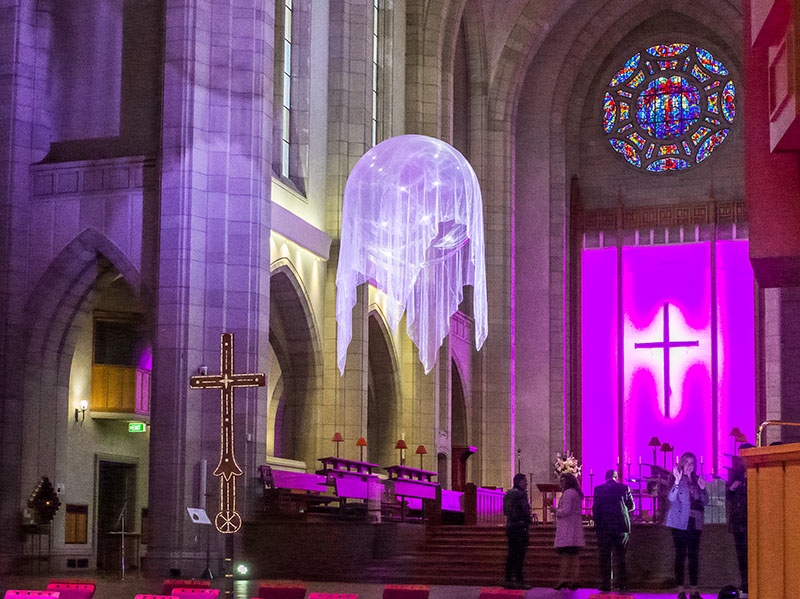
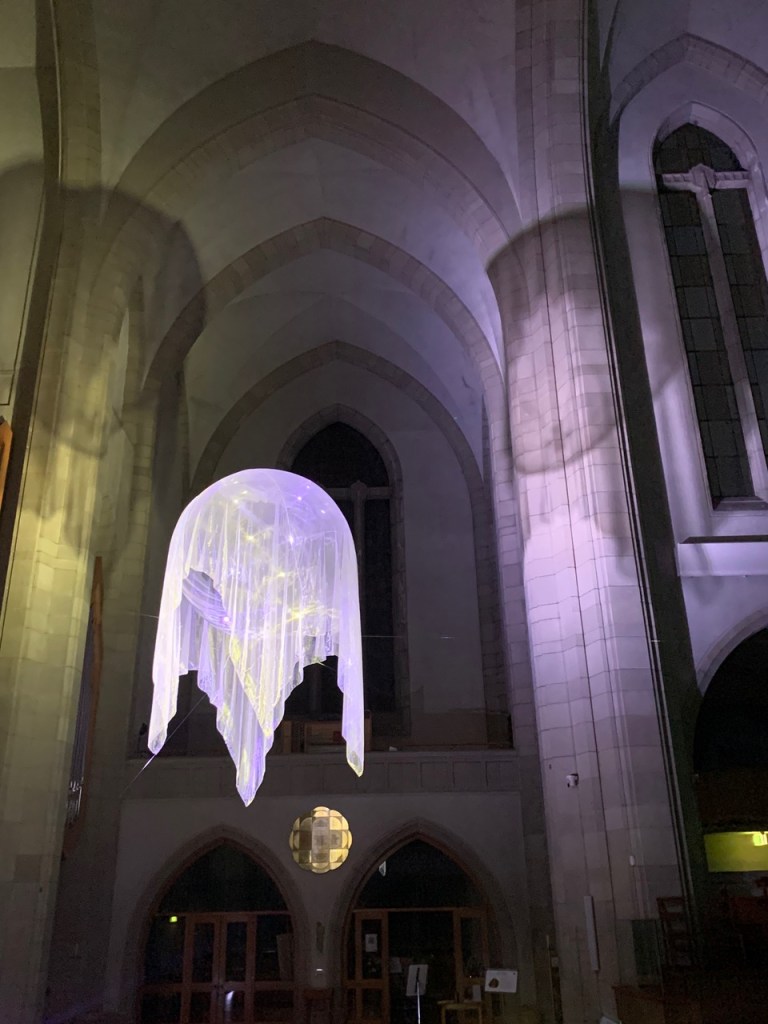
Alexandra Banks, Lost Time, 2020. Drafting paper, wool, soldering wire, 110 x 60 x 15 cm.

Looking at Lost Time, it might not be immediately clear what this object is or how to read it. The deliberately evasive title doesn’t help the viewer very much either. Nevertheless, the sculptures form and wearability captivate the imagination. This fragile object with its volumetric complexities of transitional shapes and spaces, the varying levels of translucency, and the repetition of the origami balloons have come together in this form to solidify a theme that has been present and growing in my work for a number of years. However, this artwork came about almost by accident. I was asked as a last-minute inclusion to participate in an exhibition. This show was held in a textile gallery and the exhibitions theme centred on the question: What are the hopes and aspirations we carry on our shoulders as vulnerable and compassionate human beings? Having recently returned from a conference focused on anamnesis and liturgy, I was interested in creating a work that integrated a clerical stole, dementia, and community. This exhibition gave me the opportunity to materially explore memory.

When one looks at the public perception of dementia it is profoundly negative, it has become a highly stigmatised illness. As a result of this negative perception people today are more afraid of developing dementia than cancer. The consequence of stigmatising an illness is it reduces people to labels, ideas, and abstract bodies. There is an inherent violence associated with stigmatisation. In relation to dementia the violence is subtle. There is an element of dehumanisation and detachment as the individual slowly becomes the label of their illness. Another social outcome for the person with a clinical diagnosis of dementia is they may become the misunderstood and scary villain to their close acquaintances. It is not uncommon for friends and family members to drift away from the person, stating: ‘I’d rather remember her the way she was’. As such, in the hypercognitive western society, where intellect and reason are prized over love and relational connections, the fear of loss of cognition drives our response to dementia.

It is this communal response to dementia that I wished to explore in Lost Time, in addition to how the community can reframe their response to the deep-seeded fear that is fuelled by the threat of losing one’s autobiographical self. The question is, therefore, who holds our memories? According to John Swinton, a theologian working in the field of disability and dementia, the memory problem is not with the person who has dementia but with their community. Swinton claims that a person cannot remember who they are without the help of others, as such identity is formed and given by the community that they inhabit. It is the identity given by one’s community that is the most fragile and vulnerable, as it is out of our direct control. As such you can lose yourself and your sense of belonging if your community loses connection with you and struggles to identify who you are becoming. What does this mean theologically in a community of faith when a person may be losing their cognitive agency and are facing increasing limitations?

Deborah Creamer, a disability theologian, makes the case for the application of embodiment theologies to be applied to people who are ‘differently-abled’. I would maintain that someone with dementia is ‘differently-abled’. Embodiment theologies argue that when we reflect theologically, we inevitably do it as our embodied selves, for our bodies influence our theological perspectives, as it is through our bodies that we experience and relate to God. It is the experiential aspect of embodiment theologies that led me to consider the notion of how body language, gestures, and touch can, for people with dementia draw seemingly lost memories into the present. I wanted to disrupt the assumption that all memory is linked to cognitive recall but can be experienced through our bodies with the aid of our community. How then does one depict embodied theologies, dementia and community visually?

Alexandra Banks, Lost Time, 2020. Drafting paper, wool, soldering wire, 110 x 60 x 15 cm.

In the work Lost Time, the materials of translucent paper and wool, in conjunction with the sculpture’s wearability, present the viewer with a visual metaphor of an embodied theological response to dementia. The translucent paper folded into origami water balloons functions symbolically on a number of levels. Firstly, the process of making origami balloons requires the creator to spend time preparing the paper square, pre-folding the creases, tucking the corners into the little pockets, and blowing into the deflated balloon to expand it to its final shape. This method of manipulating paper brings to mind the process of making memories. The very considered and ritualistic way we construct and breathe life into what we understand as meaningful for our own identity creation. Secondly, the choice of translucent paper, not opaque or transparent paper, adds to the notion that memories are created through communal transmission. The translucent paper points to the communicative action required for others to remember us. Likewise, the use of wool an organic material to stitch all of the memory balloons together, replicates the role of our neurobiology in the form of brain synapses, and the physical processes of embodied remembering.

Alexandra Banks, Lost Time, 2020. Drafting paper, wool, soldering wire, 110 x 60 x 15 cm.

However, to fully depict how community can respond to the ongoing cocreation and the holding of memories, the sculpture needed to be worn. The fragility of the sculpture indicates the vulnerability of our memories, and the act of wearing another’s memories implies the responsibility and privilege it is to journey with someone who is navigating the emerging ‘differently-abled’ person. The human experience is an evolving reality, and none of us will avoid being touched by the changing nature of our own physical and cognitive abilities. The purpose of Lost Time is to challenge our own perceptions of how God, community and self relates to memory.

[A version of this piece appeared in The Cooperative]

℘℘℘℘

ALEXANDRA BANKS IS A PHD CANDIDATE IN THE FACULTY OF THEOLOGY AT ST FRANCIS’ THEOLOGICAL COLLEGE, CHARLES STURT UNIVERSITY.

Finding Breath: Art as Visual Ritual

Karly Michelle Edgar, A Shorter Morning and Evening Prayer, 2019. Pages from a printed prayer book, wax, and cotton. Artist’s collection.

The process of looking at art is not only a rational activity of the mind. Looking at images arouses deeper feelings and perceptions. Images sometimes get under our skin and seem to touch the life of our body, through memory, awareness, and desire. Images touch us, they want to be cradled, felt, and held against our fingers so we can feel their texture and physicality. There is a strong connection between seeing and touch. This haptic sense of touch links our fingertips and our eyes, when we describe sensations that arouse or invite our devotion, prayer, admiration, as well as provoke anxiety, horror, or even anger. Images touch us in ways that activate our tactile memory, reminding us that seeing is not just an abstract mental activity but one that resides in our existence as creatures with skins that record memory and anticipate hope.

This vocabulary of touch is clearly at work in the creation and the visual form of the work A Shorter Morning and Evening Prayer by Australian artist Karly Michelle Edgar. The work pictured here has been laid out on the white cloth of a communion table in a church. It has been created through the folding of pages from a small book of daily prayer. Each page has been folded in the same way through repetition, covered in wax, and then sewn together with bright red thread. As a viewer, we not only see but also feel the tactile process of making, with each gesture of folding, dipping, and sewing. Over and over again this work is formed through repeated gestures that remind us of the words on the pages of this prayer book, as it is turned by hand and the words on the page become breath across the reader’s lips. The repeated ritual of prayer becomes the fragile structures of wax pages curled to contain the uncontainable, the devotion, hope, and desire of the one who prays.

Karly Michelle Edgar, A Shorter Morning and Evening Prayer, 2019. Pages from a printed prayer book, wax, and cotton. Artist’s collection.

Karly Michelle Edgar suffers from fibromyalgia, a condition that has heightened her awareness of her own peripheral senses. She writes: ‘My life requires conscious management to survive and this has led me to a deep appreciation of ritual. Symbolic actions and rituals do not create sacred spaces but rather desire that our attention be directed towards the fact that we already live within one’. Through an artistic process, the artist has found a way of making art as well as expressing her spirituality as a ritual that supports the life of her own body. Her art-making has been a means of deeply engaging her own sense of embodiment as a place where she encounters the presence of God. In looking at this work, we see not only an object but a record of an activity over time. It is the record of a ritual that contains life in a form, conveying a sense of grace and support. Each page remains open, set in wax. It is a reminder of the way each prayer and turning of the page is like a container that holds time, a cup containing grace, giving all the time that is needed to take a full breath of life.

Karly Michelle Edgar, A Shorter Morning and Evening Prayer, 2019. Pages from a printed prayer book, wax, and cotton. Artist’s collection.

Having seen this work as it was situated on the communion or Eucharistic table, the aspect that remained in my memory was the random patterns made by the scarlet red cotton threads that edge each section and form the work into one long sinuous form. These vibrant fine lines reminded me of the capillary tubes that pump blood in and around our bodies, always pulsing to the rhythm of breathing and heart movement. This work activates such memories of human bodies here at the place where the body of Christ is remembered through Eucharistic practices. This work does not point to God being found in transcendence through an escape from the body to another realm. In contrast, this work invites viewers to find God in the life of their own body, in a gesture that is as close as their next breath. This work is therefore confronting in its intimate and incarnational nature. It is in our flesh, with all its unique particularity, that we might find the place where we will see God.

[A version of this piece appeared in Artway.]

℘℘℘℘

KARLY MICHELLE EDGAR IS A MIXED MEDIA ARTIST, TRAINED IN THEATRE, WITH AN MA IN CHURCH PRACTICE. SHE WAS FORMALLY THE LECTURER IN ART AT TABOR (VIC) AND IS CURRENTLY WORKING AS A LIFESTYLE ASSISTANT IN AN AGED CARE FACILITY. SHE ALSO LIVES WITH FIBROMYALGIA, WHICH EFFECTS LIFE IN VARYING DEGREES AT DIFFERENT TIMES. KARLY’S CREATIVE WORK FOCUSES ON THE NEED FOR REST, REPETITION, THE SEARCH FOR BEAUTY, AND CREATIVITY AS SPIRITUAL PRACTICE. KARLY LIVES ON WURUNDJERI LAND.
ROD PATTENDEN IS AN ARTIST, ART HISTORIAN, AND THEOLOGIAN INTERESTED IN THE POWER OF IMAGES. HE LIVES AND WORKS ON AWABAKAL LAND.

Communion, Covenant, and Creativity

Image

Art and meaning-making during the time of COVID-19

Aboriginal photographer Wayne Quilliam has created a new series of work in response to the Covid-19 crisis entitled 'Virus'
Wayne Quilliam, Virus, 2020. [Source: SBS]

During the first phase of lockdown, I managed to break my arm while trying to keep socially distanced on a busy footpath. It was a clean break to my forearm, just below the elbow – no splint, no surgery, no complications. I was lucky. Earlier this year, my GP tripped on a tree root and broke her elbow into multiple pieces. It involved surgery, a lot of metalware, and months of recuperation. Breaking your arm can mean a lot of different things.

Not long after my fall, I was walking with a friend and her three-year-old who was curious about my broken arm. Since we were in-situ out in the street, I demonstrated the tripping over and landing on my arm. I may have been more restrained if I’d realised that his parents would be watching their lad re-enact this for the next two weeks.

My friend sent me a one-minute video of her little boy in his scooter helmet telling the story three times over. Initially the narration is hesitant: ‘I walk along the road … And what happened?’ It gathers force as he demonstrates the moment of tripping, bumping his gumboots decisively at the gutter’s edge. Then, as if he is taking a bow, he bends at the waist and lowers his helmeted head gently to the asphalt footpath – this moment in the re-enactment lends a dignity to my stumbling face-plant. After the bow, the little fellow stands up and with a triumphant flourish extends his arm, pronouncing with great finality: ‘I broke my arm!’ He flinches and holds it close: ‘Ouch!’

I felt honoured that this three-year-old took hold of the story so strongly. The quality of his attention was mesmerising to watch. As a colleague observed, it was a ‘beautiful example of how children work through disturbances in their lives until they integrate whatever the learning is’.

The three-year-old’s mother tells me that storytelling is becoming something of a rite of passage for her boy. Recently, after an episode involving a series of tantrums, he asked her, ‘What happened?’ She realised this was an invitation to telling about the episode and attempting to get a handle on it. In a continuation of this, when her son recently had a mishap on his scooter, she consoled him with telling how he had crashed when he bumped into a big stick. The story told, he was emboldened to get back on the scooter.

The capacity to story our experience is a powerful tool for reflection and understanding. As adults we learn that no story is pure and that we are capable of telling ourselves spin, but the shaping of experience into story is the bread and butter of our lives. Narrative, it has been said, is a primary act of mind.

My son was almost three when his sister was due to be born. He was bewildered by my absence. When I came home, he was waiting at the front gate: ‘Mummy, we losed-ed you’. 

His baby sister took up residence with many visitors admiring her surprisingly bright blonde hair. Bedtime stories settled into a nightly repetition of Goldilocks and the Three Bears. Our firstborn asked for it every night for those first weeks. I realised that the story of the blonde-haired female intruder needed retelling until he’d shooed off Goldilocks enough times to be able to give up his place as the singular baby bear of the family.

The two three-year-olds took hold of the tools for making sense; one by the telling of what happened, the other by adopting a story from the cultural storehouse. Meaning-making is a lifelong task that becomes more nuanced as we age.

Songwriters, poets, and musicians bring us narratives wrapped memorably in melody or honed words which allow us to see our own stories more clearly. They offer ways of naming love and loss, yearning, delight, gut-wrenching fear, and hooting hilarity. No matter if they adapt the vernacular or write in elegant prose, we receive the possibility of understanding ourselves in a new light. We may find we are not so alone after all.

It is self-evident that we need diverse artists from the varieties of ethnicity, gender, and geography if we are to see our lives reflected in these ways. Songs, poetry, and story become a shorthand whereby we integrate our own experience and find a common language. This doesn’t replace mental health-care but forms a fabric that connects us to ourselves, and to others.

Celebrity and commodification can sometimes disguise this process and lead us away from the message to being dazzled by the messenger. But there are artists, song-makers, poets, and writers who companion us and enable us to honour our ordinary lives. The best ones know that this is their job, that it is not all about them, but about where the songs or stories or poetry meet the listeners. Their words and melodies free us for the work of making sense of our un-famous lives.

When we understand what artists enable in us, it is no surprise to find outrage at their dismissal by the federal government. Notwithstanding rescue packages that give a cursory nod, the prevailing message is that artists are surplus to need. Even announcing his arts rescue package, the Prime Minister felt compelled to mention the benefit to the tradies, but unable to acknowledge the artists themselves. Earlier in the lockdown, in a move that has caused grave disquiet, the Melbourne Symphony Orchestra stood down its musicians, overlooking their offer of taking a 50% pay cut, meanwhile maintaining 75% of their administrative staff. There is a disregard of the lifelong cost of what it takes to maintain a practice as an artist.

Because many artists work in an environment where casual or short term project work forms their income, the vast majority have had to apply for Job Seeker rather than Job Keeper. Both forms of funding are subject to undermining. Last year, the Prime Minister famously refused to raise the impoverishing payments of Newstart (the precursor of Job Seeker) by saying it would be ‘unfunded empathy’. It is now clear that it was a refusal not based on a lack of funds but rather on determined hoarding. The dispersal of taxpayer funds is still in acute danger of a sports rorts style disbursement.

Before the bushfires and COVID-19, the federal government had already started shutting down the arts – rolling the department into a lumpy bed with transport and infrastructure.

When Paul Fletcher (the Minister for Communications, Cyber Safety, and the Arts) recently appeared on the ABC’s Q&A, the surety with which he asserted that there were no cuts to the ABC was breathtaking. He repeatedly interrupted other speakers with what acting-host Virginia Trioli rightly named as ‘dissertations’. In regard to the new arts rescue package, he demonstrated once more the side-stepping of established advisory bodies. The Australia Council will be consulted but not given oversight of the dispersal of the $250 million arts rescue package.

Now in a move that reveals a boxed-in version of what education is for, any young person with ambitions to explore history and philosophy in a humanities education is being made to pay double, and simultaneously instructed to train vocationally.

Educating in this way is setting the nation up for an even more gigantic failure of imagination than such policies reveal. We need people with the curriculum vitaes that show what they did when they didn’t get what they wanted – life stories that reveal their resilience and capacity to find another path.

If education teaches that A necessarily leads to B, you won’t get that resilience. You’ll get narrow minds that say, ‘What relevance does this have? Is this on the exam? Why should I participate, it’s pointless?’ The curiosity and inquiry that makes education vibrant gets lost. Occasionally, I’ve taught people with this mindset. You don’t want them on the crew when you are sinking.

Amala Groom, The Fifth Element, 2020. Acrylic, found object, 26 x 33 x 1.5cm. Artist’s collection.

And let’s stop saying that we are all in the same boat, because, actually, we’re not. We are in the same storm, but most of the artists, writers, and musicians are on hastily handmade rafts, watching the more-valued professions and high-end company directors cruise by in the shipping lanes. Meanwhile, the industries that flourish in association with a vibrant arts community are running aground; even if those boats are bigger, they’re still getting wrecked in the storm. Just as a broken arm can mean more than one thing, a broken economy costs some sectors more dearly than others. When you lose the arts, you lose more than economists can count.

We will always need creativity to open new pathways in the unknowable future. We need meaningful ways to engage with each other and a curiosity that interrogates our learning. The question is, will the economic measures that are supposed to save us simply serve to crush us? Thank goodness there are three-year-olds who know better.

[A version of this piece appeared in Eureka Street]

℘℘℘

JULIE PERRIN IS A MELBOURNE WRITER, ORAL STORYTELLER, AND ASSOCIATE TEACHER AT PILGRIM THEOLOGICAL COLLEGE, UNIVERSITY OF DIVINITY. SHE KEEPS A WEBSITE, AND HER MOST RECENT BOOK IS TENDER. SHE LIVES AND WORKS ON WURUNDJERI LAND.

3 Abstract Painters

The Fall and Expulsion from Paradise

The Sea of Faith
Was once, too, at the full, and round earth’s shore
Lay like the folds of a bright girdle furled.

– Matthew Arnold, ‘Dover Beach’

Over these last months, I’ve had the great joy of watching unfold a series of beautiful and stunning images by Michael Galovic, based on The Fall and Expulsion from Paradise. In seeing the images evolve, step by step, I gained an increasingly deep respect for the complexity of the process – from the gessoing of the boards, through the creation of each layer of moulding and gilding, and then the layers of painting where specific features and the final delicate detail emerge. This truly gave me a deeper understanding of, and insight into, the sheer complexity and technical skill involved in successfully balancing each layer, with their different components and levels of permeability to create the works.

Michael is in the very rare position of being both an iconographer and an artist. It is these two aspects of his practice that underpin his work across different material and genres. His childhood in Serbia was visually enriched by art in general, his mother being an art historian and his step-father working on the restoration of frescoes that had been whitewashed during the centuries of Ottoman rule. He then followed this with five years of training at the Academy of Arts in Belgrade.

This eclectic background gave him an enormous appreciation of the skill, subtlety, and sheer brilliance of medieval art, through from Romanesque to the early Renaissance, especially in the religious context. As a painter of icons, he had a wide-ranging technical understanding of the qualities of the media involved as well as a fascination with the imagery and symbolism portrayed in a variety of different forms. This has informed the diversity of directions in his art practice over the last thirty years he has spent in Australia, with many of his works depicting his fascination with concentric circles representing spheres, similar in effect and purpose to the almond-shaped mandorlas from which they evolved, such as those found in icons of The Transfiguration, where the viewer’s gaze is drawn further and further into the image.

Michael Galovic, Midnight in the Garden of Good and Evil, 2020. Egg tempera with gilding, 109 x 76 cm. Artist’s collection

Michael’s current journey began with ‘Midnight in the Garden of Good and Evil’, a title which both referenced the 1997 film and was inspired by a small segment, often barely noticed, of ‘Madonna della Vittoria’, painted in tempera in 1496 by Andrea Mantegna to commemorate the purported Gonzaga ‘victory’ over the French in the Battle of Fornovo. He has taken up this small image of Adam and Eve, depicting the moment at which Adam is about to bite the apple, which forms part of the dais on which the Madonna is seated, and has paid homage to the sculptural quality of Mantegna’s work by creating the scene in bas-relief, embellishing the Tree of Knowledge with delicate gilding. This image has then been placed against a predominantly dark field, evoking the night sky, that extends around and far above the figures, highlighting the momentousness of the act about to be taken. Mantegna’s work, as a whole, places the fall in relation to redemption, expressed in the standing figure of Christ on the Madonna’s knee.

A vivid visual contrast is provided by the second work in this series – ‘Before Night Falls’ (the title being another filmic reference!) – based on the Romanesque ‘Fall of Mankind’, a section of the wooden Hildesheim painted ceiling, created c. 1230. As in Mantegna’s depiction, the figures of Adam and Eve are captured at the moment of decision, backgrounded by a rain of golden apples and enclosed in a vivid red circle, highly evocative of the icon images of Elijah’s ascent in a chariot encapsulated in a fiery circle. In both instances, the circle symbolises the ‘otherness’ of the protagonists – in Elijah’s case, a positive movement beyond the earthly plain and, in the Hildesheim ceiling, the imminent loss of paradise. There also seems to be an interplay between the falling apples in the Hildesheim image and the Greek and Norse legends of the golden apples which conferred immortality. However, the Hildesheim image gives a clear message of the potential for redemption, highlighted in Christ’s gesture of blessing.

Michael Galovic, Before Night Falls, 2020. Egg tempera with gilding, 109 x 76 cm. Artist’s collection.

To the original image, Michael has added a dais made of strongly geometric images. These are an homage to the vivid and startlingly modern geometric nature of the usually overlooked painted divisions and ‘rounding-off’ of frescoes in Romanesque art. Again, the image of the circle as a representation of a sphere or other realm is highlighted and provides a strong visual link between the two parts of the image.

Michael Galovic, The Only Paradise is Paradise Lost: To Gauguin, 2020. Egg tempera with gilding, 108 x 78 cm. Artist’s collection.

The third work, ‘The only Paradise is Paradise Lost: To Gauguin’, is Michael’s exploration of Gauguin’s perception of Tahiti and the Marquesas Islands in relation to the idea of Paradise and Paradise Lost, by someone who is arguably one of his greatest admirers! In the image, Michael references aspects of five of Gauguin’s works – ‘Tahitian man, woman and cat’, ‘Parua na te varua ino (Words of the Devil)’, ‘Nevermore’, ‘The Meal’, and ‘Where do we come from, what are we, where are we going?’, as the basis for creating an enormously vibrant and dynamic image. The devil’s masked and humanoid presence in the background has been transformed into a serpent that flows to the foreground of the image, confronting the viewer, while the figures representing Adam and Eve are highlighted against an ovoid shape in tones of vermilion and orange, echoing the red disc encapsulating Adam and Eve in the Hildesheim ceiling. Other fascinating elements are the transformation of the man’s cigarette (in itself a signifier of the often-negative impact of French colonialism on the islands) in ‘Tahitian man, woman and cat’, to an apple and that of the hermaphroditic figure reaching for a fruit in ‘Where do we come from’, into Eve reaching for an apple. Her nakedness is covered by a softer version of the raven of Gauguin’s ‘Nevermore’, while Adam’s is placed behind a hand of bananas from ‘The Meal’.

Through the use of these images, Michael has evoked a deep sense of the highly ambivalent nature of Gauguin’s experience, while also creating a new work in which these elements coalesce with an acknowledgement of indigenous Australian dot work techniques to form an intensely vital exploration of The Fall, which complements the ‘frozen in time’ moment of decision captured in the first two works.

Michael Galovic, The Creation of the World and the Expulsion from Paradise, 2020. Egg tempera with gilding, 76 x 90 cm (framed). Artist’s collection.

The final piece in the series, a replication of Giovanni de Paolo’s ‘The Creation of the World and Expulsion from Paradise’, brings alive a wonderful work of 1445, discovered while researching the different forms of covering used in portrayals of Adam and Eve. In his religious paintings, Giovanni resisted the trend towards more strongly naturalistic and scientific representation. His depiction of the creation is tremendously dynamic in its portrayal of God, accompanied by seraphim, creating the earth at the centre of vivid concentric circles, representing a medieval cosmography including the elements of earth, air, fire, and water. The image with the radiance emanating from God brings to mind Gerard Manley Hopkins’s poem ‘God’s Grandeur’:

The world is charged with the grandeur of God.

It will flame out, like shining from shook foil.

Counterpointing this is the Expulsion from Paradise, with is verdant and stylistically portrayed flora backgrounding Adam and Eve’s expulsion from Paradise by a fiery-winged angel. Both Adam and Eve look backwards towards what they are losing, and it has been suggested that the unusual depiction of the angel naked suggests his empathy and compassion for their fall from grace.

Giovanni has drawn upon a rich heritage of symbolism in his depiction, as is shown throughout the visual references in his work both through his cosmography and his referencing in such touches as the four rivers flowing out from paradise. This backgrounding creates a sense of mystical ‘otherness’ which could not be achieved in a more naturalistic work. Sadly, the original is not in a great state of preservation, with its overall craquelure and discolouring, so it is especially wonderful to have this replication that brings to life the great beauty and intensity of the original.

Michael’s ability to create this is a great tribute to his outstanding work ethic. I have been repeatedly amazed by how he finds the most difficult tasks and complex works energising, rather than exhausting, but delighted that that is the case.

In conclusion, these works give a wonderful sense of God’s immanence in creation. They highlight that inherent in the Fall is the prospect of redemption, whether this is shown in Christ’s blessing or in the empathy of the angel. Even though this is understandably less explicit in ‘The Only Paradise is Paradise Lost: To Gauguin’, there is a sense of the strength and vibrancy of creation. They help to revitalise our sense of wonder and to give us a renewed appreciation of the art that has contributed to it.

I can find no better ending than these lines from T. S. Eliot’s ‘Little Gidding’:

We shall not cease from exploration and the end of all our exploring

will be to arrive where we started … and know the place for the first time.

℘℘℘℘

Kerrie Magee has had a deep interest in icons and medieval religious art for around 50 years, and has been painting under Michael Galovic’s tuition for over 20 years. Her academic background includes an MA in Medieval Studies. She has worked in teaching and gifted education. She lives on Wallumettagal country.

Voices

gabe-pierce-UW4cSsajDTM-unsplash.jpg

In memory of George Floyd (1973–2020)

voices from our lungs
have sound
vibration
colour
and life

they
laugh
sing
shout
exclaim
sigh
whine
wail
scream
play
..imitate
surprise
affirm
disapprove
dismiss
disgust
disappoint
question
scare
hesitate
annoy
yawn
moan
groan
roar
whistle
whisper
wonder
call
declare
cheer
adore
bless

every note
in high or low pitch
up or down accent
silence or noise
composed into a melody
in an ever-flowing river
of life

until
choked on the ground
smothered by the mask
crushed by Houston and Chengdu
suffocated by the pandemics
slaughtered in the home kitchen

and every moment since Eden

all we need
is to
BREATHE

[Image: Gabe Pierce]

℘℘℘℘

XIAOLI YANG IS A THEOLOGIAN, POET, AND SPIRITUAL DIRECTOR. SHE LIVES AND PLAYS ON WURUNDJERI LAND AND IN THE MIDDLE KINGDOM.

Painting’s Blessing: A Mysticism of Sight

Painting Photo.jpg

‘And so it is not the painting that ‘speaks.’ A painting does not mean (to say) anything. Were speaking in fact its aim, it would certainty be inferior to speech and would need to be ‘sublated’ by language to receive meaning, and a clearly communicable meaning at that. Between the figurative order of the painting and the discursive order of language there exists a gap that nothing can bridge’. – Sarah Kofman, ‘The Melancholy of Art’

‘What you’re looking at is a combination of my efforts to say something and what the painting is saying independent of me. It’s saying more than me now. So, I can just listen, you know?’ – Chris Ofili, ‘Interview’

‘What guides the graphic point, the quill, pencil, or scalpel, is the respectful observance of a commandment, the acknowledgement before knowledge, the gratitude of the receiving before seeing, the blessing before knowledge’. – Jacques Derrida, Memoirs of the Blind

Somewhere among the connections, disconnections, and resonances between these lines from Sarah Kofman, Chris Ofili, and Jacques Derrida is where I locate the connections, disconnections, and resonances between my ‘art’ and my ‘faith’. Somewhere among them is what could be called a mysticism of sight. Not a mysticism of the invisible but of the visible. Not a mysticism of incarnation but of carnation. A mysticism of the intensity and wonder of the world’s appearing that painting receives and blesses.

Before the End of the Word (Acrylic on paper).jpg
Peter Kline, Before the End of the World, 2019. Acrylic on paper.

Kofman denies that a painting has anything to say, otherwise why not just speak instead of paint? There is a gap between painting and language that cannot be overcome, and it is within this gap that painting offers its ‘truth’. Ofili thinks painting does speak, but it speaks as the combination of an artist’s efforts to communicate and the ‘more’ that a painting communicates beyond the artist’s (and perhaps also the viewer’s) intention. Surely both are right, even if they cannot be neatly reconciled.

If Ofili’s ‘more’ overlaps with Kofman’s ‘gap’, perhaps what comes undone between them is any notion of a sovereign, all-seeing ‘I’, or ‘eye’. There is, for both Kofman and Ofili, something about painting that confronts us with the unsovereignty of sight, with the world’s excessive appearing that overflows our ability to translate seeing into saying, or seeing into knowing. If sight were sovereign, if it could fully comprehend the world’s appearing, painting would be redundant, a mere reproduction or representation of what is known and grasped ‘immediately’ by vision’s power to receive the world as intelligible, or within the bounds of ‘discursive order’.

Apocalypse, Australia (acrylic on paper)
Peter Kline, Apocalypse, Australia, 2019. Acrylic on paper.

But sight is not sovereign. The world’s coming to appearance is never fully comprehended. No one could ever say comprehensively what a sunset means, or what the face of a child means, or what the colour blue means. Each are events or bursts of sense that are never metabolized fully within language. Painting responds to and plays with this excess. It does not represent the world; it presents its excessive appearing, becomes its appearing, supplementing, and carrying it further. Painting stages, within unending difference and variation, the wonder of existing in a world where what is visible is not a closed set of known forms but an infinitely open passage and variation of sense, never reducible to our systems of knowledge. Which is why what is visible must be shown or presented rather than accounted for or explained – every art form does this in its own way. Painting invites us to ‘listen’ to the fact that we see a world that goes far beyond any ‘discursive order’. It lets us acknowledge, as Derrida puts it, a receiving and a blessing that come before knowledge, before seeing. It opens the unsovereignty of sight.

Isolation (acrylic on canvas).jpg
Peter Kline, Isolation, 2020. Acrylic on canvas.

Painting, then, might itself be understood as an act of faith – if faith is understood as entrusting oneself to and engaging oneself with a world that goes beyond our ability to master it, a world that goes beyond itself. A world that did not go beyond itself toward what religions call ‘God’, or toward what might be called the sacred or the divine, a world that did not open beyond itself beneath a sky that illuminates it from beyond, a world collapsed on itself, perfectly at one with itself, given, completed, finalised, could not be painted – nor could it be sung or danced or filmed or narrated.

Painting, like faith, risks itself within a world that is there not as a given to be reproduced, but as a blessing to be offered, shared, and formed. Painting opens for sight the opening that the world is. It gathers and intensifies the world’s visuality, like making love gathers and intensifies the body’s touch, like singing gathers and intensifies breath and language. Sight becomes no longer functional or useful. It tips over into pleasure, into joy.

Love's Hidden Life (acrylic on canvas)
Peter Kline, Love’s Hidden Life, 2017. Acrylic on canvas.

When I paint, I never think of it as representing the content of my faith, even when I’m painting something religious. Perhaps this is because faith, for me, is not synonymous with belief, with having something to say about God. But painting is for me an act of faith, a way of staying faithful, perhaps to God, or to the open wonder of existence. Faithful to the gift and joy of the world, its carnation. Painting passes on the blessing.

Position Doubtful (acrylic on canvas).jpg
Peter Kline, Position Doubtful, 2019. Acrylic on canvas.

℘℘℘℘

Peter Kline is the academic dean and lecturer in systematic theology at St Francis College, which is part of the Charles Sturt University School of Theology. He is the author of Passion for Nothing: Kierkegaard’s Apophatic Theology. The land on which he lives and works is that of the Jagera and Turrbal peoples.

Rough and Rowdy Ways: Bob Dylan’s Gospel and the Excavation of American Music

Cover.jpg

A 79-year-old Bob Dylan released his latest album Rough and Rowdy Ways on 19 June, and it’s been widely hailed as a late-career masterpiece. The title is drawn from the 1929 Jimmie Rodgers song ‘My Rough and Rowdy Ways’, and this is only one of the numerous cultural byways that the album takes us down. Indiana Jones and Edgar Allen Poe sit comfortably alongside each other as Dylan says hello to Mary Lou, and goodbye to Jimmy Reed. In the remarkable slice of American gothic that is ‘My Own Version of You’, he plays the role of Dr Frankenstein, stitching ‘the Scarface Pacino’ and ‘the Godfather Brando’ into a ‘robot commando’ of his own making, ‘at the Black Horse Tavern on Armageddon Street’. All while ‘Mr. Freud with his dreams’ and ‘Mr. Marx with his axe’ are having the flesh torn off their backs by ‘a rawhide lash’ in a burning hell. In its own way, it’s all as stunning as the literary masterpieces that appeared on his mid-60s albums. It’s also profoundly Christian in the worldliest and most humanly-grounded kind of way. After first gaining inspiration from the elder statesmen and stateswomen of the blues, he has become one of them himself, with the same mix of worldly impulses and spiritual longing that characterised their art.

People talk about Dylan’s ‘Christian period’ or his ‘Gospel years’ (c. 1979–81) as if they ended at some point, as if the rest of his body of work were not also littered with sermonic rants, biblical allusions, prophetic denunciations, and a deeply-held personal faith. Even the material in the earlier part of his career is filled with Christian material. On his debut self-titled 1962 album, he drove the Gospel plough asking Jesus to make up his dying bed and meet him in the middle of the air. Sure, he drew much of this from the unmistakeable presence of Gospel music in the American roots music that has always been his inspiration. At the same time, there’s an unmistakeable personal conviction in his entire body of work that draws on a range of Christian ideas. When his faith became explicit in 1979 on the Slow Train Coming album, it was in some respects only a continuation of the fierce, finger-pointing, apocalypticism that had always pervaded his work. Yes, Dylan had become a Bible-bashing fundamentalist. But should this have taken us so much by surprise? After all, the guy who told the ‘masters of war’ that he would stand over their grave until he was sure they were dead was never going to become an Episcopalian.

Dylan is often seen as someone who wears masks and plays with multiple identities, refusing to be defined by anyone but himself. Early in his career, he told all kinds of lies, including that he had run away from home and joined the circus. He’s been telling tall tales ever since and baffling all attempts to quantify and commodify his art. He enraged the folk purists in 1965 by plugging in at the Newport Folk Festival and playing a very loud rock set. Two years later, on the cusp of the psychedelic era and in the wake of The Beatles’ Sgt Peppers, Dylan released John Wesley Harding (1967) an album of stripped-back mystic Americana that opened up his country gentleman period. No one saw that coming. No more than they saw his Christian conversion, or that he would one day release a Christmas album, or five discs of Frank Sinatra covers (!). On the Rolling Thunder Revue tour (brilliantly documented in Martin Scorsese’s 2019 semi-fictional film), he literally wore masks and at times switched identities with other band members. These various renditions of himself are usually seen as the expression of an artist’s unwillingness to reveal his true self to a watching world. Let the songs speak for themselves. The music recorded in the Gospel Years, on the other hand, was Dylan without masks. Listen to the deeply-personal and public songs of gratitude, faith, temptation (and yes, self-righteous piety) that are found on Trouble No More, 1979–1981: The Bootleg Series vol. 13 (2017) and you hear Dylan with the masks stripped away, achingly vulnerable to a world that either hated or loved his message of repentance, faith, and holiness.

Now in old age, Dylan’s music remains uncompromisingly personal and authentically Christian. He’s teetering on the edge of eternity and he knows it. He’s standing ‘three miles north of purgatory, one step from the great beyond’, ready to pray to the cross, kiss the girls, and cross the Rubicon. But there has never been anything polite or harmless about Dylan’s form of Christianity. He has never suffered fools gladly and his famous venom remains intact, though it sits right alongside a remarkable tenderness. On the opening track, ‘I Contain Multitudes’ (a line borrowed from William Blake), he barks:


You greedy old wolf, I’ll show you my heart

But not all of it, only the hateful part

I’ll sell you down the river, I’ll put a price on your head

What more can I tell you?

I sleep with life and death in the same bed.


A few songs later, we have the contrast of these lines from ‘I’ve Made Up My Mind to Give Myself To You’:


If I had the wings of a snow-white dove

I’d preach the gospel, the gospel of love

A love so real, a love so true

I’ve made up my mind to give myself to you.


Is this a love song or a hymn? Is the singer giving his heart to a woman or to his Lord? A line from the following stanza suggests the latter: ‘Take me out traveling, you’re a traveling man / Show me something I don’t understand’. Dylan may be a Christian, but his Gospel is definitely in inter-faith mode here. He tells us, in ‘On Key West (Philosopher Pirate)’, that he knows ‘all the Hindu rituals’, and, in ‘My Own Version of You’, that he’s studying Sanskrit and Arabic to improve his mind. On ‘Goodbye Jimmy Reed’, he lives on ‘a street named after a saint’ where ‘women in the churches wear powder and paint’ and ‘where the Jews and Catholics, and the Muslims all pray, I can tell a Proddie [Protestant] from a mile away’. And then comes the farewell to the beloved black blues man, ‘Goodbye Jimmy Reed, Jimmy Reed indeed. Give me that old time religion, it’s just what I need’:


For thine is kingdom, the power, the glory

Go tell it on the mountain, go tell the real story

Tell it in that straightforward, puritanical tone

In the mystic hours when a person’s alone

Goodbye Jimmy Reed, Godspeed

Thump on the Bible, proclaim the Creed.


‘I feel the Holy Spirit inside’, he testifies on ‘Crossing the Rubicon’, and yet he also warns us to ‘keep as far away as possible’ because ‘it’s darkest ‘fore the dawn’. The seemingly spontaneous aside ‘Oh Lord’ before admitting ‘I turned the key and broke it off’, is a groan that reminds us that the Spirt-filled person remains a flawed sinner in need of grace still at times uncertain of his or her entry to the kingdom.

In a strange way, Rough and Rowdy Ways blends the particular with the universal. It’s a quintessentially American record in its name dropping and cultural references. At the same time, it highlights the human condition from a time ‘long before the first Crusade, way back ‘fore England or America were made’. Set against the touching folk song arrangement of ‘Mother of Muses’, Dylan urges his feminine muse to take him back to more ancient times and places, to ‘sing of the mountains and the deep dark sea … of the lakes and the nymphs of the forest’. He begs her, ‘put me upright, make me walk straight … forge my identity from the inside out’, before praying: ‘Wake me, shake me, free me from sin. Make me invisible, like the wind’. It’s a song that exhibits a profound creation spirituality, and also lovingly evokes the women who have so often been the inspiration for his art.

The album closes with ‘Murder Most Foul’, the first insight we received on this new body of work when it suddenly dropped unexpectedly on the Bob Dylan YouTube channel on 27 March. That a 17-minute song about the assassination of John F. Kennedy would prove to be Bob Dylan’s first ever song to top the Billboard charts must surely be a sign of these strange times we’re living in. Perhaps it’s appearance during the pandemic struck a chord with an audience that needed a familiar voice to reassure them? Or maybe we just missed him? The song is a dream-like trance containing almost ‘spoken word’ stream of consciousness reflections about one of America’s defining moments punctuated by radio airplay requests that document an America in decline:


Goodbye, Charlie, Goodbye, Uncle Sam

Frankly, Miss Scarlett, I don’t give a damn.

What is the truth, and where did it go?

Ask Oswald and Ruby, they oughta know.


Dylan remembers the day they killed Kennedy, when someone said to him: ‘Son, the age of the Antichrist has just only begun’. During such times we need music as the soundtrack to our lives. Now we create our own Spotify playlists, but once upon a time we asked the disc jockey to play our favourite song to give meaning to our lives:


Wolfman Jack, he’s speaking in tongues

He’s going on and on at the top of his lungs

Play me a song, Mr. Wolfman Jack

Play it for me in my long Cadillac.


Sure, you might dismiss it all with, ‘Ok, boomer’, the ravings of a worn-out old man nostalgically mourning a forgotten past. But Dylan is so much more than this. As a living archivist, he carries within him the back catalogue of more than a century of music. As a hungry 20-year old kid in Greenwich Village, Dylan would beg, borrow, and steal other people’s record collections so he could excavate the hidden world contained therein. Sixty years later, he’s still engaged in the archaeology of the blues. At one point in the long playlist requested in the second half of Murder Most Foul, he requests, ‘Play “It Happened One Night” and “One Night of Sin”. There’s twelve million souls that are listening in’. ‘One Night of Sin’ was a 1956 hit for New Orleans rhythm and blues singer Smiley Lewis. When Elvis Presley covered it a year later, the risqué lyrics were sanitised to ‘One night with you’. This deep dive into the rich veins of music history is something that only our cultural elders can carry out, and it’s hard to think of anyone who can do it better than Bob Dylan. He may be one of the strangest cats on the planet, but we’ll sure miss him when he’s gone.

℘℘℘℘

Glen O’Brien is a theologian and historian. He is a Uniting Church minister employed by The Salvation Army as Research Coordinator and also serves as Chair of the University of Divinity Research Committee. Interested in all things Wesleyan and Methodist, he has published widely in that field including Methodism in Australia: A History (Ashgate, 2015) and Wesleyan-Holiness Churches in Australia (Routledge, 2018). His monograph, Liberty and Loyalty: John Wesley’s Political World, is currently in peer review with T&T Clark. Glen lives and works on Wurundjeri country in the beautiful Plenty Valley, gives thanks for the wisdom and custodianship of elders past and present, and has pledged to hear their voices and learn from their experience.

Counting Dead Women

Counting Dead Women 7.jpg
Katherine Grocott, Counting Dead Women, 2020. Copper and enamel. Artist’s collection, Adelaide.

Since 2012, an online community called Destroy the Joint has run the Counting Dead Women Project. The researchers investigate, count, and document the number of women who are murdered each year in Australia. These femicides, most of which relate to domestic violence, are published regularly on their Facebook page. The group is named after sexist comments by radio announcer Alan Jones, who claimed that ‘women are destroying the joint’. Their story states that ‘Destroy The Joint stands for gender equality and civil discourse in Australia’.

The majority of women who have been murdered in Australia in 2020 were killed by family members, most commonly their partners or ex-partners. This is the same in the case of children, who are much more likely to have been killed by their fathers. While more men have been murdered than women in Australia this year, most were killed by other men not related to them. Very few were killed by family members, and even less by the women in their family.

In her research paper Intimate Partner Femicide, Jane Monckton Smith outlines an eight-stage progression from pre-relationship to the homicide. Stage One, Pre-Relationship, acknowledges that there is a history of abuse, control, and stalking in the previous relationships of the perpetrator. Stage Two, Early Relationship, is characterised by gaining commitment by the victim. Many of the attentive and romantic gestures are present, but in fast succession. Stage Three, Relationship, sees a confirmation and commitment to the relationship by the victim coinciding with a belief in the right to control by the perpetrator. This can be seen in restriction of movement and contact, financial control, stalking, and physical and sexual abuse. Stage Four, Trigger/s, is where separation is hinted at or achieved by the victim and the perpetrator believes they have lost control, and therefore status. Only the male has the right to end a relationship. Stage 5, Escalation, sees an increase in the type and frequency of controlling behaviours in order to re-establish control. Perpetrators may share details of this with other men to get passive solidarity in order to justify their behaviour. Stage 6, A Change in Thinking/Decision, sees the perpetrator move from trying to keep the victim in the relationship to destroying her for leaving. The relationship is, only now, irretrievable in their thinking. Stage 7, Planning, has the perpetrator preparing for the killing. Research, purchasing weapons, stalking, planning on disposing of the body, etc. are all examples of preparation. The final stage, Stage 8, is the Homicide itself. The murder can be excessively violent, even in cases where there was no violence before. Children and others blocking the murder can be included in the killing. Monckton Smith concludes that frameworks of coercive control, feelings of entitlement and male privilege, and justifying behaviour are more accurate predictors of future homicide rather than simply the presence of domestic violence.

Counting Dead Women 8
Katherine Grocott, Counting Dead Women, 2020. Copper and enamel. Artist’s collection, Adelaide.

I started to make a neckpiece after hearing of the tragic murder of Hannah Clarke and her three children – Aaliyah, Laianah, and Trey – by her estranged husband on 19 February 2020. By then, she was the eighth woman to be murdered this year. I was aware of the statistics that one woman a week, on average, is murdered in Australia. It was an act of memorialisation, of remembering these women, almost half of which were not named in news reports at that time.

Responding to these deaths is tragically a work in progress. So far, in 2020, Australia has seen 29 women killed. I have constructed copper female figures and enamelled them in different colours to highlight their uniqueness and individuality as they stand in for those killed. My (naïve?) dream is that I will not have to add any more to this necklace by the end of the year. Statistics, however, seem to show that this will not be the case. In 2019, there were 61. In 2018, there were 63. In 2017, there were 53. In 2012, there were 69.

For 2020, the following women have been killed in Australia:

  1. Kimberley McRae (unknown connection male)
  2. Christine Neilan (unknown)
  3. Unnamed (husband)
  4. Maude Steenbek (male neighbour)
  5. Unnamed (stepson)
  6. Unnamed (known male)
  7. Alexis Parkes (male partner)
  8. Hannah Clarke and three children Aaliyah, Laianah, and Trey (ex-husband)
  9. Unnamed (unknown connection male)
  10. Ann Marie Smith (carer neglect)
  11. Maree Collins (male neighbour)
  12. Kim Murphy (ex-partner male)
  13. Lesley Taylor (son)
  14. Jacqueline Sturgess (ex-husband)
  15. Ella Price (known male)
  16. Erlinda Songcuan (husband)
  17. Britney Watson (known male)
  18. Unnamed (known male)
  19. Unnamed (male relative)
  20. Loris Puglia (son)
  21. Kamaljeet Sidhu (husband)
  22. Karen Leek (unknown connection female)
  23. Ruth Mataafa (ex-partner male)
  24. Gabriella Delaney (brother)
  25. Unnamed (known male)
  26. Emerald Wardle (partner male)
  27. Karen Gilliland (ex-husband)
  28. Liqun Pan (known male)
  29. Roselyn Staggard (son)

Scripture speaks of humans being made in the image of God, the imago Dei (Genesis 1.27). As such, human beings are endowed with immense value. They are precious and are to be treated with dignity, love, compassion, and care. Intimate partner violence and femicide are extreme examples of the dehumanising of another person and of distorted concepts of male superiority.

Julia Baird and Hayley Gleeson’s in-depth reporting of domestic violence in the Christian church (as well as other religious bodies), demonstrates a clear link between domestic violence and male headship theology. Hannah Wagner, in her article, Femicide is a Christian Issue, concludes:

Christianity’s history is rooted in patriarchy. Because of this, the fundamental belief that women are inferior is embedded in much of the Christian culture, especially related to how men and women interact. Dismantling the remaining remnants of misogyny in our theology should be at the forefront of Christian discussion.

This year-long memorial project has revealed a terrible emotional, social, and human cost as children, families, and communities are affected. Sexism, misogyny, and violence against women are issues that must be addressed by the church, by society as a whole, and also by men willing to listen and stand with women.

Counting Dead Women Back.jpg
Katherine Grocott, Counting Dead Women, 2020. Copper and enamel. Artist’s collection, Adelaide.

℘℘℘℘

Katherine Grocott has had many years in ministry in congregations, presbytery, and tertiary education and outdoor adventure. She is currently a Jewellery and Metal Associate at JamFactory, Australia’s leading art and design centre in Adelaide. Katherine lives and works on the land of the Kaurna peoples of the Adelaide Plains, acknowledges that sovereignty has never been ceded, and recognises the importance of The Statement From the Heart.