It was the flickering sparkle, like diamonds, that caught my eye. An ensemble of delicate jewel-like containers laid out on a small table. Not crystal but salt, and miraculously held together in fragile delicate forms like containers. They held no other function than to set out a table for beauty and light. The light flickered like fire in my eye as I moved around this display and as I drew in close, I held my breath, fearing its moisture laden content would shatter the magic of this fragile salt ensemble. I had been invited to be on the judging panel for Australia’s Blake Prize for Religious Art and this work had caught my full attention. Salt containers, a collection of tears, the spilling over of grief that marks the human journey. Here was an expression of the lament that is so much a part of the human experience and the global world in which we live. So much sadness, violence, and reconciliation, a never-ending cycle. How do we contain and understand such suffering?
Carl Jung has said, ‘The most outstanding properties of salt are bitterness and wisdom … Tears, sorrow, and disappointment are bitter, but wisdom is the comforter in all psychic suffering.’ This delicate ensemble of salt forms invites the viewer to value and make sacred the experience of tears in grief, as an accepted part of the human journey and therefore a place where God is. Rather than seeking an escape from our suffering and the pain we feel for others who also suffer, here is an honouring of the place of compassion. There is bitterness and also wisdom, and a spirituality that is embodied, earthed and compassionate that does not make us insular but interconnected. Far from being a sign of weakness, tears remind us that the journey of life is undertaken in a leaky boat. We cannot isolate ourselves from the complex and fluid dimensions of life, we float upon such a sea.
Rebekah Pryor is an artist wise to the learning found through ritual and sacred space. This work echoes the complex human experience of grief and wise containment. It is part of a larger project where she is seeking to visualise in particular the experience of the mother. In Christian imagery this is often limited to images of women who are models of obedience and passivity, well robed in blue and silent in their transcendent beauty. This work activates the role of mother to contain not only her own grief but the grief that results from being a nurturer and holding the pain of others. She writes, ‘Saltcellars is a motif of maternal lament. It is part of a larger body of work that seeks to critique traditional images of the mother in Christian religious art and generate new “icons“ that might more fully, ethically represent real maternal experience’. She adds, ‘Saltcellars suggests that bitterness and wisdom exist at once in a woman’s maternal experience. Her body feels both’.
In seeing this work we also feel it in our own body. On the edges of our seeing there are always tears, washing clean our capacity to see what is going on around us. While God might ‘wipe the tears from our eyes’ (Revelation 21.4), I think tears also enable us to see ethically and morally in a world awash with spin, illusion and the seduction of images which try to tell us that we are living in a culture where heaven is now on earth. Instead of this portrayal of a perfect world, tears remind us that the world is a sorry place. It is grief that dissolves the false promises of such cultural tropes. We have not arrived and lament is the prophetic response. This work invites us into a space that looks to me like a sacred space. God the mother sheds tears for this creation and for humans in their habitation of this planet. There is wisdom here that invites a re-orientation to nurture this vulnerable world and to see a God exercising the power of compassion. Life, after all, is worth crying for.
℘℘℘℘
Rebekah Pryoris a visual artist, curator, and academic living and working on Boon Wurrung and Wurundjeri country. Her artistic and research practice is interdisciplinary and currently explores the spatial and iconic potential of the body via a range of media and disciplines, including philosophy of religion, feminist theory, feminist theology, and architecture. Rebekah was a finalist in the 65th Blake Prize in 2018 and currently works in research and teaching in the Faculty of Arts, The University of Melbourne.
ROD PATTENDENIS AN ARTIST, ART HISTORIAN, AND THEOLOGIAN INTERESTED IN THE POWER OF IMAGES. HE LIVES AND WORKS ON AWABAKAL LAND.
A piece of music for solo piano by Philip Glass called ‘Metamorphosis Two’ is performed during a Christian worship service immediately after the reading of brief excerpts from Genesis 1. As a result of hearing this performance, several worshippers gain new insight into aspects of ‘Christian truth’.
What does textless music have to do with truth? And how can textless music be mentioned in the same breath as reason? For some, the yoking of this triad – truth, reason, and textless music – reflects shaky ground indeed! This is the case particularly if truth (including ‘Christian truth’) is seen as something to be mastered (by a select few), expressed essentially through propositional language, and accessed directly through reason, whereby reason is equated with premise-to-conclusion processing. Of course, postmodern thought in particular has shown that truth cannot be reduced to such notions, and reason exceeds deductive method. But still, how can indeterminate, non-propositional, and multivalent phenomena such as textless music play a significant role within the (Christian) truth-seeking enterprise?
Truth
It has been said that ‘… all the great philosophers have allowed for more than they could explain, and have, therefore, signed beforehand, if not dated, the death-warrant of their philosophies’.[1] Susanne Langer notes that ‘… the early philosophers are conceived to have been not so much disturbed by the contradictions in the tradition as attracted by certain factors on the horizon of experience, of which their tradition gave no adequate account’.[2] While these statements relate specifically to philosophy, they shine a light on the ever-present gap between propositions about reality claiming truth status (theological or otherwise) and actual experience of reality through time. These statements imply that truth-seeking involves a disposition of openness to disruption, purgation, and expansion of currently-held views. So how can truth be defined, particularly within a Christian context?
It is not presumed that such an immensely complex topic as truth can be dealt with adequately here, but some thoughts will be offered in light of aspects of the theories of Charles Peirce (1839–1914), an American scientist and philosopher. According to Peirce, a progressively reasonable representation of reality (what is real independently of what anyone in particular thinks)[3] is ascertained and appropriated by humanity at the communal level through the continuous growth of ideas and the emergence of real generalities (patterns or ‘laws’) over time through experience. Truth is the finally agreed upon (reasonable) representation of reality, although this does not mean that such a representation is necessarily actually attained (yet). What Peirce offers ultimately is a method for truth-seeking (in all areas of life including science, religion, and everyday experience). In this sense, truth is not like some ancient, fixed, abstract, object-like phenomenon that can be dug up, enshrined, possessed by some select group, and fortified against the onslaughts of anomaly, paradox, and new ideas and experiences. Neither is it a merely human invention to be determined or discarded at will. Rather, it is an (objective) ideal that perpetually surpasses what can be grasped fully but is, nevertheless, that toward which humanity can (and ought to) progress over time.
While some fundamental aspects of Peirce’s theoretical system are incongruent with a traditional Christian framework, truth as conceived above can be seen in some sense as coincident with God’s self-communication. Christians believe (ultimate) truth is constituted by God’s active disclosure of God’s being, nature, action, will, and relation to and view of the world (through Christ’s life, teaching, Passion, and perduring presence). However, this disclosure is not unmediated as if transmitted in some pure, complete form but is mediated symbolically and progressively (against the horizon of the final manifestation of God’s ‘kingdom’). Such symbolic mediation involves the emergence of real generalities (patterns or ‘laws’) over time through experience (according to socio-cultural contexts). (‘Experience’ is not dichotomised here into so-called ‘natural’ and ‘spiritual’ categories; however, some experiences, e.g., corporate worship, are seen as more ‘saturated’ with theological truth-seeking potential than others.)
Reason
Symbolic mediation involves (human) reason as a vital dimension. For Peirce, at any point in time, a group (or individual) operates within a particular set of ‘coherent and stable assimilated habits’.[4] Habits are mindsets or beliefs which come into operation and drive thinking and behaviour at both implicit and explicit levels (‘belief’ is conceived pragmatically by Peirce and not reduced merely to intellectual assent to some explicitly-expressed dogma). However, within experience, expectations carried by these habits/beliefs can be thwarted. Consequently, a group (or individual) can become aware of the inadequacy of these habits/beliefs to account reasonably for reality (i.e., to constitute truth). Ideally, a process of further inquiry ought to be triggered and new hypotheses generated and tested which account more reasonably for reality and lead to new, adjusted, refined, or expanded habits/beliefs.
According to Peirce, there are three necessary stages of reasoning which constitute such inquiry: abduction, deduction, and induction. Deduction (derivation of conclusions from given premises) and induction (inference of general principles from a selection of singular cases) are well-known. However, abduction, a vital first stage of the reasoning process, is not necessarily widely recognised. Abduction is the generation of a hypothesis. It is of the nature of an informed guess – a creative leap which nevertheless relates in some respect to what is already known. It is not heavily controlled by the mind and will and is predominantly unconscious; seemingly instinctive. Peirce says it ‘comes to us like a flash … it is the idea of putting together what we had never before dreamed of putting together’.[5] As open, creative, and inventive, abduction is the only means whereby new knowledge and beliefs can be acquired (e.g., in scientific, theological, and everyday contexts). As fallible, abduction needs to be tested and refined through deduction and induction. Truth-seeking demands all three stages.
Abductive-deductive-inductive reasoning is a vital dimension of human receptivity to God’s self-communication through the Spirit. (I suggest that it is overly presumptuous to equate automatically and exclusively the work of the Spirit with abduction. The emergence of thoughts or feelings as if ‘out of the blue’ – even as the Spirit works – involves the brain doing what the brain does, as in the cases of deduction and induction.) Within a Christian context, particular sets of habits/belief in relation to truth-seeking pertaining to, for example, interpretation of Scripture, and Christian dogmas, practices, and metaphors may be shown to be inadequate (or even highly problematic) through the emergence and recognition of anomalies, paradoxes, and new ideas and experiences. In such cases, it is hoped, one might be compelled to inquire further.
Textless music
Textless music, including its performance during Christian worship, can provide a rich opportunity for abduction to occur. With its non-prescriptive character, textless music can disrupt habitual, linear, premise-to-conclusion operations by allowing worshippers to experience ambiguity and surprise, and by bringing cognitive dissonance to the surface. As a result, some worshippers may engage in reasoning processes that result in shifting or enlarged views pertaining to Christian truth.
In the scenario described at the beginning of this article, the performance of Metamorphosis Two follows after the reading of excerpts from Genesis 1. These excerpts include the description of the ‘earth’ as ‘formless’, ’empty’, and covered in ‘darkness’, with the Spirit ‘hovering over the waters’ (verses 1 and 2). Small extracts of each of God’s commands (‘Let there be …’) are read (verses 3-26). Having conveyed the divine establishment of order, fullness, and light, the reading climaxes with the words, ‘God saw all that [God] had made, and it was very good’ (verse 31).
Metamorphosis Two is an evocative work that can be said to embody a range of feeling qualities (I recommend Sally Whitwell’s performance in the album Mad Rush). Three of its most salient qualities are continuity, gentle propulsion (constant oscillation between two quaver length tones a minor third apart), and circularity (a series of phrasal ebbs and flows, always returning to the tonic chord). A quality of deep profundity also marks the piece (minor mode; regular sustained tonic octaves in the bass), perhaps being heard as interiority or even desolation and/or darkness. The melodic line (played in octaves in the treble) with its accompanying harmonic progression embodies lyrical warmth, beauty, and light but could be heard also/instead as melancholy, quiet resignation, and/or uncertainty. After some time, rapid, forceful, triplet arpeggio figures break in. These figures shadow the melodic line and double the aforementioned harmonic progression, conveying what could be heard as cosmic-like power, perhaps electrifying in affect. Everything then continues as it began. (Purely for the purposes of this article, it is assumed that worshippers do not associate the piece with any other context in which aspects of it may have been utilised).
Metamorphosis Two may appear initially anomalistic or paradoxical in relation to Genesis 1, particularly if Genesis 1 has tended to be reduced in import to conveying merely some distant, cosmic, singular, literal, or final event. (One might expect a musical narrative of disorder followed by complete resolution along with pastoral, chirpy, or grand galactic musical tropes!) However, these (micro) abductions (above) can give rise to a macro level abduction which involves guessing what would have to be the case in order for this piece, with its particular range of feeling qualities, to make sense within its Christian worship context.
The piece seems to situate the worshipper within time as if folded into the continuing present; within the immediacy and flow of real life and the depths of human existence and experience (in which, for example, desolation and beauty cohere). This immediacy and flow is powered by a disruptive, creative, life-giving force (the arpeggio figures) that originates from an external source but permeates and imprints itself upon all that is encompassed by the continuing present (the arpeggio figures shadow the melodic line and double the harmonic progression). For worshippers who reflect upon such an abduction, further implications could be derived utilising deduction and induction. Straight lines could be drawn from this abduction to Christian teaching regarding the redemptive (breaking-in) work of God: the imaging of its primordial dimension in Genesis 1; its primal locus in the cross – a place of desolation and triumphant power; and its continuity expressed in the manifestation of God’s kingdom as ‘already and not yet’. Relevant data elicited by real-life experience could include the existence of ongoing desolation and uncertainty as part of life, but, at the same time, the real (not fictional) possibility of hope, strength, and transformation through, for example, suffering and acts of solidarity with those who suffer, along with other (creative) acts via which humanity can participate with divinity in bringing increasing order, fullness, and light to the world.
In this way, textless music has allowed aspects of ‘Christian truth’ in relation to God’s creative/redemptive work to cut through into the immediate, personal, general (and ongoing), always real, and developmental dimensions of existence – something that propositions (if taken ‘flatly’) cannot necessarily attain (try using a string of propositions to explain why a comic strip is funny). For some worshippers, this musical-liturgical experience may help to mitigate highly problematic mindsets such as, on one hand, ‘spiritual entitlement’ whereby God is seen largely as a ticket (for a select few!) to escape suffering, or on the other hand, fatalism in relation to suffering at global levels (often conceived through an ethnocentric, chronocentric lens). The experience may counter tendencies to reduce the proposition, ‘God saves’ to some abstract, extramundane legal transaction (as reflected in the abovementioned mindsets), and facilitate a wider (and more truthful?) vision wherein ‘God saves’ involves – as an intrinsic dimension – human participation with God in the (continuing) creation/transformation of the world.
[1] C. D. Burns, ‘The Sense of the Horizon’, Philosophy 8, no. 31 (1933): 303–04.
[2] My italics. Susanne Langer, Philosophy in a New Key, 3rd ed. (Cambridge: Harvard University Press, 1969), 6.
[3] See Cornelis de Waal, Peirce: A Guide for the Perplexed (London: Bloomsbury Academic, 2013), 130.
[4] Luis Oliveira, et al., ‘Musical Listening and Abductive Reasoning: Contributions of C. S. Peirce’s’, Journal of Interdisciplinary Music Studies 4, no. 1 (2010): 13.
[5] Charles Peirce, Collected Papers of Charles Sanders Peirce, vol. 5:181.
℘℘℘℘
Jennifer Wakeling is a musician, educator, and researcher in the area of intersection between music, theology, and worship. She has recently been awarded a PhD for her work in investigating how meaning is generated via instrumental music performance within Christian worship. She lives in Kau-in Kau-in, Ningi Ningi country.
It’s amazing what can happen when we get together! Better still if, when we get together, we come right out to our own edges to meet each other. Of course, this requires courage, boldness, and respect: all traits that we should not take for granted but that we can, of course, cultivate and practise together.
In my own exploration of the question – how can we be autonomous (or self-determining) and belong together? – the phrase ‘holy, honest confluences’ helps. A phrase of theologian Catherine Keller, it reminds us that recognition of our own limits is critical to our best being in the world and our being together. The world itself might even depend on it. Such a future will require (at least) more complex practices of relation in which bodies are understood in their ‘holy, honest confluences with the self, the neighbor, the stranger, the other: with these beings who matter, in relation to whose infinite need and newness my finitude is called to its capacity’.[i]
Who better to reflect with on matters of matter than artists? The eighteen artists in the exhibition Holy, Honest Confluences, currently on show at ACU Melbourne Gallery, respond to this question of autonomy and belonging in various ways.
Some works contemplate embodied, relational, and spiritual experiences (and their related specificities) of autonomy and belonging. Other artworks constitute actual and ritual remembrances of life and death, of other beings with whom we are or have been in relation. Some artists materially and conceptually focus on relationships with and between non-human others. Other artists examine singular human bodies in their consideration of the self-determining subject. Some artworks speak directly to the systems, conventions, and histories that limit and oppress autonomy and belonging. Still others, in their own languages, return us to the creative possibilities of all material natures.
Importantly, from the beginning, there was no mandate for artists to respond to the curatorial callout in any particular way or in accordance with any particular religious tradition. Artists (professional and established or emerging) working in any mode or medium, from any background, cultural, social or political context, and out of any religious tradition or none, were invited to draw from their own creative practice and experiences of autonomy and belonging, to reflect on the key exhibition questions and themes. This seemed to me the only way, if I were to take Keller’s imperative of confluence seriously. (Besides, however, is art about spirituality, faith, and/or religion to imaginatively invigorate new cultural and social (let alone theological) possibilities if we consistently demand more of the same?)
As I emphasise in the catalogue essay, the value of multiplicity in Holy, Honest Confluences cannot be overstated. The many (sometimes congruent, at other times contradictory) perspectives gathered together in this exhibition sustain the creative collaboration as a confluence rather than an exercise in unity. And this is precisely the point. At a time when complex legal, ethical, and social questions concerning communities (for example, religious communities and their relations to power and ‘freedom of thought, conscience and religion’ more broadly, culturally, and linguistically diverse communities and their multiple histories, and ecological communities diminished by present and imminent climate change impacts) challenge and implicate us all, Holy, Honest Confluences returns us to our own bodies and relations in search for answers.
The artworks exhibited here lead us to alternate, multiple and sometimes-ambiguous visions of matter and corporeality by which ‘space and the bodies that constitute space might better be thought of as liquid’, as Whitney A. Bauman states: unfixed and flowing with or alongside (but never as or instead of) each other.[ii] This is a necessary turn if, following the lead of Keller and others, we seek to honestly and reflexively cultivate more ethical and sustainable futures for our selves, each other, and all matter.
℘℘℘℘
Holy, Honest Confluences is curated by Rebekah Pryor. The exhibition continues until 15 December at ACU Melbourne Gallery (26 Brunswick Street, Fitzroy). For more on the exhibition, including the full catalogue containing artist bios and statements, and essays by Rebekah Pryor and Mel Dixon, visit www.rebekahpryor.com/holyhonestconfluences.
Rebekah Pryoris a visual artist, curator, and academic living and working on Boon Wurrung and Wurundjeri country. Her artistic and research practice is interdisciplinary and currently explores the spatial and iconic potential of the body via a range of media and disciplines, including philosophy of religion, feminist theory, feminist theology, and architecture. Rebekah was a finalist in the 65th Blake Prize in 2018 and currently works in research and teaching in the Faculty of Arts, The University of Melbourne.
[i] Catherine Keller. ‘The Lost Fragrance: Protestantism and the Nature of What Matters’, Journal of the American Academy of Religion 65, no. 2 (1997), 368.
[ii] Whitney A. Bauman, ‘Queer Values for a Queer Climate: Developing a Versatile Planetary Ethic’, in Meaningful Flesh: Reflections on Religion and Nature for a Queer Planet, ed. Whitney A. Bauman (Earth, Milky Way: Punctum Books, 2018), 115.
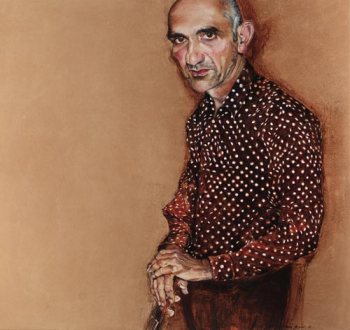
Peter Hudson, Words and Music: Portrait of Paul Kelly, 2007. Oil on canvas over board, 170 x 180cm, Art Gallery of New South Wales.
At a gathering recently I heard a rendition of Paul Kelly’s song ‘Meet Me in the Middle of the Air’. It brought back the moment, more than ten years ago, when I first heard Kelly sing it in a pub in Torquay, on the coast southwest of Melbourne.
It was the height of the summer holidays when I was struck down by a sadness I could not name. A rental holiday shack in Anglesea was not a convenient place for a dark night of the soul; it was crowded with the sleeping bodies of our teenagers and various friends bunking in on the lounge room floor. One night I ended up curled up in the car, weeping in the wee hours. In the morning, my bewildered husband suggested a drive along the Great Ocean Road.
Stopping at Airey’s Inlet, we discovered that the Eagles Nest Gallery housed a cheerful exhibition of artworks depicting lighthouses. At first, I was uneasy – lighthouses were under a kind of suspicion in my mind, associated in my childhood with a religious outlook full of certainty. Shaking off my resistance I entered the gallery.
The works were in wood, glass, oil, pastels, embroidery, charcoal and ceramics. Most were by local artists, with a connection to Airey’s Inlet. There were so many ways of seeing a lighthouse; some were straight and sure with the white tower of strength topped by the red cap of a lifesaver. Others were delicately drawn with architectural accuracy.
Playful lighthouses were surrounded by motifs of fish and flowers, some bending and scooping upwards in trajectories of joy, some standing firm above a flurry of waves. A single black and white photograph, magnetic to the eye, showed the small white pillar of a lighthouse, stark against the huge dark sky; one small vertical amid parallel lines of gathering cloud and billowing seas.
Unassumingly in a corner hung exhibit number one. A painting by Juri Tibor Novak. His picture suggested the lighthouse aloft. There in the small rectangular frame, the lighthouse was suspended in mid-air. It sat on a round foundation, a rock in the middle of the sky above the sea. It did not hover with uncertainty, it simply claimed the space and waited there, whimsical and solid, softly coloured above the flat horizon. Something expanded in me. The lighthouse aloft began to inhabit a space in my chest.
That same night we were booked to hear Paul Kelly back along the coast. The beer garden of the Torquay Hotel was packed with young people. The band and Kelly unfurled onto the stage. His darting head and silver shaved hair gave off a shimmer; with beetle black eyebrows he conducted the band and the audience.
We knew his songs, singing the words of ‘Deeper Water’ from start to finish. Kelly grinned to the band and immediately taught us a new song, complete with parts. We were in a pub with a bunch of 20-somethings and we were all singing the same song. Kelly’s pace was intense, no wasted moments. The songs themselves were spacious and resonant. I watched a couple in their 30s, entranced in the evening light, their faces utterly still with a peculiar expectant beauty.
At the end, the musicians re-grouped. Instruments aside they stepped forward, heads close around one microphone for the last song. Kelly sang the first line then sang it again as the audience settled into the surprise of a capella from a rollicking band of blokes.
All the more surprising to recognise the words of the 23rd Psalm. The words were familiar and re-cast all at once; the Shepherd, the pastures green, the valley of shadow, the cup running over. There was a new refrain running through: ‘I will meet you in the middle of the air.’ The old invitation was here offered with a new cosmology.
The songs met us in hope and in despair in ‘the middle of the air’. There was a space of yearning there. That space is where the artists, songwriters, and psalmists send us. That is the place we can be met.
At the end of the night, I returned to the tiny holiday shack. In my mind’s eye, the lighthouse hovered on its boulder over the flat horizon. I no longer felt alone in my sorrow. I felt I had been heard and met.
JULIE PERRIN IS A MELBOURNE WRITER, ORAL STORYTELLER, AND ASSOCIATE TEACHER AT PILGRIM THEOLOGICAL COLLEGE, UNIVERSITY OF DIVINITY. SHE KEEPS A WEBSITE, AND HER MOST RECENT BOOK IS TENDER. SHE LIVES AND WORKS ON WURUNDJERI LAND.
All are warmly invited to join the Reconciliation Action Plan Committee at St Kilda Baptist Church to celebrate the annual Aboriginal art exhibition from Galiamble and Winja Ulupna.
The artists are currently participants at the local Aboriginal drug and alcohol recovery centres based in St Kilda – Galiamble and Winja Ulupna. This annual event offers the participants in these programs the opportunity to exhibit and sell their paintings. Artworks will be available for sale on the night at affordable prices (under $150) – cash sales only with all proceeds going to the artists. Sold paintings can be collected at the end of the night.
Queenie McKenzie, People talking to Jesus in the Bough Shed, 1995. Christof Collection of the Diocese of Broome. This painting was the theme image for Catholic celebrations of NAIDOC Week 2019.
HTS Teologiese Studies / Theological Studies, a South African-based open-access journal, has just published a little piece that I wrote:
From many Aboriginal elders, such as Tjangika Napaltjani, Bob Williams and Djiniyini Gondarra, to painters, such as Arthur Boyd, Pro Hart and John Forrester-Clack, from historians, such as Manning Clark, and poets, such as Maureen Watson, Francis Webb and Henry Lawson, to celebrated novelists, such as Joseph Furphy, Patrick White and Tim Winton, the figure of Jesus has occupied an endearing and idiosyncratic place in the Australian imagination. It is evidence enough that ‘Australians have been anticlerical and antichurch, but rarely antiJesus’ (Stuart Piggin). But which Jesus? In what follows, I seek to listen to what some Australians make of Jesus, and to consider some theological implications of their contributions for the enduring quest for an Australian Jesus.
I had thought the tangible empty
the tingling hint the yearning
for palm to palm – an absence
but I begin feel a whisper
Your whisper across my palm
where no other hand will fit,
no other can remain,
in intimate embrace
others feel Your grasp in
the clasping hands with an other, but I –
am I destined for a different
kind of intimate?
not sex not tawdry not ‘in love
with God My Saviour’
this taking hand in hand
this different
I have known much longer
than admitted
without name without voice
for what was clouded before
the forced withdrawal this fogged
fatigue demanded cleared
the way and now as once before
in darkness here we are
here with me You are here
the only one I never
turn away and is that not
the intimate, are You not
the one to hold my hand, the one
who will bear witness, and it has taken
me till now to truly shed
the story I’ve been told
that in that place can only
stand a human?
I hear another story
Hildegard, Julian, Thérèse
tell me another story of being one
whose hand is held by
Holy hand – and by no other
tell me now my story so that I
can feel the whisper
on my palm as Presence.
℘℘℘℘
Sarah Agnew is a storyteller, poet, and Uniting Church minister currently in placement with Canberra Central Parish. Her poetry and liturgy appear in Wild Goose Publications as stand-alone e-liturgies, and in edited anthologies as weekly prayer-poems at Pray the Story. Her most recent published poetry collection is Hold Them Close (Resource Publications, 2018). She lives and works on Ngunnawal country.
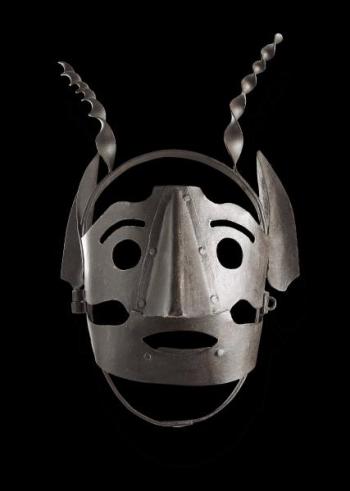
This formidable object was designed to be worn around the head. Called a branks or scold’s bridle, the manufacture of such headpieces arose in Britain from the 1500s and their use spread across Europe, until they were last deployed in the workhouses of the 1800s.
This object was designed as a form of social control through public shaming for those with wayward tongues, such as those thought to be gossips, those speaking insults or malice, or those who simply nagged or complained too often. The headpiece was worn as part of a public procession ordered by a magistrate. Many of these objects included a small length of metal that could be inserted into the mouth to firmly press the tongue down, so no speech could be uttered. In this state the wearer could neither drink nor swallow properly for the duration of this public parade of shaming.
In practice these scold’s bridles were used mainly on women. In this cultural period women were less able to speak in public or even to speak for themselves. This object was clearly designed to silence those women who had used their tongue to speak, and in speaking to assert any independence, wit, or wisdom that questioned the order of things.
Employing the tongue is a natural human response to dismantling pomposity and power. For subjugated people there is a tendency to speak otherwise, to find through scoffing, irony, or coded speech a means of asserting freedom from those who seek to enforce their silence.
This object is rather terrifying evidence of a form of control based on gender. One can only imagine the circumstances of the many women who would have been forced to wear this particular headpiece and their resulting public humiliation. In contrast to the forced silence this object threatens to achieve, there is a time for swearing, cursing, and cantankerous speech, especially if it is in the face of oppression and inhumane control. There is a time for tongues to be let loose. As the novelist Arundhati Roy (2004) states: ‘There’s really no such thing as the “voiceless”. There are only the deliberately silenced, or the preferably unheard’.
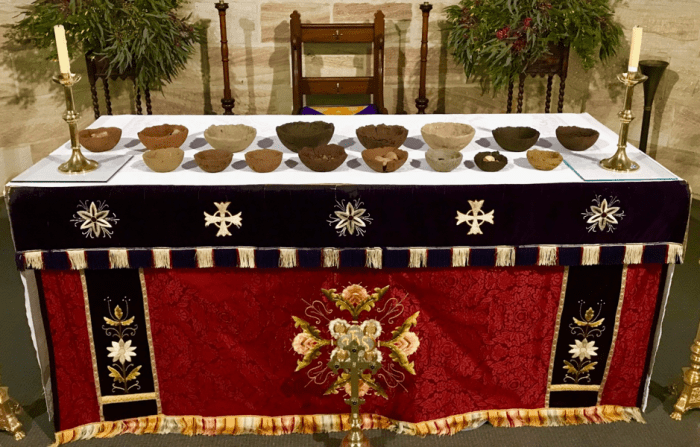
Penny Dunstan, Dirt/Soil/Earth installation, 2018. Altar/d at Adamstown Uniting Church. Photograph by John Cliff.
I am standing on the river flats of the Hunter River at Warkworth (-32.490620,151.028671: paddock reference). It’s a narrow flat valley slashed through with a slow meandering river resting in a deep sinuous trench. The soil under the drought-browned pasture is black. It crumbles easily in my hand. In the distance, there’s a mob of kangaroos grazing on the remaining plant roots. Across the river, there’s an old farmhouse that in times past belonged to a breeder of stock horses. I stayed there once as a guest but the family has long since moved out. Now it belongs to a mine with an overburden wall that rises up like a frozen tidal wave, forever threatening the house and the surrounding river flats.
Here, soil is a commodity. Soil is not as valuable as the coal that lies underneath it if we think in short term economics. But thinking intergenerationally, these black-soiled river flats should be preserved. One day, once again, humans may need them to grow food.
How shall I talk about the absolute importance of soil to human civilisation? Soil, along with air and water, is one of our most fundamental natural resources. Soil grows food for us and earth-others. It grows trees and grasses and fungi and a host of micro-lifeforms that we never see but are dependent upon to survive. A teaspoon of a well-cared-for soil can contain up to one billion bacteria, several meters of fungal filaments, several thousand protozoa, and scores of nematodes. Soil contains vast quantities of carbon and is a holder of surface water.
In the transitional zone between open-cut mining and rehabilitated post-mining landscape, soils are a carpet of hope rolled out to pacify the requirements of legislation. Mines managers assume soils will be resilient and cover up the mountains of Permian stone piled high. The small lives contained in soil often don’t transition well from pasture to the manufactured lands via heavy machinery, trucks, piles, bulldozers, and ploughs. It is asking a lot of one of our most valuable resources to cover up the sins of avarice.
Michael Northcott (theologian and ethicist) puts the problem this way:
… the earth and we are in co-creaturely relationship and … when we neglect the beneficence of God’s good earth and the prudential use of what God has granted to us, and subject nature … to our devices and desires, we not only frustrate the capacity of our fellow creatures to give God praise; we also put at risk the very services that the earth renders us.
Penny Dunstan, Merriwa soil bowl in Sixteen Earth Bowls 2018, installed at the Hyatt Canberra for the National Soils Conference. Photograph by the author.
Making earth bowls is a way of thinking about my ethical responses to soil use in a post-mining landscape. It is a way of thinking with my heart and not just my head. As I work with each Hunter Valley topsoil, I come to understand each as an individual, a special part of God’s creation. Each soil behaves according to its own chemical nature and historical past when I fashion it into a bowl shape. Some hold their shape, and some don’t; or perhaps, is it that some won’t? The agency (or will) of the soil is expressed by the way the bowl keeps form. Soils with good health often crack or crumble. Sad soils, those mistreated and overworked, stay where they are put.
Each bowl is made from a Hunter Valley topsoil, except for one. The grey bowl is mudstone doing its best to impersonate soil. It’s having trouble as it hasn’t been to the surface of the earth for 250 million years. Of all the soils, this one is the most sterile. This is the soil that will be found on the surface when we run out of topsoils rescued from mining. It is a legacy that our grandchildren will not thank us for.
Penny Dunstan, Sixteen Earth Bowls, 2018. Installed at Holy Trinity Church, Merriwa for the Festival of the Fleeces. Photograph by the author.
So here is a question: What were those earth bowls doing on the altar? And on a white linen cloth? This is where you, the reader, come in. Art should make you question the world. Are those bowls made of dirt (plus all those beasties) that we should sweep out of the door and into the bin? Or are they made of soil that we should at least put on the garden, but really, they have no place in church? Or are they made of earth to be examined, to be questioned, to be listened to as earth-others?
These soils, full of tiny lives, are responsible for growing our food, making our air and storing atmospheric carbon. Our very lives as humans on the earth depend on them. By fashioning these soils into bowls and placing them in sacred places, I hope to remind us to honour the earth that we stand upon, that earth that speaks to us by pushing back at our feet. Soils deserve care and nurture, as they reciprocate to care and nurture us. Tangled in the web of earth understandings is a call to think about an intergenerational issue such as postmining land rehabilitation and building housing estates on prime agricultural soils. When we care for soils, we are in fact caring for ourselves and our descendants.
℘℘℘℘
Penny Dunstan is a soil scientist/agronomist and artist with particular interests in anthropogenic landforms and the human/land dialogue that arises when humans create the world. Her transdisciplinary PhD research investigated post-coalmining rehabilitated land at one mine site in the Hunter Valley, through fine art, human geography, and soil science. She has presented and published in a wide variety of forums including Hunter Valley Rehabilitated Mine Lands, National Soil Science Association, Institute of Australian Geographers, and Creative Arts forums in Australia and overseas. Penny is an accomplished artist who regularly exhibits work that details aspects of the Upper Hunter interactions with the Anthropocene. She works within and with Wonnarua country.






 Art/s and Theology Australia