Articles

A Resurrection Triptych

In 2014, the ‘broken Christ’ crucifix that Michael Galovic had brought with him from Yugoslavia in 1990 was used as the core in his creation of an image of the desolation and humanity of Christ as evoked in his anguished cry from the cross and translated as, ‘My God, my God, why hast Thou forsaken me?’ These are also the opening words of Psalm 22. The juxtapositioning of the broken Christ with the lances of Diego Velázquez’s The Surrender of Breda (1634–35) highlights the sense of defeat and desolation as well as the continuing threat of violence. As Galovic notes:

These lances, for me, feature as an ominous foreboding symbol of ‘empire’, or system, ready and capable of destroying any human.

The image is one of almost utter desolation; light from no discernible outside source illuminating Christ’s face.

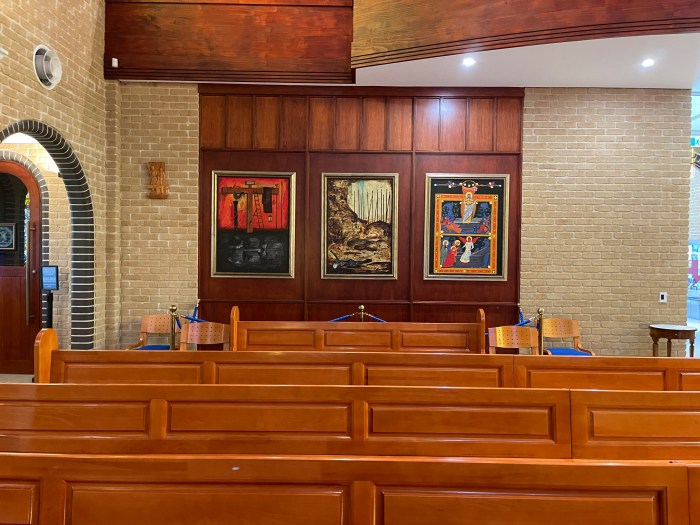
Shortly after the work’s installation in Our Lady Help of Christians Church, Rosemeadow, in February 2023, the parish priest, Father Christopher Sarkis, suggested that it might form part of a triptych. Having seen a medieval manuscript’s illustration of the resurrection, he felt that this depiction would be suitable as the final image. Galovic suggested that the first item could portray Christ’s crucifixion and death through the imagery of the Arma Christi, and the head of Christ is based on the Shroud of Turin in the lower part of the image.

Left panel: Michael Galovic, Arma Christi with the Shroud of Turin, 2023. Egg tempera on linen on board, 120 x 90 cm. Our Lady Help Of Christians Church, Rosemeadow, Australia. Central panel: Michael Galovic, Lord, O Lord, why hast thou forsaken me?!, 2014. Mixed media on board, 120 x 90 cm. Our Lady Help Of Christians Church, Rosemeadow, Australia. Right panel: Michael Galovic, The Resurrection, 2023. Egg tempera and gold on linen on board, 120 x 90 cm. Our Lady Help Of Christians Church, Rosemeadow, Australia.

The completed work would thus contain a central contemporary work in muted tones, a first panel drawing on images of objects coming from a collection that has been a part of Christian iconography with its central image, the crucifix, having been used since the fourth century CE and a third panel based on a medieval manuscript. This seemingly disparate grouping also needed to be created in a way that would form a coherent whole. While having a linear structure in time that covered the period of Christ’s betrayal through to his resurrection and empty tomb, it also needed to have links established through the use of colour and form.

In the Arma Christi, the upper register highlights the betrayal of Christ and the mockery and savagery that attended his crucifixion. As with the central image, it references Psalm 22.16b–18:

[T]hey bound my hands and feet.
I can count all my bones.
They stare and gloat over me;
they divide my clothes among themselves, and for my clothing they cast lots.

Christ’s final words from the cross – ‘Father, into your hands I commend my spirit’ (Lk 23.46) – with their tranquillity and faith, are embodied in the lower image, based on the Shroud of Turin, which, irrespective of its authenticity, forms a depiction of the final aspect of Christ’s human role in salvation.

In contrast to the violent instruments of betrayal, humiliation, and torture against their fiery background, it is a wonderfully expressive portrayal of calmness and completion. There is a great gentleness in the muted tones and careful delineation of the features, overlaid by the delicate treatment of the weaving of the cloth.

However, there is also a linking through colour, with the blue tones shown especially in the rooster, whip, and lance head in the top register being subsumed into the blue depiction of Christ’s face below. These two colour tones of blue and vermilion flow through to the central panel. In ‘Eloi, Eloi’, they appear in muted tones in the rocks foregrounding the spears, with the blue used on the image of the broken Christ.

They are then developed vibrantly in the final panel, which depicts two images associated with the resurrection. The vivid vermilion and oranges both frame the upper and lower panels depicting Christ’s resurrection and the myrrh-bearing women who came to anoint Christ’s body and form a significant part of each of the images.

The figure of the resurrected Christ in the top panel, surrounded by a golden-rayed mandorla, connects this image with the sacred, while the deeper tones used on the garments of the sleeping soldiers evoke Roman costumes.

In the lower image, the treatment of the angel at the tomb, with its flame-like wings and fiery countenance, creates a sense of otherness that is accentuated by the luminous white and gold of the robe. It also resonates with the garments of the two holy women closest to the tomb. Throughout both images, orange and vermilion tones highlight the fruitfulness of the trees while also forming contrasting highlights to the use of blue beneath them on the varying rock formations.
The interplay of colours creates a harmony that works beautifully throughout to unite the three images. But that is only one of its aspects. The top register of the first image, with its strong orange and vermilion tones highlighting instruments of torture and mockery, also evokes the fiery infernos of medieval hell-mouths and Renaissance depictions of hell. The contemporary image of the broken Christ, with its background imagery of war and defeat, highlights the bleakness of destruction. Yet, in the final image, all of these aspects are subsumed into the vibrancy and vividness of Christ’s resurrection, in which even the sleeping Roman soldiers had a place.

The Triptych is a tribute to both creativity and flexibility of form. In bringing together aspects of Christianity from different eras, cultures, and perspectives, it focuses on Christ’s sacrifice to redeem humanity. Each of the individual works evokes a different perspective, and through these images, the viewer is given a sense of the beauty and complexity of responses to the crucifixion and resurrection throughout the history of Christian art.

℘℘℘℘

Kerrie Magee has an MA in Medieval Studies and lives in the area of the Wallumedegal People. Michale Galovic is a renowned iconographer living in the area of the Darkinjung People.

Rituals of Embodied Knowing

Sarah Tomasetti, Rivus (detail). Fresco, pigment, muslin, and encaustic wax. From the Birrarungbanner series, 2022–23. Photo: Emma Byrnes.

The exhibition Rituals of Embodied Knowing brings together ten established artists with diverse forms of practice that engage plants, video, sound, movement, painting, drawing, and installation. These artists have been working together with an academic group on the project ‘Spiritual Understanding in a Secular Age: Engaging Art as Religious Ritual’, funded by the Templeton Religion Trust.

The project conceptualises art-making as a form of knowledge or understanding that aims to make contact with various aspects of reality such as the natural world, human history, and our individual selves, thus considering how art-making practices in a secular context might, when seen in this way, share similarities with religious ritual.

Academics from a variety of fields such as history, anthropology, psychology, sociology and theology, have identified how key dimensions of each of these practices – movement, time, media, subtraction, invention, and attention – are also leveraged in religious rituals to make contact with reality.

The project calls on us to see art-making in a new way, and has also challenged academics to see aspects of reality in new ways through engaging art-making itself as a means of knowing and understanding. This exhibition invites viewers to consider whether and how the works included could be thought about as ritual-like in their unique ways of employing embodied experience.

This exhibition also launches the new CBONE Gallery, combining the previous Eastgate Gallery and Chapman and Bailey project space into one entity that will show a range of contemporary visual art.

Joining the project artists, Heather Hesterman, Adam Lee, Louise Weaver, Dominic Redfern, Harry Nankin, Chris Bond, Peter Ellis, Mark Newbound, Live Particle, and Sarah Tomasetti, are Yolngu artist Djirrirra Wunnumarra and emerging artist Uma Christensen.

An edited volume of essays emerging from the project will be published in 2024.

Exhibition Dates: 18 February – 18 March 2023.

Where: CBONE Gallery, 1C Marine Parade, Abbotsford, Melbourne.

Live Particle (Angela Clarke and Camilla Maling) will be presenting a series of Soma Scores using their unique sensory objects to generate embodied experience on Saturday 11 March.

There will be a discussion panel and closing event on Saturday 18 March.

Wes Campbell: Disturbing Illusions of Peace

Wes Campbell, Silence II, nd.

Last month, Jason Goroncy spoke at the opening of an exhibition of Wes Campbell’s artwork. Wes is a theologian, artist, and (retired) Minister of the Word in the Uniting Church in Australia. An edited version of his talk is now available on the ABC’s Religion and Ethics portal.

Wes Campbell: A Retrospective

Double Book Launch

Anne Elvey’s new poetry collection – Leaf

Anne Elvey has a new poetry collection, Leaf, forthcoming from Liquid Amber Press. It will be launched by Shari Kocher as part of Liquid Amber’s Eco-poetics Zoom event on Thursday 22 September 2022, along with readings from Peter Larkin and John C. Ryan.  The evening begins at 7.30pm. Bookings are free but essential.

Visit here for further details and booking.

These Times

Emmanuel Garibay, Selda (Prison Cell), 2020. Oil on canvas, 122 x 152.5 cm. Artist’s collection.

Emmanuel Garibay is a leading painter from the Philippines with an international reputation for work that reflects on issues of power and injustice. His works reflect the capacity for images to wake up the imagination to the experiences of marginalization, racism, and class difference, and to therefore affect change in social, political, and religious structures.

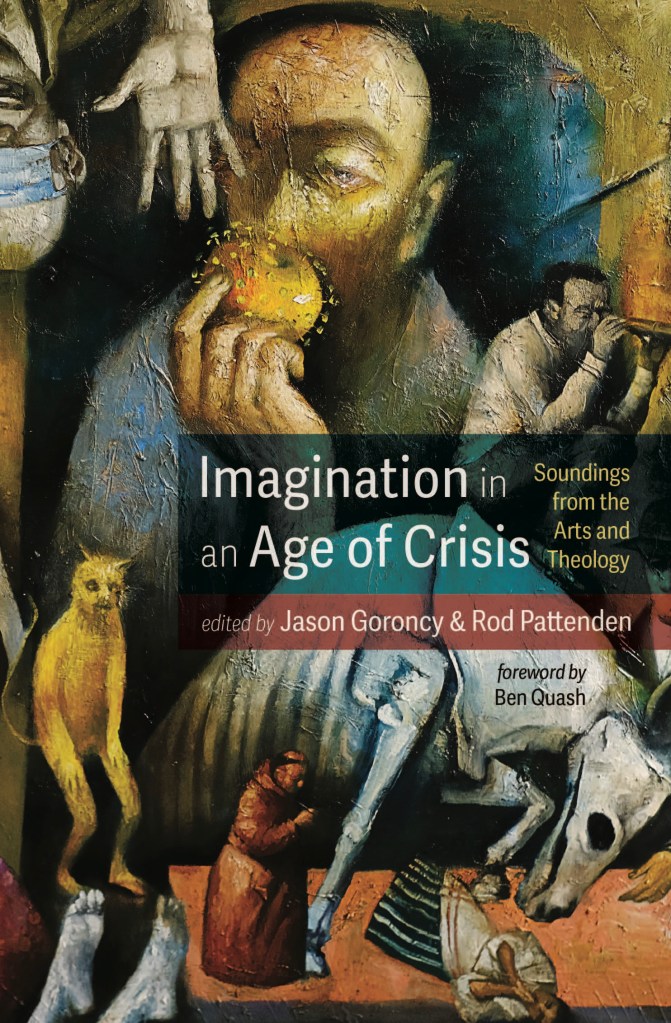
The work Selda, or prison cell in English, is a work that responds to current issues facing the Philippines, and, in turn, other regions around the world in the face of the COVID-19 pandemic, increased military and political activity, and the resultant curtailment of individual freedoms. It is a large-format work made up of many smaller elements that are painted in an expressive and textured manner. The central figure of the composition is eating a golden apple, a symbol that should offer the promise to live forever, but instead has become infected with the coronavirus. To the left, a front-line health worker pales into death, sacrificed by a government that prefers to spend money on military budgets. Two authoritative figures carry a large book with the names of those who need to be sanctioned or disciplined, and then walk over a dead body. A figure in the sky is blinded by a face mask that has slipped over their eyes, a representation of delusion and false news. A woman flies a paper plane, representing the huge number of Filipino workers overseas who contribute more than ten percent of the nations’ income, while a sinister yellow cat lurks in the shadows.

Below the central figure is the kalabaw, the native water buffalo which is often used as a symbol of the hard-working prosperity of the nation; but here it has died. Underneath, a friar knocks over an indigenous woman representing the ongoing impact of political and religious colonialism. To the right, a figure with a telescope, the current president, is seen spying on the helpless, while a hand comes in with a red yo-yo, an action that names “red tagging” or accusing trouble makers of having anti-government sentiments. And then, finally, tucked in near a golden door, is the historic figure of José Rizal, the great hero of the independence movement who was executed in 1896. He was a writer, artist, and scientist, and Garibay gives him a position of understated prominence in this work, affirming the role of the artist, who might see more clearly what is going on in these fractured and overwhelming times. The entire work is imbued with a golden light, full of promise and prosperity, that turns, at times, into a sulphurous yellow, toxic and decaying. The artist does not offer a possible future, but rather a contemporary view of this historical moment, full of warnings of danger that call for urgent response.

––℘–℘–℘–℘––

RP. This work stands in the tradition of large mural paintings that will often convey the triumph of history or the virtues of the nation. But this work is far more complex and fragmented. The viewer has to weave these disparate elements together.

EG. The fragmented nature of these works manifests the inability of most people to find a synthesized grasp of the general situation. Some aspects of what is going on tend to be intentionally highlighted, while others tend to be obscured. We have a media that is easily co-opted by those in power. You have to make an effort to dig deeper and scrutinize, to analyze, to have a more complete and bigger picture.

RP. What role do you think artists have at a time like this? Do artists help people see more clearly?

EG. Artists have an opportunity to be much more fluid and flexible, to have the greatest degree of exposure to many aspects of life. Their life situation means they are not confined to routines and patterns like a nine-to-five job. The innate qualities of an artist—such as being sensitive, observant, and analytical—enable an artist to grasp or wrestle more with seeking clarity in one’s life situation and to understand the dynamics at play. This striving enables artists to have a more-complete understanding of life situations. When I paint, I listen to podcasts and lectures on theology, history, and philosophy. In other words, it enables me to have a wider basis for understanding things, not just through one perspective but through multiple perspectives.

RP. As an artist, you’re not only looking, but you’re also thinking about looking, and questioning your looking.

EG. In my case, I prefer to paint. It’s something that’s been done for thousands of years. It’s a direct action of you as a person. So, it is a constant affirmation of my self as a human being. Instead of exploring new technologies, it’s about resisting the need to innovate. At this point, I don’t see technical innovation as providing direction towards human development. I think it also helps people to slow down and to see. It also connects us to the past. What we have lost is a conscious connection to the past, and this accounts for why there is a massive loss of belief in this generation. This loss of belief makes us very vulnerable to all sorts of incursions by those in power to manipulate and control our worldview.

RP. You mean we lack an awareness of history, which means we are too buoyant, without a place of stability to make decisions about the present or the future.

EG. In the Philippines, it’s the fault of the Church for having misrepresented Christianity, because it was obsessed with power and authority. It forgets Christianity is the exact opposite. So as a result, it has misrepresented belief.

RP. What would you say that faith or Christianity has to offer this moment in history?

EG. I think it is more about being truly in tune with our humanity. It is one of the problems with the theology of the church fathers in the past. It emphasized too much the divinity of Christ and very little on his humanity. The deification of Christ is really about the idea of God becoming human, so that humans can understand the mind of God. So, it is a model to be followed rather just a figure to worship. There’s too much emphasis on worshipping Christ—in affect, worshipping the Church that contains this Christ. That is the main reason people have lost faith in belief.

RP. So the figure of Christ is a picturing of God. These christological images then also offer us options about what it is to be a human person.

EG. This is most emphasized in the way he lived his life, through washing the feet of his disciplines, uplifting the lowly, healing the sick, his passion for social justice. All of these are glossed over in favour of emphasizing the divinity. That is what stories are all about, and what art can do best. It can perpetuate the hope of what humanity is truly all about.

℘℘℘℘

Emmanuel Garibay (b. 1962) is a leading artist from the Philippines who has a wide reputation having exhibited his work in Europe and the United States. His work explores the experience of those marginalised in his own country and is strongly informed by a theological critique of social power and politics. In 2011, the book Where God is: The Paintings of Emmanuel Garibay was published by OMSC (Overseas Ministries Study Center) in New Haven, USA, bringing his work to wider audiences.
Rev Dr Rod Pattenden is an art historian and theologian from Australia. He has written widely on the arts and creativity. HE LIVES AND WORKS ON AWABAKAL LAND.

This interview with Emmanuel Garibay is an excerpt from the new book, Imagination in an Age of Crisis: Soundings from the Arts and Theology (Pickwick, 2022), edited by Jason Goroncy and Rod Pattenden, with a foreword by Ben Quash. This book explores the vital role of the imagination in today’s complex climates – cultural, environmental, political, racial, religious, spiritual, intellectual, etc. It asks: What contribution do the arts make in a world facing the impacts of globalism, climate change, pandemics, and losses of culture? What wisdom and insight, and orientation for birthing hope and action in the world, do the arts offer to religious faith and to theological reflection? Marked by beauty and wonder, as well as incisive critique, it is a unique collection that brings unexpected voices into a global conversation about imagining human futures.

A video introduction and review of the book, plus details on how to obtain a 40% discount, is available here.

replanted

after Psalm 1

Photo by Kaja Reichardt on Unsplash

dig in deeper
to the river
running living water
my roots dive for
depth strives for
after dusty shallows
rocky fallows deserted
so I’m thirsting
from the working hard
to stay alive
and now it’s simple
to truly thrive
by the source
realigned with this replanting
though the uprooting
from familiar
mud dried up
shook the muck
from my feet and I
am replete
digging deeper
down
into
the river

℘℘℘℘

SARAH AGNEW IS A STORYTELLER, POET, AND UNITING CHURCH MINISTER. HER POETRY AND LITURGY APPEAR IN WILD GOOSE PUBLICATIONS AS STAND-ALONE E-LITURGIES, and IN EDITED ANTHOLOGIES. HER MOST RECENT PUBLISHED POETRY COLLECTION IS WHISPER ON MY PALM (RESOURCE PUBLICATIONS, 2022). SHE LIVES AND WORKS ON Kuarna COUNTRY.

Three Poems: Jezebel, Makeda, Esther

As a woman, I gravitate to the stories of women in the scriptures. Women balance multiple gender roles and identity tensions. Their stories are often hinted at or mentioned in passing. We get glimpses rather than full narratives. Nevertheless, they are there, often unnamed or in the shadows. Unlike many of the other women, these women are named. They are queens who had highly vulnerable political positions.

Lucia Lukas, Queen, 2021. Markers, oil, photographs, acrylic, and fabric on canvas. 81.7 x 107.5 cm. Artist’s collection.

Jezebel (from Her Foreign Majesties)

Reflected in the mirror, I wonder at my crown.
Who placed it there upon my maiden brow?
A princess of Phoenicia, so foreign to this Land
How can I live authentically in this state?

O Jezebel, how came you here?
What will you do?
What have you done?
Begone!

I did not choose to come here – sold by my tribe for peace…
I come as token gesture – a prize to be displayed
Today I’m claimed as Ahab’s queen, to mother his offspring
My body – chattel of the state – is not for me to own.

O Jezebel, who are you here?
Are you considered human?
Of are you simply of another
Man?

Makeda – Queen of Sheba

Love? No – maybe it was more of a curiosity …
A fascination with a legend.
I have had presented chiefs and princes …
The finest warriors and generals,
the richest men with the greatest lands.

I have no need to search,
But my interest has been aroused
by the tales of Wisdom.
What man is really wise?
Is there such a beast?
If so, might he be worthy of my attentions?

These days, I could be bored,
for my wealth is unsurpassed,
My lands are peaceful,
My realm is stable.

What more could a girl ask for?
I seek adventure … to travel to exotic places,
To meet interesting people …
To see this Temple of wonder
Being built for a single God!

Perhaps I will find more than sights to see?
Perhaps I will find a King worthy of a Queen?

Esther

Reflected in a mirror, I see my exiled face
Who gave me over to become a wife?
A Queen my Master made me – to people not my own
While mine are slaves and foreign to this place

O Esther, how came you here?
What will you do?
What have you done?
Beware!

I did not choose to be here – taken from my people – dispossessed …
I am prize of warfare – a prize to be displayed
Today I’m Queen of Persia – but silent is my role
Do I dare disobey the boundaries of my life?

O Esther, who are you here?
Can you be given voice before your King?
Do you have words
from another Lord?

℘℘℘℘

Amelia Koh-Butler is Minister, Eastwood Uniting Church, and is currently living on Wallamategal and Barramattegal Country of the Darug-speaking peoples.

Imagination in an Age of Crisis

Jason Goroncy and Rod Pattenden – this site’s editors – are thrilled to announce that they have a new book out.

Imagination in an Age of Crisis: Soundings from the Arts and Theology explores the vital role of the imagination in today’s complex climates – cultural, environmental, political, racial, religious, spiritual, intellectual, etc. It asks: What contribution do the arts make in a world facing the impacts of globalism, climate change, pandemics, and losses of culture? What wisdom and insight, and orientation for birthing hope and action in the world, do the arts offer to religious faith and to theological reflection?

These essays, poems, and short reflections – written by art practitioners and academics from a diversity of cultures and religious traditions – demonstrate the complex cross-cultural nature of this conversation, examining critical questions in dialogue with various art forms and practices, and offering a way of better understanding how the human imagination is formed, sustained, employed, and expanded.

The book has been well received, with Professor Jeremy Begbie (Duke University) describing it as an ‘extraordinarily energetic and imaginative collection’, while Professor Stephen Pickard (Australian Centre for Christianity and Culture) calls it a ‘remarkable collection of reflections on the power of the imagination to instil hope and meaning in disturbing times. … [A] breath of fresh air’.

The book has a strong range of contributions from the Australian context, as well as those from the Pacific, Asia, the United Kingdom, and the USA. It is an international collection with a common concern to celebrate and prize imagination for these times. A video review is provided by Rev Dr Jane Foulcher (Senior Lecturer, Charles Sturt University), along with an introduction by the editors:

Through 35 individual contributions, the book weaves its many conversations around the capacity of the imagination, and the arts in particular, to provide a means of cultural resilience, protest, questioning, and critique. It explores the work of a wide range of writers, playwrights, poets, musicians, and visual artists, to provide imaginative resources to articulate the challenges and the choices facing human beings in a world both drawn close and made distant through networks of disease, conflict, commerce, and culture.

The book is richly illustrated in colour with 39 images, including a stunning cover image by Filipino artist Emmanuel Garibay that graphically expresses the cultural collisions of our time. Another strong creative feature of the collection is the engagement provided by poets, including Petra White, Kevin Hart, Christian Wiman, Jordie Albiston, Pádraig Ó Tuama, and Michael Symmons Roberts. The result is a volume marked by beauty and wonder, as well as incisive critique. It is a unique collection that brings unexpected voices into a global conversation about imagining human futures.

Imagination in an Age of Crisis is available now at a special introductory price of 40% off. Use the code “Crisis40” at checkout through Wipf & Stock, or through customer service by phone (1-541-344-1528), or via email.