I. The west-to-east wind breathes the leavings from a few naked groves across to up against where there’s no more field; it creates a waiting on the verge of woods like an invasion.
But the fodder stays, relents puts up no fight shows itself in piles to the lorn few or the theologians or the simple or the true in all this angled light the small houses the spare lots, the pines the hardwood all are convinced the dry months will come and cold. And cold.
II. Roberta smiles through broken glass of west facing windows sees highways cracked and broken, road-tar having oozed from a thousand Augusts, now as still as Rome. She smiles without knowing that her own empire stumbles and falls down to only a trace.
As the day turns red out towards Columbus she watches as some lights come-on beyond a hedge out under where the linings of clouds make bloodshot edges. The sky behind has already lost blue for gray for black and Roberta chuckles at all the overlap the lifespans make, shortening our idea of forever.
III. The grace of those numbers too big to consider the size of that sky is there whether noticed or not and the God of such distance as to be here and here soaks Roberta’s fabric, utterly. And what she wears can’t lose its weather being a host for those things never to be tagged.
℘℘℘℘
L. Ward Abel’s work has appeared in Rattle, Versal, The Reader, Galway Review, Main Street Rag, and elsewhere. He is the author of four collections and ten chapbooks of poetry, including his latest collection – Green Shoulders: New and Selected Poems 2003–2023 (Silver Bow, 2023). He is a retired lawyer and teacher of literature, and he writes and plays music. Abel resides in rural Georgia, USA.
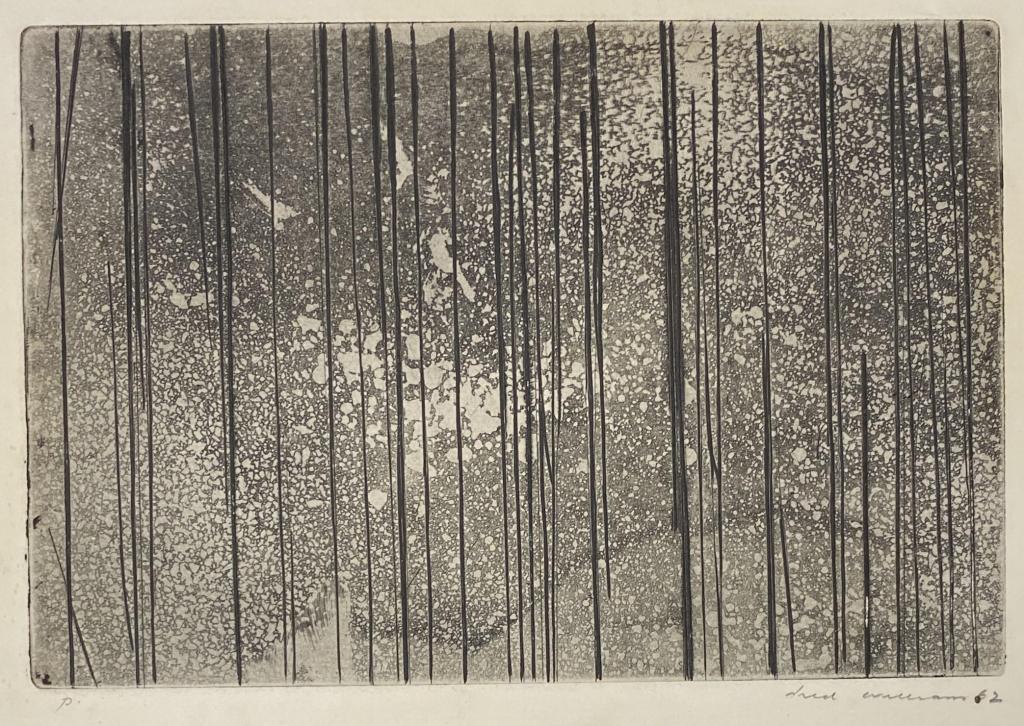
Fred Williams, Sapling Forest, 1962. Etching, 13.7 x 20.2 cm. Private collection.
‘Believing in the Light you shall not abide in darkness’. – George Fox (1654)
Light’s labour is to tell darkness back, push it toward eternity’s edge –
although much darkness slips back through, grieving the hearts of all who must live here.
Like lead, darkness weighs nearly as much as gold.
But Light’s feel is the alchemy of love falling in bright colour,
as stars sometimes do, back to earth’s gravity.
There turned to chemical (even among fireflies) it burns gold-like
attracting more love still, across open hearts,
against night’s threshold.
℘℘℘℘
Ed Higgins is an American poet and short fiction writer whose work has appeared in various print and online journals. Ed is Asst. Fiction Editor for Brilliant Flash Fiction. He has a small organic farm in the United States of America, where he raises a menagerie of animals, including a rooster named StarTrek.
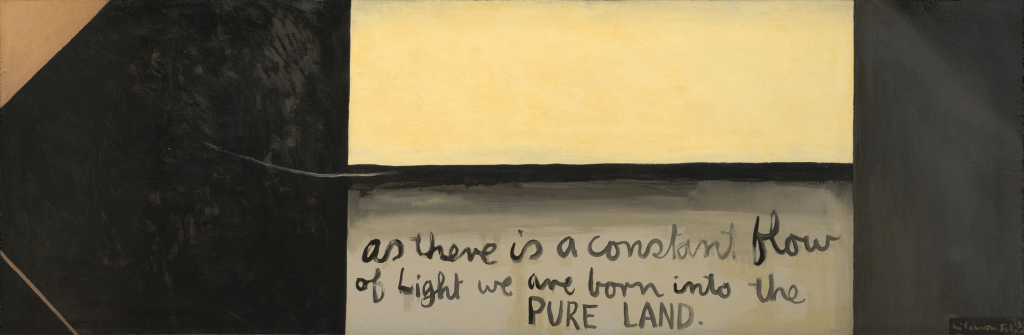
Colin McCahon, As There as a Constant Flow of Light we are Born Into the Pure Land, 1965. Synthetic polymer emulsion on hardboard, 59.8 x 180 cm. Christchurch Art Gallery Te Puna o Waiwhetu, Christchurch, Aotearoa.
loved in Pure Land – awe – four generations fam, friends – fortunate – poof gone
℘℘℘℘
Gerard Sarnat is an American poet, aphorist, and humorist. His work has been widely published in journals and newspapers. He currently serves on the board of Climate Action Now.
This thirst for love, is it a product of evolution or a longing for home?
This yearning has seen me chasing mirages and drinking saltwater until dehydration became an identity.
Would this thirst be satisfied if my childhood was well-watered or I could draw from a well of relationships?
Or would my soul still pant for water of a different kind, a never-ending and life-giving source?
Do those who have drinks nearby even realise they are thirsty?
℘℘℘℘
Liz Jakimow is a writer, poet, and photographer living in Araluen. Her photos, poems, and articles have appeared in many publications, including As Surely as the Sun and Gossamer Arts. She works as a communications officer for the Australian Centre for Christianity and Culture, is the Assistant Editor for Engage, and has a Bachelor of Theology from St Mark’s National Theological Centre.
In 1998, during my second pastoral tenure with a Wesleyan Methodist Church in suburban Brisbane, I attended a series of workshops over two weeks in Melbourne. It was sponsored by Scripture Union, World Vision, and Whitley College. It was held at the Carlton Baptist Church in an old two-story disused shop complex and hosted by New Zealand art lovers and Baptist theologians Mike Riddell* and Mark Pierson. The basic idea of the seminar was to consider how to think about and be active around evangelism and worship ‘using the arts’ in the emerging culture. As a pastor in a fundamentalist evangelical organisation at the time, applications and future options were conceived, while the arts, my true love, were firing mystery and dreams.
Now, the landscape was completely different then – no 9/11, high-octane social media, COVID-19, Trump, Morrison, Putin, Boris or Ukraine/Russian or Palestinian/Israeli atrocities. Almost a generation on and now we are living in an unimagined landscape. However, those of us in that building in 1998 were thinking about ‘new music and art’ in worship settings and conversations with ‘outsiders’ that were not based around ‘selling the gospel’. In 1998, ‘Church Growth’ [sic] had become a disease of franchised McDonald’s proportions, burning out pastors who were not inclined to be into sales, while Hillsong was on the ascendency.
Those two weeks opened new doors onto new rooms of thought and imagination, rooms that would lead me to become immersed in the arts, leave the religion-based pastoral enclave and return to medical imaging. It would also find me grappling with the arts, fundraising, personal art practice, and questioning my theology more deeply as I attempted to unravel and move out from under the iron-clad Christian dualism construct.
My ‘thinking life’ before pastoral appointments and during them included applied science, Baptist and reformed theology morphing to Arminian understandings, and an immersion in various social and theological constructs that had not honoured the arts or open-ended question thought processes. At times, I thought they had, but they had not. My whole world of thought at its deepest levels was that of a passionate insistence on dualistic evangelical conversion and subsequent piety. The bottom line had always been to find ways to ‘get people saved and sanctified’, aka Billy Graham, and use love of ‘the other’ if necessary. The arts were, in that context, only utilitarian; that is, for worship or evangelism. In some ways, from what I can see from a distance is that the agenda of the Christian church seems to have hardly changed, particularly in the narrow evangelical fundamentalism that I shut the door to. I am thankful that in the midst of growing up in a fundamentalist and compassionate household, my Christian parents had oddly enough fostered a love of a wide-ranging arts exploration in their children – except for the ‘devil’s rock and roll music’ – that served us well, and that partly saved us from a more cultic infirmary.
My time post-pastorate since 2003 has been immersed in the arts – including co-founding Jugglers Art Space – medical imaging, family life, and completing an MA in Creative Arts Therapies. I am slowly learning to see, as per John Berger in Ways of Seeing, where he ‘challenges the elitist and mystified status of art that neglected the political, social, and ideological aspects that shaped the ways in which we look at art’.
Conversely, I’ve been exploring what spirituality in art means both within and outside religious iconographic and narrow utilitarian frameworks. Kandinsky’s epiphany affected philosophy helps here: ‘At its outset all art is sacred, and its sole concern is the supernatural. This means that art is concerned with life – not with the visible but the invisible’.
Building on a range of influences as Kandinsky’s, references to the ‘moving of the spirit’ in the scriptures, whirling dervishes in Islamic mysticism, Quaker meetings, aboriginal understandings of country, and so on, I initiated a series of group art events at Jugglers Art Space. My quest was to host a gathering of artists with no known religious background or involvement, construct a sound and design space and for us to respond silently but together with the intent to see if it was possible for something beyond ourselves to form and affect us. An epiphany, perhaps? Over the past 12 years, I have curated and co-curated these events, with the significant impact being the inexplicable silence attending the music and mark-making find their end. I cannot say what happened, but the sense of what happened has not been forgotten by me or all those who came. Mark-making together without speech is the central activity for the artists with a range of musical atmospheres created via, for example, Gavin Bryars’ amazing 75-minute ‘Jesus’ Blood Never Failed Me Yet’ (a shorter version is shared below), Arvo Pärt, improv live performances, or the beach with lapping seas.
The shift from ‘being saved and sanctified’ and preaching as the only answer to my and others’ search for meaning is significant. Within my evolving art practice, love has grown in response to the call of the spirit and the soul. I have also realised and embraced an embedded desire for inexplicable epiphany, not that created by systems, argument, exegesis, or consumption but that which is there, here and around, present and through. And the artists are the seers.
* Rev Mike Riddell died in his sleep in 2023 in Dunedin, NZ. He was 69.
Some recommended reading/watching:
Adam Edward Carnehl, The Artist as Divine Symbol (Cascade, 2023)
Thomas Crow, No Idols: The Missing Theology of Art (Power, 2017)
Jeffrey L. Kosky, Arts of Wonder (University of Chicago Press, 2016)
Emergence Magazine: Ecology, Culture and Spirituality, editions 1–5
Bruce Wilson, Reasons of the Heart (Allen & Unwin, 1998)
John O’Donohue, Beauty: The Invisible Embrace (Harper/Perennial, 2003)
Jason Goroncy & Rod Pattenden, eds., Imagination in an Age of Crisis: Soundings from the Arts and Theology (Pickwick, 2022)
Christian Wiman, Zero at the Bone: Fifty Entries Against Despair (Farrar, Straus and Giroux, 2023)
George Prochnik, In Pursuit of Silence: Listening for Meaning in a World of Noise (Anchor, 2011)
In Pursuit of Silence (a film directed by Patrick Shen, 2017)
Catherine Keller, On the Mystery: Discerning Divinity in Process (Fortress, 2008)
The New Boy (a film directed by Warwick Thornton, 2023)
℘℘℘℘
Peter Breen is the co-founder and current chair/director of Jugglers Art Space Inc., in Brisbane. He maintains a website at www.peteskibreen.com.
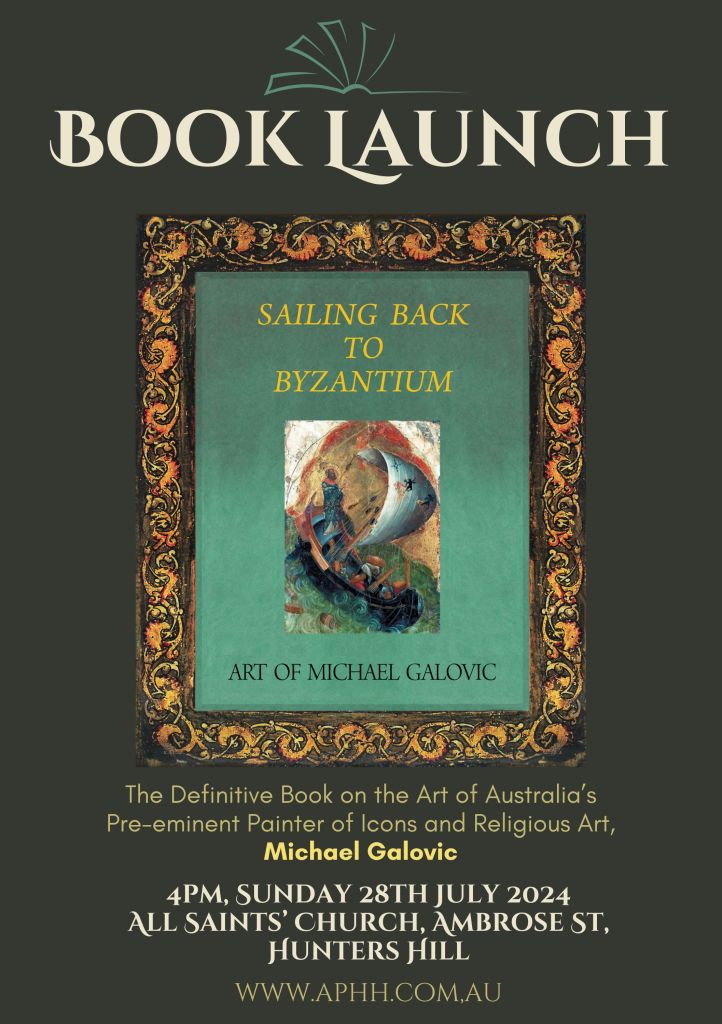
Sailing Back to Byzantium: Art of Michael Galovic. Melbourne: Yarra and Hunter Arts Press, 2024.
This lavish, large-format publication on the work of iconographer Michael Galovic is a welcome addition to the coverage of the arts and spirituality in Australia. It is a beautiful book, an art work in itself. In around 260 pages, it surveys the work of one of Australia’s most well-known painters of icons, covering traditional themes, innovative new work, and important commissions around the country.
Born in Belgrade, Michael Galovic arrived in Australia in 1990 and set about sharing his cultural knowledge through small exhibitions and workshops. The 2006 publication Icons and Art provided a visual overview of the first 15 years of his art production. This new and more generous publication covers the next 17 years, providing an overview of this important innovator and translator of the Orthodox tradition.
The book is divided into sections covering such themes as the Annunciation, the Son of Man, Theotokos, and angels, more innovative themes such as Uluru as an icon, and more experimental ideas that explore the nature of spirituality in multicultural Australia. These are supported by 24 short writing sections that address issues of technique, history, and theological themes. These are provided by the artist as well as a range of authors from art historical or theological perspectives. This enriches the book as a wider resource in understanding the role of the icon as a source of spirituality and the role that vision has in informing spiritual responses.
What is clear is the immense skill and labour that is needed to follow this ancient tradition and to make each work come alive through a fresh illumination rather than appearing as a tired copy. Galovic is a keen student of the past and pays great respect to traditional techniques. He has, however, also allowed himself to experiment with fresh ideas and approaches and has found inspiration in a wide variety of sources, including modern art and the art of Indigenous Australians.
The extensive range of commissions has allowed him to enliven the worshipping spaces of a wide variety of churches, chapels, and schools and to renew this tradition as a lively and contemporary form of seeing faith. This book provides rich resources for understanding this tradition and for appreciating this artist and his life’s work.
The book will be launched at an event in Sydney on Sunday, 28 July, at All Saints Church Ambrose St, Hunters Hill, at 4pm. It is available from the artist through his website. It would be a great addition to a personal library, a beautiful gift, or an important resource in a school or college library.
℘℘℘℘
REV DR ROD PATTENDEN IS AN ART HISTORIAN AND THEOLOGIAN FROM AUSTRALIA. HE HAS WRITTEN WIDELY ON THE ARTS AND CREATIVITY. HE LIVES AND WORKS ON AWABAKAL LAND.
As religious affiliation declines, can art provide fresh ways of exploring the questions posed by theology? Might art – its creation as well as reception – lead to the discovery of new spiritual information? What do faith traditions lose when they overemphasize the written word and neglect the role of images?
Historically, faith traditions have focused on both the written word and images as sources of knowledge and meaning. Some would claim that words have taken undue precedence as theologies have developed, while images seem to have been left behind. Has this shift in focus left us wanting?
Art and theology have more in common than is seen at first glance. As George Pattison, a philosopher of religion, has argued: ‘Theology can learn from the particularity, the integrity, the will to wholeness and the pluralism of art’. Both theology and art can help us find new ways to engage with faith and discover reality, seen and unseen. Sometimes, our words fail us, and we need another option to reveal what we revere.
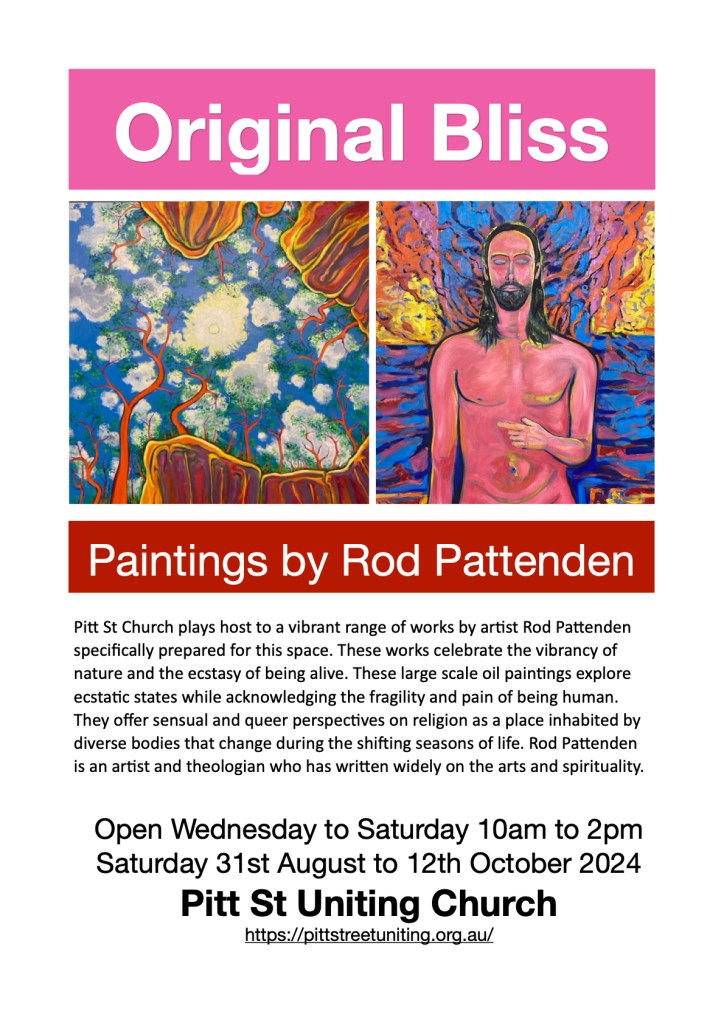
Two years ago, I received a Templeton Foundation Grant focused on ‘Art Seeking Understanding’. This video is a precursor to a larger related book project. In it, I do my best to tell my story, shedding some light on our cultural/religious stagnation.
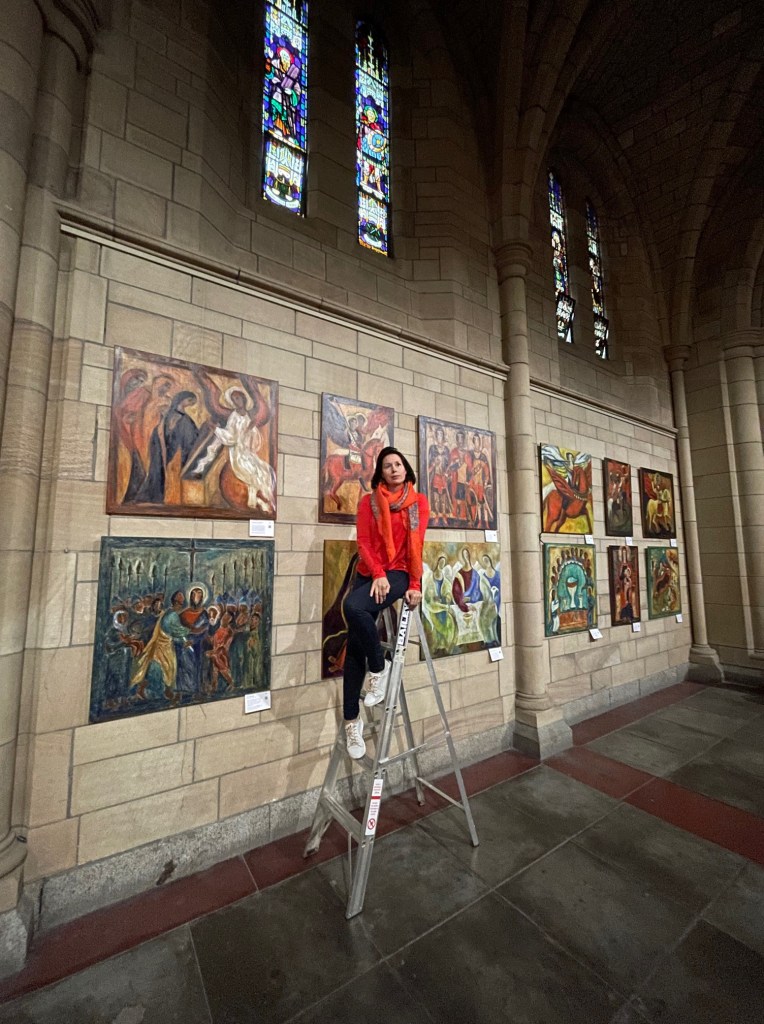
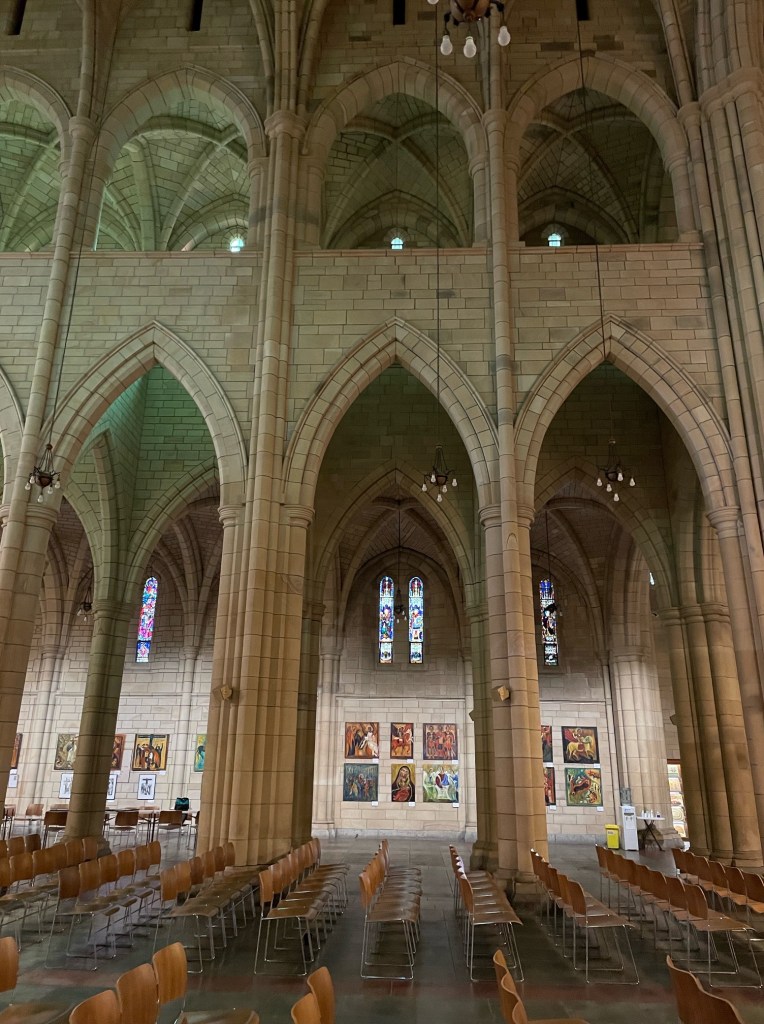
Where: St John’s Anglican Cathedral, 373 Ann St, Brisbane City, Queensland
Opening: Thursday 11 July, 6.30–8.30pm. The opening night will feature classical music performances by Amalia Safonov (vocalist and flautist) and Artemii Safonov (pianist and composer).
RSVP: 0410 197 946
Sailing to Byzantium is an exhibition that blends the sacred art of the Early Renaissance and Byzantine periods with themes from William Butler Yeats’ poem. Hosted at historic St John’s Anglican Cathedral in Brisbane, this collection of recent paintings and sketches invites you on a journey through faith, history, and artistic expression.
The exhibition’s title comes from W. B. Yeats’ poem, ‘Sailing to Byzantium’, which speaks of the quest for eternal beauty and spiritual transcendence. In the poem, Byzantium symbolizes an ideal world of artistic and intellectual perfection, a place where the soul finds peace beyond the physical. This idea connects deeply with the spiritual essence of early Christian art, where every detail holds profound religious meaning.
As someone who has been studying the history of art extensively, I am captivated by the intricate, aspiring abstract designs and joyful colours of this historical period. The luminous golds, vibrant blues, and rich reds are not just decorative but symbolize divine light and the heavenly realm. Each piece in this exhibition is a modern tribute to the craftsmanship and spiritual depth of ancient iconographers and Renaissance masters, aiming to inspire faith and devotion.
Through this collection, I hope to bridge the past and present and invite you to reflect on the enduring power of sacred art. By reimagining these traditional motifs, I aim to create a dialogue between the ancient and the modern, much like Yeats’ poetic journey to Byzantium.
The exhibition invites you to embark on your own voyage of discovery and contemplation. I hope you will enjoy it!
If you’d like to know more about my Christianity-inspired paintings, check out this article.
℘℘℘℘
OLGA BAKHTINA IS AN ARTIST WHO LIVES AND PAINTS ON JAGERA AND TURBAL COUNTRY.

 Art/s and Theology Australia