Seeing Over the Fence: Visualising Trauma and The Royal Commission into Institutional Responses to Child Sexual Abuse

As both an artist and a pastor, I am well aware of the capacity for works of art to bring healing, to provide a container for grief and loss, and to create a future based in hope. I have also experienced the capacity for works of the imagination to break down the supposed barriers between the church and its community, between the holy and the profane, the sacred and secular, and to create a fruitful conversation about life’s meaning. I have great hopes that the arts provide us with resources for engaging the culture we inhabit and for dealing with any of the big difficult issues we face together. But despite these hopes, I am really struggling with how to respond at a visual level to the aftermath of the Royal Commission into Child Sexual Abuse, and the terrible stories that have surfaced into public consciousness. As an artist, I wonder how to help people visualise the trauma and pain of such experiences, and how the Church as an institution allows for this to be made present in sign, symbol, and art making. How might art help the healing process and bring reconciliation and understanding?


Pople Last Supper.jpg
Rodney Pople, Last Supper, 2008. Oil on canvas.


It was about fifteen years ago through my work with the Blake Prize that I first began to observe visual responses to this issue. In 2008, Rodney Pople submitted a work entitled Last Supper, a work that proved to be something of a premonition of the impending crisis for organised religious institutions. A reference to the Last Supper of Jesus with his disciples has been pushed to the back of the picture as something of incidental interest. What takes centre stage is a vast chandelier that seems to shudder under its own weight of self importance. Not a light but a weighted piece of staging that is about to come crashing down. The metaphor is clearly about a structure that has become too focused on its own importance and grandeur, so much so that even the Last Supper has been pushed to the periphery. Rodney Pople went on to deal more directly with these issues. In one of his later exhibitions, held in trendy Paddington in Sydney, a group of pious folk camped outside praying for his soul and for those brave enough to enter the gallery under prayerful siege.

But Pople was correct in anticipating that there would be a shaking of foundations and a rattling of fences. It was during 2015 when the Royal Commission heard stories in the city of Ballarat that ribbons began appearing on the fence of St Patrick’s Roman Catholic Cathedral. They were tied on the fence as a simple memorial to those who had died or still suffer as a result of a history of abuse. This simple act of remembrance has spread quickly around Australia and is now found all around the world. This gesture has, however, not always been well received by those on the inside. Whether it was Church authorities or parishioners there were reports of ribbons being removed. The visibility of the act of colourful ribbons fluttering in the breeze was perceived by some as a protest of anger at the Church or at least a criticism of its silence and lack of visible response. St Patrick’s Cathedral has continued to dialogue with this wider ribbon community and there are now plans for the fence to open up into a memorial garden where a more permanent space of recognition is be created. Through the visual form of ribbons, known locally as the ‘Loud Fence’, boundaries have been shifted and a new more open conversation has begun.

Ballarat Loud fence.JPG

In Geelong, at St Mary’s Basilica, the Loud Fence response took a different turn. One of the key priests on staff actively worked with survivors through the Life Boat Project and with the assistance of a group from a Men’s Shed found a means of preserving the ribbons and the heartfelt gestures that had created them. A container in the form of a boat has been introduced inside the Basilica where ribbons can be permanently stored after they have flown on the fence. This shifts the visual reception of the ribbons to a more permanent memorial where they are being treated with dignity and respect. This boat has become part of the interior fabric of the Church alongside other memorials that remember significant moments of national and local history. What is being preserved is not just silk threads, but the deeply-felt gestures that have been repeated over and over again as people express their sense of grief and loss. Gathering them up for preservation emphasises the importance of these small acts of grief and remembrance. Someone is listening, noticing, seeing. The Loud Fence project looks for a community of people who speak up and act on behalf of those who are victims.

Geelong.jpeg

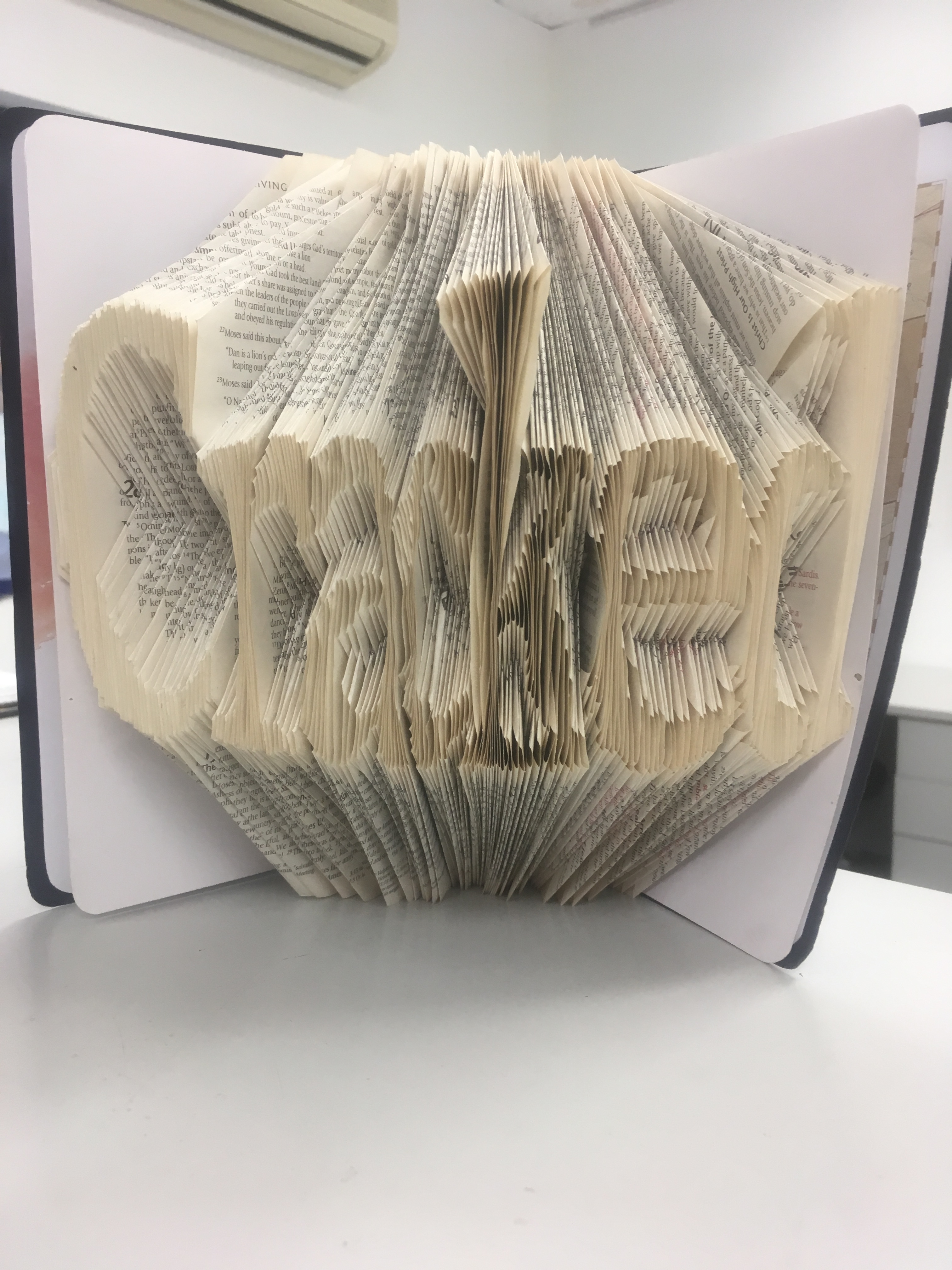
In my local city of Newcastle, like in many cities around Australia, ribbons appear and disappear off the fence of the local Cathedral. It is a disputed space between those who want this to be visible and those who wish it to remain hidden or at least managed out of sight. This is a pressing issue as in my city the extensive volume of abuse and the individual number of stories is staggering. Thousands of people in my local community are suffering the long-term effects of grief and trauma, including their families, neighbours, as well as the educational and religious institutions of the region. It must be one of the largest contributors to mental illness and social trauma in my local community and it is otherwise hidden. But it is also appearing more often in the work of local artists, like in the work Cracked by Janita Ayton. Here, the soft pages of a Bible have been repetitively folded over to spell out the word cracked. This is only observed when the Bible is opened and the word then literally spills out. Clearly, the culture of secrecy and power that once clothed the Church has now been cracked. For the first time in Australian history, the Church has been drawn to public account for its actions, inactions or shameful cover-up. This assumed privilege due to social power or religious authority has been found wanting. The Church is not above the law; it is accountable to the people it seeks to serve.


Cracked.JPG
Janita Ayton, Cracked, 2018. Bible with folded pages.


Cracked is an artwork that visualises the crisis of authority facing organised religion. But it also offers, to my mind, a way forward. When something is cracked, then what is contained inside can get out. Rather than fear being the first response, a response that reinforces denial and secrets, here is an invitation to find within the life of the Church a range of other responses that focuses on victims and those impacted by this history of abuse. The Church has nothing to fear in losing its well-preserved social power if it, in turn, recovers what is at its heart in terms of compassion, forgiveness, and love. Self-preservation cannot be the default position of the Church when facing this sort of accountability in the public square. Here is an opportunity to visualise compassion and a form of agency based on love. The loss to the Church in the face of this ongoing scandal is incalculable, but the opportunity for the Church to renew its purpose will be life-giving and renewing. Cracked leaves me with the possibility of such a hope.

Rod Pattenden is an artist, art historian, and theologian interested in the power of images. He lives and works on Awabakal land.


Visualising the Fanfare

fanfare 2.JPG

Last night, we went to the Christmas Sydney Town Hall Concert. It was a family event organised by my wife Heather; a wonderful gift for our extended family. I sat next to my 8-year-old grandson, Tom, and invited him to anticipate the ‘fanfares’ that came at regular intervals in the concert. The ‘fanfare’ to me is a loud crescendo of orchestra and organ, working together to lift the whole work to another level, and to attract my attention so that I know that something special is happening. I enjoy the way the fanfare calls my attention to something special, and it invites me in to pay close attention.

This morning, I have come into the studio, and with lots of energy have used smaller brushes very freely, energetically, and gesturally, building on a structure made with my freehand scribble that grows from the discipline of decades of looking and drawing to the point that all that drawing influences, shapes, and forms the scribbles that I make. And, in the midst of my frenetic activity on plywood boards, a thought emerged in my head – that what I was painting, and the manner of my painting, was, ‘fanfare’. 

fanfare 1.JPG

I want to use colour, line, subtle layering, and gestural mark-making to announce the mystery for which I have no adequate name. Our culture for millennia has used the word, or sound, ‘God’ to give name to the mystery and centuries of scholars have worked to ‘grasp’ that mystery. Simpler minds (not meant as a derogatory comment in any way), have personified the mystery to make it easier to grasp and to talk about … even to relate to. 

In the concert, the fanfare was used five times, each to announce a special carol or notable verses or stanzas within the carols; each announcing the arrival of someone special (Jesus, Emmanuel, King of Kings, Son of God). In my paintings today, I want to create works that somehow evoke the crescendo of the whole organ and orchestra, working together, calling us to notice that which is special. For me, what is special is that we humans can be aware of the mystery, and then have a willingness to be open to, and, to be willing to be addressed by, (the voice of) that mystery. In so doing, my hope is that the viewers might be enabled to live into the fullness of their being.

℘℘℘℘

DOUG PURNELL IS A PASTORAL THEOLOGIAN WHO IN HIS RETIREMENT IS FOCUSING ON A COMMITMENT TO A FULL-TIME STUDIO PRACTICE OF PAINTING THAT EXPLORES THE NATURE OF ABSTRACTION AND MARK MAKING. HE WAS FOR 17 YEARS THE DIRECTOR OF THE BLAKE PRIZE FOR RELIGIOUS ART. HE LIVES AND PAINTS ON GADIGAL LAND.

Finding Christ in Asia: The Great Disrupter

Emmanuel Garibay, ‘Bathala’, 1997. oil on canvas, 182.88 x 137.16cms. Collection of the artist.

Striding out of the picture plane, this figure of Christ seems to rip through the surface of the work, hammer and crowbar in hand ready to disrupt the very order of things. No gentle saviour or calm man of peace who would be at home in the churches of the middle class, this figure concentrates his gaze on some point situated in the world of the viewer. He is striding with urgency towards an appointment with the future. Two sets of eyes, one fixed perhaps on the viewer, the other on this moment of decision and disruption. This Christ is the Liberator, disturber, prophet, and builder. He has in one hand a hammer to build; in the other a crowbar to pull apart. One can imagine that this tool could have even been useful in pulling out the nails in his hands. This is a figure of fierce passion and decisive action, an unstable, unpredictable force for renewal, the iconoclast, a breaker of images, with eyes on the emerging signs of justice and compassion.


This is the work of Filipino artist Emmanuel Garibay, an artist who has received wide recognition in his native country for his challenging and moving realist images of Filipino society. He is a person of great warmth with a steely eye for injustice and pompous self-righteousness. In a country that is mainly Christian, he scrutinises the conventions and comfortable icons of his culture to shake out the new possibilities of hope and renewal. His works are often funny, ironic, and full of curiosity and compassion. They often represent the poor in dignified roles while upending those in power who are too familiar with their social prestige and the trappings of position. When he turns to religious imagery he is particularly sharp and incisive. This Christ is not a light-skinned person of European origin, which is the manner in which the Spanish depicted the figure during the 400 years of colonial rule. Nor does he fit the glossy expectations of TV evangelists and modern-day miracle workers that have arrived through American pop culture. This is an indigenous Christ, who arises within the culture as a force for hope and liberation.

The European colonialisation of the Philippines stands out in contrast to most other countries in Asia. While the rest of the region has maintained distinctive indigenous cultures and religious expression, mainly through Buddhism, the Philippines has been subject to over 400 years of European colonisation. From the 1540s, the Spanish ruled this chain of over 700 islands, linked closely to trade and cultural links with their Latin-American colonies in Mexico and Cuba. This was followed in 1898 when the USA annexed the country as part of their colonial expansion. The country only found its independence in 1945 after the Second World War, and now boasts a population of over 100 million people. It is a country with a split personality, where the tourist brochures proclaim the citizens as the happiest people on earth, while its inhabitants continue to live under this colonial imagination, held captive by corruption and the forces of globalisation.

Garibay, through his lively and expressive works, provides a sympathetic window into this complex yet wonderful country. He also gives insights into the complex problems of colonisation and the challenge of seeing things as they really are. Garibay’s search for an Asian or indigenous Christ figure is at the centre of his work. In that search, he draws attention to the nature of our situation where we are often blind to the truth of things because we are cultured, because we see things as natural and self-evident when in fact they are mediated to us by our context. Simply put is the image of Christ a European one fair-haired and blue-eyed, or even perhaps a Middle Eastern one darker skin with a curly dark beard? Garibay peals off the skin that sticks to our eyes to realise how conditioned we have been to the figure of Christ who is at home within our culture and rendered as a safe citizen who obeys the laws. This familiar Christ is rather ineffective and finds no vocation as a prophet within our world.  The work Bathala renders the Christ as a disruptor of culture. It is representative of Garibays tendency in all his work, to wake us up to our blindness, and to awaken a Christ set free from stereotypes, churchly piety, and good manners, that in turn may upend the order of the things towards a more just and humane world.

 ℘℘℘℘

Emmanuel Garibay is an important artist from the Philippines who has gained wide recognition in his own country for his social realist painting and drawings. His works have been exhibited in Australia, Europe, and North America. His work has also been widely reproduced through many publications around the world as they explore issues of justice and the search for Christ in Asia. In 2011, the Overseas Ministries Study Centre (OMSC) published a 72-page book Where God Is: The Paintings of Emmanuel Garibaywhich provides a useful full-colour survey of his work.
Rod Pattenden is an artist, art historian, and theologian interested in the power of images. He lives and works on Awabakal land.

Riza Cages

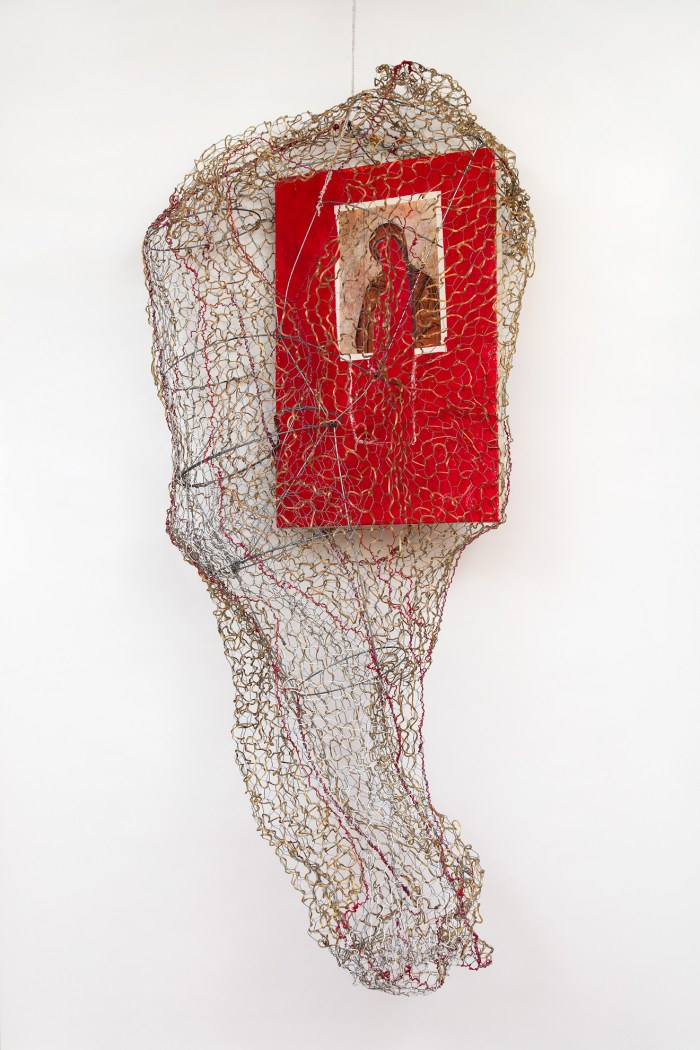
Full of Grace (1).jpg
Alfonse Borysewicz, ‘Full of Grace’ (2017–18), 84 x 34″. Oil & Wax on Linen with Riza Cage.

Two years ago, a friend asked me to make a sculptural piece for her dance company. All of us involved in New York City had limited means and space, as artists are pushed out of this-once art capital. As such, I began to create these shapes out of chicken wire mesh with tomato wire stakes as its armature (the garden), wrapped with electrical/lamp/cable wire (offering a gold leaf like light and hue). Eventually, I filled these voids with paintings of mine and/or crumbled up pages from discarded icon books, thinking of the “throw away culture” so poignantly revealed in Pope Francis’s Laudato Si and of my own attempts to rescue and to recycle these images.

Icons have traditionally employed metal coverings with stones and emeralds, Rizas, to protect the sacred image. Same here. Recently, I met a Ukrainian woman at my art opening who didn’t appreciate what I was doing with her tradition of sacred icons. Slowly, I walked her through my creative process and offered her the possibility that I was not only rescuing these images but liberating them from discarded books, bringing them out into the open. She nodded and had a change of view. As evidenced in Star, a light for us to follow in this Advent season.

Also brought to my attention by various strangers (this is why the viewer is so important in the visual arts) was the realization that these Riza sculptures which to me reveal the sacred icon image outside of book form, as well as my own renderings, were in the shadows – literally, cages – that echo the tragedy unfolding in my own USA, the dystopia of incarcerating immigrant adults, families and children.

Star.jpg
Alfonse Borysewicz, ‘Star’ (2018), 30 x 12″. Collage with Riza Cage.

℘℘℘℘

Alfonse Borysewicz is a Brooklyn-based painter.

A Studio Reflection

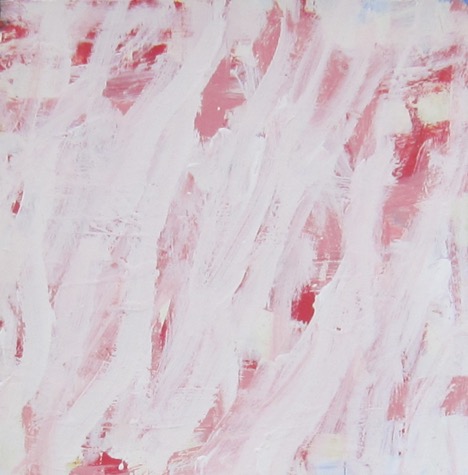
Doug Purnell - Echoes (59cm x 59 cm acrylic on paper).jpg
Doug Purnell, ‘Echoes’ (59cm x 59cm. Acrylic on paper)

I have been trying to articulate how for me as a pastoral theologian the primary text is lived experience. I hold that in conversation with received tradition (which I am asking a lot of questions about), through an act of the imagination, the work of artists, and seeking to discern the voice of God breaking into our world in fresh ways. That is what I feel called to as artist, so I am not trying to represent surfaces, but, with integrity, to create works that are open to the mystery of what is beyond our immediate grasp.

I want to share with you an experience of working alongside my two granddaughters in my art studio. Before they arrived, I cleaned up the mess and made a space for them to work. On the beach last week, I had found a 3–4” long and perfectly formed shell. So I put it out for them, gave them a big piece of board (about 70 x 70 cms) and a pencil, and asked them to draw a big picture of the shell. Pollyanna is 10 and Darby 7. They made their drawings and I put out some paint. I put out a couple of buckets filled with brushes of all sizes and shapes, including dish mops and scrapers. Pollyanna began with a big 7 centimeter brush, painting the background in multiple colours, and Darby began painting the shell. Intriguingly, the shells remained part of their composition, but were not the focus of their action. They began to play with the paint and the brushes and the mark making, and they both came up with interesting paintings. The shells were there, as part of the whole, but were not the main focus.

They wanted to do more paintings. Darby, who I always think has the mind spirit of the artist, found a tennis ball in one of the nearby boxes and asked if she could put paint on it. Then she wanted a large box so that she could put the paper in the box and roll the tennis ball covered in paint around in the box, ‘to see what happened’. She quickly changed to bouncing the paint-soaked tennis ball on the paper lying in the box, and forming a quality pattern in the bouncing of the ball. Pollyanna had her go, again having painted the background first. Nice, splurty, round marks. Then Pollyanna found a rubber wheel with corrugations in the rubber. I suggested making prints on the paper with it, and they were off on another stream of creating. I became intrigued with how they had begun with a specific task – to draw the shell – and had, in a short time, moved into a playful extension that was free, expressive, energetic, and poetic.

Later in the day, I was watching a documentary from 1973 on Painters Painting. Barnett Newman was ruminating on whether painting focuses on the objects painted as the subject of the painting, and whether the subject of a painting could be more than the objects within it. He talked about Cezanne’s apples. Are they the subject of the painting, or simply objects within the painting? He saw them as being like cannon balls, and the painting was much more than the objects depicted within it. What my granddaughters did yesterday was to begin their paintings with an object – the shell. And quickly their processes moved from the shell as the object and subject of the painting to the painting as a process that was more than depicting the shell. That transition – from an object being depicted, to a painting being created – was a very significant step that seems to reflect my own processes as an artist. I sit in the landscape for solid periods. I look and draw and scribble and play and reflect on the object of the landscape. And then I come back to my studio and I play, and I hope that by engaging the process I might make works that go beyond the object of land or face or whatever. It was intriguing to observe and reflect on their processes.

℘℘℘℘

Doug Purnell is a pastoral theologian who in his retirement is focusing on a commitment to a full-time studio practice of painting that explores the nature of abstraction and mark making. He was for 17 years the director of the Blake Prize for Religious Art. He lives and paints on Gadigal land.

Altar/d

During 2018, Adamstown Uniting Church played host to the Altar/d Art Installation series curated by Rod Pattenden, who is also the minister of the Church situated in Newcastle, NSW. The title of the series was a play on the words ‘altar’ and ‘alter’, and invited responses about change, transformation, and hope. Six artists were chosen to display work in the body of the church and to take on its architectural form while continuing the interests of their own practice. In this video, Rod Pattenden highlights the features of each artist’s work and the responses they found among the ‘congregation’ of viewers. The video was produced by John Cliff.

Rosemary Valadon: A Sensual World

This documentary, which recently aired on the ABC’s Arts Channel, looks at the life, influences, and work of multi-award winning painter Rosemary Valadon. The artist explores a space for feminine self-actualisation as well as a distinctive spirituality. Valadon won the Blake Prize of Religious Art in 1991 with a work that drew criticism for its lush sensual nature. While offering a survey of her art practice, this beautifully-crafted film is framed by the seasonal changes evidenced in the place where she lives and works, the remote rural community of Hill End. This frames the influences on her life as she recounts the stories of her upbringing, her experiences as a mother, dealing with a diagnosis of breast cancer, and the joys of renewed success and interest in her work. It’s a delightful survey that evidences a rich and lived sense of spirituality.


 ℘℘℘℘

Rod Pattenden is an artist, art historian, and theologian interested in the power of images. He lives and works on Awabakal and Worimi land.