The Trance

In my head was an ocean of thoughts,
And monologues of indistinct voices
Floating, trying not to drown

In my depths of silence.
Faceless entities broke through my mouth
And spoke to the wall with my eyes closed.

But no sleep— just teleportation
Through nostalgia’s portal.
No amount of noise was enough

To pull my eyes back to life.
I hoped to doze off and dive
Into the waves of my mind

In the light’s absence. Here,
The darkness was the screen
Framing the invisible

Like a monochrome photograph.
So, I swiftly clapped and clasped
My hands to trap the elusive entities.

In poetry’s mystical conjuring.
I hoped to wake in a dream
Where my mind becomes a small room

Peopled with voices urging me
To keep going, without showing me
The way. Sometimes, I listen

To dying whispers
Singing life into my ears.
Like Milton, dark is the sight I wield

In the socket of my skull, but not
My foresight of the road ahead.
Sometimes, I feel like a seer

Who has seen it all, but
To what end? Through this tunnel
I go, making the narrow path

My only map in and out
Of my hallucination, because
I must chase this shadow.

I keep running after this tail of mine
That leads my head
In a soothing cycle of trance.

℘℘℘℘

Tukur Ridwan is a Nigerian writer and the author of three poetry chapbooks. He serves as a poetry mentor with the SprinNG Writing Fellowship, and, in March 2018, he won the Brigitte Poirson Monthly Poetry Prize. His work has appeared in publications such as Aké Review, Poetry Potion, Coalition Works, Stripes, Engendered, Afrocritik, and ArtisansQuill, among others.

Photo by Rasmus Ødegaard on Unsplash.

Haikus to Him

Gold light shatters the
mornings of mourning, divine
prayer slips from mouth

shame skewers pride’s lung.
God commands me to talk. I
do not know how long

has passed. Words sizzle,
cumin seeds in burnished oil.
Delayed meal tasting

like only joy can.
Hearts-to-hearts require response
says my forlorn heart.

Knees dig into earth
the metaphor eludes me
answer me, I plead.

Give me a sign. One.
Dusk shatters through my waiting
God answers in silence.

℘℘℘℘

Aatiqa Mankani is a student poet currently based in Vietnam. When not writing, she enjoys reading about history and exploring nearby museums.

Photo by Tin Ly on Unsplash.

Shostakovich String Quartet no 8 in C Minor

Faster        faster                even faster 
Fly the wheels of industry – turningturning
Hurry hurry keep moving never stopping
All is synchronization regimentation

We the workers cannot stop
The machines ever smarter ever smarter swallow us
Faster faster ever faster
humming like insects
The machines talk to each other, a frenzied tune

We workers cannot sing sweet songs anymore
Our music is crushed like grapes by the sharp blades
Of the machines that command that control us

Only the whispers of a few old men resound in these
Haunted halls -- muttering bbbbbbbbb ggggggggg
Endlessly screeching tzzjxzprtz! myzzxltwz! unintelligible
Lamentations – for the dead.

℘℘℘℘

Norma Felsenthal Gerber is an educator, journalist, and photographer whose work spans literature, public affairs, and the visual arts.

The love I bear thee, finding words enough

After Elizabeth Barrett Browning

Gods are like clouds, rain, rainbows; you can see &feel but can’t touch
God chatting in the forest, among the trees,
God is justice, not books
Light shines, out in the darkness
The subconscious energy guides your body
The void within you drives you to express.
You have given life to me, you have given joy to me
You gave what was behind me
You will give what’s ahead of me
Her ways are many, her ways are mysterious
Her interpretations are many, her meaning is one
She’s an editor, changes my manuscript
Holding your voice deep within
Filling with feelings of pleasure to treasure
There’s a certain slant of light, there’s a certain slant of sight
Thanks to the morn, thanks to the noon
Thanks to the flower, thanks to the valley
This blessed life, this blessed grace
To act, to find, to feel, to live
Poems are written by bores like me
But only God’s grace showers freely

℘℘℘℘

Pulkita Anand is an avid reader of poetry. The author of two children’s e-books, her most recent book is we were not born to be erased: an eco-poetry collection. She has also published in New Verse News, Green Verse: An Anthology of Poems for our Planet (Saraband), Comparative Women, Origami Press, Asiatic, Inanna, Bronze Bird Books, SAGE Magazine, The Sunlight Press, and elsewhere.

Photo by Tom Barrett on Unsplash.

Finding Sacred Ground in the Suburban Ordinary: Paul Mitchell’s High Spirits

Paul Mitchell, High Spirits. Puncher & Wattmann, 2024.

In an era when poetry often retreats into obscurity or dissolves into mere confession, Paul Mitchell‘s High Spirits offers something refreshingly different. Reviewed by Jason Goroncy in TEXT Journal, this collection demonstrates how poetry can be both deeply personal and universally resonant, spiritually grounded yet artistically sophisticated.

Mitchell’s work achieves a delicate balance where the spiritual illuminates the mundane without overwhelming it, where the sacred emerges from careful attention to the world as it is. His poems capture the texture of daily life – family dynamics, the rituals of domestic existence, even conversations about Bunnings that blend seamlessly with apocalyptic imagery – while extending beyond the personal to encompass broader cultural and environmental concerns.

One thing that distinguishes this collection is Mitchell’s conversational tone that feels like overheard conversations with a particularly thoughtful friend – accessible without being casual, profound without being pretentious. Whether satirising Australian suburban masculinity in ‘Weekend Warriors of the Apocalypse’ or writing an epistolary meditation to Franz Kafka, Mitchell demonstrates remarkable range and wit.

The collection’s fundamental conviction is that the world is enough – not through complacency, but through hard-won wisdom. Mitchell’s terrific humour never cheapens the gravity of human experience but illuminates it from unexpected angles, finding epiphanies of grace amid chaos.

In a cultural moment characterized by cynicism and fragmentation, High Spirits suggests that careful attention to the ordinary might reveal it to be, if not perfect, then sufficient – and perhaps, in its sufficiency, sacred.

Read the full review here.

Two poems: ‘Sensitive’ and ‘The Janitor’

Sensitive

Sensitive
is
a
word

that
shivers
off
the
tongue

expecting
a
laugh

instead
silence,
only
quiet.


The Janitor

I’m
happy
where
I’m
at

pushing
the
dustmop

I’m
in
the
light.

℘℘℘℘

Danny Barbare’s award-winning poetry has been published widely, most recently in the Birmingham Arts Journal, Pennsylvania Literary Journal, Blue Unicorn, California Quarterly, and many other online and print publications. He lives with his wife and his sweet dog Oliver, a Boston Terrier, in Simpsonville, South Carolina.

pentecost

Chiharu Shiota, Absence Embodied, 2018. Bronze, plaster, and red wool. Art Gallery of South Australia, Tarntanya– Adelaide, Kaurna Country.

in wind & flame
they felt acknowledgement

fill that room stronger

than any wind felt before
these gales of rushing promise

Spirit sent flames astounding

light dazzling all who were 
there not speechless but into

all speech forever one tongue

of many flaming voices moving 
all, filling all, powering all

with surge of bright burning

receiving His love of 
dove descended blaze.

℘℘℘℘

Ed Higgins is an American poet and short fiction writer whose work has appeared in various print and online journals. Ed is Asst. Fiction Editor for Brilliant Flash Fiction. He has a small organic farm in the United States of America, where he raises a menagerie of animals, including a rooster named StarTrek.

Roberta’s Grace

I.
The west-to-east wind
breathes the leavings
from a few naked groves 
across to up against 
where there’s no more field;
it creates a waiting
on the verge of woods like an
invasion.

But the fodder stays, relents
puts up no fight
shows itself in piles
to the lorn few
or the theologians or the simple
or the true
in all this angled light
the small houses
the spare lots, the pines
the hardwood
all are convinced
the dry months
will come
and cold.
And cold.

II.
Roberta smiles through broken glass
of west facing windows
sees highways cracked and broken,
road-tar having oozed
from a thousand Augusts, now
as still as Rome.
She smiles without knowing that
her own empire stumbles
and falls down
to only a trace.

As the day turns red
out towards Columbus
she watches as some lights
come-on
beyond a hedge
out under where 
the linings of
clouds make 
bloodshot edges.
The sky behind 
has already lost blue for gray
for black
and Roberta chuckles
at all the overlap
the lifespans make,
shortening our idea
of forever.

III.
The grace of those numbers
too big to consider
the size of that sky is there
whether noticed
or not and the God of such distance
as to be here and here
soaks Roberta’s fabric, utterly.
And what she wears
can’t lose its weather
being a host
for those things
never to be
tagged.

℘℘℘℘

L. Ward Abel’s work has appeared in Rattle, Versal, The Reader, Galway Review, Main Street Rag, and elsewhere. He is the author of four collections and ten chapbooks of poetry, including his latest collection – Green Shoulders: New and Selected Poems 2003–2023 (Silver Bow, 2023). He is a retired lawyer and teacher of literature, and he writes and plays music. Abel resides in rural Georgia, USA.

Light’s labour


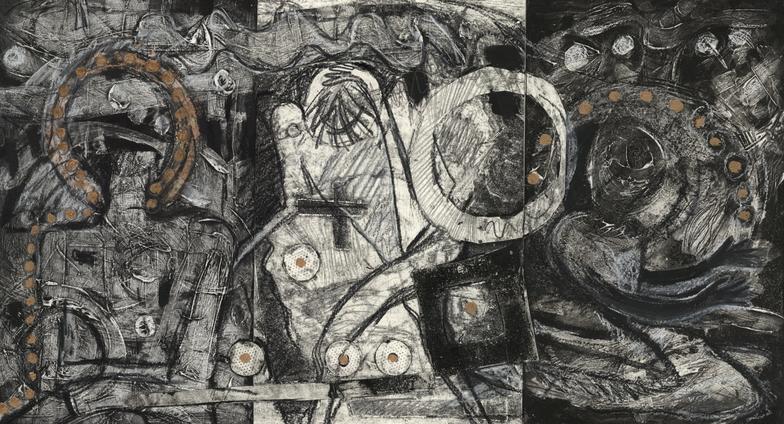
Fred Williams, Sapling Forest, 1962. Etching, 13.7 x 20.2 cm. Private collection.

Believing in the Light you shall not abide in darkness’. – George Fox (1654)

Light’s labour
is to tell darkness back,
push it toward eternity’s edge –

although much darkness slips back
through, grieving the hearts 
of all who must live here.

Like lead, darkness weighs
nearly as much as gold.

But Light’s feel 
is the alchemy of love
falling in bright colour, 

as stars sometimes do,
back to earth’s gravity.

There turned to chemical
(even among fireflies)
it burns gold-like

attracting more love still,
across open hearts,

against night’s threshold.

℘℘℘℘

Ed Higgins is an American poet and short fiction writer whose work has appeared in various print and online journals. Ed is Asst. Fiction Editor for Brilliant Flash Fiction. He has a small organic farm in the United States of America, where he raises a menagerie of animals, including a rooster named StarTrek.

Pure Land: A Haiku

Colin McCahon, As There as a Constant Flow of Light we are Born Into the Pure Land, 1965. Synthetic polymer emulsion on hardboard, 59.8 x 180 cm. Christchurch Art Gallery Te Puna o Waiwhetu, Christchurch, Aotearoa.

loved in Pure Land – awe
– four generations fam, friends –
fortunate – poof gone

℘℘℘℘

Gerard Sarnat is an American poet, aphorist, and humorist. His work has been widely published in journals and newspapers. He currently serves on the board of Climate Action Now.