Broken Vessel

broken body
broken heart
forever hanging
held by
the crying love of the Spirit

his wound
my hurt
our blood mixing together

his open arms
my nailed hands
pierced together

we share
the birth pain
we partake
the letting go

we release
the life to become
we form
the theology from the womb

we groan
with hope
we sob
with agony

until
creation is fully alive
until
lives flourish without blemish

℘℘℘℘

XIAOLI YANG IS A THEOLOGIAN, POET, AND SPIRITUAL DIRECTOR. SHE LIVES AND PLAYS ON WURUNDJERI LAND AND IN THE MIDDLE KINGDOM.

Liminal Space

Picture1.png

I stood between the Atlantic Ocean and the Pacific Ocean recently, watching an ocean liner passing through the Panama Canal. The giant ship was moving slowly, almost unnoticeably, between the narrow banks. With the help of locomotives, the gigantic body of the ship was moving forward within 60cm of the banks on each side. Yet the liner needed to trust the water to uphold her body and the locomotives to take her through the narrow canal. During the 8 minutes of waiting between the gate to the lock and the valve, she patiently waited for the water to gradually reach another level. She did not stop moving forward – however painfully slow and helplessly depending on the water below and the need to trust the engines beside. She envisioned the wide-open sea ahead that would eventually embrace her after this bottleneck and then 8–10 hours of transit on the canal.

For me, this is a perfect image of a liminal space. It is an in-between space, a transition and a threshold. It is the time between the ‘what was’ and the ‘next’, a place of waiting and not knowing, a place of now and not yet. The wise tell us that it is also a place of transformation. In the waiting, we let it form us. However, we often find ourselves caught in the process and still waiting for the moment of transformation. We can experience various degrees of uncomfortableness, disorientation, dizziness, grief, vulnerability and even bodily reactions like tears or tiredness in this space. We may feel restless and disorientated. We may feel lonely and that we have got into a dark hole not being able to get out.

Like a hen hatching an egg, the egg has been broken yet life is yet to be formed. We don’t know what it will become. There are mixed feelings of grief and hope, fear and uncertainty, waiting and expectancy. Like on a stormy sea, we feel dizzy and sick, not being able to survive, left alone holding the wheel and steering the ship. Like Tom Hank’s film Terminal, we are caught between two countries, rejected by both and stuck in an airport going nowhere.

This is the world we live in – global displacement, refugee camps, migrant movement, political trauma of native people, villages overtaken by shopping malls. People are on the move globetrotting yet don’t talk to the neighbours across the street. Despite the ever-increasing speed of technology, we find ourselves more and more isolated and lost. Anxiety and frustration creep in and continue to fill this age, as if we are ‘waiting for Godot’ who will never arrive.

How do we navigate our own lives of transition? How do we live in an age of postmodern displacement and dislocation? As we open the pages of the Bible and lift our gaze to the Crucified one, we find a God calling his people out of comfort zones to a place of discomfort again and again whether it is in Exodus or in Exile. It is the same God who woos them to the place where they truly belong, somewhere they call home. This paradoxical place they stand on is the biblical liminal space, somewhere between the wilderness and the Promised Land, between homelessness and home. In the New Testament, the disciples were called from a self-assured life to the way of brokenness. In the light of the Cross, they wrote the Gospels and Acts, which heralded a new human history. The Spirit of love breaks in, speaks to the womb and brings the darkness to the light, brokenness to transformation, nothingness to everything.

This awareness gives us hope and vision to live here and now fruitfully and welcome the invitation to go deeper in our faith – to listen attentively, struggle genuinely, and question authentically even with our uttermost nihilism. The liminal space is the richest mine to explore this treasure, and trust courageously the hidden fingers that guide us.

Liminal Space

invites us
to put our ears
on the ground
to hear the sound
from the basement
of our hearts

to enter into the room
with courage and curiosity
to push darkness
to touch the unknown
to dance in-between the gap
though our senses are numb
our eyes are blind
our voice has no sound
till we are used to this hollow ground

nobody, nothing, nowhere
breathless
sleepless
restless
timeless
thoughts tangled in a mass
sweat intermingled in a pool

our bodies move
struggle
exhaust
collapse
…………..let go

whatever comes
whatever emerges
whatever settles
the divine surgery
…………..let come

℘℘℘℘

Xiaoli Yang is a theologian, poet, and spiritual director. She lives and plays on Wurundjeri land and in the Middle Kingdom. Details about her latest publication can be found here.

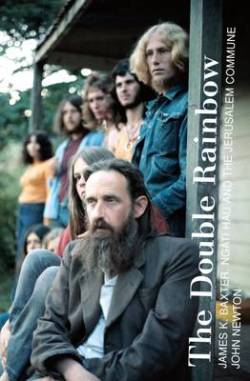
‘“Jerusalem” was never an alternative to the poetry; it was part of it’. A review of John Newton’s The Double Rainbow: James K. Baxter, Ngāti Hau and the Jerusalem Commune

the-double-rainbow.jpgJohn Newton, The Double Rainbow: James K. Baxter, Ngāti Hau and the Jerusalem Commune (Wellington: Victoria University Press, 2009). 224 pages. ISBN: 9780864736031.

John Newton’s engaging book, The Double Rainbow: James K. Baxter, Ngāti Hau and the Jerusalem Commune, examines the Ngāti Hau community that Aotearoa’s best-known poet James K. Baxter was instrumental in establishing at Hiruhārama, on the Whanganui River – ‘the country’s first and most influential experiment in “hippie” communalism’ (p. 38). As Newton notes in his Introduction:

The double rainbow is Baxter’s symbol for a mutually regenerative bicultural relationship. He recognised that the Pākehā majority ignored Māori culture, not just to the cost of Māori … but also to its own detriment. Pākehā, he wrote in 1969, a few months before he first moved to Jerusalem, ‘have lived alongside a psychologically rich and varied minority culture for a hundred years and have taken nothing from it but a few place-names and a great deal of plunder’. Pākehā culture’s material dominance was accompanied by an arrogance and ethnocentrism which left it spiritually impoverished.

He cites Baxter:

‘Ko te Maori te tuakna. Ko te Pakeha te teina …’ The Maori [sic] is indeed the elder brother and the Pakeha [sic] the younger brother. But the teina has refused to learn from the tuakana. He has sat sullenly among his machines and account books, and wondered why his soul was full of bitter dust …

And then offers the following commentary:

The cost was everywhere to be seen, but nowhere more plainly than among urban youth. For Baxter, their wholesale disaffection was a realistic verdict on the society they had inherited, a mainstream culture whose spiritlessness and meanness – to say nothing of its arrogance towards its neighbours – deserved no better. In the Māori world, by contrast, and particularly in Māori communalism, he believed he could see an alternative to this atomised majority culture – a system of values that answered to the longings and frustrations that he recognised, both in himself and in the young people around him. To establish an alternative Pākehā community that could ‘learn from the Maori side of the fence’ was to help restore, symbolically, the mana of the tangata whenua and to begin to resuscitate a Pākehā culture that was choking to death on its own materialism. (pp. 11–12)

Such constitutes the earth from which a functioning intentional community at Hiruhārama budded, a community made up largely of those for whom mainstream Aotearoan society meant fatherlessness.

While concerned to not diminish Baxter’s part in the formation of the Ngā Mōkai community but rather to place it in the context of a larger ‘utopian experiment’ (p. 88) he initiated, Newton seeks to ‘offer a stronger account of what Baxter achieved at Jerusalem by bringing into focus its collaborative dimension’ (p. 16). He properly contends that what the 41-year-old Baxter set in motion, and towards which the baby-boomer ‘orphanage’ of the damaged which was his living poetry bore witness to, was something considerably bigger than Baxter himself, and that the unique cohabitation and set of cultural negotiations which was embodied in the Whanganui River communities (particularly Ngāti Hau, Ngā Mōkai, the church – which was ‘threaded through the life of the river’ (p. 59) – and the Sisters of Compassion) draw attention to implications far beyond both Baxter or to the communities themselves. This, of course, is of the essence of Baxter himself, that before he was a hippie, he was ‘a Catholic, a Christian humanist, and an aspiring Pākehā-Māori’ (p. 36), he was a poet-prophet charged not simply with interpreting the social environment which he inhabited, but of actively improving it, of giving material shape to it. The book is loosely divided into three main sections: an introductory phase that addresses the pre-history of the community and Baxter’s first year of residence; a middle section that covers its heyday; and a downstream phase that describes the community’s various offshoots, and considers its legacy. The result – for the reader prepared to follow the narrative – is the stripping away of ‘cultural safety’.

Newton details further upon what we know of Baxter from other places while eloquently introducing us to a host of other equally-fascinating characters – Father Wiremu Te Awhitu, pā women Dolly, Alice, Lizzie, and Wehe (who are often remembered as ‘substitute’ mothers (p. 89)), Aggie Nahona, and Denis O’Reilly among them. He also highlights Baxter’s visionary kinship with French-born nun Marie Henriette Suzanne Aubert with whom he shared ‘a staunch commitment to Māori, and to spiritual love as the first principle of a hands-on social mission’ (p. 45). Newton argues that this part of Baxter’s history ‘doesn’t get acknowledged in Baxter’s rhetorical point-scoring at the expense of the mainstream church. Without it, however, his own Jerusalem “orphanage” would never have eventuated. In one sense the debt is symbolic or poetic: the presence of the church at Jerusalem draws te taha Māori into dialogue with the other key spiritual driver of his later career, namely his Catholic faith … Baxter brought his showmanship, and his personal (some might argue, narcissistic) sense of mission. But he also brought with him – embodied, or enacted – the self-interrogation and social radicalisation that had seized hold of the Catholic Church globally in the wake of Vatican II. After the Berrigans and the draft card burnings, after liberation theology, what did the Christian mission imply in the context of ongoing colonial injustice?’ (pp. 46, 47).

Jerusalem was Baxter’s riposte to all those Pākehā institutions – the churches, the university, the nuclear family and so on – whose lack of heart and small-minded materialism were now failing Pākehā youth in the same way that Pākehā culture had always failed Maori. In looking for a remedy for the failings of Pākehā society, he found his prime inspiration in the communitarian virtues that he saw among Māori: aroha, mahi, kōrero, manuhiritanga. This was ‘learn[ingJ from the Maori side of the fence’: his community was to be modelled on the marae. Of course, in offering this open door the commune depended entirely on the hospitality of Ngāti Hau … But the commune was not just a place to live – a material shelter for whomever happened to be there … it was also a piece of political theatre. And the commune’s significance as a political intervention depended for its fullest expression on publicity: it was intended, at least in part, to be a spectacle, a City on a Hill! At the same time, it was integral to the kaupapa that it be open to all comers. This was the paradox that Baxter was confronted by: the more effectively this vision was communicated, the more would it lead to a pressure of numbers that would overwhelm the commune’s own capacity to provide for itself, and which eventually must wear out the patience of the local community. (p. 65)

Yet Newton is at pains to point out throughout his study that Hiruhārama is bigger than Baxter. Indeed, the bulk of the book is given to defending and illustrating this thesis, that Hiruhārama after Baxter entered into a period of unforeseen maturity, and particularly the maturity of its relationship with the pā. Community life under Greg Chalmers’ leadership may have been less eventful, but those years from 1972 do more to fulfil Baxter’s hopes of regenerative partnerships than those prior.

Two chapters are concerned with articulating the events birthed following the final closure of the community at Hiruhārama, and to highlighting that while a distinctive phase of the Ngā Mōkai narrative had reached its end, its impulse didn’t die with the community itself. Newton draws attention to a network of loosely affiliated houses – from flats and private homes, to crashpads and urban shelters, to far-flung intentional communities – which functioned as homes-away-from-home for a diasporic Ngā Mōkai whānau, a ‘network of initiatives which imported the Jerusalem kaupapa back into urban contexts’ (p. 154), and there ‘offering a dispersed community the chance of reconnection, reaffirmation and renewal’ (p. 164). He recalls Hiruhārama’s various germinations at Reef Point, Wharemanuka, and Whenuakura. ‘With the shutting of the original commune, these “shoots of the kumara vine” [became] the focus of the Ngā Mōkai story. It’s here, in this ramshackle archipelago, that those who had been touched by Jerusalem attempted to keep alive the kaupapa’ (p. 131).

The penultimate chapter, ‘Baxter’s Wake’, re-spotlights Baxter, and is given to argue that Baxter’s literary legacy and his social legacy are ‘shoots of the same vine’ (p. 169):

‘Jerusalem’ was never an alternative to the poetry; it was part of it, its logical destination, even its most vivid accomplishment. In his burial on the river we find Baxter the poet and the Baxter the activist inextricably entwined. This integration was precisely his ambition, and the fact he achieved it is what makes these events still resonate. (p. 171)

So Newton appropriately accentuates Baxter’s formulation of the poet’s ethical task to be no mere interpreter of society but one who endeavours to make society more just: ‘It is this sense of embodied ethics … which leaps into focus when we think about Jerusalem’ (p. 179).

The Double Rainbow is the fruit of an incredibly-impressive amount of extensive and laborious research. Newton commendably resists romanticising Baxter, Baxter’s vision, or the Ngāti Hau ‘classroom’ itself. Those engaged in Baxter’s work and who want to better understand his Jerusalem Daybook or who are interested in his biography, those seeking to understand, assess, and inform Aotearoa’s multi-cultural, historical, and spiritual landscape, those wanting to listen and to speak intelligently into contemporary debates about the relationship between government authorities and badge-wearing gangs carving out their own neo-tribal identity, and, more broadly, to a nation fascinated with re-carving a new national identity which buries settler mono-culturalism in its wake, and those devoted to the challenging work of inspiring, creating, leading, building, replanting, and closing local and grassroots communities will be well-served to have Newton’s essay in hand. An invaluable and timely record, it is also certain to inform, impress and inspire.

℘℘℘℘

JASON GORONCY IS A THEOLOGIAN, ARTIST, AND TRY-HARD POET WHO LIVES AND PLAYS ON WURUNDJERI LAND.

I come to You with Nothing

I come to You with Nothing
dark abyss and empty
sometimes I pretend
sometimes I avoid
sometimes I hide.

But if I came to You
with my hands full
I would not be able
to receive anything.
You.

You spun heaven and
earth and light and
dark and land and
sky and birds and
beasts and me …
from Nothing.

You are not afraid of it,
the possibility of it,
and nor shall I be.
Dark abyss and empty
potential.

℘℘℘℘

Talitha Fraser is a Kiwi urban contemplative theopoetics-dabbler who lives ON WURUNDJERI LAND. Her poems and reflections can be found at itellyouarise and thelightanddarkofit.


God, did you see the news today?

God, did you see the news today?

We’re killing one another.
We’re killing in places killing has gone on so long we don’t know how to stop …
We’re killing next door.
We’re killing one another.

God, did you see the news today?

We’re laying waste to the world
to consume, consume, consume
an appetite “stuff” cannot sate.
Our elders know. Our elders tell us.
We ignore their wisdom.

God, did you see the news today?

People are saying hateful, hurtful things
what is right, what is wrong
what is holy, what is profane
… as if we know. As if we could know.

God, did you see the news today?

Were you there when we turned the boats away?
We are denying people food, electricity, sanitation, shelter, medical care…
We are denying people their basic human rights.

People are grieved and weary.
Longing for a world that is different
but not knowing where to start.
Not knowing how to start.
All victims, variously blind.

I’m not pointing fingers, I’m raising my hand.
I need Your help. We need Your help.

Amen.

℘℘℘℘

Talitha Fraser is a Kiwi urban contemplative theopoetics-dabbler who lives ON WURUNDJERI LAND. Her poems and reflections can be found at itellyouarise and thelightanddarkofit.

For Leo, my Son, named after Lion

Will Small has been writing and performing poetry for about a decade. He uses poetry to explore unresolved questions, frustrations, doubts, and hopes, and to try to understand the world – or to surrender lack of understanding.

He is also the father of two sons – Noah and Leo. Throughout his life, he has heard people express fears for the safety of their daughters. He writes: ‘It only struck me recently that we should be equally afraid our sons could be part of the reason for that fear. In whatever way I can, I want to teach my sons to be brave and gentle, strong and sensitive, courageous and humble. So a year ago, after Leo was born, I wrote him the words in this poem’.

It’s a good meditation on masculinity.

Christ You Made Me Wait

Christ
You made me
Wait

So long
Patience
Perfected
Her work
And now

I can leave you
Waiting
Too

℘℘℘℘

CHRIS GREEN IS PROFESSOR OF THEOLOGY AT SOUTHEASTERN UNIVERSITY IN THE USA. HE IS THE AUTHOR OF SEVERAL BOOKS, INCLUDING SURPRISED BY GOD AND THE END IS MUSIC, BOTH PUBLISHED BY CASCADE PRESS. HE IS ALSO A VISUAL ARTIST.

The Only Christ I Know

He was there, I was there
And no one else besides

His body blacked
And yellowing

Riven-red and starved
Who are you I said

I am
Who you are

And my body at once opened
Bright with its own scars

℘℘℘℘

Chris Green is Professor of Theology at Southeastern University in the USA. He is the author of several books, including Surprised by God and The End is Music, both published by Cascade Press. He is also a visual artist.


Prayers of a Secular World: A Review

Prayers_FC_HR1Prayers of a Secular World. Edited by Jordie Albiston and Kevin Brophy; introduction by David Tacey. Carlton South: Inkerman & Blunt, 2015. 160pp, ISBN: 978-0-9875401-9-5

Way back in 2015, so three Prime Ministers ago, Inkerman and Blunt published a new anthology of work, a beautiful little book by an impressive range of some 80 mostly-Antipodean poets, some very well known, others hardly at all. The collection, Prayers of a Secular World, was edited by Melbourne poets Jordie Albiston and Kevin Brophy, and is introduced, fittingly so, with a brief essay by David Tacey on the religious nature of secularism. The latter helps to orient the reader to some of the terrain they are about to enter.

In their call for submissions, the editors said that they were ‘looking for poems of wonder and celebration, poems that mark the cycle of the day – dawn, midday, evening, night – the seasons, the progression of planets, the evolution of weather; poems of becoming – first steps, first words, transitions, epiphanies and inspirations; poems of belief and of doubt, pleas for protection, poems of remembrance and blessing, of forgiveness and redemption, poems of gratitude’. Short of the sternest editorial policing, such an invitation almost guarantees, more than most edited collections I think, the kind of hotchpotch smorgasbord of aptitude evident in the volume’s final form. Still.

The book’s title – which echoes Donna Ward’s claim, in Australian Love Poems, that ‘poems are prayers of the secular world’ – appears, at first glance, to promote the somewhat late-Victorian idea that poets are the new priests. But the pages therein are marked by a welcome avoidance of such presumption, their words occupied with patterns of time and of place, of dying and of encountering the world anew, and with the sounds of landscapes mostly suburban, where the majority of its readers, no doubt, dwell and pass through. In a review published in The Australian, Geoff Page noted of the title: ‘They are certainly not be [sic] “prayers” in the intercessory sense but they are contemplative and very likely to widen and diversify the metaphysical sensibilities of all but the most hardened of fundamentalists – who, no doubt, already have their own (more limited) rewards in view’. This is a point worth repeating, especially perhaps for those uncomfortable, in Tacey’s words, with the notion that ‘the transcendent doesn’t happen elsewhere, apart from the world, but is a dimension of the world’. Still, the publisher’s description of the book as ‘a meditation on living in a post-religious world’ strikes me as very odd – odd not only as a sketch of the book’s content, but also odd in terms of its assessment of things. Observers of the cultural landscape of our day might well inquire what world exactly is being spoken of here.

There is, for many, the perennial temptation to will oneself into a kind of authenticity. Such efforts are an expression of a romanticism that either refuses or forgets to weave into the solidest realities a knowledge of its loss. The result is, as the poet Christian Wiman has observed, a ‘soft nostalgia’. There are here, happily, a good number of notable exceptions to what might otherwise be merely another unwelcome example of such, of groping disorientated by a handful of tamed Emersonian ghosts trying to iron out the highs and lows of life apparently naïve to the view that our being of dust does not equate to an uncritical defence of some pathetic form of natural theology. In this volume, poems by Chris Wallace-Crabbe, Andrew Lansdown, Fiona Wright, Robyn Rowland, Debi Hamilton, Ron Pretty, Anne Elvey, Michelle Cahill, and David Brooks, for example, serve this end particularly well. So do, I think, these two contributions:

‘Da Barri Barri Bullet Train’, by The Diwurruwurru Poetry Club with Mista Phillip

we bin get up with mista an habim gooda one feed
we bin jumpin da mudika
an millad bin go lunga bush
mimi an kukudi bin come too
an dey bin singim kujika
dey bin learnim us mob
for sing im kujika
we likim learn for sing us mob kujika
wen us mob bin lyin down in da darkes
darkest night I bin look da barri barri
e bin movin really really like da bullet train
I bin hold ma mimi really tight
da fire us mob bin make next ta millad mob
poking tongue like a big one king brown
an millad mob listen noise one side na water
must e bin da buffalo drinkin water
den us bin listen da croc bin snap da buffalo
da gnabia out there too
an he bin make us mob so frightn
but ma mimi bin sing out
hey you mob stop all da noise
ma mimi bin start to sing
da song na us mob country
sing in da old language
dem old people did sing
an make millad mob so shiny an strong
an I bin lyin da listen na mimi
I bin feel really really safe
den I musta bin go sleep

And

‘Eucalyptus Regnans’, by Meredi Ortega

for Brandi

that was some fiery trajectory you took, moving to Kinglake
to be among giants and clouds
I recall you dying once before
…….. .. run down at the crossing, going home for lunch

but you’re on Yea oval, among the nightied and discalceate
and you’re okay
road posts gone
all delineators and signs, the way forward and way back
…….. ..only black stags, ash deafening

one charred fence post
and your old weatherboard like a kind of gloating, it falls to you
…….. ..to be the lucky one
better to believe in regnans than luck, they have what it takes
martyrdom, lofty sentiments
…….. ..all crown and nimbus and resurrection

up on the mountain, no one knows if lyrebirds
are mimicking silence
…….. ..volunteers go into the wasteland, leave songs out
musk and fern and siltstone tunes

it rains and then some
…….. ..and the green is giddying
stags wash white, their millioned saplings serry
…….. ..knit roots, squeeze out the other then each other
ashes move up the escarpment and up
to the yellow-raddled cockatoo, yellow-eyed currawong, to the sun
and you are in the very dawn of things

℘℘℘℘

Jason Goroncy is a theologian, artist, and try-hard poet who lives and plays on Wurundjeri land.