Premonition: Paintings and Drawings

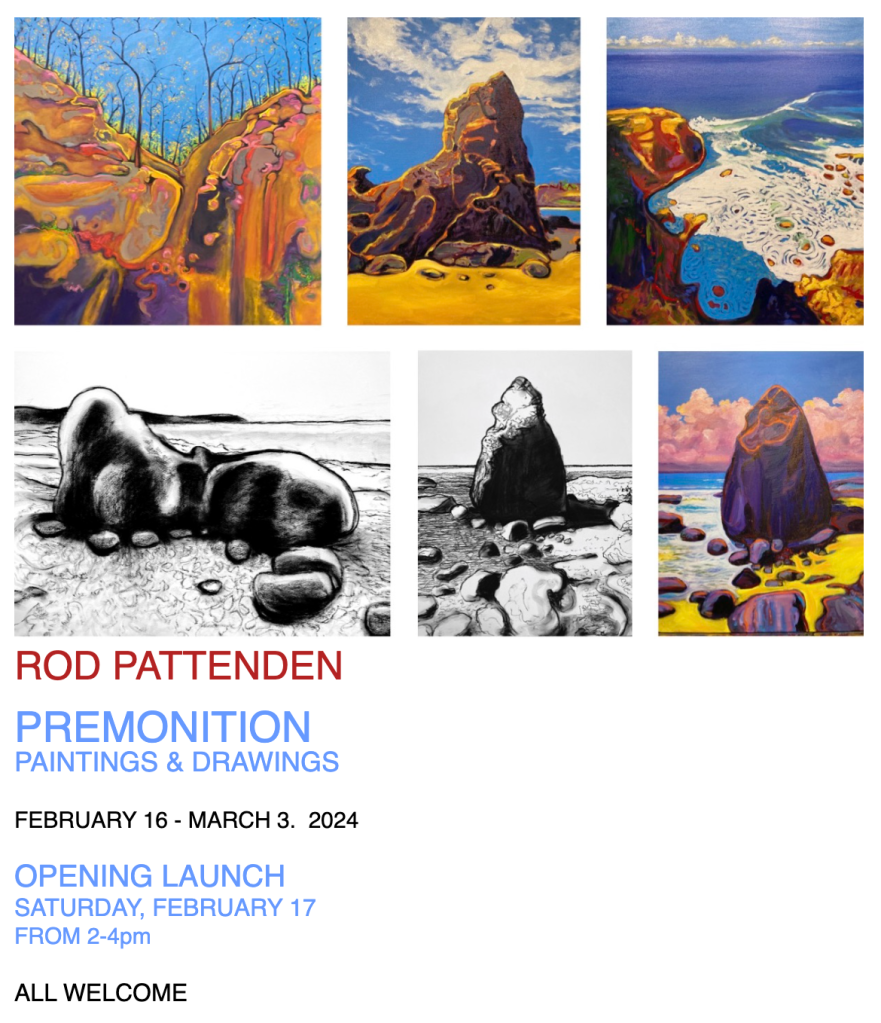
Join us for the Opening Launch of Premonition, by Rod Pattenden on Saturday 17 February, from 2 pm.

This is Rod Pattenden’s second solo exhibition at ASW and promises to be another celebration of sensuous colour and form. Pattenden describes this new body of work as:

New paintings and drawings with a vivid presence and an uncertain future breaking in. Works in vibrant colour, small to large scale  with a range of stark large scale charcoal drawings.

Open Lecture: Art and the Christian in an Age of Mass Culture

Illustration by Patrick Bremer, in The New Yorker.

The Centre for Theology and Public Issues at the University of Otago has extended an invitation to an open lecture by Professor Ephraim Radner.

The lecture will be on ‘Art and the Christian in an Age of Mass Culture: A Theological discussion on a famous argument of Walter Benjamin regarding art and its reproduction’.

Time: Tuesday 13 February at 5:15pm – 6.30pm (NZ time)

Place: Archway 2, University of Otago, Dunedin, or livestreamed here.

Making art in a time of crisis

Rod Pattenden, Jason Goroncy, and Maissa Alameddine were recently interviewed by Meredith Lake for the ABC’s Soul Search program. We talked about art, theology, and other stuff, and about how art really matters in sustaining and developing what is most eloquent and wonderful about being human.

You can listen to the interview here.

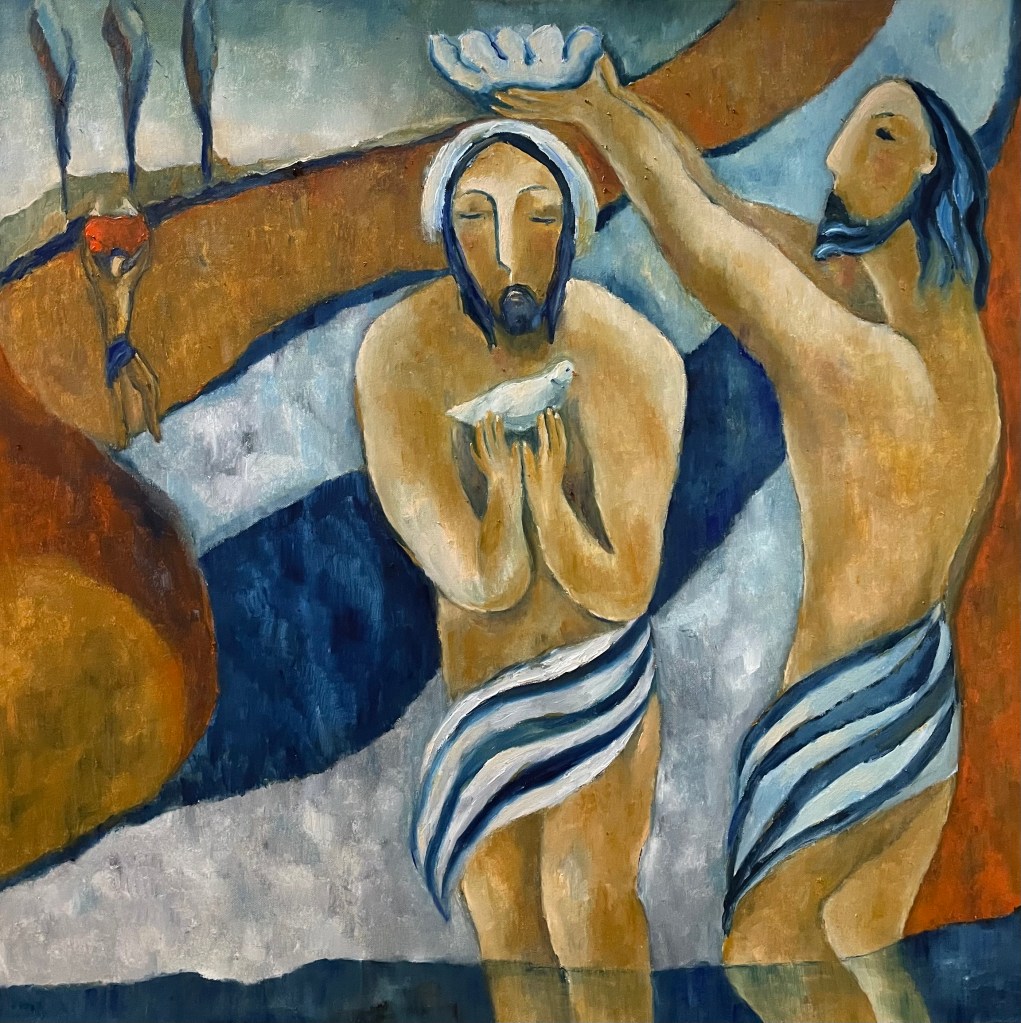
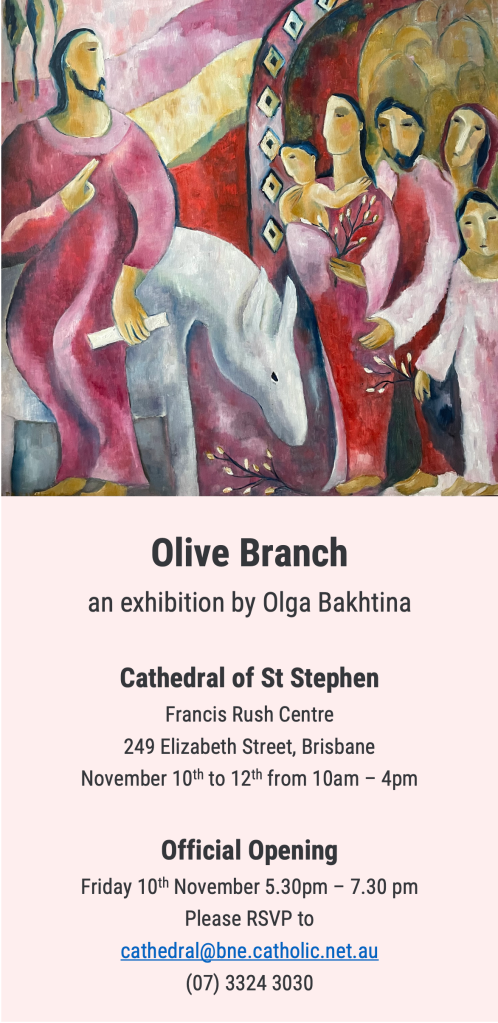
Olive Branch: An exhibition by Olga Bakhtina

Olga Bakhtina is a Queensland-based artist working in oil and charcoal. She studied painting 15 years ago in the Sultanate of Oman while living there with her family for 4 years. Currently, she studies the history of art at the University of Queensland. Olga has a passion for Early Renaissance art, in which she finds serenity and inspiration.

Since her first solo exhibition in 2012 in Oman, Olga has been exhibiting regularly across Australia. Her recent solo exhibition, ‘Good Samaritan and other Biblical Stories’, showed in St John’s Anglican Cathedral, Brisbane, in July 2023. Olga has been the finalist and winner of a number of Australian Art awards, including the COSSAG (Cathedral of Saint Stephen Art Group) Award in 2016 and 2018.

Olga’s artworks are in the collections of the Archdiocese of Brisbane, the Australian Catholic University, Rosebank College, and St Anselm Abbey, New Hampshire, USA. Her work also hangs in various private international collections.

Olga’s work has been published in various publications worldwide, most recently in The Double: Identity and Difference in Art since 1900 (National Gallery of Art, 2022).

In 2022, the Archdiocese of Brisbane created a video series titled Art Aficionados, in which Olga’s Good Samaritan painting featured:

Olga writes:

I’m often asked why I paint Bible scenes. There are several reasons, but the most important one is that my paintings are not just about the Bible. They are about humanity and what comes with it – the beautiful things in life, like love, unexpected kindness, devotion, and sacrifice. But humanity also brings pain and tragedy – betrayal, greed, cruelty, and war. Has anything really changed since the Bible was written? 

Nowadays it seems that the world is collapsing back to biblical times, as if there is a crack in civilisation. On one hand, there is humanism and advanced technologies, which Joshua, who stopped the sun in the Old Testament, did not dream of. On the other hand, there remains a lot of hate and barbarism, which sadly we continue to see around the world way too frequently. Sometimes, it feels like we’re flipping through the Bible and checking it with our reality.  

I think we can all relate to the biblical stories and lessons, in one way or another. The Bible has lots of answers. My biblical paintings are my attempts to find them, to process what is happening in the world, and in my own life. They are my prayers, too. Someone said that art is the highest form of hope.

Olga is having an exhibition as a part of the 150th Anniversary celebration programme of the Cathedral of St Stephen, in Brisbane. The exhibition opens this Friday evening. RSVP to cathedral@bne.catholic.net.au or (07) 3324 3030.

℘℘℘℘

Olga Bakhtina is an artist who lives and paints on Jagera and Turbal country.

Two poems

Alive

if you still your heart
to hear the tales of ocean waves
if you lay your ear on a seashell
to learn the dance on a distant shore
if you open your eyes
and pay attention
to tiny stamens
with awe
if you sensitize your nose and echo
moods of rainforests
with reverence
if you breathe in deeply
and caress gumtrees
with gratitude
if you lengthen your antennae
and receive outpourings of
divine love and beauty
every part of you
awakened
attuned
alive

生机

如果你安静你的心
聆听海浪的故事
如果你把耳朵贴近在贝壳上
在遥远的海岸学习舞蹈
如果你睁开眼睛
并留意风中
那轻微抖动微小的花蕊
抱着敬畏之心
如果你让鼻子灵锐
和雨林的情态
相呼应
怀着崇敬之肠
如果你深深地呼吸
抚爱星辉包裹的胶树
带着感激之情
如果你延长触角
并领受神圣的爱与美
倾盆降下
你的每一部分
觉醒
谐和
生机

℘ ℘ ℘ ℘ ℘

A Sacred Space

weep and lament
loudly or quietly
but certainly
as much as you can
in the parched and weary land
a wilderness
a wasteland
where hope is no more
……

cracks start to open
tears spring up
from within
calling all
to sit and share
openly and honestly
letting fountains surge
from underneath desert land
……

a rainforest of greens
emerging
moisturizing
replenishing
enticing you
to play and dance
in rhythms and shades
of sunlit sprinklings

一个神圣的空间

哭泣和哀叹
高声喊叫或轻言细语
但肯定得
痛痛快快地
在干旱疲惫之地
一片旷野
一片荒地
希望已不复存在
……

裂缝开始张开
泪水源自内心
而涌出
呼唤所有人
开诚布公地
坐下来分享
让喷泉从沙漠的底层涌出
……

一片翠绿的雨林
冒出地面
滋润
补充
引诱你
在阳光洒落的节奏和色调中
尽情玩耍和舞蹈

XIAOLI YANG IS A THEOLOGIAN, POET, AND SPIRITUAL DIRECTOR. SHE LIVES AND PLAYS ON WURUNDJERI LAND AND IN THE MIDDLE KINGDOM. Some of her poems also appear here.

Recognition for Imagination in an Age of Crisis

Jason Goroncy and Rod Pattenden are delighted and honoured that their edited book, Imagination in an Age of Crisis: Soundings from the Arts and Theology, has been shortlisted for the 2023 Australian Christian Book of the Year Award. One of ten shortlisted volumes chosen from over 100 published works, this recognition attests to the importance of this innovative collection of essays and reflections by artists, poets, and academics.

The book brings together a creative conversation about the role of the imagination through the work of creatives and academics as they reflect on the many ways in which the arts and theology provide resources for negotiating change and generating hope during a time of rapid cultural change and an uncertain future. It includes significant Australian perspectives that are set within a wide international context and conversation.

The book has received widespread recognition by a number of reviewers. For example, Angela McCarthy, Adjunct Senior Lecturer at the University of Notre Dame, writes:

This collection of writings ranges in depth and focus to bring a richness of cultural awareness and imaginative power that indeed brings hope and value to our culture through the interactions and power of artists.

And Catherine Lambert describes the book as:

A montage of evocative poetry, poignant artworks, insightful essays and personal reflections. Each piece is an invitation to look more deeply, linger a little longer and savour each offering. This is not a book to devour, but invites a more reflective contemplative reading. … Through the generous sharing of the contributors, the reader is invited to engage both their head and their heart in responding to this age of crisis. … [A]n invaluable gift to the conversation between arts and theology.

This year’s Australian Christian Book of the Year will be announced in a ceremony in Melbourne on 31 August.

A video introduction and review of the book, plus details on how to obtain a 40% discount via the publisher’s website, is available here. Copies of the book are also available from wherever decent books are sold.

Beauty as Witness: Art, Poverty, and Ethics in Christian Theology

Beginning in 2017, Ridley College’s biennial Evangelical Women in Academia conference is a women-only event seeking to platform, promote, encourage, train, equip, and inspire Christian women in academic work across Australia. This year’s conference keynotes are given by constructive theologian Dr Natalie Carnes (Baylor University) teaching on ethics, art, and poverty in Christian theology.  

Friday’s event will feature Aboriginal and Torres Strait Islander artist and educator Safina Stewart speaking about art, faith, and indigenous spirituality. Safina will also lead in some hands-on responsive creative work of the participants’ own. 

In addition, short papers and workshops/seminars provide an opportunity to learn from a wonderful lineup of Australian Christian women HDR students, academics, writers, and practitioners.

To find out more, visit here.

Ka Mua, Ka Muri

On 15 June, from 7.00–8.15 pm (New Zealand time), the theology programme at the University of Otago is hosting a public seminar with Dr Christopher Longhurst on the subject of Renaissance art. Details and Zoom link below:

Can An AI Paint An Icon?

The Severed Head of St. John the Forerunner, c. 1870s. Egg tempera on silvered and gessoed wood, 31 x 26 cm. Private collection.

There’s a timely reflection by Seung Heon Sheen over at Transpositions on the relationship between AI-generated art and iconography, with implications for how we might consider the relationship between an artist and their work more generally. It draws on relevant texts from the iconoclast controversies of the eighth and ninth centuries. Here’s a snippet of the argument in nuce:

… any ‘icon’ generated by a ML algorithm would be inherently idolatrous since the relationship between the image and the archetype would be severed. That is, although the works produced by a human iconographer and an AI ‘iconographer’ may be outwardly similar, inwardly they would be radically different due to the disparity in the process of their creation. A human iconographer faithfully contemplates and depicts the archetype; an AI abandons the archetype and merely replicates its images. And if this is so in the case of iconography, it implies a danger of idolatry in involving AI in religious art or employing it for religious purposes.

You can read the full piece here.

What Comes to Light

Loud Sky is an exhibition of works by five artists who have responded to engagement with survivors of institutional child sexual abuse. This engagement has included direct conversations, the recounting of stories of survival, the sharing of treasured objects, and, in some cases, the direct involvement of survivors in the making of the final artwork. The lives of survivors are made visible and imprinted in and through the works commissioned especially for this exhibition. Loud Sky is a term borrowed in part from the Loud Fence movement, which began in Ballarat in 2016 and has now gone around the world, where ribbons have been tied on church fences as a form of memory making, protest, of visualising loss, and also a celebration of human life. Loud Sky seeks to visualise the story of those impacted in the Hunter Region, honouring their courage, resilience, and instincts for survival. Institutional child sexual abuse has had a profound and far-reaching impact on this region and has directly affected the lives of many thousands of people. This exhibition gives expression to these human stories, giving them a voice and a form of visual presence. Despite the horror of abuse, these works visualise courage, containing elements of profound and great beauty.

Clare Weeks, notes to self, #07, #08, #09, #11, #13, #14, #19, #23, 2023. Digital inkjet print from scanned silver gelatin photographs, 79.5 x 59.5 cm each panel. Photograph by Ben Adams.

This sense of imprinting is found in the strategy developed by Clare Weeks, where she invited survivors to take a sheet of plain paper and imagine themselves writing a word that expresses their sense of resilience and hope. She invited respondents to fold or crease this paper into an enfolded form. Each of these was then documented through a process of numbering, unfolding, and photographing their surface and then refolding them to their original condition. Each scanned surface reveals unique, idiosyncratic, and textured features. Thirty-two members of the survivor community responded to this invitation, and each is treated with reverence and importance as objects that contain memories of great significance. They each carry a fragile delicacy and beauty. Each fold is unique and particular. This record of the physical process of remembering reminds us of the manner in which we fold up what is most precious to us. We carefully enfold our hopes as precious possessions, keeping them safe, tucked neatly below our rib cage. Clare Weeks draws attention to the manner in which human memories are transferred to objects, things we hold dear that become relics or tokens of hope that empower a sense of resilience. These are delicate and beautiful objects that reveal, as through a veil, a remarkable expression of hope.

Damien Linnane, Bob (dominos), 2022. Graphite on paper, 420 x 297 cm. Photograph by Ben Adams.

Objects that serve as vessels for memory are evidenced in an even more distilled form through the eloquently rendered drawings of Damien Linnane. Inviting survivors to share a treasured object, the artist calls for our sympathetic engagement with objects that carry a form of empowerment that aids survival. These are objects alive with resonant significance that amplify human hopes, ambitions, and pleasure. They represent relationships of love, playfulness and achievement. These are objects of power. When so much else has been taken away from survivors in their childhood, these objects operate as rudders for hope to be touched, held, and found in the present moment as a tangible form of resilience. Linnane’s drawing technique gives these objects a striking visual presence as each surface is delicately observed so that the light seems to emanate from within. These are lovingly rendered, and we sense the delight, interest, and commitment of the artist as we follow with our own eye each mark and gesture that gives life and presence to otherwise inanimate objects – these things that are alive with memory. It is a privilege for the viewer to be given intimate access to this treasured relic and its capacity for hope.

Fiona Lee, Why Bother?, 2023. Latex and acrylic paint, 98 x 167 cm. Photograph by Ben Adams.

Fiona Lee’s work presents the softly lit form of three casement windows. The viewer is placed in a stance of both looking out and looking in. This is a space of hovering decision-making about where to focus one’s attention. The particular form of the work came as a response to a question the artist asked survivors about what motivated them to begin their day, which more deeply frames questions about life’s purpose, and finding the energy for action. Honest, straightforward answers included the choice to stay in bed, or to reach towards relationships of love, or the mundane responsibilities that accompany being in community. The material of the window is a latex mould. It is like a skin, or a print, of a lead-lined casement window. It materialises the question we face at the beginning of every day – every plan, every hope, and every action – of whether it will be worth the effort to engage this day, this opportunity. To open this window involves risk, the potential for change and loss, and also the fresh air of new possibilities. Every window has this quality of beckoning the imagination. Their frames of tight geometry play out a matrix of fear and expectations, or they provide escape, freedom, or hope without restraint. This particular window holds us in the moment of decision-making, with the question of where this day might lead.

Peter Gardiner, The Fire, 2023. Oil on 300gsm Arches paper, 250 x 550 cm. Photograph by Ben Adams.

Peter Gardiner brings us into the searing presence of light and heat. The fire is a metaphor for danger and catastrophe that appears out of the darkness with the lighting of one match. This is the wildfires ignited by the Royal Commission that resulted in over 8,000 recorded testimonies of institutional abuse. There was smoke, as things were rumoured, that now appear in the light for all to see. However, the full force of this grand scene is held in check. We can observe the impact of the fire from a safe distance and begin to see that within the fire, there is the possibility of survival, renewal, and a new order of things. Fire not only destroys; it also brings new life to the environment; it purifies, transforms, and renews; it turns from red into gold. Gardiner’s work carries both horror and hope. We are in the presence of some immense catastrophe that will change how we live well into the future so that this does not happen again. It is an active vigilance towards justice that arises from a community having been confronted with the truth. No longer is there a tolerance for darkness, as there can only be light, even if it threatens to burn.

Lottie Consalvo, Silent Film, 2023. Single-channel video, 4 min 1 sec. Photograph by Ben Adams.

Lottie Consalvo’s work is a collaboration with a survivor, and his wife, around the question of what has sustained their lives. It offers a meditative exploration through silence and slow-moving gestural forms. The video-based work carries a grainy texture like paint, slowing our looking towards a more considered and contemplative place. We are in the presence of a human life, but one where each gesture becomes magnificent, primal, and beautiful. There are passages where an arm reaches out in ritual-like action, perhaps reaching for something, and then, at other times, a gesture of letting go. Without a narrative structure, the viewer has to put together this work in their own imagination as we follow the subtle shifts of gesture and the phrases of text that evoke states of silence. The artist invites us to be present as viewers of the simple beauty of silence at the heart of human existence. This is the invitation to be still and to be quiet, to have nothing, and to have everything, all at the same time. This is a space beyond fear, manipulation, and anxiety, where a human being might thrive in and through the small gestures of living. This is finding a life worth living and being grateful for that because it is enough. The silence of this work speaks with eloquence. It amplifies the beauty of being human.

This exhibition includes a timeline that lays out the history of the emerging public awareness of the abuse as well as television footage of these events as they unfolded. Words by family members of survivors that record the impact on their lives are also included, as well as a series of school photos of victims, not all of whom have survived. Against this dark and difficult reality, the work of the five artists commissioned for this exhibition offers something tangibly beautiful about the nature of being human. What comes to light is the courage and resilience of victims and survivors.

Christ Church Anglican Cathedral Newcastle installation view, ribbon flowers and bamboo. Photograph by Ben Adams.

A final expression of the exhibition’s aims was the installation of around 7,000 ribbon flowers on the grounds of both the Catholic and Anglican Cathedrals in Newcastle. Made by survivors, friends and family, and community and church members, they are an act of remembering victims and survivors. They express a desire for truth-telling and community healing. Art provides the resources to approach experiences of horror and disintegration in a manner that brings deeper understanding, shared compassion, and the possibility of a more hopeful future.

Loud Sky is on exhibition at The Lock Up Contemporary Art Space in Newcastle until 21 May.

℘℘℘℘

REV DR ROD PATTENDEN IS AN ART HISTORIAN AND THEOLOGIAN FROM AUSTRALIA. HE HAS WRITTEN WIDELY ON THE ARTS AND CREATIVITY. HE LIVES AND WORKS ON AWABAKAL LAND.