Finding Sacred Ground in the Suburban Ordinary: Paul Mitchell’s High Spirits

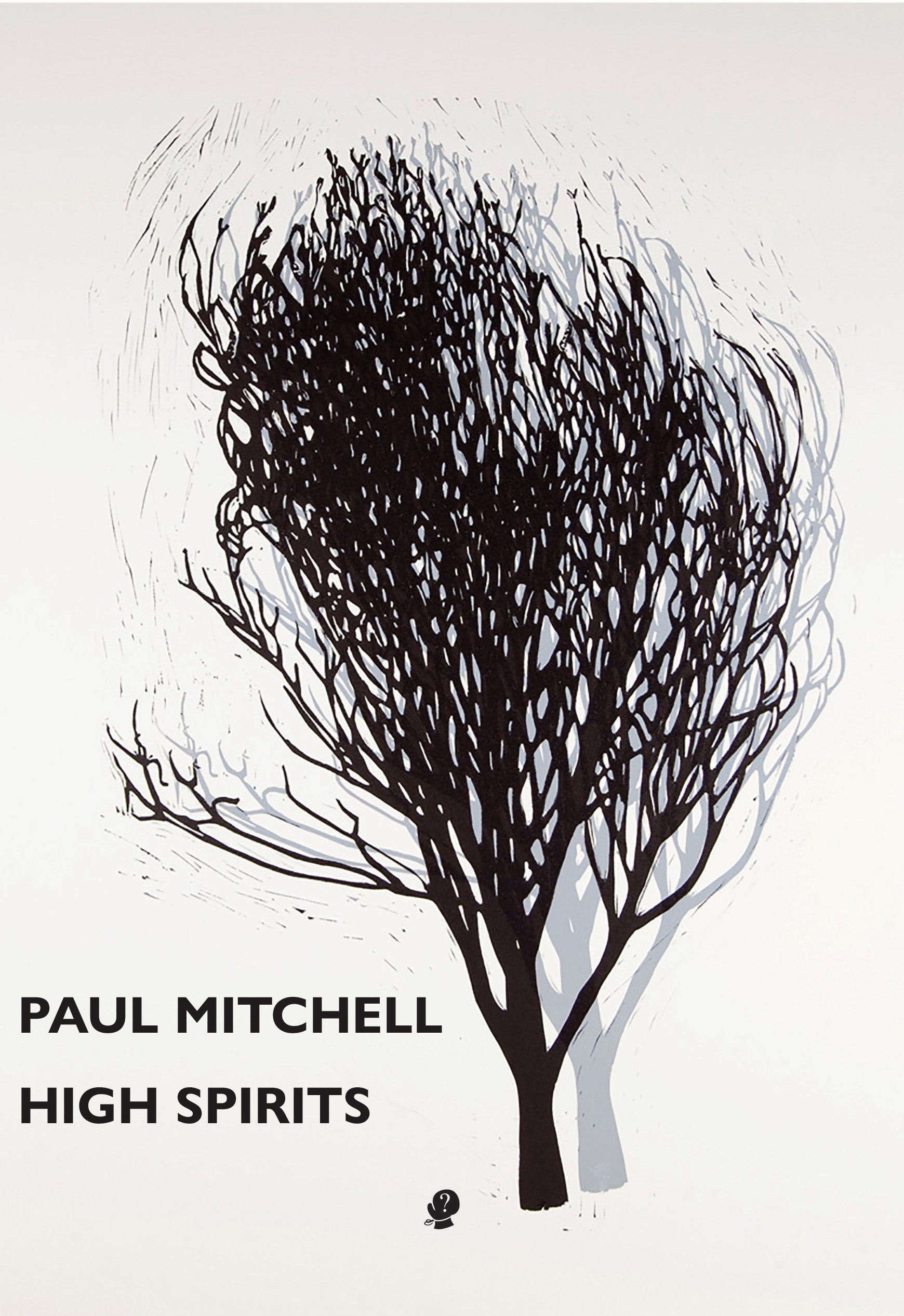
Paul Mitchell, High Spirits. Puncher & Wattmann, 2024.

In an era when poetry often retreats into obscurity or dissolves into mere confession, Paul Mitchell‘s High Spirits offers something refreshingly different. Reviewed by Jason Goroncy in TEXT Journal, this collection demonstrates how poetry can be both deeply personal and universally resonant, spiritually grounded yet artistically sophisticated.

Mitchell’s work achieves a delicate balance where the spiritual illuminates the mundane without overwhelming it, where the sacred emerges from careful attention to the world as it is. His poems capture the texture of daily life – family dynamics, the rituals of domestic existence, even conversations about Bunnings that blend seamlessly with apocalyptic imagery – while extending beyond the personal to encompass broader cultural and environmental concerns.

One thing that distinguishes this collection is Mitchell’s conversational tone that feels like overheard conversations with a particularly thoughtful friend – accessible without being casual, profound without being pretentious. Whether satirising Australian suburban masculinity in ‘Weekend Warriors of the Apocalypse’ or writing an epistolary meditation to Franz Kafka, Mitchell demonstrates remarkable range and wit.

The collection’s fundamental conviction is that the world is enough – not through complacency, but through hard-won wisdom. Mitchell’s terrific humour never cheapens the gravity of human experience but illuminates it from unexpected angles, finding epiphanies of grace amid chaos.

In a cultural moment characterized by cynicism and fragmentation, High Spirits suggests that careful attention to the ordinary might reveal it to be, if not perfect, then sufficient – and perhaps, in its sufficiency, sacred.

Read the full review here.

On the way out of church

Photo by Jr Korpa | Unsplash.

In 1998, during my second pastoral tenure with a Wesleyan Methodist Church in suburban Brisbane, I attended a series of workshops over two weeks in Melbourne. It was sponsored by Scripture Union, World Vision, and Whitley College. It was held at the Carlton Baptist Church in an old two-story disused shop complex and hosted by New Zealand art lovers and Baptist theologians Mike Riddell* and Mark Pierson. The basic idea of the seminar was to consider how to think about and be active around evangelism and worship ‘using the arts’ in the emerging culture. As a pastor in a fundamentalist evangelical organisation at the time, applications and future options were conceived, while the arts, my true love, were firing mystery and dreams.

Now, the landscape was completely different then – no 9/11, high-octane social media, COVID-19, Trump, Morrison, Putin, Boris or Ukraine/Russian or Palestinian/Israeli atrocities. Almost a generation on and now we are living in an unimagined landscape. However, those of us in that building in 1998 were thinking about ‘new music and art’ in worship settings and conversations with ‘outsiders’ that were not based around ‘selling the gospel’. In 1998, ‘Church Growth’ [sic] had become a disease of franchised McDonald’s proportions, burning out pastors who were not inclined to be into sales, while Hillsong was on the ascendency.

Those two weeks opened new doors onto new rooms of thought and imagination, rooms that would lead me to become immersed in the arts, leave the religion-based pastoral enclave and return to medical imaging. It would also find me grappling with the arts, fundraising, personal art practice, and questioning my theology more deeply as I attempted to unravel and move out from under the iron-clad Christian dualism construct.

My ‘thinking life’ before pastoral appointments and during them included applied science, Baptist and reformed theology morphing to Arminian understandings, and an immersion in various social and theological constructs that had not honoured the arts or open-ended question thought processes. At times, I thought they had, but they had not. My whole world of thought at its deepest levels was that of a passionate insistence on dualistic evangelical conversion and subsequent piety. The bottom line had always been to find ways to ‘get people saved and sanctified’, aka Billy Graham, and use love of ‘the other’ if necessary. The arts were, in that context, only utilitarian; that is, for worship or evangelism. In some ways, from what I can see from a distance is that the agenda of the Christian church seems to have hardly changed, particularly in the narrow evangelical fundamentalism that I shut the door to. I am thankful that in the midst of growing up in a fundamentalist and compassionate household, my Christian parents had oddly enough fostered a love of a wide-ranging arts exploration in their children – except for the ‘devil’s rock and roll music’ – that served us well, and that partly saved us from a more cultic infirmary.

My time post-pastorate since 2003 has been immersed in the arts – including co-founding Jugglers Art Space – medical imaging, family life, and completing an MA in Creative Arts Therapies. I am slowly learning to see, as per John Berger in Ways of Seeing, where hechallenges the elitist and mystified status of art that neglected the political, social, and ideological aspects that shaped the ways in which we look at art’.

Conversely, I’ve been exploring what spirituality in art means both within and outside religious iconographic and narrow utilitarian frameworks. Kandinsky’s epiphany affected philosophy helps here: ‘At its outset all art is sacred, and its sole concern is the supernatural. This means that art is concerned with life – not with the visible but the invisible’.

Building on a range of influences as Kandinsky’s, references to the ‘moving of the spirit’ in the scriptures, whirling dervishes in Islamic mysticism, Quaker meetings, aboriginal understandings of country, and so on, I initiated a series of group art events at Jugglers Art Space. My quest was to host a gathering of artists with no known religious background or involvement, construct a sound and design space and for us to respond silently but together with the intent to see if it was possible for something beyond ourselves to form and affect us. An epiphany, perhaps? Over the past 12 years, I have curated and co-curated these events, with the significant impact being the inexplicable silence attending the music and mark-making find their end. I cannot say what happened, but the sense of what happened has not been forgotten by me or all those who came. Mark-making together without speech is the central activity for the artists with a range of musical atmospheres created via, for example, Gavin Bryars’ amazing 75-minute ‘Jesus’ Blood Never Failed Me Yet’ (a shorter version is shared below), Arvo Pärt, improv live performances, or the beach with lapping seas.

The shift from ‘being saved and sanctified’ and preaching as the only answer to my and others’ search for meaning is significant. Within my evolving art practice, love has grown in response to the call of the spirit and the soul. I have also realised and embraced an embedded desire for inexplicable epiphany, not that created by systems, argument, exegesis, or consumption but that which is there, here and around, present and through. And the artists are the seers.

* Rev Mike Riddell died in his sleep in 2023 in Dunedin, NZ. He was 69.

Some recommended reading/watching:

  • Adam Edward Carnehl, The Artist as Divine Symbol (Cascade, 2023)
  • Thomas Crow, No Idols: The Missing Theology of Art (Power, 2017)
  • Jeffrey L. Kosky, Arts of Wonder (University of Chicago Press, 2016)
  • Emergence Magazine: Ecology, Culture and Spirituality, editions 1–5
  • Bruce Wilson, Reasons of the Heart (Allen & Unwin, 1998)
  • John O’Donohue, Beauty: The Invisible Embrace (Harper/Perennial, 2003)
  • Jason Goroncy & Rod Pattenden, eds., Imagination in an Age of Crisis: Soundings from the Arts and Theology (Pickwick, 2022)
  • Christian Wiman, Zero at the Bone: Fifty Entries Against Despair (Farrar, Straus and Giroux, 2023)
  • George Prochnik, In Pursuit of Silence: Listening for Meaning in a World of Noise (Anchor, 2011)
  • In Pursuit of Silence (a film directed by Patrick Shen, 2017)
  • Catherine Keller, On the Mystery: Discerning Divinity in Process (Fortress, 2008)
  • The New Boy (a film directed by Warwick Thornton, 2023)

℘℘℘℘

Peter Breen is the co-founder and current chair/director of Jugglers Art Space Inc., in Brisbane. He maintains a website at www.peteskibreen.com.

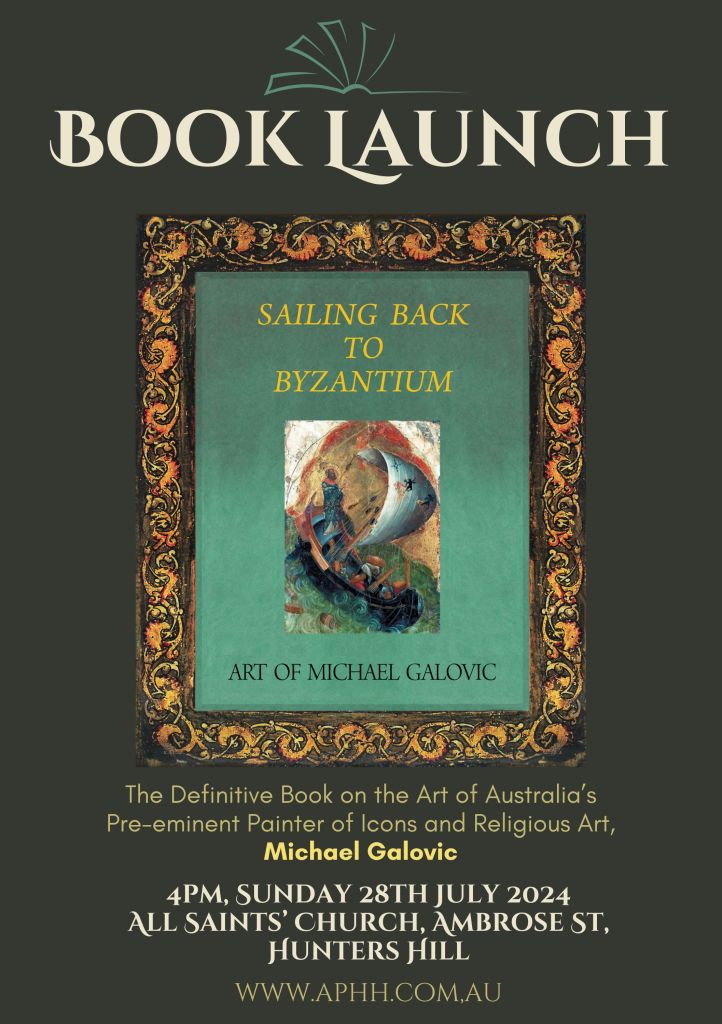
Sailing Back to Byzantium: Art of Michael Galovic

Sailing Back to Byzantium: Art of Michael Galovic. Melbourne: Yarra and Hunter Arts Press, 2024.

This lavish, large-format publication on the work of iconographer Michael Galovic is a welcome addition to the coverage of the arts and spirituality in Australia. It is a beautiful book, an art work in itself. In around 260 pages, it surveys the work of one of Australia’s most well-known painters of icons, covering traditional themes, innovative new work, and important commissions around the country.

Born in Belgrade, Michael Galovic arrived in Australia in 1990 and set about sharing his cultural knowledge through small exhibitions and workshops. The 2006 publication Icons and Art provided a visual overview of the first 15 years of his art production. This new and more generous publication covers the next 17 years, providing an overview of this important innovator and translator of the Orthodox tradition.

The book is divided into sections covering such themes as the Annunciation, the Son of Man, Theotokos, and angels, more innovative themes such as Uluru as an icon, and more experimental ideas that explore the nature of spirituality in multicultural Australia. These are supported by 24 short writing sections that address issues of technique, history, and theological themes. These are provided by the artist as well as a range of authors from art historical or theological perspectives. This enriches the book as a wider resource in understanding the role of the icon as a source of spirituality and the role that vision has in informing spiritual responses.

What is clear is the immense skill and labour that is needed to follow this ancient tradition and to make each work come alive through a fresh illumination rather than appearing as a tired copy. Galovic is a keen student of the past and pays great respect to traditional techniques. He has, however, also allowed himself to experiment with fresh ideas and approaches and has found inspiration in a wide variety of sources, including modern art and the art of Indigenous Australians.

The extensive range of commissions has allowed him to enliven the worshipping spaces of a wide variety of churches, chapels, and schools and to renew this tradition as a lively and contemporary form of seeing faith. This book provides rich resources for understanding this tradition and for appreciating this artist and his life’s work.

The book will be launched at an event in Sydney on Sunday, 28 July, at All Saints Church Ambrose St, Hunters Hill, at 4pm. It is available from the artist through his website. It would be a great addition to a personal library, a beautiful gift, or an important resource in a school or college library.

℘℘℘℘

REV DR ROD PATTENDEN IS AN ART HISTORIAN AND THEOLOGIAN FROM AUSTRALIA. HE HAS WRITTEN WIDELY ON THE ARTS AND CREATIVITY. HE LIVES AND WORKS ON AWABAKAL LAND.

Book Launch: High Spirits

Paul Mitchell’s new book of poetry, High Spirits (Puncher and Wattmann, 2024), will be launched in the Westgate Baptist Community Hall (16 High Street, Yarraville, Victoria) on Saturday 25 May. Michael McGirr, author of the best selling non-fiction work, Books That Saved My Life, will do the launching. 3pm for a 3.30pm start. All welcome.

Recognition for Imagination in an Age of Crisis

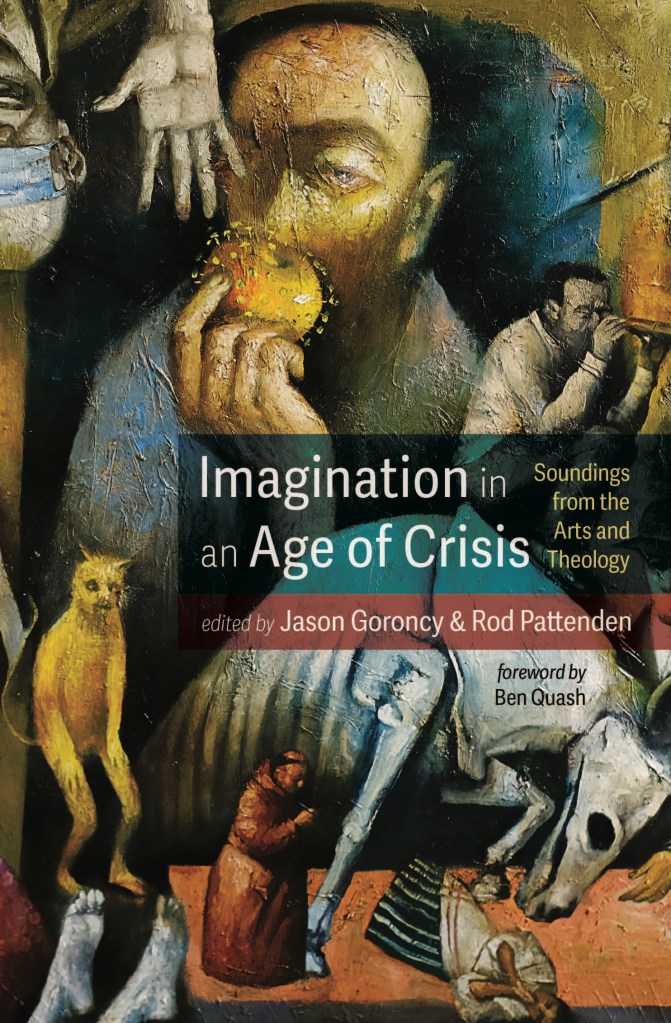
Jason Goroncy and Rod Pattenden are delighted and honoured that their edited book, Imagination in an Age of Crisis: Soundings from the Arts and Theology, has been shortlisted for the 2023 Australian Christian Book of the Year Award. One of ten shortlisted volumes chosen from over 100 published works, this recognition attests to the importance of this innovative collection of essays and reflections by artists, poets, and academics.

The book brings together a creative conversation about the role of the imagination through the work of creatives and academics as they reflect on the many ways in which the arts and theology provide resources for negotiating change and generating hope during a time of rapid cultural change and an uncertain future. It includes significant Australian perspectives that are set within a wide international context and conversation.

The book has received widespread recognition by a number of reviewers. For example, Angela McCarthy, Adjunct Senior Lecturer at the University of Notre Dame, writes:

This collection of writings ranges in depth and focus to bring a richness of cultural awareness and imaginative power that indeed brings hope and value to our culture through the interactions and power of artists.

And Catherine Lambert describes the book as:

A montage of evocative poetry, poignant artworks, insightful essays and personal reflections. Each piece is an invitation to look more deeply, linger a little longer and savour each offering. This is not a book to devour, but invites a more reflective contemplative reading. … Through the generous sharing of the contributors, the reader is invited to engage both their head and their heart in responding to this age of crisis. … [A]n invaluable gift to the conversation between arts and theology.

This year’s Australian Christian Book of the Year will be announced in a ceremony in Melbourne on 31 August.

A video introduction and review of the book, plus details on how to obtain a 40% discount via the publisher’s website, is available here. Copies of the book are also available from wherever decent books are sold.

Bringing hope and value to our culture through the interactions and power of artists

Review of Imagination in an Age of Crisis: Soundings from the Arts and Theology, edited by Jason A. Goroncy and Rod Pattenden. Review by Dr Angela McCarthy.

This is a book that one can dip in and out of many times, and the gift still keeps giving. Poets, writers, musicians, artists, journalists, and others have contributed to this volume, which makes it very rich, and this book review cannot cover all the richness. Some of the contributions are short, and others lengthy.

Trevor Hart’s contribution, ‘Why Imagination Matters’, declares that the presumption behind this book is that imagination certainly matters, particularly in times of crisis, including the COVID pandemic, war, and climate change. Imagination does not only matter to artists, although their work is bound to the imagination. In times of crisis, scientists, medical professionals, bureaucrats, and many others also bring imagination to problem-solving so that the result can benefit society.

Lyn McCredden, in writing ‘Imagination and the Sacred’, explores ‘the sacred’ as a sense of reality that embraces the places and times where individuals and communities encounter meaning. Australian secularism decries the need for religion for moral or social benefits, but in examining literature post-1950, McCredden delineates the presence of ‘the sacred’ being firmly present. She uses the experience of Nick Cave, a contemporary musician who has suffered and shared his profound and personal grief, and how he links his pain in growing to know the impermanence of things with illumination. The pain helped him enter into the transcendent, and McCredden links that to the experience of Patrick White. These are powerful connections being made within Australian culture.

Libby Byrne looks at the reality of being a professional artist and what that means to herself and those who encounter her works. She briefly reviews the artist’s place in society over time and culture to show that the postmodern artist is part of a set of shifting identities. In the past, the artist did not often sign their work as it was done for ‘the glory of God’ at the behest of a religious institution. Now, the artist’s identity in the public space has a completely different social and economic relationship. Byrne dwells on the Brooklyn Art Library’s collection of 50,000 artist sketchbooks and what it means to be included in such a collection in the public sphere.

Trish Watts, in ‘Every Life Can Sing’, describes her experience in Cambodia, where she sought to help the people who had lost their songlines because of the oppression suffered under the regime of Pol Pot. Watts is a professional singer and Voice Movement Therapy practitioner and accepted the challenge to help rebuild the voice of the people. Only fragments of the culture were left because ninety per cent of the artists, musicians, teachers, doctors, and other professionals had been eradicated. To rebuild the voice and the imagination that could once again voice hope in a crushed country is indeed a healing experience.

Steve Bevis writes about Ida Nangala Granites, a senior Warlpiri woman caught between the two worlds of Alice Springs and her home country of Yuendumu in the Tanami Desert. Ida re-enacts her truth, her participation in her Dreaming, through her paintings. Everything in her paintings is symbolic. She paints within the same reality as her ancestors; everything is expressed through the symbolism of who she is in her country. Ida is economically marginalised and sometimes cannot afford art materials. However, in this crisis and through her imagination, she helps others see and grow in understanding of her country and people.

Rod Pattenden writes about the art of George Gittoes, setting his commentary on the return of the arts to a socially and ethically responsible realm. For much of the twentieth century, art focussed on what is fashionable and avant-garde in an economy dominated ruthlessly in some places by art critics. In a world where horror images and violence dominate and intend to unsettle our society, art is needed in the action of social renewal and ethical behaviour. War and climate change have certainly exposed the need for seers. Pattenden has long worked with George Gittoes and has valuable access to his methods, art, and capacity to use his imagination in conflict areas. He can show how Gittoes can be seen as a prophet and mystic in his ‘role that values actions towards provoking awareness, creating change, and offering hope in social contexts’.

This collection of writings ranges in depth and focus to bring a richness of cultural awareness and imaginative power that brings hope and value to our culture through the interactions and power of artists.

℘℘℘℘

Dr Angela McCarthy is an adjunct Senior Lecturer at the University of Notre Dame Australia and lives in Wadjuck country of the Noongar nation. Her primary research interest is theology and art, and she is the Chairperson of the Mandorla Art Award.

Double Book Launch

Anne Elvey’s new poetry collection – Leaf

Anne Elvey has a new poetry collection, Leaf, forthcoming from Liquid Amber Press. It will be launched by Shari Kocher as part of Liquid Amber’s Eco-poetics Zoom event on Thursday 22 September 2022, along with readings from Peter Larkin and John C. Ryan.  The evening begins at 7.30pm. Bookings are free but essential.

Visit here for further details and booking.

Imagination in an Age of Crisis

Jason Goroncy and Rod Pattenden – this site’s editors – are thrilled to announce that they have a new book out.

Imagination in an Age of Crisis: Soundings from the Arts and Theology explores the vital role of the imagination in today’s complex climates – cultural, environmental, political, racial, religious, spiritual, intellectual, etc. It asks: What contribution do the arts make in a world facing the impacts of globalism, climate change, pandemics, and losses of culture? What wisdom and insight, and orientation for birthing hope and action in the world, do the arts offer to religious faith and to theological reflection?

These essays, poems, and short reflections – written by art practitioners and academics from a diversity of cultures and religious traditions – demonstrate the complex cross-cultural nature of this conversation, examining critical questions in dialogue with various art forms and practices, and offering a way of better understanding how the human imagination is formed, sustained, employed, and expanded.

The book has been well received, with Professor Jeremy Begbie (Duke University) describing it as an ‘extraordinarily energetic and imaginative collection’, while Professor Stephen Pickard (Australian Centre for Christianity and Culture) calls it a ‘remarkable collection of reflections on the power of the imagination to instil hope and meaning in disturbing times. … [A] breath of fresh air’.

The book has a strong range of contributions from the Australian context, as well as those from the Pacific, Asia, the United Kingdom, and the USA. It is an international collection with a common concern to celebrate and prize imagination for these times. A video review is provided by Rev Dr Jane Foulcher (Senior Lecturer, Charles Sturt University), along with an introduction by the editors:

Through 35 individual contributions, the book weaves its many conversations around the capacity of the imagination, and the arts in particular, to provide a means of cultural resilience, protest, questioning, and critique. It explores the work of a wide range of writers, playwrights, poets, musicians, and visual artists, to provide imaginative resources to articulate the challenges and the choices facing human beings in a world both drawn close and made distant through networks of disease, conflict, commerce, and culture.

The book is richly illustrated in colour with 39 images, including a stunning cover image by Filipino artist Emmanuel Garibay that graphically expresses the cultural collisions of our time. Another strong creative feature of the collection is the engagement provided by poets, including Petra White, Kevin Hart, Christian Wiman, Jordie Albiston, Pádraig Ó Tuama, and Michael Symmons Roberts. The result is a volume marked by beauty and wonder, as well as incisive critique. It is a unique collection that brings unexpected voices into a global conversation about imagining human futures.

Imagination in an Age of Crisis is available now at a special introductory price of 40% off. Use the code “Crisis40” at checkout through Wipf & Stock, or through customer service by phone (1-541-344-1528), or via email.

‘Embracing the Subjective’: A Review of Sarah Agnew’s Embodied Performance: Mutuality, Embrace, and the Letter to Rome

Sarah Agnew, Embodied Performance: Mutuality, Embrace, and the Letter to Rome (Eugene: Pickwick Publications, 2020). 298 pages. ISBN: 9781725257849.

‘And the Word became flesh and dwelt among us, making scholars the world over profoundly uncomfortable’ (John 1.14, Mossfield paraphrase).

At first glance, Sarah Agnew’s new book Embodied Performance: Mutuality, Embrace, and the Letter to Rome (2020) has a relatively straightforward goal: to develop a methodology by which contemporary biblical storytellers might share in a scholarly fashion the insights they gain into a text through performance. Indeed, the need for a such a methodology may appear self-evident and the reader might rightly wonder why no such method already exists. Yet, this absence in the field of biblical criticism reveals the deeper and more important project which Agnew undertakes in this book: challenging modern biblical scholars to take seriously the reality of embodiment and incarnation which lies at the heart of the Christian story.

Like in other academic fields, the watchwords of modern biblical criticism include objectivity and reason. As a performer-interpreter of biblical texts, however, Agnew became increasingly aware of intuitive, subjective insights that the act of performance gave her into Scripture. Noting increasing interdisciplinary evidence of ‘embodied cognition’ (that is, knowledge gained through the body), and building on the growing field of Biblical Performance Criticism (BPC), Agnew consequently developed her Embodied Performance Analysis (EPA) to allow the subjective to speak into contemporary scholarship. In her own words, ‘EPA invites the physical, emotional, and relational aspects of human meaning-making to contribute to conversations generally dominated by rational objectivity’ (142). Here, Agnew seeks to transcend the limits of BPC (with its focus on how a text was historically performed) and embrace the subjective, contemporary performance as a realm for authentic interpretation and meaning making.

Yet, Agnew’s EPA method does not seek to supplant traditional, objective scholarship. Rather, through a three-stage process of preparation, performance, and critical reflection, Agnew hopes to create a dialogue between reason and embodied knowledge. In the EPA framework, therefore, ‘the performer-interpreter employs tools of the body, emotion, and audience, integrated [my emphasis] with a range of pertinent exegetical approaches, to discern meaning in a biblical composition, presented in an Analysis comprised of Performance Interpretation and Critical Reflection’ (132). It is this interaction between Agnew’s observation of her embodiment of the Word (through movement, tone, hesitation, voice, and gesture), and preexisting scholarly debates over the meaning of a text, that makes Embodied Performance most compelling to read. For, as a preacher, I am conscious of the ways studying a text with the goal of proclaiming good news to my congregation presents unique understandings that I could not have gained in the seminary library. Likewise, Agnew’s insight into the text through her performance of it, offers another rich lens of meaning to me as both a preacher and a disciple. Agnew, however, seeks to go a step further – not just naming insights in an interesting way, but enabling them to participate in ongoing academic debate.

What Agnew demonstrates in Embodied Performance is that, when given voice, performance may indeed contribute significant value to biblical criticism. For example, in preparing to perform Paul’s letter to the Romans, Agnew noted the way she would step intuitively to one side or another as she embodied different voices or personas in Paul’s argument. Agnew was surprised, however, to find herself stepping in a new direction when speaking the words at Romans 7.15, ‘I do not understand my own actions’ (NRSV). In engaging with preexisting commentaries, Agnew discovered an ongoing dialogue between scholars over the meaning of the ‘I’ in this discourse at the end of the chapter. While some argued that Paul was referring to himself, others suggested that the ‘I’ was a rhetorical device with which Paul sought to include his audience in the narrative of sin. For Agnew, however, her body’s movement revealed ‘instinctively this felt like a discrete, new, voice’ (166). Consequently, Agnew concluded, along with the second group of scholars, that the ‘I’ of Romans 7 was ‘an “every-person” caught up in the cosmic battle of good and evil’ (167). While Agnew’s conclusion may not be unique (indeed, it is well within the bounds of the existing debate), her embodied insights offer a new interpretative lens that helps ‘tip the argument’ where traditional scholarship had reached an impassable stalemate. Embodied Performance Analysis then may indeed offer meaning to biblical scholars in a way that alone studying words on a page may not.

Of course, as with any new methodology, Agnew’s Embodied Performance has some limitations. Agnew herself highlights the omission of some difficult passages (such as those dealing with the place of Israel in Romans 9–11) from the performance for lack of an appropriate way to parse their meaning with sufficient nuance; the need for other performer-interpreters to also use and test the method; and the risk that the performer may impart too much of their own theology into the meaning-making process. In addition, I note that Agnew’s critical reflection on the performance at times blurs the line between performance insights (that is, meaning derived from the act of performance and contributed to scholarly debates), and performance choices (that is, those places where Agnew chooses to perform a passage in a certain way because of the scholarly position, without necessarily offering any new insights toward it). In Embodied Performance, Agnew does begin to take steps towards addressing some of these limitations (such as using omission as a source for exegetical discussion, or noting audience reactions against those places where she intentionally imparted too much of her own theology). Nevertheless, none of these issues prevents Agnew from demonstrating her key point: performance does indeed have important insights to contribute to biblical scholarship.

But what of the average preacher or congregant? As a Minister in a local congregation, I had some mixed reaction to the utility of Agnew’s book in my context. As a preacher, I noted the encouragement to engage with my subjective insights into a biblical text as part of the interpretative task. Throughout my reading of the text, however, I was also conscious that I am not a biblical storyteller and wondered if I should ever have occasion to practice Agnew’s EPA methodology myself. Yet, this is not what Agnew asks of either the biblical scholar or the local church leader. Instead, Agnew encourages us to hear the insights gained by biblical storytellers as a key part of the ‘fullness of human epistemology’ (191) and to be open to the knowledge of embodied existence for understanding the meaning of any biblical text. And so, if the only outcome of my reading this book is that I begin to include EPA scholars in my weekly reading in preparing the sermon, then it seems to me this shall have been a book worth reading. For Agnew’s Embodied Performance challenges both the Church and academia to embrace the embodied Word. The question that remains is: will we?

℘℘℘℘

Daniel Mossfield is a Minister of the Word of the Uniting Church in Australia. He serves in rural NSW, working at the intersection of traditional and emerging forms of church, and is passionate about the sacramental nature of preaching and what it means to be the church in a secular age. He lives and works on Gundungurra and Wiradjuri land.