Articles

Taking Wing – Christ on High

Brett a’Court - Manu (Kahu) Oil on Canvas, 2007
Brett a’Court, Manu (Kahu), 2007. Oil on canvas. Private collection.

This striking image of an airborne Christ is from New Zealand painter Brett a’Court. It is part of his investigation into a way of bringing together the spiritual insights of the indigenous culture of the Māori people and that of Christianity brought to New Zealand by British settlers. In cultural terms, it is a hybrid image. This is something that occurs when two cultures are in a process of mutual re-assessment. That sort of conversation is full of conflict and critique but also allows for the potential for new forms to arise that express the best of both traditions. A Christ figure flying in the sky like a kite is such a form. It is a new thing, a potential heresy or aberration, but one full of potential for new insight and spiritual refreshment.

Christianity has expanded over recent centuries into a world religion, bringing with it European visual forms. At times these have been part of the conquering ideology as European colonial expansion has repressed the cultures of indigenous peoples seeing them as backward, pagan, or even demonic. As a result, objects were destroyed or burnt, cultural practices repressed or forbidden, and mythic narratives banned. In its place peoples were Christianised, therefore ‘civilised’, and presented in newly-minted European clothes and behaviours. Now, in this current post-colonial period, there has been a recognition of the violence done to people through denying them their own culture. In New Zealand since the 1980s, there has been a revival of traditional indigenous forms. New Zealand now seeks to be a bi-cultural nation, using forms from both traditions to mark out its national life. This hybrid Jesus, therefore, speaks to this new period of cultural re-formation offering new possibilities in deepening spirituality that arises from within this complex and newly emerging situation.

The ‘Manu-Kahu’ in Maori culture refers to the harrier hawk, a bird associated with being a spiritual connection to the divine. It also refers to the cultural practice of making kites, which was not only a common recreational practice but also a religious one as massive large-scale kites were produced for significant ritual occasions. These could carry the weight of a human person and were flown with up to a kilometre of rope to therefore command vast terrains in their ritual role. These kites ‘evoked the supernatural powers indicative of the Māori life force and associations with animals, birds, and the dream of flight. Used as communication devices to their gods, Māori kites became a link with the great natural powers which ruled their life’ (John Tarlton, ‘Ancient Maori Kites’, Art New Zealand, December, 1976). For the artist, this provides an appropriate link to the cultural place of the Christ figure who holds the land with benevolence and grace. It is also a visual statement of confidence in Christian spirituality as a relevant force in contemporary society, particularly during this period of post-colonial reformation.

Brett a’Court has created something new. It is a surprising innovation and unsettles traditional iconographical conventions. It disturbs expectations and could therefore be considered a threat to correct theological form. It also dislodges the colonial mentality that considers the European way of seeing things to be the correct and authoritative one. It is also something curious and worthy of consideration – a Christ figure in flight, who brings together belief and the physical environment in which people live. This is a thoroughly-contextual Christ for New Zealand, the land where birds have become the dominant species. This is a Christ at home in this particular cultural landscape. This is not an introduced species carrying an exotic spirituality. This is Christ at home in the physical landscape of the Pacific. A’Court shows his respect for the great innovative New Zealand painter Colin McCahon by using the device of speech bubbles echoing biblical quotes, which were part of McCahon’s innovative and hybrid response to colonialism. For viewers further afield, this work serves to expand our sense of encounter with a God at home in the world, an incarnation that honours the material world we inhabit, a Christ both particular and universal, both newly strange and safely familiar.

Reposted from ArtWay.

℘℘℘℘

ROD PATTENDEN IS AN ARTIST, ART HISTORIAN, AND THEOLOGIAN INTERESTED IN THE POWER OF IMAGES. HE LIVES AND WORKS ON AWABAKAL LAND.
Brett A’Court is a New Zealand painter who has been active since 1995 holding a series of successful exhibitions in his home country. His work draws on popular and historical fragments to explore issues of spirituality and meaning. He is interested to explore this in the context of the bi-cultural nature of New Zealand/Aoterora, ‘dissecting the imagery to unveil the light within, aware also of my place in Aoterora, soaked in Māori and Christian spirituality’.

One a Week Psalms Project

Ps 11.jpg

I have an odd relationship with my body. It doesn’t have the stamina I would like and I feel like it lies to me quite regularly. But it doesn’t lie. Rather, it whispers in a way that requires an intense listening. Slowly I feel that I might be learning the full-bodied type of listening required that creativity has been helping me learn and that I have been trying to be intentional about this year. It has come as the result of a reluctant road I’ve followed due to ill health. Late in 2005, I was diagnosed with fibromyalgia, a condition characterized by unexplained pain, insomnia, and what is commonly referred to as fibro fog – a deep, grey and constant unclearness, or fogginess, of mind. It has become an underlying pillar of my life, providing an unsteady platform on which to construct my thoughts about life and faith.

While my health is somewhat improved presently is still requires management. This life has thrust to the forefront the importance and necessity of a slower paced approach, steering me in the direction of contemplative spirituality and a deep appreciation of ritual. I have a deepening and growing appreciation for the sacramentality of creativity, as in the past few years just about any moments of grace have been felt through some creative engagement.

I feel like I have to constantly fight against my body to not feel uncomfortable. And by fight I mean carefully and deliberately care for it in a way that I was not taught would be necessary. I must consciously and deliberately spend time at the end of the day encouraging my body to let go. An evening is sometimes the very least amount of time it takes for me to ‘come down’ from the day. Many days I can physically feel and hear the ‘buzzing’ of my blood as it races around my body and into my brain as though hyped up on a constant new influx of fizzy drink by direct injection.

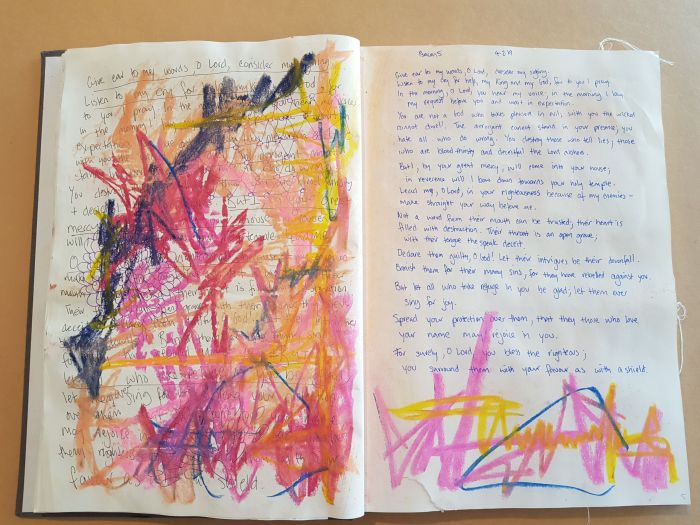
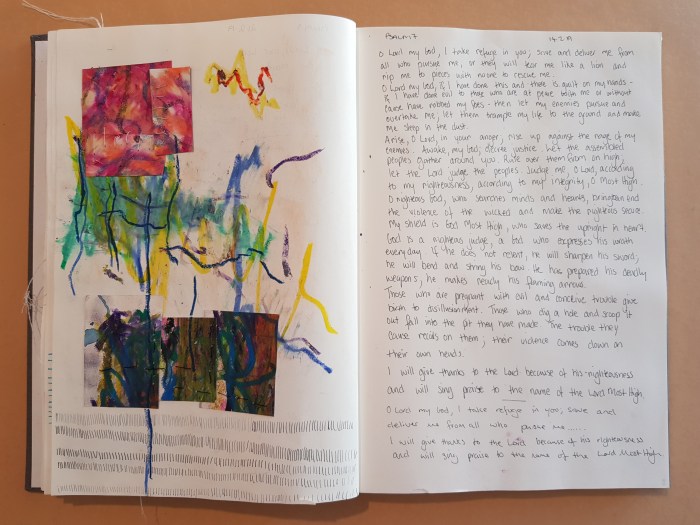
Ritual has become a path to follow and a direction to face myself towards. One of the most recent for me is ‘The One A Week Psalms Project’. The premise is to reflect on one Psalm a week and engage creatively as a spiritual discipline. At the moment I have an A4 journal that serves as the basis of the creative practice along with a writing journal and I do any combination of read, pray, write, sit, become distracted, draw, scribble, make, glue, and stare at the page.

Ps 5.jpg

At the moment, only just six months in, I think I am learning to practice a type of listening I now realize I tentatively began a few years ago. I spend a lot of the Psalm Project time listening to, and with, my body. And in this process I have discovered some of those grace-filled, sacramental moments. I sit and read, and think, and feel, and then decide with my whole body what I might like to try ‘doing’. The gestures that feel drawn from me, or to me. What marks do I want to make and what process do I want to engage with: Precise circle drawings? Free repetitive lines? Random scribbles? Colour? Black ink? Cursive letter drawing?

It can be difficult for me to realize how it is that I actually feel underneath my fizzy blood and what I am thinking in my buzzed up brain. This process encourages me to wait, with a small blank page, and small expectations. It is becoming a spiritual discipline that is surprising built around a growing awareness of my longings – not frivolous wants or desires – but deep physical and feeling longings to sit in the quiet and desire to learn to listen to God’s words through, around, above, beneath, and within me. It is teaching me to be integrative, incarnational, to not divorce aspects within myself, and instead to try and be as honest as I can.

It is in these moments that I am learning to wait. Waiting is difficult; I have plans and ideas and things to do. But that is not how my life can be lived. It is not wrong, rather it is different to my expectation of how I would live my life. It is also not a waiting for everything to just fall into my lap without participation. It is an active waiting; a waiting until waiting can be done no longer. This creative and spiritual practice bleeds into the rest of my life and I find that I am slowly, and with many failures, learning to be active and still with an ear more tuned towards God. I am learning also that God is there in the waiting, life is not passing me by in the waiting but is the actual life. We live and do and be and all while we wait upon God.

Ps 7.jpg

In this space of engagement with the Psalms I am continually invited to reflect on who I am, and who God is. I’m not any more certain of anything, but I think I am learning to sit within the uncertainty. All I can do is hope that I am able to continue the practicing. We both practice and live life simultaneously in this weird, public, performance art rehearsal space.

The Psalm Project is not meant to be the entirety of either my art or spiritual practice. It is simply a way of practicing. It is a place to begin that builds on what has come before. It allows me to sit within the pains, the busy mind, the uncertain thoughts, and sometimes to simply stare at the page and the psalm and wonder yet again, why these psalms are so upbeat and joyful, why they are so violent and bloodthirsty, why they are so depressing and lamenting? How do they depict what I am feeing, and also what I am not? Whatever life is at the moment, it is something I am learning will be enough so long as I am facing towards God, often with a pen, or pencil or pastel in my hand but always trying for some stillness.

℘℘℘℘

Karly Michelle Edgar is a mixed media artist, trained in theatre, with an MA in Church Practice. She was formally the Lecturer in Art at Tabor (Vic) and is currently working as a lifestyle assistant in an aged care facility. She also lives with fibromyalgia, which effects life in varying degrees at different times. Karly’s creative work focuses on the need for rest, repetition, the search for beauty, and creativity as spiritual practice. This is a version of a paper originally presented at Vessels: Art & Theology Symposium, Woy Woy, 2019, titled ‘The Space Between Breathing: One a Week Psalms Project’. Karly LIVES ON WURUNDJERI LAND.

The nature of things

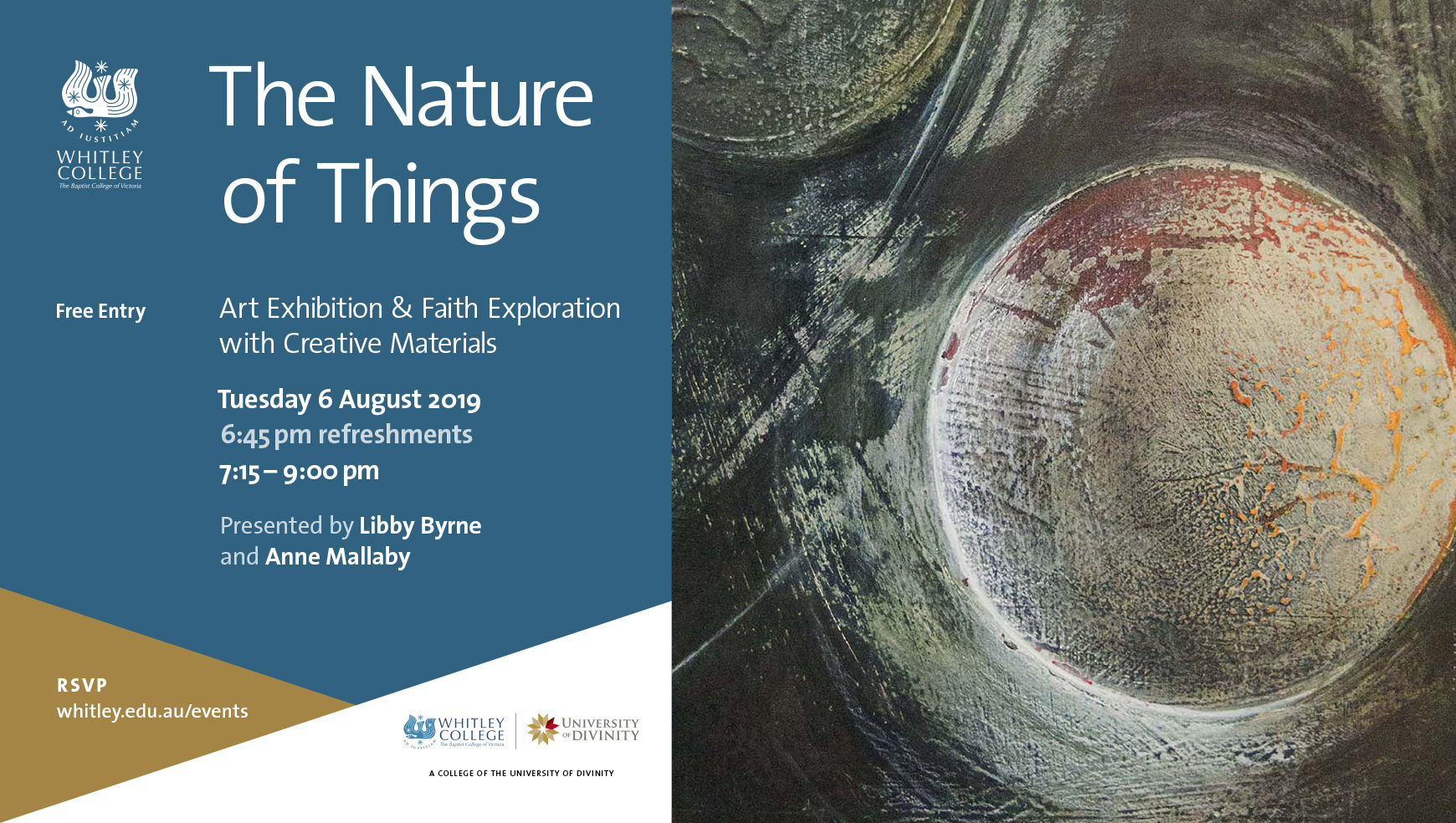
You are invited to join us on Tuesday August 6th @ Whitley College to share with Anne Mallaby and Libby Byrne in a material conversation about the way art prompts us to make sense of the nature of things we encounter in the creative process.

The exhibition features selected works from my inquiry into nature of transcendence and joy in ordinary time. Funded by a Field Development grant from the Yale Center for Faith and Culture, this work identified how the experience of drawing in-church each week through ordinary time extended my capacity to see the effects of God’s action in the world, just as the work of art itself was to drawing-in (the) church, transforming our collective capacity to see.

The process revealed the participatory nature of the creative process, engaging people who saw and heard me working in conversation that focussed our attention on one another and on the possibility of something that was still becoming. The conversation will continue to unfold on Tuesday August 6th as together explore some of the ways in which the discipline of regularly seeing and making art can prompt us to engage the stories of our lives with the work of meaning-making and the art of well-being.

℘℘℘℘

LIBBY BYRNE IS AN HONORARY RESEARCH ASSOCIATE (WHITLEY, UD), LECTURER IN ART THERAPY (LA TROBE UNIVERSITY), AND MEMBER OF THE CENTRE FOR RESEARCH AND SOCIAL POLICY (RASP). SHE LIVES ON WURUNDJERI LAND.

Kindness stories in the modern spiritual mode

tender.jpgEvery generation throws up popular reflection on how best to live. Much of it comes from within religious traditions. It is designed to help people reflect on their lives by building bridges between religious traditions and the world in which the reader lives. It is instructive to note how its style and emphases vary with changes in the religious and broader culture.
Julie Perrin‘s recent book Tender, a collection of short reflections, grouped thematically, is splendid in its own right. It is spare and elegant in its writing, inclusive in its address and open-ended in its invitation to reflection. It also offers an occasion to reflect on the ways in which spiritual writing has changed.

Seventy years ago much spiritual writing was based in the language, ritual practices and shared faith of religious communities. Readers outside the community would normally feel themselves made outsiders. A reader wandering along shelves of spiritual books would look first for their denominational origin to see if they were Anglican, say, or Catholic. If readers drew on their own experience or on contemporary news, they usually did so simply to illustrate a point already made conceptually.

Fifty years ago many churches were becoming less tribal, ascription to faith was less certain, and people looked to a range of authorities when seeking wisdom. Though spiritual writers generally worked within a particular tradition, they also drew on other Christian and religious traditions and appealed to psychology and other secular sources. The writing was often exploratory rather than didactic. Readers measured it, not by its denominational solidity, but by its spiritual depth.

Today another genre coexists with those earlier ones. In it, writers with a strong and questioning faith address a general audience, using anecdotes, inherited wisdom, contemporary social debates and a broad cultural reference to encourage their readers to move beyond inherited prejudice and ask themselves what really matters. The heart of the exercise is to find the right words that will disclose the depth in ordinary experience. The writing encourages readers to pay attention to the world around them, to wonder, and to celebrate God’s presence there. Readers evaluate it by the quality of the writing and its attentiveness to the depth of ordinary human experience.

Among writers familiar in Australia who write in this vein are Michael McGirr, Terry Monagle, Pádraig Ó Tuama and the much missed Brian Doyle. Their writing does not merely describe but evokes and creates a world, and shapes a human response that respects its variety and mystery. Significantly, too, these writers are masters of short anecdotal pieces which invite us to see the great in the small. They also write fastidiously, choosing words that disclose freshly aspects of reality which the language of traditions conceals at first reading. Following the age-old advice to writers their words don’t merely tell but show.

These qualities are evident in Tender. Even the title is evocative. Not Tenderness, a lovely word, but sometimes tainted with sentimentality, the adjective Tender suggests at once rawness, vulnerability, affection and offering. In the subtitle — stories that lean into kindness — lean intimates the delicacy of an invitation to follow a direction without compulsion. It also suggests the intimacy shown when we lean on another’s shoulder, and perhaps trust that the reader will respond to the gentle invitation. Kindness evokes both generosity and our shared humanity.

The encounters and reflections that compose the book display the same sharp attention to the rawness and pathos of reality and the possibilities of words. Behind the initial detail of description of place, time and ordinary actions, a deeper reality is disclosed that leads to reflection inviting readers to ask themselves what matters. In ‘Bank Teller’, for example, the opening paragraph sets the scene through simple, carefully observed detail:

In Melbourne, I’m walking along Sydney Road, Brunswick, the traffic is stretched bumper to bumper. There is a taxi at the kerb outside the bank. As I enter the foyer through the glass doors a young man is walking towards me. His arm is outstretched as if to make a space ahead of him. With his other arm he is guiding a woman dressed in long flowing robes and hijab.

The succeeding paragraphs fill out the description. The young man is corporately dressed, sharp, but in his attention there is something unexpectedly ‘decorous, almost tender’. The woman’s face is a mass of scarring, with no nose, and she seems to be blinded. As they talk together, ‘he leans his head closer, so he can hear’. The final paragraph sums up the story into which the reader has been drawn and invites them to ponder a larger question:

Human cruelty and human kindness, they sit closely together. The bank teller carved out a space for the scarred woman to walk in. Her presence and energy called something out of him, and from other witnesses to their conversation. What will it take before we can make space on our shores for people who carry their scars less visibly?

In this writing, every word, every punctuation mark, every turn of phrase has been considered in order to draw the reader into the human reality of a simple action, to share the writer’s compassionate regard, and finally to embrace a question that ripples out into widening circles. Our shores can be those of our inner life, our domestic relationships, of our workplace and, evidently, of our nation.

In this book, as in the genre of which it is representative, the writing encourages the readers to draw on their traditions, not as authorities to close conversation but as resources to open it. It displays devotion to the word fleshed out.

Reposted from Eureka Street.

℘℘℘℘

Andrew Hamilton is consulting editor of Eureka Street.

Conversations and Explorations with Friends by the Sea: Worship in the 21st Century

ConExp-Beach.jpgThe Centre for Music, Liturgy and the Arts (a Ministry Centre of the South Australian Synod of the Uniting Church in Australia) is running a conversational event over three days offering the opportunity to talk, explore, and think deeply and widely about why and how we worship in our churches and communities now and into the future.
When: 8–10 October

Where: St Andrew’s by the Sea, Jetty Road, Glenelg, South Australia

Presenters:

  • Libby Byrne is a visual artist, art therapist, and theologian. She will offer participants the chance to have a go at art making.
  • Malcolm Gordon is a songwriter and minister in the Presbyterian Church of Aotearoa New Zealand. He will offer guidance to those wanting to engage in song writing.
  • Mark Pierson is a minister in the Baptist family of Churches in New Zealand. He will lead sessions in curating worship and events that integrate the arts and faith.
  • Charissa Suli is one of the National Consultants in the UCA’s National Assembly’s Resourcing Unit. She will offer space to think about and create worship that encourages and honours diversity.

Key presenters will not only start conversations but also offer the opportunity to work with them in creative spaces.

For more information and bookings, visit here.

Vessels: Theology and the Arts Symposium

https___cdn.evbuc.com_images_52243547_208684879680_1_original.jpg

As noted in an earlier post, St Luke’s Woy Woy (147–149 Blackwall Rd, Woy Woy) will host a three-day symposium (12–14 July) gathering theologians, artists, clerics, and philosophers to explore the relationships between the arts and theology.

There will be an art exhibition, poetry, creative workshops, short papers and music. The last fifty years has seen some astonishingly inventive solutions to creatively engage with theology, ecclesiology, liturgy, and the public sphere of spirituality and faith.

This three-day symposium seeks to explore the shifts in method, style, and theory found in the liminal space created when the creative arts, scripture, theology, faith and community coalesce.

The aim of this symposium is to draw people from within the Australian context to reflect, discuss and analyse the integral place of the arts in Christian expression.

Further details and registration here.

The Cross and the Tree of Life

Finnie 1(1).jpg

One of the pressing questions for the Church is how we see Christology being renewed in the face of climate change and the potential for the quality of life on this planet to decline. Who is Jesus for us in the midst of the profound changes that are occurring to the earth, water, and air of our world? It is clearly not just a question about theological language as it is more material and global in scope, calling us to transcend our liturgical customs, our cultural allegiances, and our national identities. Is Jesus part of our future as we dare to imagine what that future will be?

Andrew Finnie’s image The Body of Christ, The Tree of Life is an attempt to re-imagine the figure of Christ in conversation with the earth and the networks that sustain human life in all its thriving beauty. Here, the traditional figure of the cross has become entwined in the roots of the tree, a tree of life that is giving form to the variety and beauty of the natural world.

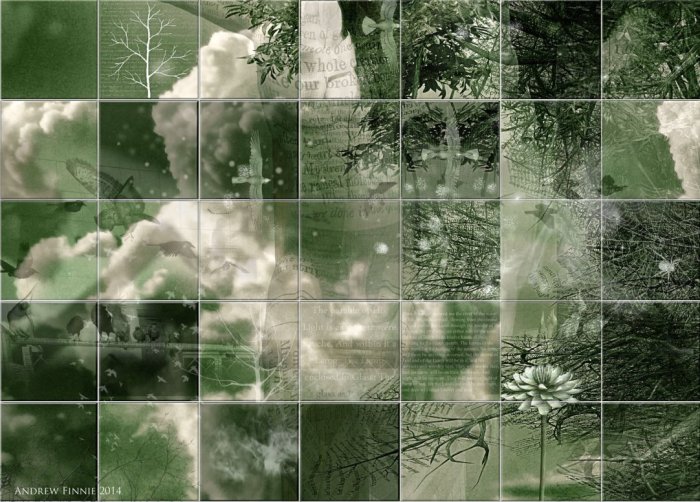
Andrew Finnie, an artist from Newcastle, Australia, is well known for his paintings of rich colour that express the sensual delight of the local beach-side landscape. Alongside this practice, Finnie is also a skilled digital artist, who is able to transform images into new forms with unexpected relationships. Here in this complex large-scale digital image we have a multitude of visual fragments that work to express the complex significance of the cross for this time in history.

Finnie 2.jpg

Finnie has placed the cross not in the position favoured in former centuries, high in the sky in glory, but deep into the shadows and roots of a large green tree. He explains: ‘This is the Tree of Life – this apparently jumbled mass of branches we see behind Christ. Inscribed in the bark of the tree are prayers and biblical texts. These prayers gather at the trunk of the tree, and make their way through the branches and transpire through the leaves, heading off towards heaven. So the Tree of Life’s story in this image is that it is a channel for our prayers’.

What strikes me most profoundly about this image is its insistence that my eye keeps returning to the earth, the ground. It reminds me that life is here and now and that God is incarnational, taking on human flesh. It also echoes the idea that the grace of God flows in and through creation; it is, therefore, an eco-theological insight for our times. We are invited to love the earth as God’s beautiful creation. In this regard, one is reminded of the medieval theologian, scientist, musician, and visionary Hildegard of Bingen who talked about ‘viriditas’, the greening force which is God’s gift and energy in creation. As Hildegard writes: ‘Christ brings lush greenness to shrivelled and wilted people’. The vibrant green of this work is the thing that pulses throughout all its branches and the tiny unfolding details that draw you down into its tendrils and roots.

Finnie 3

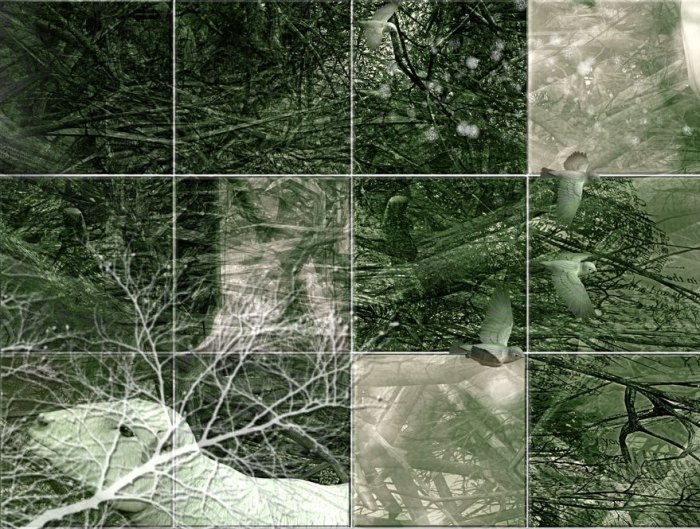
One of the devices used by the artist is the surface of repeated square divisions, which provides distinct pictures of engagement as worlds in themselves. The digital process has allowed Finnie to enhance the eye’s engagement through the fine details of cobwebs, insects, and flowers, as well as text that sounds out the words of Psalm 23, ‘The Lord is my Shepherd’. The fulness of engagement found in this work is at this level of detail, where one’s eyes are found wandering among the fragments, networks and connections. An apprehension of the whole is the awareness of an interconnected network of myriad details. An appreciation of the work builds through encountering these small meditations of looking into these tiny windows of intricate detail.

Arising out of these fragments and networks is the figure of the Christ crucified. The figure has been constructed from a found image used in a medical text, and is without skin and flesh. This emphasises the muscular structure and allows the figure to take on a more androgynous likeness, in turn allowing for the possible representation of both the male and female form. If this view is correct, then a maternal figure may draw us even closer to those earthly connections, where grace is found in human love and connection.

Does this figure represent a crucified and risen Christ who can embrace this world and respond to the travail of climate change and environmental stress? Who is God for us in this moment in our world history? How can we connect what we know about the cross, the redemption and resurrection, and apply it to God’s purpose for all creation? Andrew Finnie offers us a refreshingly hopeful opportunity to think about Christ and God’s purpose for human existence, embedded as we are in God’s creation, sharing its travail and looking for its redemption.

Reposted from ArtWay.

℘℘℘℘

ROD PATTENDEN IS AN ARTIST, ART HISTORIAN, AND THEOLOGIAN INTERESTED IN THE POWER OF IMAGES. HE LIVES AND WORKS ON AWABAKAL LAND.


Artist callout: Holy, honest confluences

Dr Rebekah Pryor has issued a callout to ‘artists (professional and established or emerging) working in any mode or medium, from any background, cultural, social or political context, and out of any religious tradition or none’ to contribute to an exhibition exploring ‘complex personal and communal relationships between humans, and between humans and other living beings and things’. Details here.


Sacred Silence in Literature and the Arts

The Australian Catholic University (Sydney Campus) is hosting a conference on Sacred Silence in Literature and the Arts, set for 4–5 October. Details here.

Screen Shot 2019-05-18 at 11.01.29 am

Joel McKerrow & the Mysterious Few – Welcome Home

℘℘℘℘

Joel McKerrow is a writer, speaker, educator, creativity specialist, and performance poet. He also lectures at Whitley Theological College in Melbourne, on Wurundjeri land.