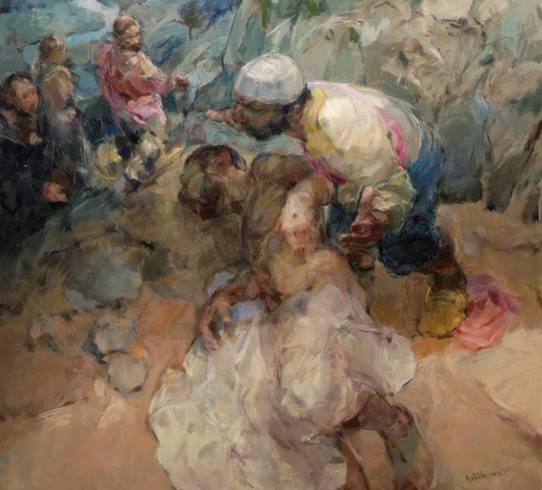
Bob Booth, I am Your Neighbour, 2010. Oil on canvas.
The story of the Good Samaritan is a familiar one, so much so that its very mention tends to celebrate a comfortable kind of religion as listeners reassure themselves of their place in the story. We should be reminded that in its original context it was a story that was utterly shocking to its first hearers. It dramatically crossed boundaries that were simply inconceivable for those listening. If this parable had been taken seriously, it would have upended cultural and religious conventions that had been carefully policed and reinforced. It is a story that has drawn many artists to re-invigorate in fresh ways both its attraction and its threat. For artist and priest Bob Booth it is a story worth the effort of exploring its potential to upset allegiances and to re-examine values and ethical actions in the contemporary world we inhabit.
Booth takes us into the drama of the story by placing the viewer just above the action, taking in the injured figure, helper and the passers-by. The composition allows our eye to sweep around the scene taking in both human actors and the compressed space of the landscape. Our eye comes to rest, after making this aerial survey, firstly on the hand of the fallen man and then to the hand of the ‘Samaritan’ with a finger decidedly pointing in our direction. We are drawn in, complicit, involved viewers, who are close enough to lend a hand and yet remaining fixed outside the picture plane. It is both a simple and yet complex composition that has been carefully crafted to include us in its sweep. The brush strokes and coloration serve to heighten its dramatic focus and its sensual textured surface emphasises a tender and compassionate moment. This painterly seduction only heightens the tension the viewer feels about a decision on whether to get involved.
The fallen man is somewhat reminiscent of a Christ figure, partly naked with a white cloth over his legs. What is utterly unfamiliar is the facial features of the helper and the skull cap that marks him out as a follower of Islam. Muslim men will often wear the white Taqiyah (Arabic for skull cap) as a sign of respect. This is worn especially during the five periods of prayers required each day. Bob Booth comments: ‘Had the parable of the Good Samaritan been presented in Australia today, I think that there would have been every chance that a Muslim would have taken the title role. I sometimes wonder how we manage to read this parable in church without causing a riot!’ The shock of this painting is appropriate to its original intentions to cross over the sharp divide of social enmity found between Jews and Samaritans. While they shared common ancient traditions, they were passionately divergent about the physical location of the most holy place to worship. Such enmity is echoed in contemporary ways as we have witnessed the terrible acts of violence in New Zealand and then in Sri Lanka during the first half of this year.
Underlying the disturbing shock of this story of hospitality and compassion is the boundary-breaking words and actions of Jesus in upsetting the religious conventions of his day. In the material actions of touching the untouchables, speaking to women in public, challenging religious leaders, breaking the Sabbath, feasting rather than fasting, Jesus enacts a more passionate and generous vision of who God might be. Bob Booth takes this as evidence that Jesus had his eye not on the rules and regulations of religious formalism but on something completely in opposition to such strictures. ‘It seems to me that Jesus was intoxicated with an audacious thought of goodness and beauty, a joy that was set before him for which he would endure anything’. This familiar story is therefore not so much about kindness or the virtues of middle-class niceness, but rather a way of seeing other human beings as being made in the image of God. It is in the encounter with strangers, or even perhaps with enemies, that we find our heart expanded and we see the possibilities of God’s grace at work in the world.
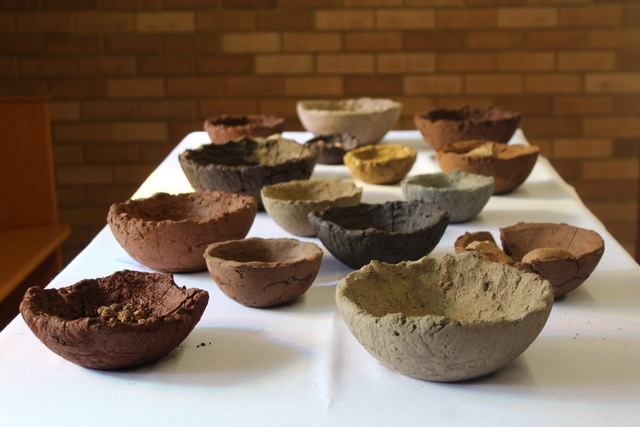
Why do we as humans crave acceptance and the space to be seen and heard? That was the initial driving force behind wanting to bring together like-minded individuals who share an interest in the interdisciplinary field of theology and the arts. It was out of sheer frustration and loneliness that I decided to do something about finding my theological/artistic tribe. So earlier this year, on the weekend of 12–14 July, the Anglican Parish of Woy Woy hosted ‘Vessels: Theology and the Arts Symposium’.
The goal of this symposium was to draw together theologians, practicing artists, clerics, philosophers, and poets to explore the relationships, intersections, and challenges that exist when the arts and theology come together. The three-day forum offered participants a multimodal and experiential platform to encounter the interdisciplinary interactions between the creative arts and theological theory. Over the three-day event, seventy participants listened to and interacted with five extraordinary keynote speakers, and a further seventeen short paper presentations. Additionally, those involved had the opportunity to participate in three creative workshops, listen to poetry performances, an interactive prayer space, and engage with the artworks displayed in the exhibition.
The organisation of a symposium, however, is an interesting adventure. I would first like to thank all the keynote speakers – Glenn Loughrey, Dorothy Lee, John McDowell, Rod Pattenden, and Chris Bedding – who, thanks to their wonderful contribution, and their commitment to continuing the conversation in the interdisciplinary space, enabled many others to experience a wide range of creative theological intersections. From Chris Bedding’s Pirate Faith to John McDowell’s analysis of theology and the art of popular cinema. From the confronting truths of Glenn Loughrey’s investigation of the impact of neo-colonialism and nostalgia on the perception of Aboriginal art and spirituality to the poetry of Dorothy Lee and her exploration of the transfiguration in the Gospel and poetry. To, finally, a reflection on what’s next by Rod Pattenden with his exploration of the tensions that exist between art and theology. These contributions gave us much food for thought and conversation.
Throughout the process of developing the program for the ‘Vessels’ symposium, liturgy and music was an important consideration. As I believe it is in our communal expression of praise and worship through liturgy where we are immersed at the intersection between human creativity and the grace of God. As such it was imperative to reflect on and create a liturgical space where the participants felt that the worship was not separate from the proceedings, but a natural part of the experience. The driving force behind the liturgical landscape of the event was the consummate teacher, composer, and musical liturgist Michael Mangan. Michael worked with the St Luke’s community, made informed musical choices and contributed significantly to the liturgical style of the event. His passion for liturgical music and liturgy is palpable, and one cannot but be impressed with his skills at bringing a community into the worship space.
It takes courage to walk into a theological space that is for many, outside their comfort zone. I have been asked on a number of occasions: Are you wanting to be an artist or a theologian, because surely you cannot be both? I believe, that for me, I cannot be one without the other. It is who I am, and who I am becoming. In light of this observation looking at the creative arts theologically is not just an academic pursuit, but it is in fact deeply practical in consequence and orientation. My thanks go to all participants who proposed and presented short papers, workshops, interactive prayer spaces, artworks, and poetry performances. It is heartening to hear so many people adding their voices and creative skill to this growing area of inquiry. The diversity of the creative input at this symposium was astonishing, and it highlighted the wonderful contributions of people in the fields of ecclesiastical ornamentation, poetry, philosophy, and many other disciplines.
I would like to make special mention of Rebekah Pryor, without whom this event would not have been as well organised. Rebekah is responsible for the professional curation of the exhibition, artist statements, exhibition catalogue, and co-convener. Working with Rebekah on this project was incredibly beneficial, as creative collaboration is key to having the opportunity to challenge oneself and take on board exciting perspectives and ideas.
It is my hope that from this event further conferences, communities, grants, prizes, and conversations are initialised. I now believe I have found my tribe, and I look forward to the next event.
℘℘℘℘
ALEXANDRA BANKS IS A PHD CANDIDATE IN THE FACULTY OF THEOLOGY AT ST FRANCIS’ THEOLOGICAL COLLEGE, CHARLES STURT UNIVERSITY.
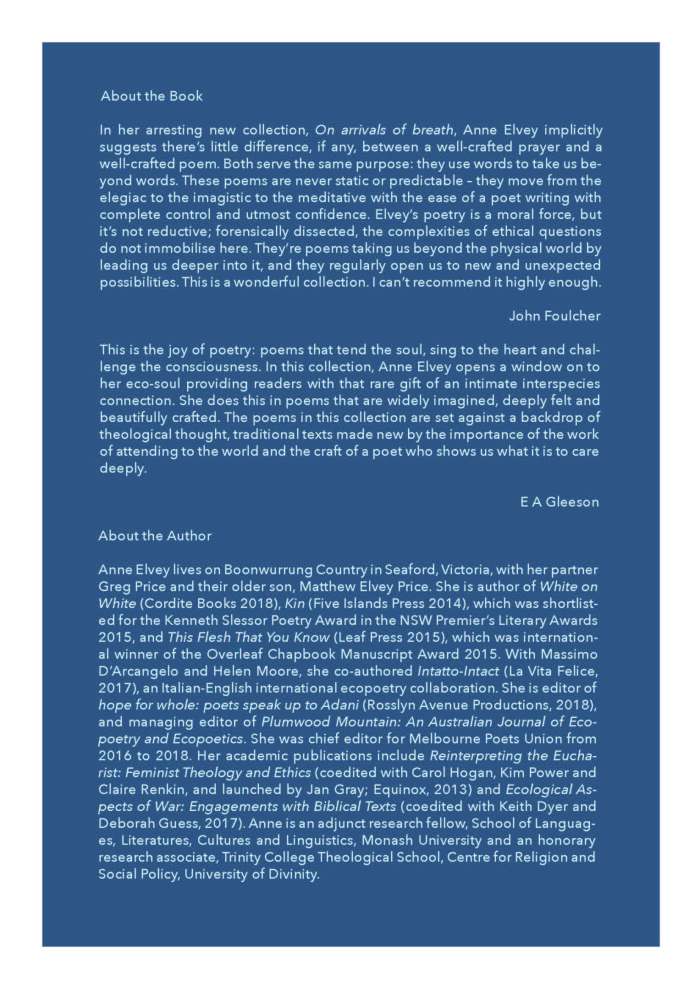
Readers of ATA are warmly invited to the launch of Anne Elvey’s new collection of poetry and prayer-like poems, On Arrivals of Breath. This will take place in Melbourne on Tuesday 15 October 2019, and in Sydney on Tuesday 22 October 2019. Details below.
He is a man fully present to himself. In the botanical gardens he wears a neat, close-brimmed hat and weaves through the crowd following a child. Deftly he catches her up, bringing her back into the gathering for the wedding ceremony. He is bearded and his body is compact, perfectly formed and compellingly small. He has such gravitas and is utterly himself. Later you will meet him and his partner, the mother of the doll-like child. While you are making introductions he will beam up at this woman who is beautifully round in ways that redefine the delights of a shapely waist and abundant breasts.
Her dress has a firm bodice and flares confidently in a full-skirted flounce. The floral fabric speaks happiness wrapped close to the heart of this woman. Her gaze carries such warmth that you feel immediately cosied. She gleams. Her dear friend is getting married. They did their doctorates together in a far place, and she has come to witness this wedding. Now we have seen the brides arriving and we are filled with delight.
That night you will see the man and the woman dancing. There is a live band, the music calls and people dance on the deck. The man has removed his hat and from behind you notice his upturned head and the fringe of hair that circles it. As the pair twirl you see them in profile, a picture of rapture so binding that you want to hold this moment, let the sweep of their love suffuse you.
There is an easy grace in their dance-hold. They are not new to this posture and they inhabit it with the familiarity of old dance partners. This couple are young, perhaps in their 30s – yet old enough to have arrived into themselves in this way. Their physical difference might have once isolated them, made them “other”, the non-standard versions of shape and height. Here, now, they are so clearly content that their wholeness speaks love for themselves as well as each other.
So much is lost when beauty is homogenised to replications of tall men and slim women. It is also damaging. Celebrating only narrowly defined ranges of human loveliness is a form of un-love and a silent erasure. Constant exposure to the supposed perfection of celebrity stereotypes is designed to find us wanting. Jesus of Nazareth often responded to people whose lives were enacted outside the embrace of communal approval. He spoke with them and named them as faithful. By implication the harmful other-ing of their communities was faith-less. His censure to gendered power and religious entitlement remain provocations to this day.
JULIE PERRIN IS A MELBOURNE WRITER, ORAL STORYTELLER, AND ASSOCIATE TEACHER AT PILGRIM THEOLOGICAL COLLEGE, UNIVERSITY OF DIVINITY. SHE KEEPS A WEBSITE, AND HER MOST RECENT BOOK IS TENDER. SHE LIVES AND WORKS ON WURUNDJERI LAND.
This richly-illustrated lecture will explore the ways in which the figure of Jesus Christ has appeared in the history of Australian Art. Some of these images will appear familiar and confirm the roles of Jesus as teacher and healer. Some of the images can be found in Churches while others appear in the private studios of artists who have been drawn to the figure of Christ as a source of inspiration. Other images will be surprising as they arise in unexpected place with artists outside the Christian faith who nevertheless bring insights about the search for spirituality in Australia. Some of these images arrive with a sense of shock as they break open expectations about who Jesus is in the complexity of our contemporary culture. This fascinating overview will explore how the image of Jesus has found a home within Australian culture while also turning to challenge its comfortable illusions.
Rev Dr Rod Pattenden is an art historian and theologian interested in the power of images. He considers that looking at art helps us see more clearly the culture we inhabit and what shapes our faith, hopes, and desires in this complex postmodern era. Rod has written and lectured widely on art and spirituality in Australia and for many years was the Chair of the Blake Prize for Religious Art. He is currently minister of the Adamstown Uniting Church where he leads a vibrant arts and community development ministry.
WHEN: Thursday 12 September 2019 at 7:30pm
LOCATION: St Cuthbert’s Anglican Church, Cnr Darlington and Hillsden Roads, Darlington, WA 6070
In many places of Christian worship throughout Australia, at any given worship service, music will play a significant role in the facilitation of worship. Music will be utilised to accompany text, it may function as a cue or fill, and it will provide possibly a soundtrack for audio-visual presentations, prayers, and other worship rituals. But how often does music stand alone – as textless? Can textless music function as a corporate worship act? Can, for example, the contemplation of a Bach fugue or an improvised guitar solo during worship mediate Christian experience, meaning-generation, and transformation? If so, how? And to what do we ascribe music’s mediatory power?
If one adopts a logocentric model of divine revelation, whereby knowledge and experience of God’s self-communication is reduced to what can be articulated verbally and propositionally, the validity and value of textless music would tend to be, understandably, questionable. (Such questionability would relate probably also to other non-verbal art forms and poetic modes of language). Within such a model, music might be seen as useful within worship only when tied – handmaiden-like – to song lyrics. Within this model, it is difficult to see how music could function beyond highlighting and heightening what is otherwise believed to be expressible clearly and precisely through texts. However, experience shows that textless music does ‘speak’ to people in ways which exceed and precede words.
Views of divine revelation whereby human receptivity to God’s self-communication is seen as encompassing and originating potentially in all dimensions of human existence and experience (including the senses and the emotions) are more conducive to the use of textless music (and other art forms) within worship. However, when textless music in worship does elicit some form of meaning, we can grapple for ways to come to terms theologically with such meaning. Such meaning is extremely precise in terms of neurophysiological responses, affects, and the field of meaning-generating possibilities elicited by those responses and affects. However, such meaning is also fundamentally vague in the sense that it is indeterminate. How can such meaning qualify as Christian? How can it facilitate our transformation into the community of Christ?
Christian discourse can sometimes appear to imply that divine word and power is siphoned (magically?) through music (and music-maker) from divine source to human recipient in a linear, direct, unidirectional way – like the music is some sort of hollow conduit. At times, the discourse seems to evoke images of music (and music-maker) as an empty container being temporarily inhabited by divinity. These images represent understandings which are not only highly problematic theologically, but ultimately restrictive and unhelpful. They can deny, paradoxically, both the radical transcendence of God and God’s immanence in the world. They reflect a ‘god-of-the-gaps’ mentality which sets up a false dichotomy between ‘spiritual’ and ‘material’ processes. They ignore (among much else) the dynamics of human anthropology, subjectivity, and receptivity; context; and musicological dimensions including the specific musical properties and structures of particular musical pieces and performances.
A model of divine revelation which is helpful for grounding understanding of the mediatory role of textless music (and other art forms) within worship is symbolic mediation (Avery Dulles presents this model in Models of Revelation). God’s self-communication is mediated via entities (verbal and non-verbal) functioning as symbols. This model recognises originating divine source and initiative in God’s self-communication, but it also acknowledges that human receptivity to God’s self-communication is constructive (it constructs). This means the myriad and diverse particularities of anthropological, social, cultural, and historical contexts, and, importantly, the specific materiality of mediating symbols are crucial to Christian experience, meaning-generation, and transformation.
Entities function as symbols when they manifest, via their own constitution, realities distinct from themselves (such as when a harsh vocal tone manifests and thus refers to anger). At the same time, entities functioning as symbols do not reduce those realities to themselves (anger is not equivalent to or exhausted by a harsh vocal tone). Symbols could be likened to prisms which refract white light in myriad, diverse colours, shapes, intensities, and angles according to the prisms’ own constitution. The refracted light is the light (in one sense or another); it is the means whereby the light is manifest in particular ways; but the refracted light does not exhaust the light’s possibilities.
For Christians, Christ is the preeminent symbol (incarnation) of God’s self-communication. Christ’s humanity – his life as a whole – and the Christ event in particular, mediates divine life, character, and purpose. Christ is divine; Christ’s humanity and the Christ event is the means whereby the divine is manifest; but mediation of the divine through Christ is a continuing, progressive, inexhaustible process. (I am not claiming equivalence between Christ’s symbolic function and that of other symbols. Rather, within the Christian tradition, Christ as symbol of the divine is the condition whereby, and paradigm through which, all other entities functioning as symbols of the divine can, respectively, do so and be investigated.)
Christian worship symbolically mediates Christ and the Christ event (like a symbol within a symbol) according to a particular range of acts, words, feelings, physical items, etc. (which function as symbols). For example: the material constitution of bread and wine manifests the dissolution and change inherent within Christ’s death and resurrection; the public reading of Scriptural narratives, exhortations, and poetry opens up windows on specific aspects of divine realities; and union and communion during worship is a realisation of Trinitarian union and communion. Such symbols are the realities to which they refer (in one sense or another); they are the means whereby these realities are manifest in particular ways; but they are not equivalent to these realities – the realities transcend the symbols.
Textless music belongs to a special group of symbols (including other art forms) within worship which can offer potentially new and deeper levels of mediation of Christ and the Christ event due to their nonconventionality and multivalence. The specific properties and structures (as heard by listeners) of a piece of textless music enable the piece to function symbolically when they are perceived as manifesting particular qualities. These qualities are not determinate in meaning but they are full of possibility for, and thus condition, meaning-generation. When these qualities are brought into mutual dynamic relation with particular symbols of the worship context, meaning of a determinate nature can emerge. Such meaning may take the form of concrete experiences, thoughts, images (sensory and conceptual), ideas, behavioural responses, and mindset changes which can constitute Christian insight and transformation.
Imagine a piece of textless music mediating qualities which could be described as profoundly mystical, calmly ecstatic, expressively warm, and deeply interior. This piece is performed during a Christmas Eve service. Due to the unique convergence of and interaction between these qualities and the mediation (through worship symbols) of events surrounding, and notions pertaining to, Christ’s birth, new experiences and insights could emerge regarding the Incarnation and the ramifications of the Incarnation for the world and worshippers’ individual lives. It is impossible to predict exactly what might emerge, and outcomes would differ for each worshipper, but this explication shows that the specific musical properties and structures of the piece (along with dimensions of human subjectivity and the Christian tradition) are constructive of what is communicated of the divine. The specific musical properties and structures are (in the sense of being recruited as part of) the realities to which they refer; they are the means whereby such realities are manifest in specific ways; but they are not equivalent to these realities – these realities transcend the musical properties and structures.
Textless music thus functions as a symbol within a symbol (the entire worship event) within a symbol (Christ/the Christ event). This symbol scheme does not connote a simple top-down or bottom-up hierarchy. The symbolic power of textless music is not merely determined by other symbolic layers nor does it invent Christian experience and meaning. Rather, the symbolic power of textless music interacts in potentially dynamic and unpredictable ways with/within these other symbolic layers to enlarge, purge, or even disrupt what is (has been in the past and will be in the future) mediated by these other symbolic layers. Such dynamism and unpredictability is not equated with the work of the Spirit (as if the Spirit is only ‘present’ when such dynamism and unpredictability is clearly at play), but dynamism and unpredictability is seen here as one of multiple modes in which the Spirit can be at work (perhaps another mode can be a musician’s daily and sometimes painful surrender to the physical and mental discipline required for attaining musical expertise).
Space limitations preclude (much-needed) further explication of the musical-liturgical meaning-generating process including the bases on which relations are established between musical properties and structures; qualities; and experiences, thoughts, and ideas. However, at the very least, it is hoped that a picture is being painted here which begins to cut through, on one hand, dismissive attitudes towards the mediatory power of textless music, and on the other hand, banal, esoteric explanations of such power. Perhaps if we can catch a glimpse of the beautifully confounding conjunction of precision, complexity, and seeming inexhaustibility involved in God’s self-communication, people involved in the facilitation of Christian worship may be enabled to embrace increasingly the rich and infinitely-expansive possibilities that textless music can open up for Christian experience, meaning-generation, and transformation.
℘℘℘℘
Jennifer Wakeling is a musician, educator, and researcher in the fields of music theology and worship theology. She has submitted her PhD thesis entitled ‘Divine Resonance: Meaning-Generation via Instrumental Music within Christian Worship’. She lives in Kau-in Kau-in, Ningi Ningi country.
On Maundy Thursday, Good Friday’s Victim “placed Himself in the order of signs.”[1] By this gesture, Jesus is understood to have handed himself over, traditioned himself, into the human economy of meaning and signification, and so into the realm of human art. So resplendent with meaning was the Sign he gave, that its radiance generated, within mere centuries, the essential form and complexity of the Latin Rite.[2]
In both the original gesture, which is the still point of the Canon that lies at the heart the Rite, and in the fullness of the Rite in its most elaborate expression, the meaning of the Sign could never be separated or dissociated from the medium that sustains it and accomplishes it. The Tridentine conviction that in the liturgy “nothing is superfluous” points precisely to this radiance of the whole of the liturgical gesture, and not to the narrow neo-scholastic minimalism of sacramental “validity.”[3] Like any work of great human art, the beauty of the liturgy—the Sign traditioned through history—is sustained within an indissoluble unity of form and content; the kernel and the husk are here one.
What is most surprising as regards the liturgy is what is at same time most obvious: the sheer humanness of the manner of this communication. As a rational animal who learns through his sense, who reasons from the world he touches and tastes, the human being is among the beings of the world uniquely “sacramental” and “ritualistic.” He is, as the Welsh-English poet David Jones used to say, “sacrament at every turn and all levels of the ‘profane’ and ‘sacred,’ in the trivial and in the profound, no escape from sacrament.”[4] The Council Fathers at Trent were keenly aware of this when they justified the un-bloody sacrifice of the Mass as a thing “the nature of man demands.”[5]
The human being lives and moves in signs; and at the highest reaches of his life and experience, these signs radiate a meaningfulness beyond what can be abstracted from the sign that signifies. The human is a being of media and mediation.
In our epoch, after the double explosion of the electronic age and the digital revolution, the human is in a paradoxical situation. Humans have never been so saturated by the fact of media in the form of a plethora of competing media and rival significations, while at the same time, the sign of the mystery of being, the medium of his own destiny and the Sign of the God-Man handed over to him on Holy Thursday, has never been so difficult to discern, so abstract and so seemingly irrelevant to his media world.
This is due to at least two factors. On the one hand the relentless competition of media vying for human attention hits the human mind with a dizzying experience of being “Distracted from distraction by distraction.”[6] Concentration and silence lead, in our culture, less to contemplation of being and more the anxious vertigo of despair of significant meaning.
While on the other, the nature of digital media, with its hyper-virtuality, tends, at least in the first instance and on the surface, to hide the mediating character of media itself, so much so that “content” is paradoxically experienced as without any real relation to form. The message exists as if it is indifferent to its media.
The reproductions, multiplications, and endless variations in the field of media have, in this sense, achieved the alienation of the human being, not so much from God, but from the significant meaning of his own humanity. From the point of view of the Christian religion, this alienation of the human being from the significance of his being is yet more disastrous than alienation from the question of God. This is because it is estrangement from the medium God himself chose when he became Incarnate and left to us the work of propagating his memory in the fleshy art of the liturgy that grows and is sustained from his original traditioning.
All I have said so far has been gesturing to the diagnosis of Marshal McLuhan, whom I consider not only a great Catholic thinker, but one of the key voices through which we can come to better understand the digital age in which we now live.
McLuhan, of course, wrote long before the invention of the internet and digital technology. He diagnosed what he called the “electronic age”—the age of the television, the movie, the telephone, and radio. His insight is well summed up in his famous adage: the “medium is the message.” In his 1964 work Understanding Media McLuhan argues that the social impact of communication, its power to radically transform culture and human life, never lies in the inputs of new messages or ideas, but rather overwhelmingly in the introduction of new media. This is the case, according to McLuhan, because media is what fashions and determines “the scale and form of human association and action” (Understanding Media, 9). Here we could say that media has the power both to “enframe” and to “expand” our experience of being.
McLuhan takes film as an example that shows how a unique medium reconstrues the human experience of reality:
The movie, by sheer speeding up of the mechanical, carried us from the world of sequence and connections into the world of creative configuration and structure. The message of the movie medium is that of transition from lineal connections to configurations (12–13).
This realignment of the human experience of time, from the sense of historical and narrative connection to a situation of punctiliar juxtaposition of configurations, is one way the electronic age reconceives our humanity.
To understand the real depth of this impact, it is crucial to grasp how, for McLuhan, every media is an extension of the human nervous system, a portal of transportation both in space and time. So that, ultimately, what new media introduce, in each case, is a new experience of scale, temporal and spatial. This is the real message of the medium: the way that roads reduced the scale of distance between towns and the invention of the car accelerated this; so the television introduces us into the simultaneous spatially collapsed world of, what McLuhan called, the “global village”; or how the internet now has introduced us to the pure presence of virtual identity and connection, devoid of the significance of our carnality and geography.
But even as new media extend the human nervous system, this extension of human experience collapses not only the lineal connection of life into configuration, but overwhelmingly the carnal connection of persons. In other words, our new media, which are generated from the sacramental possibility of the human creature itself, now become the very means of the concealment of this most human fact of being.
The more the world becomes pure presence from Beijing to Buenos Aires, from New York to Johannesburg, the more the absence of the carnal other becomes unremarkable since we remain virtually connected, while its concrete presence becomes an irrelevance, apart from the inconvenience its presence poses to my use of my digital media that mediates the world to me.
McLuhan helps us clarify how this is so, since for him it is not merely the fact that the medium is the message, but more: the “‘content’ of any medium is always another medium” (8). McLuhan illuminates this claim with the example of light generated from a light bulb, which is “pure information” precisely because it is “a medium without a message” (Ibid.). The light bulb has no “content” the way a book has “content”; yet, as a medium, its impact is radical: the light bulb enables the human being to create spaces in times of the day and in places in which it would have been impossible, and so creates “an environment by its mere presence” (Ibid.) an environment which allows for other media.
The extension of the human nervous system in the electronic age—the age of airplanes and television, radio, and telephones—becomes a global transportation system deconstructive of human scales of mediation: the old media of city and marketplace, sidewalk and local shop, house and porch, which mediated human life on a more human scale, now become obstacles. If we can already see the deconstructive character of the electronic age, the digital age represents a radicalization of the transportation system, which McLuhan perhaps anticipated but could never have fully imagined.
The smartphone and the internet represent the total collapse of the human encounter into the virtual, since these forms of communication travel faster even than the speed of the human central nervous system. Now even the airplane and the television, the highway and the radio are too incarnate to keep pace with the spatialized speed of the digital transportation system. At this point our own bodies, our physical communities and our next of kin, become increasingly irrelevant to our sense of life.
For McLuhan the aesthetic announcement of his thesis and its distortive consequence was given by the Cubist movement in art:
[C]ubism, by giving the inside and outside, the top, bottom, back, and front and the rest, in two dimensions, drops the illusion of perspective in favor of instant sensory awareness of the whole (13).
This sensation of “instant sensory awareness of the whole” is perhaps related to Heidegger’s experience of “enframement,” the technological paradigm of thought “the gathering together of that setting-upon which sets upon man, [and so] challenges him forth, to reveal the real, in the mode of ordering, as standing-reserve.”[7]
It is also very close to what Catherine Pickstock, in her seminal book After Writing, diagnosed as the “spacialization” of being. Pickstock defines this spacialization of being as the result of “a textual calculus of the real” ruled by “protocols of division and manipulation” that function “independent of time and space” and thus work to suppress “embodiment and temporality.”[8] While for her the roots of this spacialization lie in the univocal conception of being associated with the figure of John Duns Scotus, the philosophical apogee comes for her with Descartes, and what she understands as his “subject”frozen in space, which is predicated on the collapse of time into space. For Pickstock, on the level of culture, the impact of digital technology carries this process to its logical and most radical conclusion.
But if aesthetically, for McLuhan, specialization is understood as evidenced in the figures of Cubism, in Cubism there is still a complexity. Furthermore, McLuhan discerns in Cubism also a moment of discovery. He writes: “Cubism, by seizing on instant total awareness, suddenly announced that the medium is the message.” (Understanding Media, 13). This announcement is the discovery, for McLuhan, of the electronic age, before which this fact of human being and communication was not yet obvious because not yet problematic (Ibid., 13–14). The electronic age, for McLuhan, not only saturates the human being with media in a way that alienates him from both the height and depth of the Sign’s meaningfulness, it is also a portal of discovery, and so holds within in the promise of recovery of a genuinely human gaze on the real. And in this way McLuhan links up with the ultimate wager of Heidegger’s “The Question Concerning Technology,” which is not merely a critique of technology but a search for a way beyond the trap of the technological paradigm.[9]
Now, if the essence of technology for Heidegger is the “destining of revealing,” then technology in the originary sense is bound up, paradoxically, with unconcealing, that is, with bringing-forth, even if it ends up doing the opposite.[10] Drawing on Aristotles’s account of the four causes, Heidegger argues that both physis and poiesis are ways of unconcealing. It is not just nature that brings forth being; art does this too.
Thus, the encounter with being as such (physis) and the act of making signs (poiesis) both involve aletheia: truth as unconcealment rather than capture. And herein lies, for Heidegger, is the origin of “technology,” which derives from techne, which according to him at one time also meant “the bringing-forth of the true into the beautiful.” Techne in its originary sense thus is bound to—and convertible with—poiesis, human art, and the discovery of beauty.
In this light we can perhaps see that the technological paradigm, the electronic age, and the digital revolution all bring us to the brink of discovery: to the Cubist moment. The hyper inhumanity of our dislocation that forces an encounter with the truth of human being. The Italian philosopher Emanuele Severino once remarked: “the gaze that notices the desert does not belong to the desert.”[11] In a similar way McLuhan notes the irony of “a culture like ours, long accustomed to splitting and dividing all things as a means of control,” comes now to discover, through the contradiction of its own production, that “in operational and practical fact, the medium is the message” (Understanding Media, 7). The question then becomes: where is the medium that saves the meaningfulness of our own humanity?
From a Catholic point of view all of this points back at Holy Thursday, when Good Friday’s Victim “placed Himself into the order of signs.” The wager of the Christian claim is that, in that moment, the divine Mystery took the form of human art and made of it a perfect communication of our salvation. The meaningfulness of the Mystery become flesh is not a human achievement or ingenuity, it neither conquers being nor divine meaning, but is rather the work of divinity imitating human nature, as it were, to disclose the divine brilliance and destiny of the human being.
In traditioning himself into the human economy of meaning as the Sign of salvation, Good Friday’s Victim made himself the medium even of the salivation of the digital age since he is now the medium of a perfect message, not in the sense of a lightbulb that generates “pure information” because it is “a medium without a message,” but in the sense of a medium that is coterminous with its message. In Jesus Christ the human nervous system is extended into communion with the whole for which it was made.
All of the forgoing in this light points to a need for a renewed and contemplative attentiveness to the liturgical gesture traditioned at the heart of the Church’s life. In the Cenacle, when Jesus handed himself over, he established the Sign to which alone all meaning and depth adheres.
“I have given you a sign (ὑπόδειγμα)” (Jn 13:15). Jesus does not give a discourse or doctrine, a moral teaching or gnosis. He gives an indication, a showing, a gesture, a Sign. In fact this is the method Jesus used throughout his mission: “believe the works, that you may know and understand that the Father is in me and I am in the Father” (Jn 10:39); “Go and tell John what you have seen and heard” (Lk 7:22). Jesus does not ask for mere adherence to what he says, he entrusts the evidence of his being to the hearts of those who have seen him, and thus activates their capacity to judge the signs he gives of his being.[12]
The artistic fruitfulness of Jesus’s last Sign, the Eucharist, is an original fullness of splendor hidden in evident poverty. The graceful poverty of the great splendor of this gesture is the basis of the formal elegance and beauty of the mature liturgy, which sustains the original medium of Jesus’s self-traditioning; Sign precisely in the wholeness of the rite, in which the medium is the message.
The radiance of the liturgical gesture is beheld by the astonished eyes of faith, which awaken thereby to the glory of the divine presence in the indissoluble unity of form and content the Sign requires. That the liturgy grew so quickly into a cathedral of ritual postures, elegant formal speech, rubrics, set music and architecture, plays of light and shadow, verifies and confirms the conviction of the original gesture: only human art can be the medium of the human memoria of Jesus’s un-utterable self-gift pronobis.
As veritatis splendor, the liturgy, in the sublimity of its expression, is truly the glory of God made flesh and blood here and now, a present fact of our own human history; and therefore it grows in time. The liturgy grows (it is not made) because it is not only a memory of the past, but a gathering together of the past towards the Destiny to which all human life strains, especially when it sees the desert. The Christian task in our moment, in the human desert of the digital age, is the same as it was at the beginning: “Do this in memory of me.”
[1] Maurice de la Taille, as quoted in David Jones, “Art and Sacrament,” in Epoch and Artist (London: Faber and Faber, 1959), 143–179, at 179.
[2] Cf. Joseph Jungmann, S.J., The Mass of the Roman Rite: Its Origins and Development, 2 vols. trans. Francis Brunner (New York: Benziger, 1951), vol. 1, 49–60.
[3] Cf. Council of Trent, “Decree on the Sacraments,” canon 4 (DS 1604).
[4] Jones, “Art and Sacrament,” 217.
[5] Council of Trent, “Doctrine and Canons on the Sacrifice of the Mass,” chapter 1 (DS 1740).
[6] T. S. Eliot, “Burnt Norton,” III, 12, Four Quartets in The Poems of T. S. Eliot, Vol. 1. Collected and Uncollected Poems, ed. Cristopher Ricks and Jim McCue (London: Faber and Faber, 2015), 182.
[7] Martin Heidegger, “The Question Concerning Technology,” in The Question Concerning Technology and Other Essays, trans. William Lovitt (New York: Garland Publishing, Inc., 1977), 3–35, at 20.
[8] Catherine Pickstock, After Writing: On the Liturgical Consummation of Philosophy (Oxford: Blackwell, 1998), 3 and see 47–100.
[9] The way he puts it at the beginning of his essay is that he seeks a “free” relationship to technology, that “opens our human existence to the essence of technology.” (Heidegger, “The Question Concerning Technology,” 3)
[10] Heidegger, “The Question Concerning Technology,” 34–5.
[11] Emanuele Severino, Téchne: La radici della violenza (Milan: Rizzoli, 2002), 301. Quoted in Alberto Savorana, The Life of Luigi Giussani, trans. Mariangela C. Sullivan and Christopher Bacich (Montreal & Kingston: McGill-Queen’s University Press, 2018), 789.
[12] Cf. Julián Carrón ¿Dónde está Dios? La fe cristiana en tiempos de la gran incertidumbre (Madrid: Encuentro, 2017), 94–95.
Aaron Riches is a Canadian theologian currently serving at Benedictine College in Atchison, Kansas, USA. He is also the author of Ecce Homo: On the Divine Unity of Christ.
Brett a’Court, Manu (Kahu), 2007. Oil on canvas. Private collection.
This striking image of an airborne Christ is from New Zealand painter Brett a’Court. It is part of his investigation into a way of bringing together the spiritual insights of the indigenous culture of the Māori people and that of Christianity brought to New Zealand by British settlers. In cultural terms, it is a hybrid image. This is something that occurs when two cultures are in a process of mutual re-assessment. That sort of conversation is full of conflict and critique but also allows for the potential for new forms to arise that express the best of both traditions. A Christ figure flying in the sky like a kite is such a form. It is a new thing, a potential heresy or aberration, but one full of potential for new insight and spiritual refreshment.
Christianity has expanded over recent centuries into a world religion, bringing with it European visual forms. At times these have been part of the conquering ideology as European colonial expansion has repressed the cultures of indigenous peoples seeing them as backward, pagan, or even demonic. As a result, objects were destroyed or burnt, cultural practices repressed or forbidden, and mythic narratives banned. In its place peoples were Christianised, therefore ‘civilised’, and presented in newly-minted European clothes and behaviours. Now, in this current post-colonial period, there has been a recognition of the violence done to people through denying them their own culture. In New Zealand since the 1980s, there has been a revival of traditional indigenous forms. New Zealand now seeks to be a bi-cultural nation, using forms from both traditions to mark out its national life. This hybrid Jesus, therefore, speaks to this new period of cultural re-formation offering new possibilities in deepening spirituality that arises from within this complex and newly emerging situation.
The ‘Manu-Kahu’ in Maori culture refers to the harrier hawk, a bird associated with being a spiritual connection to the divine. It also refers to the cultural practice of making kites, which was not only a common recreational practice but also a religious one as massive large-scale kites were produced for significant ritual occasions. These could carry the weight of a human person and were flown with up to a kilometre of rope to therefore command vast terrains in their ritual role. These kites ‘evoked the supernatural powers indicative of the Māori life force and associations with animals, birds, and the dream of flight. Used as communication devices to their gods, Māori kites became a link with the great natural powers which ruled their life’ (John Tarlton, ‘Ancient Maori Kites’, Art New Zealand, December, 1976). For the artist, this provides an appropriate link to the cultural place of the Christ figure who holds the land with benevolence and grace. It is also a visual statement of confidence in Christian spirituality as a relevant force in contemporary society, particularly during this period of post-colonial reformation.
Brett a’Court has created something new. It is a surprising innovation and unsettles traditional iconographical conventions. It disturbs expectations and could therefore be considered a threat to correct theological form. It also dislodges the colonial mentality that considers the European way of seeing things to be the correct and authoritative one. It is also something curious and worthy of consideration – a Christ figure in flight, who brings together belief and the physical environment in which people live. This is a thoroughly-contextual Christ for New Zealand, the land where birds have become the dominant species. This is a Christ at home in this particular cultural landscape. This is not an introduced species carrying an exotic spirituality. This is Christ at home in the physical landscape of the Pacific. A’Court shows his respect for the great innovative New Zealand painter Colin McCahon by using the device of speech bubbles echoing biblical quotes, which were part of McCahon’s innovative and hybrid response to colonialism. For viewers further afield, this work serves to expand our sense of encounter with a God at home in the world, an incarnation that honours the material world we inhabit, a Christ both particular and universal, both newly strange and safely familiar.
ROD PATTENDENIS AN ARTIST, ART HISTORIAN, AND THEOLOGIAN INTERESTED IN THE POWER OF IMAGES. HE LIVES AND WORKS ON AWABAKAL LAND.
Brett A’Court is a New Zealand painter who has been active since 1995 holding a series of successful exhibitions in his home country. His work draws on popular and historical fragments to explore issues of spirituality and meaning. He is interested to explore this in the context of the bi-cultural nature of New Zealand/Aoterora, ‘dissecting the imagery to unveil the light within, aware also of my place in Aoterora, soaked in Māori and Christian spirituality’.
I have an odd relationship with my body. It doesn’t have the stamina I would like and I feel like it lies to me quite regularly. But it doesn’t lie. Rather, it whispers in a way that requires an intense listening. Slowly I feel that I might be learning the full-bodied type of listening required that creativity has been helping me learn and that I have been trying to be intentional about this year. It has come as the result of a reluctant road I’ve followed due to ill health. Late in 2005, I was diagnosed with fibromyalgia, a condition characterized by unexplained pain, insomnia, and what is commonly referred to as fibro fog – a deep, grey and constant unclearness, or fogginess, of mind. It has become an underlying pillar of my life, providing an unsteady platform on which to construct my thoughts about life and faith.
While my health is somewhat improved presently is still requires management. This life has thrust to the forefront the importance and necessity of a slower paced approach, steering me in the direction of contemplative spirituality and a deep appreciation of ritual. I have a deepening and growing appreciation for the sacramentality of creativity, as in the past few years just about any moments of grace have been felt through some creative engagement.
I feel like I have to constantly fight against my body to not feel uncomfortable. And by fight I mean carefully and deliberately care for it in a way that I was not taught would be necessary. I must consciously and deliberately spend time at the end of the day encouraging my body to let go. An evening is sometimes the very least amount of time it takes for me to ‘come down’ from the day. Many days I can physically feel and hear the ‘buzzing’ of my blood as it races around my body and into my brain as though hyped up on a constant new influx of fizzy drink by direct injection.
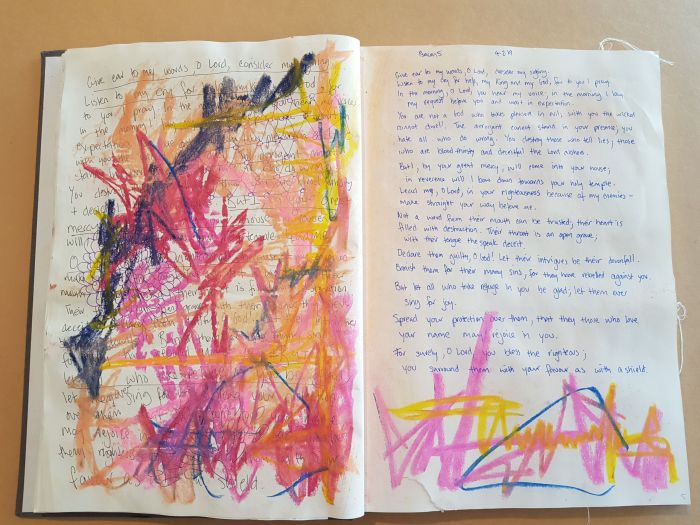
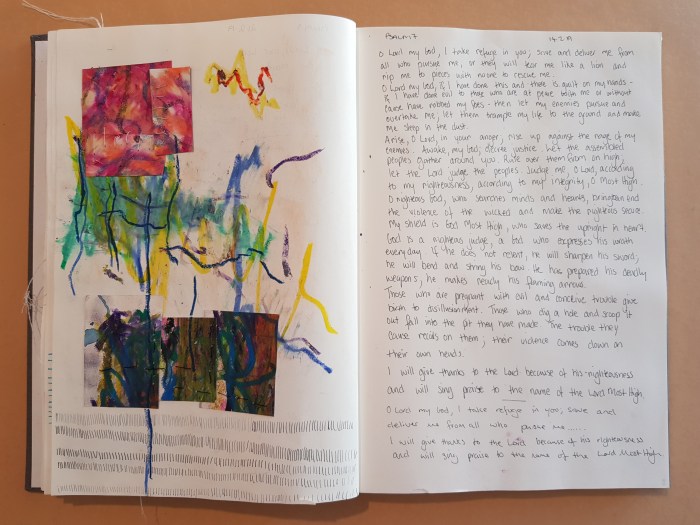
Ritual has become a path to follow and a direction to face myself towards. One of the most recent for me is ‘The One A Week Psalms Project’. The premise is to reflect on one Psalm a week and engage creatively as a spiritual discipline. At the moment I have an A4 journal that serves as the basis of the creative practice along with a writing journal and I do any combination of read, pray, write, sit, become distracted, draw, scribble, make, glue, and stare at the page.
At the moment, only just six months in, I think I am learning to practice a type of listening I now realize I tentatively began a few years ago. I spend a lot of the Psalm Project time listening to, and with, my body. And in this process I have discovered some of those grace-filled, sacramental moments. I sit and read, and think, and feel, and then decide with my whole body what I might like to try ‘doing’. The gestures that feel drawn from me, or to me. What marks do I want to make and what process do I want to engage with: Precise circle drawings? Free repetitive lines? Random scribbles? Colour? Black ink? Cursive letter drawing?
It can be difficult for me to realize how it is that I actually feel underneath my fizzy blood and what I am thinking in my buzzed up brain. This process encourages me to wait, with a small blank page, and small expectations. It is becoming a spiritual discipline that is surprising built around a growing awareness of my longings – not frivolous wants or desires – but deep physical and feeling longings to sit in the quiet and desire to learn to listen to God’s words through, around, above, beneath, and within me. It is teaching me to be integrative, incarnational, to not divorce aspects within myself, and instead to try and be as honest as I can.
It is in these moments that I am learning to wait. Waiting is difficult; I have plans and ideas and things to do. But that is not how my life can be lived. It is not wrong, rather it is different to my expectation of how I would live my life. It is also not a waiting for everything to just fall into my lap without participation. It is an active waiting; a waiting until waiting can be done no longer. This creative and spiritual practice bleeds into the rest of my life and I find that I am slowly, and with many failures, learning to be active and still with an ear more tuned towards God. I am learning also that God is there in the waiting, life is not passing me by in the waiting but is the actual life. We live and do and be and all while we wait upon God.
In this space of engagement with the Psalms I am continually invited to reflect on who I am, and who God is. I’m not any more certain of anything, but I think I am learning to sit within the uncertainty. All I can do is hope that I am able to continue the practicing. We both practice and live life simultaneously in this weird, public, performance art rehearsal space.
The Psalm Project is not meant to be the entirety of either my art or spiritual practice. It is simply a way of practicing. It is a place to begin that builds on what has come before. It allows me to sit within the pains, the busy mind, the uncertain thoughts, and sometimes to simply stare at the page and the psalm and wonder yet again, why these psalms are so upbeat and joyful, why they are so violent and bloodthirsty, why they are so depressing and lamenting? How do they depict what I am feeing, and also what I am not? Whatever life is at the moment, it is something I am learning will be enough so long as I am facing towards God, often with a pen, or pencil or pastel in my hand but always trying for some stillness.
℘℘℘℘
Karly Michelle Edgar is a mixed media artist, trained in theatre, with an MA in Church Practice. She was formally the Lecturer in Art at Tabor (Vic) and is currently working as a lifestyle assistant in an aged care facility. She also lives with fibromyalgia, which effects life in varying degrees at different times. Karly’s creative work focuses on the need for rest, repetition, the search for beauty, and creativity as spiritual practice. This is a version of a paper originally presented at Vessels: Art & Theology Symposium, Woy Woy, 2019, titled ‘The Space Between Breathing: One a Week Psalms Project’. Karly LIVES ON WURUNDJERI LAND.
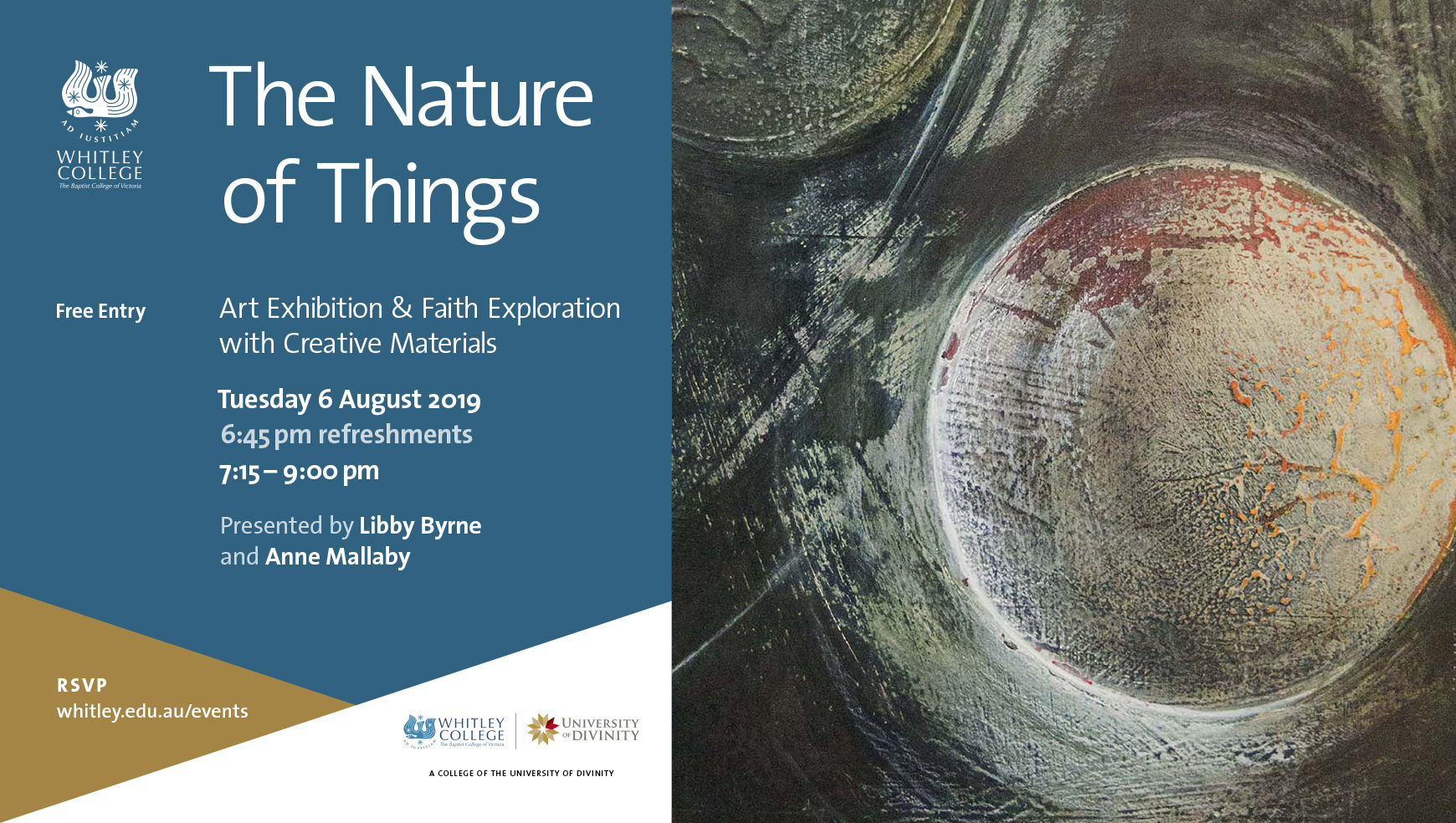
You are invited to join us on Tuesday August 6th @ Whitley College to share with Anne Mallaby and Libby Byrne in a material conversation about the way art prompts us to make sense of the nature of things we encounter in the creative process.
The exhibition features selected works from my inquiry into nature of transcendence and joy in ordinary time. Funded by a Field Development grant from the Yale Center for Faith and Culture, this work identified how the experience of drawing in-church each week through ordinary time extended my capacity to see the effects of God’s action in the world, just as the work of art itself was to drawing-in (the) church, transforming our collective capacity to see.
The process revealed the participatory nature of the creative process, engaging people who saw and heard me working in conversation that focussed our attention on one another and on the possibility of something that was still becoming. The conversation will continue to unfold on Tuesday August 6th as together explore some of the ways in which the discipline of regularly seeing and making art can prompt us to engage the stories of our lives with the work of meaning-making and the art of well-being.
℘℘℘℘
LIBBY BYRNE IS AN HONORARY RESEARCH ASSOCIATE (WHITLEY, UD), LECTURER IN ART THERAPY (LA TROBE UNIVERSITY), AND MEMBER OF THE CENTRE FOR RESEARCH AND SOCIAL POLICY (RASP). SHE LIVES ON WURUNDJERI LAND.








.jpg)