Articles

Conversations and Explorations with Friends by the Sea: Worship in the 21st Century

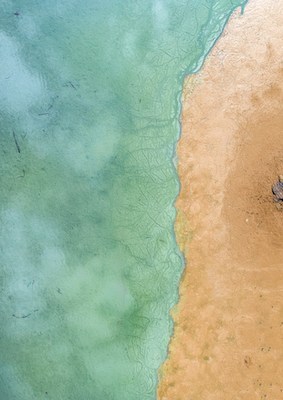
ConExp-Beach.jpgThe Centre for Music, Liturgy and the Arts (a Ministry Centre of the South Australian Synod of the Uniting Church in Australia) is running a conversational event over three days offering the opportunity to talk, explore, and think deeply and widely about why and how we worship in our churches and communities now and into the future.
When: 8–10 October

Where: St Andrew’s by the Sea, Jetty Road, Glenelg, South Australia

Presenters:

  • Libby Byrne is a visual artist, art therapist, and theologian. She will offer participants the chance to have a go at art making.
  • Malcolm Gordon is a songwriter and minister in the Presbyterian Church of Aotearoa New Zealand. He will offer guidance to those wanting to engage in song writing.
  • Mark Pierson is a minister in the Baptist family of Churches in New Zealand. He will lead sessions in curating worship and events that integrate the arts and faith.
  • Charissa Suli is one of the National Consultants in the UCA’s National Assembly’s Resourcing Unit. She will offer space to think about and create worship that encourages and honours diversity.

Key presenters will not only start conversations but also offer the opportunity to work with them in creative spaces.

For more information and bookings, visit here.

Vessels: Theology and the Arts Symposium

https___cdn.evbuc.com_images_52243547_208684879680_1_original.jpg

As noted in an earlier post, St Luke’s Woy Woy (147–149 Blackwall Rd, Woy Woy) will host a three-day symposium (12–14 July) gathering theologians, artists, clerics, and philosophers to explore the relationships between the arts and theology.

There will be an art exhibition, poetry, creative workshops, short papers and music. The last fifty years has seen some astonishingly inventive solutions to creatively engage with theology, ecclesiology, liturgy, and the public sphere of spirituality and faith.

This three-day symposium seeks to explore the shifts in method, style, and theory found in the liminal space created when the creative arts, scripture, theology, faith and community coalesce.

The aim of this symposium is to draw people from within the Australian context to reflect, discuss and analyse the integral place of the arts in Christian expression.

Further details and registration here.

The Cross and the Tree of Life

Finnie 1(1).jpg

One of the pressing questions for the Church is how we see Christology being renewed in the face of climate change and the potential for the quality of life on this planet to decline. Who is Jesus for us in the midst of the profound changes that are occurring to the earth, water, and air of our world? It is clearly not just a question about theological language as it is more material and global in scope, calling us to transcend our liturgical customs, our cultural allegiances, and our national identities. Is Jesus part of our future as we dare to imagine what that future will be?

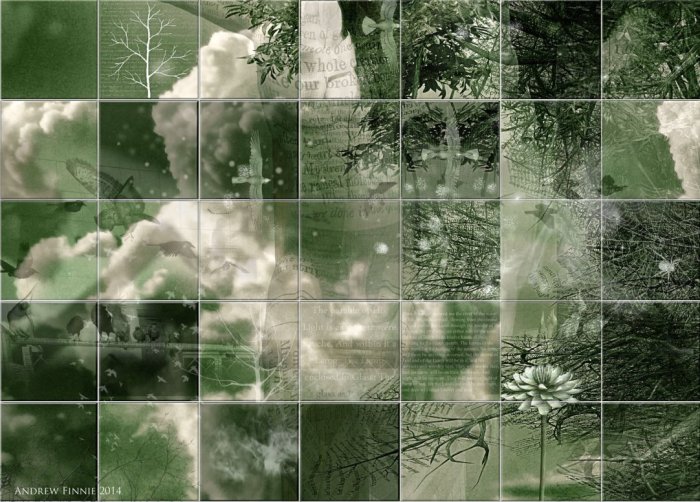
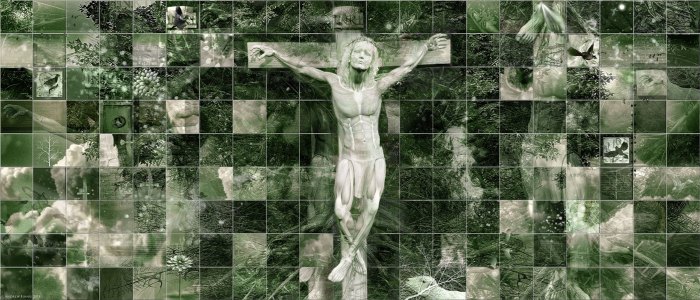
Andrew Finnie’s image The Body of Christ, The Tree of Life is an attempt to re-imagine the figure of Christ in conversation with the earth and the networks that sustain human life in all its thriving beauty. Here, the traditional figure of the cross has become entwined in the roots of the tree, a tree of life that is giving form to the variety and beauty of the natural world.

Andrew Finnie, an artist from Newcastle, Australia, is well known for his paintings of rich colour that express the sensual delight of the local beach-side landscape. Alongside this practice, Finnie is also a skilled digital artist, who is able to transform images into new forms with unexpected relationships. Here in this complex large-scale digital image we have a multitude of visual fragments that work to express the complex significance of the cross for this time in history.

Finnie 2.jpg

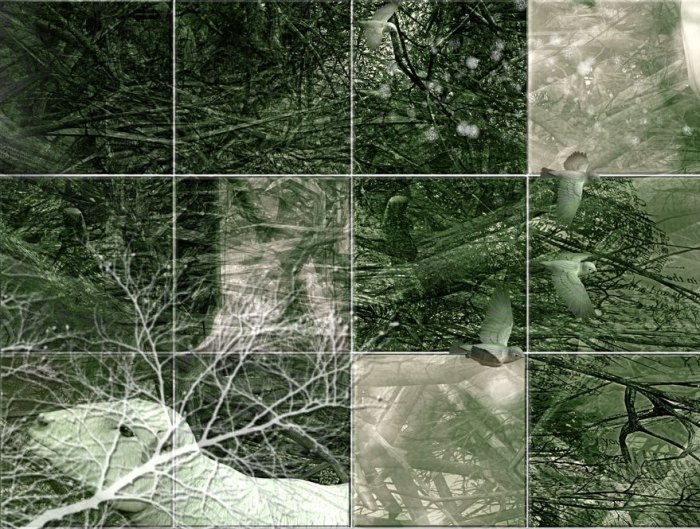
Finnie has placed the cross not in the position favoured in former centuries, high in the sky in glory, but deep into the shadows and roots of a large green tree. He explains: ‘This is the Tree of Life – this apparently jumbled mass of branches we see behind Christ. Inscribed in the bark of the tree are prayers and biblical texts. These prayers gather at the trunk of the tree, and make their way through the branches and transpire through the leaves, heading off towards heaven. So the Tree of Life’s story in this image is that it is a channel for our prayers’.

What strikes me most profoundly about this image is its insistence that my eye keeps returning to the earth, the ground. It reminds me that life is here and now and that God is incarnational, taking on human flesh. It also echoes the idea that the grace of God flows in and through creation; it is, therefore, an eco-theological insight for our times. We are invited to love the earth as God’s beautiful creation. In this regard, one is reminded of the medieval theologian, scientist, musician, and visionary Hildegard of Bingen who talked about ‘viriditas’, the greening force which is God’s gift and energy in creation. As Hildegard writes: ‘Christ brings lush greenness to shrivelled and wilted people’. The vibrant green of this work is the thing that pulses throughout all its branches and the tiny unfolding details that draw you down into its tendrils and roots.

Finnie 3

One of the devices used by the artist is the surface of repeated square divisions, which provides distinct pictures of engagement as worlds in themselves. The digital process has allowed Finnie to enhance the eye’s engagement through the fine details of cobwebs, insects, and flowers, as well as text that sounds out the words of Psalm 23, ‘The Lord is my Shepherd’. The fulness of engagement found in this work is at this level of detail, where one’s eyes are found wandering among the fragments, networks and connections. An apprehension of the whole is the awareness of an interconnected network of myriad details. An appreciation of the work builds through encountering these small meditations of looking into these tiny windows of intricate detail.

Arising out of these fragments and networks is the figure of the Christ crucified. The figure has been constructed from a found image used in a medical text, and is without skin and flesh. This emphasises the muscular structure and allows the figure to take on a more androgynous likeness, in turn allowing for the possible representation of both the male and female form. If this view is correct, then a maternal figure may draw us even closer to those earthly connections, where grace is found in human love and connection.

Does this figure represent a crucified and risen Christ who can embrace this world and respond to the travail of climate change and environmental stress? Who is God for us in this moment in our world history? How can we connect what we know about the cross, the redemption and resurrection, and apply it to God’s purpose for all creation? Andrew Finnie offers us a refreshingly hopeful opportunity to think about Christ and God’s purpose for human existence, embedded as we are in God’s creation, sharing its travail and looking for its redemption.

Reposted from ArtWay.

℘℘℘℘

ROD PATTENDEN IS AN ARTIST, ART HISTORIAN, AND THEOLOGIAN INTERESTED IN THE POWER OF IMAGES. HE LIVES AND WORKS ON AWABAKAL LAND.


Artist callout: Holy, honest confluences

Dr Rebekah Pryor has issued a callout to ‘artists (professional and established or emerging) working in any mode or medium, from any background, cultural, social or political context, and out of any religious tradition or none’ to contribute to an exhibition exploring ‘complex personal and communal relationships between humans, and between humans and other living beings and things’. Details here.


Sacred Silence in Literature and the Arts

The Australian Catholic University (Sydney Campus) is hosting a conference on Sacred Silence in Literature and the Arts, set for 4–5 October. Details here.

Screen Shot 2019-05-18 at 11.01.29 am

Joel McKerrow & the Mysterious Few – Welcome Home

℘℘℘℘

Joel McKerrow is a writer, speaker, educator, creativity specialist, and performance poet. He also lectures at Whitley Theological College in Melbourne, on Wurundjeri land.

Relics of war

ChaliceGold.jpg

The Great War presented clergymen with the ultimate test of faith; reconciling the benevolence of God with the greatest conflict in modern history. Killing on a grand scale would seem at odds with Christian fellowship and moral rightness. Most AIF chaplains believed the war to be just, the Will of God, King, and Country, part of God’s redemptive plan. Christians put an emphasis on the love and mercy of God, so the idea of God as warrior can seem difficult to reconcile.

The experience of army chaplains is well recorded – selfless service in very difficult conditions; coping with death, wounds, grief, and sorrow on an unprecedented scale. Churchmen provided spiritual consolation to the men as well as assisting with the wounded, boosting morale, providing entertainment, burying the dead, and writing to families.

In the same way as the men who served in the trenches, chaplains could not have returned to parish life unchanged. Dead sons, fathers, uncles, and brothers were not repatriated to Australia for burial and so churches became the important place to commemorate the conflict and honour the lost. Even in our increasingly-secular nation, Anzac Day ceremonies have an undeniably religious element, uniting people of different denominations for one day of remembrance.

As a Master of War Studies candidate of UNSW ADFA, I am writing my thesis on war relics in Australian churches. There exist already excellent works on memorial windows and honour boards in churches; I am focusing on artefacts or relics directly connected with the Australian experience of war that churches hold.

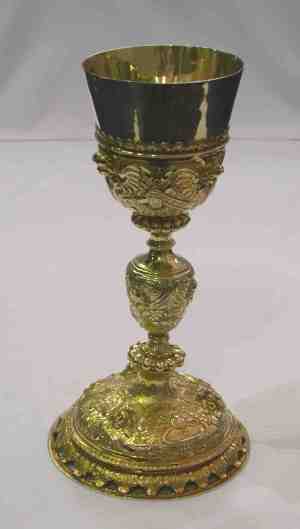
My interest began in Canberra – at the Warrior Chapel within St Andrew’s Presbyterian Church, Forrest. Rev Dr John Walker served as an AIF chaplain in World War One. Five of his children also served, and three sons were killed. Walker conceived the idea of embodying within the church a fitting tribute to the memory of parishioners who had given their lives in the Great War. Two communion chalices are used alternately in chapel services held on Anzac Day and Armistice Day – a silver chalice used on the Western Front by Chaplain Captain Percival Hope, and a small brass chalice used by Chaplain Rowan MacNeil while a prisoner at Changi.

I have asked just over 2000 Australian churches if they hold war relics within their buildings. The vast majority, of course, do not. But 2.75% do hold extraordinary and sometimes surprising relics. Grave markers, crosses, flags flown in battle, portable altars, communion linens from Nui Dat, Lae, and Palestine fit comfortably within the church fabric.

I have identified many churches where highly polished artillery shell vases are used for floral displays. Were they simply tokens of remembrance brought home as souvenirs? What memory did chaplains seek to evoke?

Millions and millions of artillery shells were fired in the First World War. Artillery was the biggest killer and provided the greatest source of war wounded. A very beautiful baptismal ewer at Grafton was crafted from a First World War artillery shell. Was this simply practicality or symbolic of new life at baptism received from something designed to kill?

All bar one of the 55 churches identified contain First and Second World War relics. Yet the tradition continues. At the Kapooka Soldier’s Chapel in Wagga, where raw army recruits are trained, a wooden crucifix contains metal from an armoured vehicle in which an Australian soldier in Afghanistan was travelling when he was killed.

It is easier, perhaps, to understand how some chaplains and soldiers brought souvenirs home from ruined churches; shards of broken church windows were gathered in ruined French and Belgian towns by an Anglican chaplain in the First World War and brought home to his parish. He had them made into windows that still bring the light into St John’s Reid. Candlesticks, chalices, patens, statues were all gathered from the rubble of destroyed churches on the Western Front and reinstalled in Australian churches in city and country.

Several churches have a ‘Blitz’ piece of St Paul’s Cathedral and All Hallows in London, Coventry Cathedral, and other English churches, sent out as tokens of gratitude to far-flung churches of empire who had contributed financially to their rebuilding after the Second World War.

I am not trying to simply document these relics but to understand why they were brought back, how they evoke memory and the stories behind each relic. I will also attempt to understand the religious nature of our commemoration, and the interconnection between war and Christianity. The relics may present an important perspective on the Judeo-Christian [sic] God as a warrior. One relic defies time; olive cuttings taken by a Light Horse chaplain at Gethsemane still flourish in the grounds of Our Lady Help of Christians, Ardlethan.

℘℘℘℘

Emily Gibbs works art the Australian War Memorial and is conducting research into war relics and religious faith. She can be contacted by email.

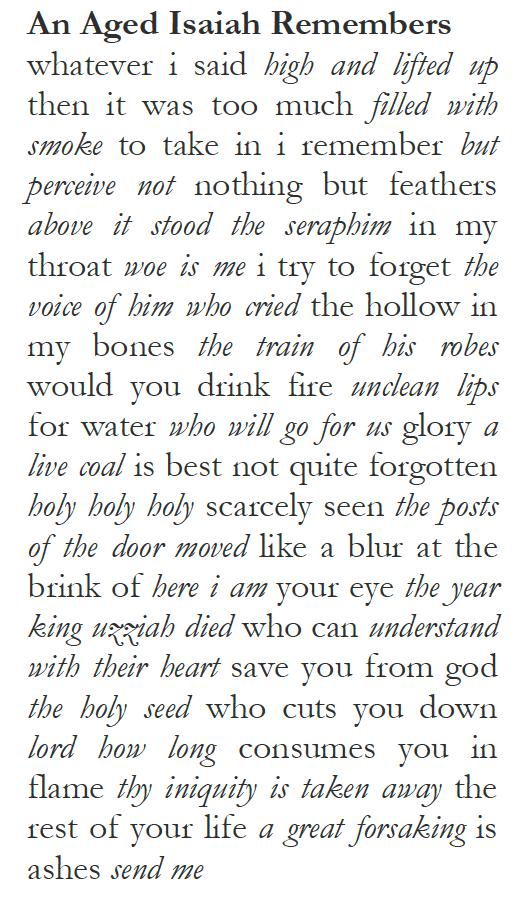
An Aged Isaiah Remembers

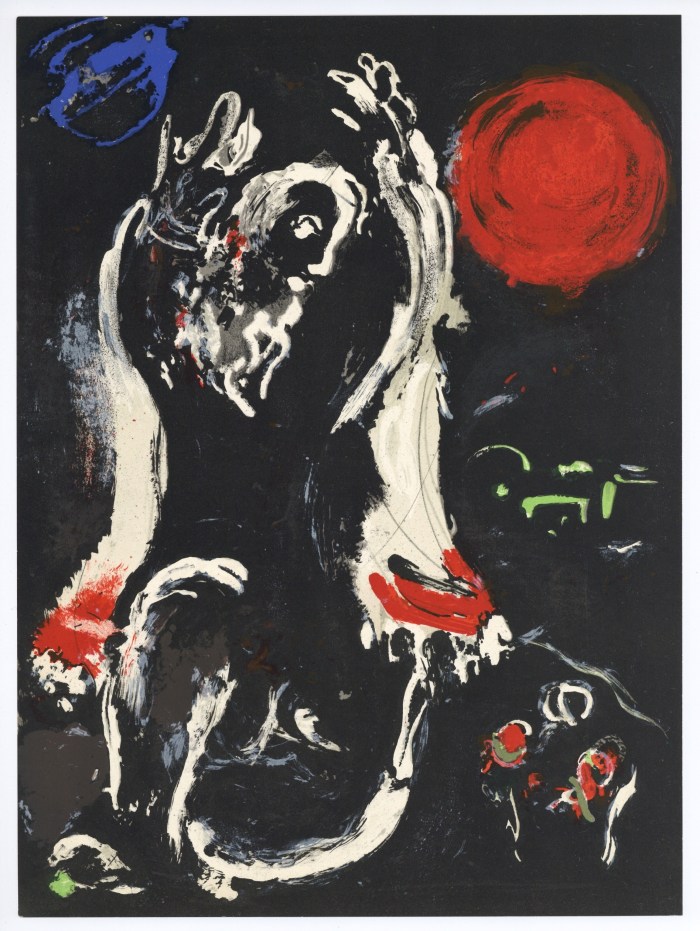
Chagall - Isaiah, 1956. Lithograph, 31.8 × 24.1 cm.jpg
Marc Chagall, Isaiah, 1956. Lithograph, 31.8 × 24.1 cm. Private collection.

Screen Shot 2019-05-04 at 8.33.10 pm.png


℘℘℘℘

CHRIS GREEN IS PROFESSOR OF THEOLOGY AT SOUTHEASTERN UNIVERSITY IN THE USA. HE IS THE AUTHOR OF SEVERAL BOOKS, INCLUDING SURPRISED BY GOD AND THE END IS MUSIC, BOTH PUBLISHED BY CASCADE PRESS. HE IS ALSO A VISUAL ARTIST.

Idris Murphy – Empyrean

Here, Idris Murphy introduces us to his upcoming exhibition of paintings – a luminous mystical response to the stark presence of the desert landscape, a meditation that invites theological and philosophical responses to the mystery we feel in a sense of place.

The Visual Commentary on Scripture

A new and dynamic online resource – The Visual Commentary on Scripture – has recently been launched by a team centred at King’s College London that is providing resources for those interested in the visual interpretation of the Bible, including general readers, scholars, preachers, and study groups. The project draws on diverse scholars in art and religion from around the world and will eventually build a library of up to 1500 commentaries that give a visual insight into the Biblical tradition. Each entry is curated like a small exhibition, and provides three key images that offer visual insight into a given passage. A longer overview is then provided where we both read and see the various insights into the process of understanding the meanings contained in a passage.

The project team is led by theologian Professor Ben Quash of King’s College who here offers a helpful introduction to the value of the project:

This unique project demonstrates the value of the visual arts in expanding our means of understanding, and our response to texts and their interpretation. There are currently over 80 completed commentaries now available on the website.

Professor Ben Quash explains that the project offers three main purposes:

First, it seeks to instruct those with little knowledge of the Bible about its contents. We hope this will be part of the strategic ‘impact’ of this project.

Second, it uses the warrant of the incarnation to affirm that physical sight can be a pathway to spiritual insight.

Third, the VCS aims to refresh viewers and engage their affective responses as well as their intellectual ones, affirming that images are made ‘to be gazed upon, so that we might glorify God and be filled with wonder and zeal’.

The Visual Commentary on Scripture is an exciting development. It is a richly-engaging resource that has been made easily accessible. It will be a valuable resource to students of the Bible, and those who teach and reflect on its ongoing relevance and authority. Bringing the world of the visual arts into this process of interpretation heightens an awareness of the lived experience of the biblical world as well as our own contemporary context. It allows for a renewed valuing of the visual arts as a means of accessing the world of the biblical tradition in conversation with the current horizon of our lives.

℘℘℘℘

ROD PATTENDEN IS AN ARTIST, ART HISTORIAN, AND THEOLOGIAN INTERESTED IN THE POWER OF IMAGES. HE LIVES AND WORKS ON AWABAKAL LAND.