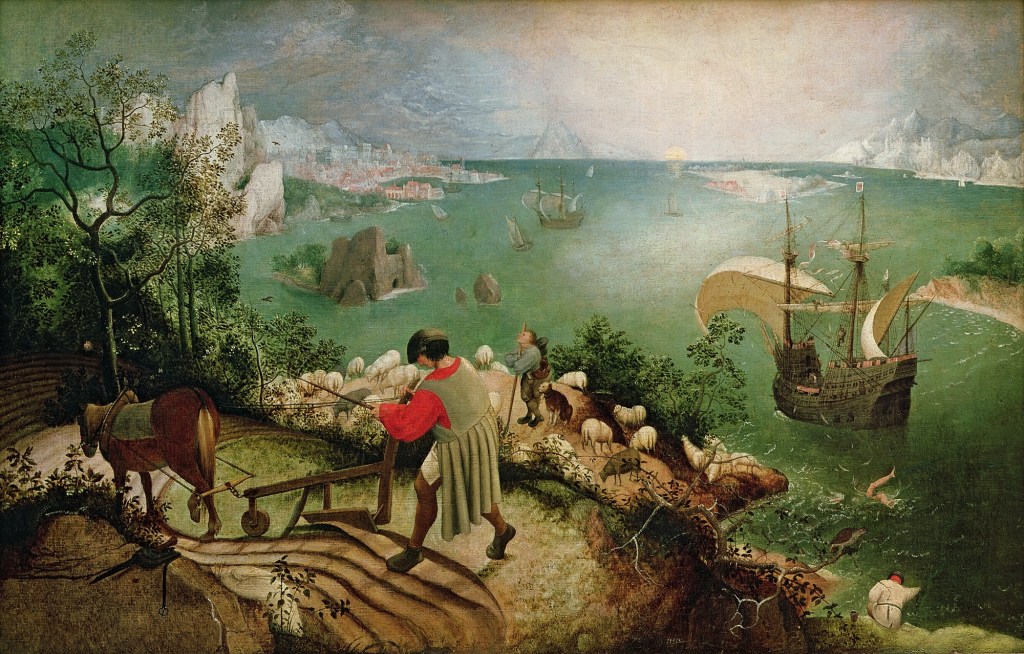
Pieter Brueghel the Elder, Landscape with the Fall of Icarus, c. 1558. Oil on canvas, mounted on wood, 73.5 x 112 cm. Royal Museums of Fine Arts of Belgium, Brussels, Belgium.
After W. H. Auden had visited the Musées Royaux des Beaux-Arts de Belgique in Brussels, and seen Pieter Brueghel the Elder’s Landscape with the Fall of Icarus, he went away and penned the following words:
About suffering they were never wrong, The Old Masters; how well, they understood Its human position; how it takes place While someone else is eating or opening a window or just walking dully along; How, when the aged are reverently, passionately waiting For the miraculous birth, there always must be Children who did not specially want it to happen, skating On a pond at the edge of the wood: They never forgot That even the dreadful martyrdom must run its course Anyhow in a corner, some untidy spot Where the dogs go on with their doggy life and the torturer’s horse Scratches its innocent behind on a tree. In Breughel’s Icarus, for instance: how everything turns away Quite leisurely from the disaster; the ploughman may Have heard the splash, the forsaken cry, But for him it was not an important failure; the sun shone As it had to on the white legs disappearing into the green Water; and the expensive delicate ship that must have seen Something amazing, a boy falling out of the sky, had somewhere to get to and sailed calmly on.
The American theologian William Willimon recalls Brueghel’s painting, and Auden’s poem, in his book On a Wild and Windy Mountain (Abingdon Press, 1984), wherein he observes that we trudge past bleeding crosses with a shrug of the shoulders, that Good Fridays are so commonplace among us as to be unnoteworthy, and that tragedy achieves nobility only in the theater. ‘Everydayness and ordinariness’, he writes, ‘become our best defenses, the most effective relativizers of the tragic in our midst. Some young Icarus falls from the sky every day, so one had best get on with the business at hand until the extraordinary comes. For now, go to work, eat, make friends, make money, make love, mind your business – that’s the best way to cope, for the time being, with the expectedness of the tragic. The old masters knew best’ (p. 15).
Pieter Bruegel the Elder, The Numbering at Bethlehem, 1566. Oil on panel, 116 × 164.5 cm. Royal Museums of Fine Arts of Belgium, Brussels, Belgium.
Willimon proceeds to compare Landscape with the Fall of Icarus with another of the Dutch masters’ works: Numbering at Bethlehem. He notes the ordinariness of the depiction, a day mundane and unpromising – in its highlights at least – and nothing beyond the expected.
But then … they appear.
They appear. ‘An inconspicuous, thoroughly ordinary young woman on a little donkey led by a stoop-shouldered, bearded peasant who carries a saw. Here is Mary, with Joseph the carpenter, come to town to be counted. They are so easily overlooked in the midst of ordinariness. Old masters like Brueghel’, Willimon suggests (and we might add Rembrandt, for example), ‘were never wrong’. Rather, they understood, and bore witness to in their work, the truth of Emmanuel, the scandal of the unostentatious God living – and dying – with us, of God stained with the sweat of human bondage and soaked – baptised – in the blood of human violence, of God incognito. ‘They understood our blindness not only to the tragic but also to the triumphant in our midst … In life, the Presence goes unnoted as we thumb through the evening paper. And so we wait, sitting in the darkness of the everyday until something extraordinary breaks in. Someday God may break into this world, we say. But for the time being, it is best to work, eat, make love, pay taxes, fill out government forms, and mind our business. The old masters knew it best’ (p. 16).
I have posted elsewhere on the pseudonymous activity of God, suggesting that ‘in the economy of holy love, the locus of greatest clarity equates to the point of greatest incongruity and surprise’. It is precisely that we may see what Willimon so beautifully refers to as ‘the triumphant in our midst’ that we are graced, and that we might witness to the day when good will triumph over all, certain that the grace of holy love will win at last because it did not fail to win at its most decisive time. In the meantime, such seeing typically requires what is another great advent theme: waiting, or what R. S. Thomas, in his poem ‘Kneeling’, referred to as ‘moments of great calm’:
Moments of great calm, Kneeling before an altar Of wood in a stone church In summer, waiting for the God To speak; the air a staircase For silence; the sun’s light Ringing me, as though I acted A great role. And the audiences Still; all that close throng Of spirits waiting, as I, For the message. Prompt me, God; But not yet. When I speak, Though it be you who speak Through me, something is lost. The meaning is in the waiting.
– R. S. Thomas, ‘Kneeling’, in Not that He Brought Flowers (London: Rupert Hart-Davis, 1968), 32.
℘℘℘℘
JASON GORONCY IS A THEOLOGIAN, ARTIST, AND FOLK FESTIVAL TRAGIC WHO LIVES AND PLAYS ON WURUNDJERI LAND.
Over these last months, I’ve had the great joy of watching unfold a series of beautiful and stunning images by Michael Galovic, based on The Fall and Expulsion from Paradise. In seeing the images evolve, step by step, I gained an increasingly deep respect for the complexity of the process – from the gessoing of the boards, through the creation of each layer of moulding and gilding, and then the layers of painting where specific features and the final delicate detail emerge. This truly gave me a deeper understanding of, and insight into, the sheer complexity and technical skill involved in successfully balancing each layer, with their different components and levels of permeability to create the works.
Michael is in the very rare position of being both an iconographer and an artist. It is these two aspects of his practice that underpin his work across different material and genres. His childhood in Serbia was visually enriched by art in general, his mother being an art historian and his step-father working on the restoration of frescoes that had been whitewashed during the centuries of Ottoman rule. He then followed this with five years of training at the Academy of Arts in Belgrade.
This eclectic background gave him an enormous appreciation of the skill, subtlety, and sheer brilliance of medieval art, through from Romanesque to the early Renaissance, especially in the religious context. As a painter of icons, he had a wide-ranging technical understanding of the qualities of the media involved as well as a fascination with the imagery and symbolism portrayed in a variety of different forms. This has informed the diversity of directions in his art practice over the last thirty years he has spent in Australia, with many of his works depicting his fascination with concentric circles representing spheres, similar in effect and purpose to the almond-shaped mandorlas from which they evolved, such as those found in icons of The Transfiguration, where the viewer’s gaze is drawn further and further into the image.
Michael Galovic, Midnight in the Garden of Good and Evil, 2020. Egg tempera with gilding, 109 x 76 cm. Artist’s collection
Michael’s current journey began with ‘Midnight in the Garden of Good and Evil’, a title which both referenced the 1997 film and was inspired by a small segment, often barely noticed, of ‘Madonna della Vittoria’, painted in tempera in 1496 by Andrea Mantegna to commemorate the purported Gonzaga ‘victory’ over the French in the Battle of Fornovo. He has taken up this small image of Adam and Eve, depicting the moment at which Adam is about to bite the apple, which forms part of the dais on which the Madonna is seated, and has paid homage to the sculptural quality of Mantegna’s work by creating the scene in bas-relief, embellishing the Tree of Knowledge with delicate gilding. This image has then been placed against a predominantly dark field, evoking the night sky, that extends around and far above the figures, highlighting the momentousness of the act about to be taken. Mantegna’s work, as a whole, places the fall in relation to redemption, expressed in the standing figure of Christ on the Madonna’s knee.
A vivid visual contrast is provided by the second work in this series – ‘Before Night Falls’ (the title being another filmic reference!) – based on the Romanesque ‘Fall of Mankind’, a section of the wooden Hildesheim painted ceiling, created c. 1230. As in Mantegna’s depiction, the figures of Adam and Eve are captured at the moment of decision, backgrounded by a rain of golden apples and enclosed in a vivid red circle, highly evocative of the icon images of Elijah’s ascent in a chariot encapsulated in a fiery circle. In both instances, the circle symbolises the ‘otherness’ of the protagonists – in Elijah’s case, a positive movement beyond the earthly plain and, in the Hildesheim ceiling, the imminent loss of paradise. There also seems to be an interplay between the falling apples in the Hildesheim image and the Greek and Norse legends of the golden apples which conferred immortality. However, the Hildesheim image gives a clear message of the potential for redemption, highlighted in Christ’s gesture of blessing.
Michael Galovic, Before Night Falls, 2020. Egg tempera with gilding, 109 x 76 cm. Artist’s collection.
To the original image, Michael has added a dais made of strongly geometric images. These are an homage to the vivid and startlingly modern geometric nature of the usually overlooked painted divisions and ‘rounding-off’ of frescoes in Romanesque art. Again, the image of the circle as a representation of a sphere or other realm is highlighted and provides a strong visual link between the two parts of the image.
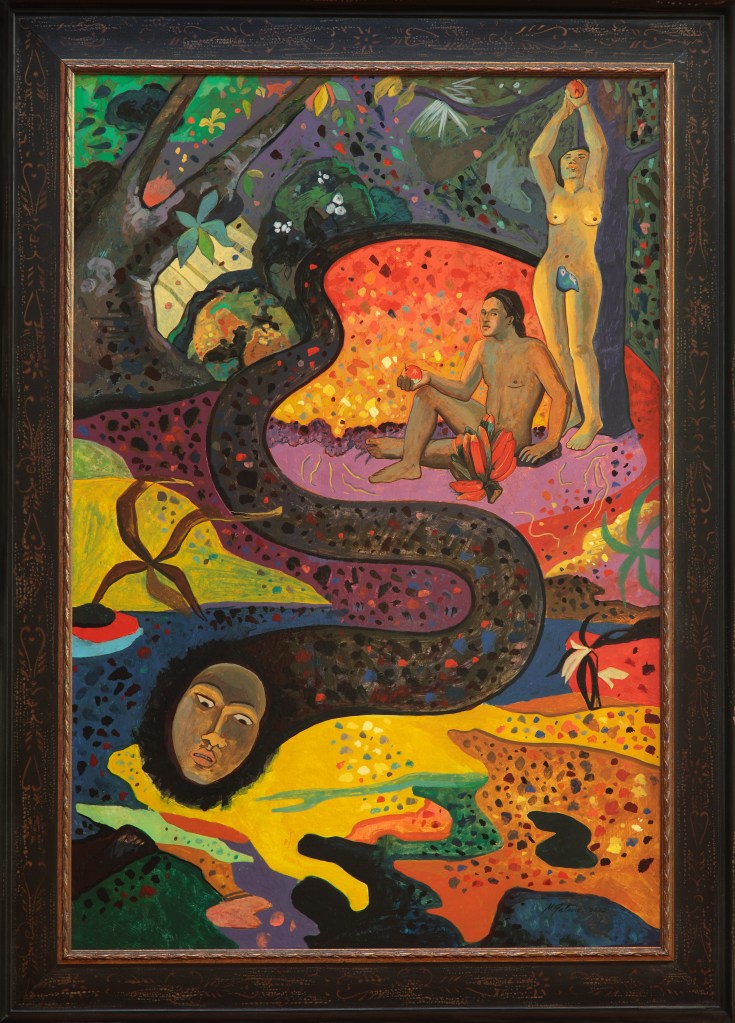
Michael Galovic, The Only Paradise is Paradise Lost: To Gauguin, 2020. Egg tempera with gilding, 108 x 78 cm. Artist’s collection.
The third work, ‘The only Paradise is Paradise Lost: To Gauguin’, is Michael’s exploration of Gauguin’s perception of Tahiti and the Marquesas Islands in relation to the idea of Paradise and Paradise Lost, by someone who is arguably one of his greatest admirers! In the image, Michael references aspects of five of Gauguin’s works – ‘Tahitian man, woman and cat’, ‘Parua na te varua ino (Words of the Devil)’, ‘Nevermore’, ‘The Meal’, and ‘Where do we come from, what are we, where are we going?’, as the basis for creating an enormously vibrant and dynamic image. The devil’s masked and humanoid presence in the background has been transformed into a serpent that flows to the foreground of the image, confronting the viewer, while the figures representing Adam and Eve are highlighted against an ovoid shape in tones of vermilion and orange, echoing the red disc encapsulating Adam and Eve in the Hildesheim ceiling. Other fascinating elements are the transformation of the man’s cigarette (in itself a signifier of the often-negative impact of French colonialism on the islands) in ‘Tahitian man, woman and cat’, to an apple and that of the hermaphroditic figure reaching for a fruit in ‘Where do we come from’, into Eve reaching for an apple. Her nakedness is covered by a softer version of the raven of Gauguin’s ‘Nevermore’, while Adam’s is placed behind a hand of bananas from ‘The Meal’.
Through the use of these images, Michael has evoked a deep sense of the highly ambivalent nature of Gauguin’s experience, while also creating a new work in which these elements coalesce with an acknowledgement of indigenous Australian dot work techniques to form an intensely vital exploration of The Fall, which complements the ‘frozen in time’ moment of decision captured in the first two works.
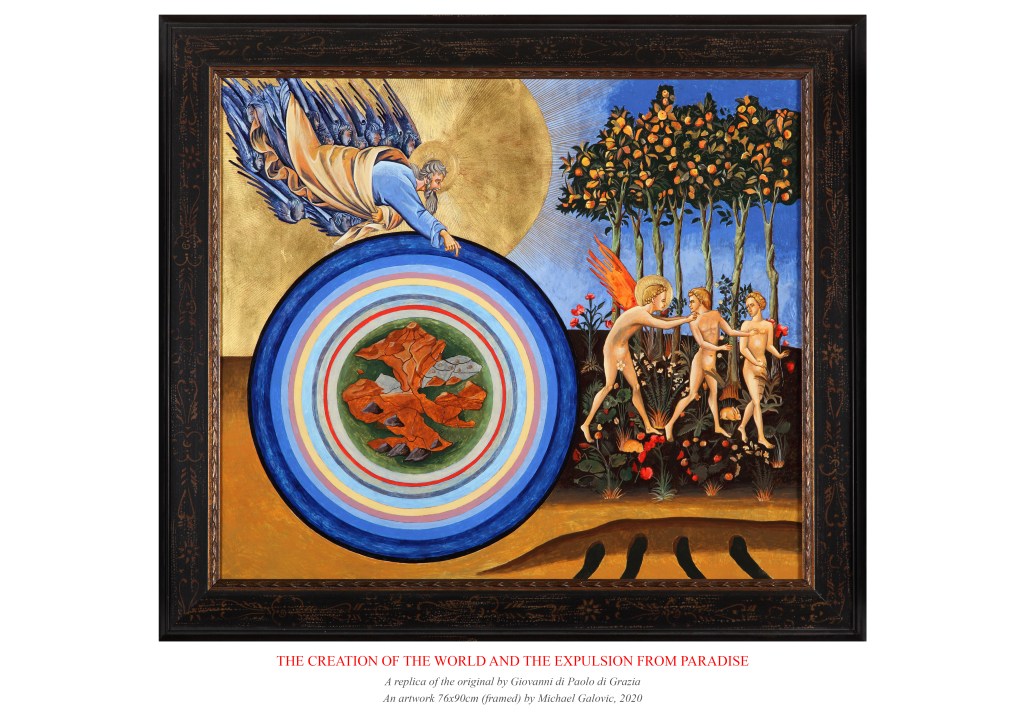
Michael Galovic, The Creation of the World and the Expulsion from Paradise, 2020. Egg tempera with gilding, 76 x 90 cm (framed). Artist’s collection.
The final piece in the series, a replication of Giovanni de Paolo’s ‘The Creation of the World and Expulsion from Paradise’, brings alive a wonderful work of 1445, discovered while researching the different forms of covering used in portrayals of Adam and Eve. In his religious paintings, Giovanni resisted the trend towards more strongly naturalistic and scientific representation. His depiction of the creation is tremendously dynamic in its portrayal of God, accompanied by seraphim, creating the earth at the centre of vivid concentric circles, representing a medieval cosmography including the elements of earth, air, fire, and water. The image with the radiance emanating from God brings to mind Gerard Manley Hopkins’s poem ‘God’s Grandeur’:
The world is charged with the grandeur of God.
It will flame out, like shining from shook foil.
Counterpointing this is the Expulsion from Paradise, with is verdant and stylistically portrayed flora backgrounding Adam and Eve’s expulsion from Paradise by a fiery-winged angel. Both Adam and Eve look backwards towards what they are losing, and it has been suggested that the unusual depiction of the angel naked suggests his empathy and compassion for their fall from grace.
Giovanni has drawn upon a rich heritage of symbolism in his depiction, as is shown throughout the visual references in his work both through his cosmography and his referencing in such touches as the four rivers flowing out from paradise. This backgrounding creates a sense of mystical ‘otherness’ which could not be achieved in a more naturalistic work. Sadly, the original is not in a great state of preservation, with its overall craquelure and discolouring, so it is especially wonderful to have this replication that brings to life the great beauty and intensity of the original.
Michael’s ability to create this is a great tribute to his outstanding work ethic. I have been repeatedly amazed by how he finds the most difficult tasks and complex works energising, rather than exhausting, but delighted that that is the case.
In conclusion, these works give a wonderful sense of God’s immanence in creation. They highlight that inherent in the Fall is the prospect of redemption, whether this is shown in Christ’s blessing or in the empathy of the angel. Even though this is understandably less explicit in ‘The Only Paradise is Paradise Lost: To Gauguin’, there is a sense of the strength and vibrancy of creation. They help to revitalise our sense of wonder and to give us a renewed appreciation of the art that has contributed to it.
I can find no better ending than these lines from T. S. Eliot’s ‘Little Gidding’:
We shall not cease from exploration and the end of all our exploring
will be to arrive where we started … and know the place for the first time.
℘℘℘℘
Kerrie Magee has had a deep interest in icons and medieval religious art for around 50 years, and has been painting under Michael Galovic’s tuition for over 20 years. Her academic background includes an MA in Medieval Studies. She has worked in teaching and gifted education. She lives on Wallumettagal country.
‘And so it is not the painting that ‘speaks.’ A painting does not mean (to say) anything. Were speaking in fact its aim, it would certainty be inferior to speech and would need to be ‘sublated’ by language to receive meaning, and a clearly communicable meaning at that. Between the figurative order of the painting and the discursive order of language there exists a gap that nothing can bridge’. – Sarah Kofman, ‘The Melancholy of Art’
‘What you’re looking at is a combination of my efforts to say something and what the painting is saying independent of me. It’s saying more than me now. So, I can just listen, you know?’ – Chris Ofili, ‘Interview’
‘What guides the graphic point, the quill, pencil, or scalpel, is the respectful observance of a commandment, the acknowledgement before knowledge, the gratitude of the receiving before seeing, the blessing before knowledge’. – Jacques Derrida, Memoirs of the Blind
Somewhere among the connections, disconnections, and resonances between these lines from Sarah Kofman, Chris Ofili, and Jacques Derrida is where I locate the connections, disconnections, and resonances between my ‘art’ and my ‘faith’. Somewhere among them is what could be called a mysticism of sight. Not a mysticism of the invisible but of the visible. Not a mysticism of incarnation but of carnation. A mysticism of the intensity and wonder of the world’s appearing that painting receives and blesses.
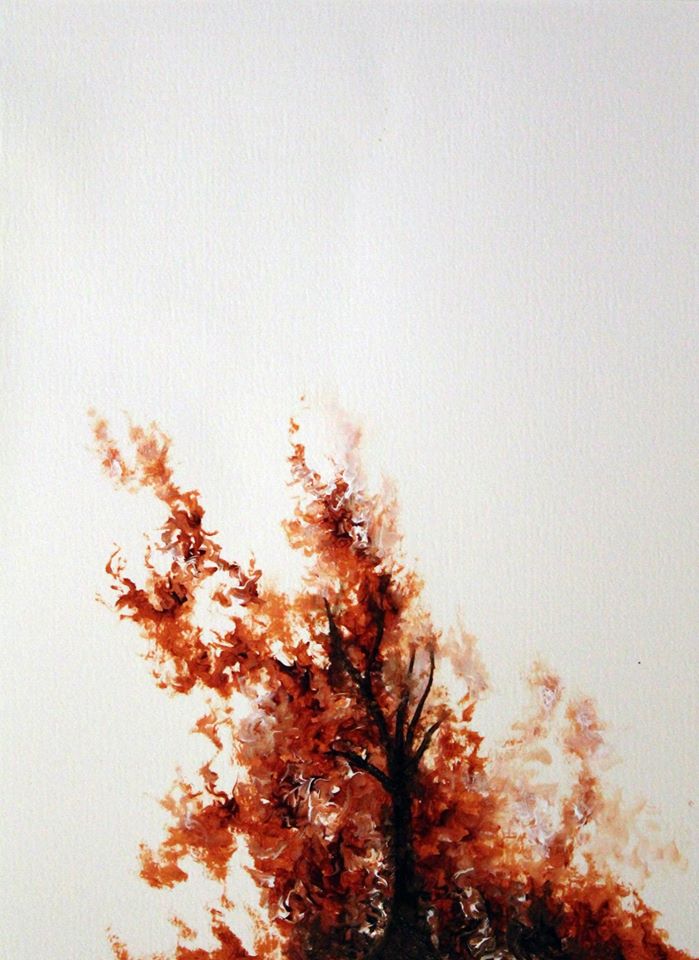
Peter Kline, Before the End of the World, 2019. Acrylic on paper.
Kofman denies that a painting has anything to say, otherwise why not just speak instead of paint? There is a gap between painting and language that cannot be overcome, and it is within this gap that painting offers its ‘truth’. Ofili thinks painting does speak, but it speaks as the combination of an artist’s efforts to communicate and the ‘more’ that a painting communicates beyond the artist’s (and perhaps also the viewer’s) intention. Surely both are right, even if they cannot be neatly reconciled.
If Ofili’s ‘more’ overlaps with Kofman’s ‘gap’, perhaps what comes undone between them is any notion of a sovereign, all-seeing ‘I’, or ‘eye’. There is, for both Kofman and Ofili, something about painting that confronts us with the unsovereignty of sight, with the world’s excessive appearing that overflows our ability to translate seeing into saying, or seeing into knowing. If sight were sovereign, if it could fully comprehend the world’s appearing, painting would be redundant, a mere reproduction or representation of what is known and grasped ‘immediately’ by vision’s power to receive the world as intelligible, or within the bounds of ‘discursive order’.
Peter Kline, Apocalypse, Australia, 2019. Acrylic on paper.
But sight is not sovereign. The world’s coming to appearance is never fully comprehended. No one could ever say comprehensively what a sunset means, or what the face of a child means, or what the colour blue means. Each are events or bursts of sense that are never metabolized fully within language. Painting responds to and plays with this excess. It does not represent the world; it presents its excessive appearing, becomes its appearing, supplementing, and carrying it further. Painting stages, within unending difference and variation, the wonder of existing in a world where what is visible is not a closed set of known forms but an infinitely open passage and variation of sense, never reducible to our systems of knowledge. Which is why what is visible must be shown or presented rather than accounted for or explained – every art form does this in its own way. Painting invites us to ‘listen’ to the fact that we see a world that goes far beyond any ‘discursive order’. It lets us acknowledge, as Derrida puts it, a receiving and a blessing that come before knowledge, before seeing. It opens the unsovereignty of sight.
Peter Kline, Isolation, 2020. Acrylic on canvas.
Painting, then, might itself be understood as an act of faith – if faith is understood as entrusting oneself to and engaging oneself with a world that goes beyond our ability to master it, a world that goes beyond itself. A world that did not go beyond itself toward what religions call ‘God’, or toward what might be called the sacred or the divine, a world that did not open beyond itself beneath a sky that illuminates it from beyond, a world collapsed on itself, perfectly at one with itself, given, completed, finalised, could not be painted – nor could it be sung or danced or filmed or narrated.
Painting, like faith, risks itself within a world that is there not as a given to be reproduced, but as a blessing to be offered, shared, and formed. Painting opens for sight the opening that the world is. It gathers and intensifies the world’s visuality, like making love gathers and intensifies the body’s touch, like singing gathers and intensifies breath and language. Sight becomes no longer functional or useful. It tips over into pleasure, into joy.
Peter Kline, Love’s Hidden Life, 2017. Acrylic on canvas.
When I paint, I never think of it as representing the content of my faith, even when I’m painting something religious. Perhaps this is because faith, for me, is not synonymous with belief, with having something to say about God. But painting is for me an act of faith, a way of staying faithful, perhaps to God, or to the open wonder of existence. Faithful to the gift and joy of the world, its carnation. Painting passes on the blessing.
Peter Kline, Position Doubtful, 2019. Acrylic on canvas.
℘℘℘℘
Peter Kline is the academic dean and lecturer in systematic theology at St Francis College, which is part of the Charles Sturt University School of Theology. He is the author of Passion for Nothing: Kierkegaard’s Apophatic Theology. The land on which he lives and works is that of the Jagera and Turrbal peoples.
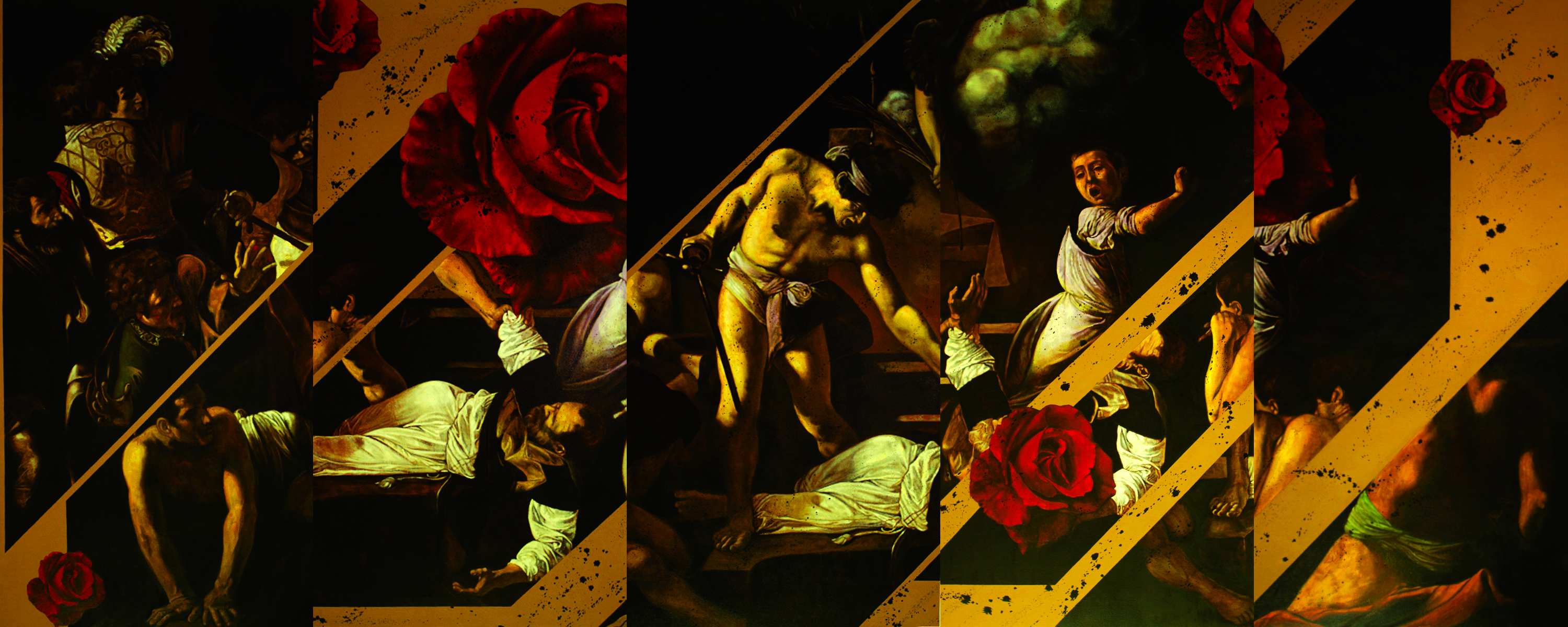
Robert Besana, Non in cruciatu sed causa quae facit martyrem (It is not the punishment but the cause that makes the martyr), 2018. Oil on canvas, 244 x 609.5 cm.
The image of victims whose individual lives have been crushed by political or social forces is a common part of our media consumption in this period of increased international conflict and tension. While local circumstances contribute to such deaths occurring, there are clearly larger social interests at play when one death becomes a cry that their death will result in change and justice may prevail. This is the anger and hope that is reflected around the name of an African American victim of police violence, George Floyd, that has resulted in a movement towards justice that has been echoed around the world. This is heard, most especially, where social inequality prefers certain people based on their colour, race, religion, or gender to enjoy the luxury of privilege and power.
Robert Besana is a skilled painter, musician, and educator working in the Philippines. In an important solo exhibition in 2018, he explored the subject of martyrdom and the lens that it provides in looking at the meaning of death at the hand of political and social forces. The title of the major work in this exhibition is a quote from a sermon by St Augustine about the meaning of the death of a martyr: ‘It is not the punishment but the cause that makes the martyr’. Besana uses this phrase as a means to advance concerns about the meaning of death in contemporary society, in particular of those who die violent deaths as a result of government or political intent. Since 2016, the Philippines has endured a government-led ‘war on drugs’ that has seen many unlawful killings, including a bounty on murdered criminals and drug addicts. The subject of martyrdom also reflects on the longer history of political repression, especially by the Marcos regime during the 1970s and early 1980s, that forms part of the public consciousness of Filipino identity.
Besana has taken a historical work, The Martyrdom of St Matthew by Caravaggio (1599–1600), as the basis for his own interpretation. The original work, which is part of the cultural-religious imagination, has been enlarged to panoramic scale and then divided by angular gold bands. In some ways, the viewer has to reassemble the work and its subject in their own imagination. These gold bands – or as he calls them, slashes – are stained with black liquid, reminiscent of dried blood. At several points, a large red rose intersects the composition. The act of visual repair required by the viewer becomes a metaphor for considering an unjust death and the pursuit of freedom in the face of oppression and corrupt structures. It offers a visual link between these historical markers of martyrdom and the meaning of contemporary deaths caused by unjust actions. The red roses reference the daily practice of the rosary so familiar to Filipinos, a prayer that focuses on the suffering and redemption of Christ.
Contemporary art in the Philippines is engaged with questions of representation and their social and political implications. Artists are alive to the power of images for uncovering the effects of colonisation in the past and the nature of freedom in the present. Filipino culture has undergone over four centuries of European colonisation. It has been formed within a vocabulary that reflects Spanish Catholicism and inherent hierarchies of power. Set within an Asian context, these unique cultural forms of visual awareness deserve wider international attention. These perceptions also resonate for those in first world situations who struggle to uncover the ingrained habits of visual ordering that are based on the apparent colour of skin. In this work, Robert Besana offers a meditation on violent death that affirms the meaning of life itself, reflected in the sacrifice and redemption found in the Christian story of faith. Death is not an end, for like a seed it holds the possibility that it may break open the future with hope.
Reposted (with some editorial changes) from Artway
℘℘℘℘
Robert Besana (b. 1976) is an artist, musician, and educator working in the Philippines. He is presently the Executive Director of the Asia Pacific College in Makati, Manilla. He has served on the Commission on Higher Education (CHED) Philippines as Technical Committee Member for Multimedia Arts since 2011. Since 2008, Robert Besana has held nine solo exhibitions and has joined various group exhibitions in art galleries in the Philippines including Galerie Anna, Blanc Compound, Blanc Peninsula, Nineveh Art Space. He has exhibited in the Art Fair Philippines and Manila Art Fair. He holds a Master of Arts in Fine Arts and Design from the Philippine Women’s University, Manila.
ROD PATTENDENIS AN ARTIST, ART HISTORIAN, AND THEOLOGIAN INTERESTED IN THE POWER OF IMAGES. HE LIVES AND WORKS ON AWABAKAL LAND.
My world has contracted, the dining table replacing my studio, my watercolours small enough to occupy that limited space. It’s my habit to begin each day with a watercolour reflection on the state of things around me. I’ve been comforted by small pleasures; knitting, cooking and our sunny balcony but saddened to see empty shelves and abandoned playgrounds, birthdays celebrated alone and embraces from afar. The idea that this too will pass sustains us and the creative impulse never wanes. – Margaret Ackland
I have become so very conscious of the empty spaces, and all the in-between manoeuvres that I have had to negotiate to keep my distance from other bodies. This is especially focused when I take an afternoon walk in my local park. It is filled with other bodies longing to break out of confinement. Bikes, wheelchairs, dogs, and runners are all vying for space on the footpath. At every potential meeting, there is an awkward hesitation of give and take as we work out who goes where. My eye is on the space to make it through, no time to recognise faces. I imagine this is what footballers do – looking for the opening space, with their eye on the prize. Freedom at last!
In the last nine to ten weeks there has been an abundance of space. My diary was the first thing to empty out; first in days, then weeks, and then for the ‘foreseeable future’, a phrase now in constant use. Space appeared as the garden called for nurture, half-finished projects reached their completion, my floors appeared from under piles of paper, and small things found an unexpected level of importance. Space appeared for cakes, slow cooking, vegetables, art-making, sunshine, and that elusive sensation of actually feeling time pass. I loosened demands that I had on myself. I got bored. I watched re-runs of old comedies. I felt nostalgia. I made no plans. I wasted time and did not feel guilty. I slowed down and actually felt life, like a pulse under my skin.
I could sense the expectations peeling off – of getting things done, of tidying up, of always being cheerful, on time, efficient, careful, spontaneous, and always great company! I lessened the strangle-hold that the consumption of products has had over me. I purchased nothing for weeks and found I was not in the need for anything. I discovered online shopping, and I thoroughly enjoyed the arrival of luxury in the post! I was inconsistent and enjoyed it. I have enjoyed this isolation. I have been an indulged introvert! As things begin to open up, I want to treasure this sense of finding the space in between. This might prove useful in negotiating the bigger spaces of my life and work, and especially how I judge my life to be productive, useful or full!
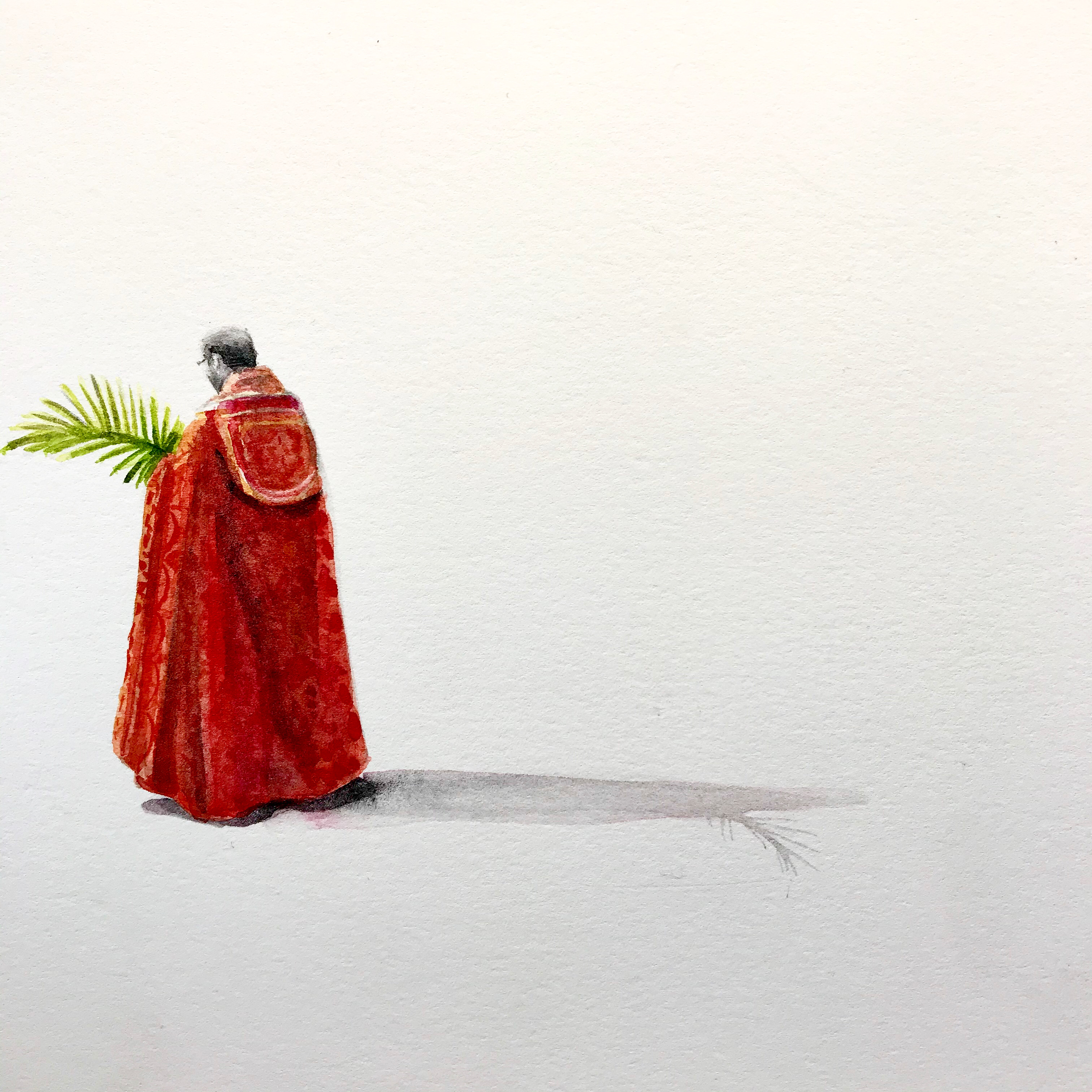
Margaret Ackland, Social Distancing #7 – Palm Sunday, 2020. Watercolour on paper, 18 x 24 cms.
Artist Margaret Ackland has pictured it well. In a series of small watercolours, she presents moments of intense stillness and empty space that become the centre of her interest and awareness. This intensity of looking indicates a refined observation of things usually overlooked and pushed the edge of vision. Palm Sunday, the fifth of April, now so many weeks ago, Margaret Ackland captures the profile of a priest leading a televised service in a church empty of a congregation. The placement of this robed figure to the left of the page, leaves an accentuated empty space held in place by a shadow and a curled palm frond. It is as if there is a tug of war going on for our attention between the figure intent on religious ceremony moving to the left and the space that opens up to the right. There is an interplay between activity and rest, movement and stillness, presence and absence, that leaves this otherwise empty space alive with possibilities. I remember how busy I was, that time now so long ago, when this emptiness arrived and piqued my interest.
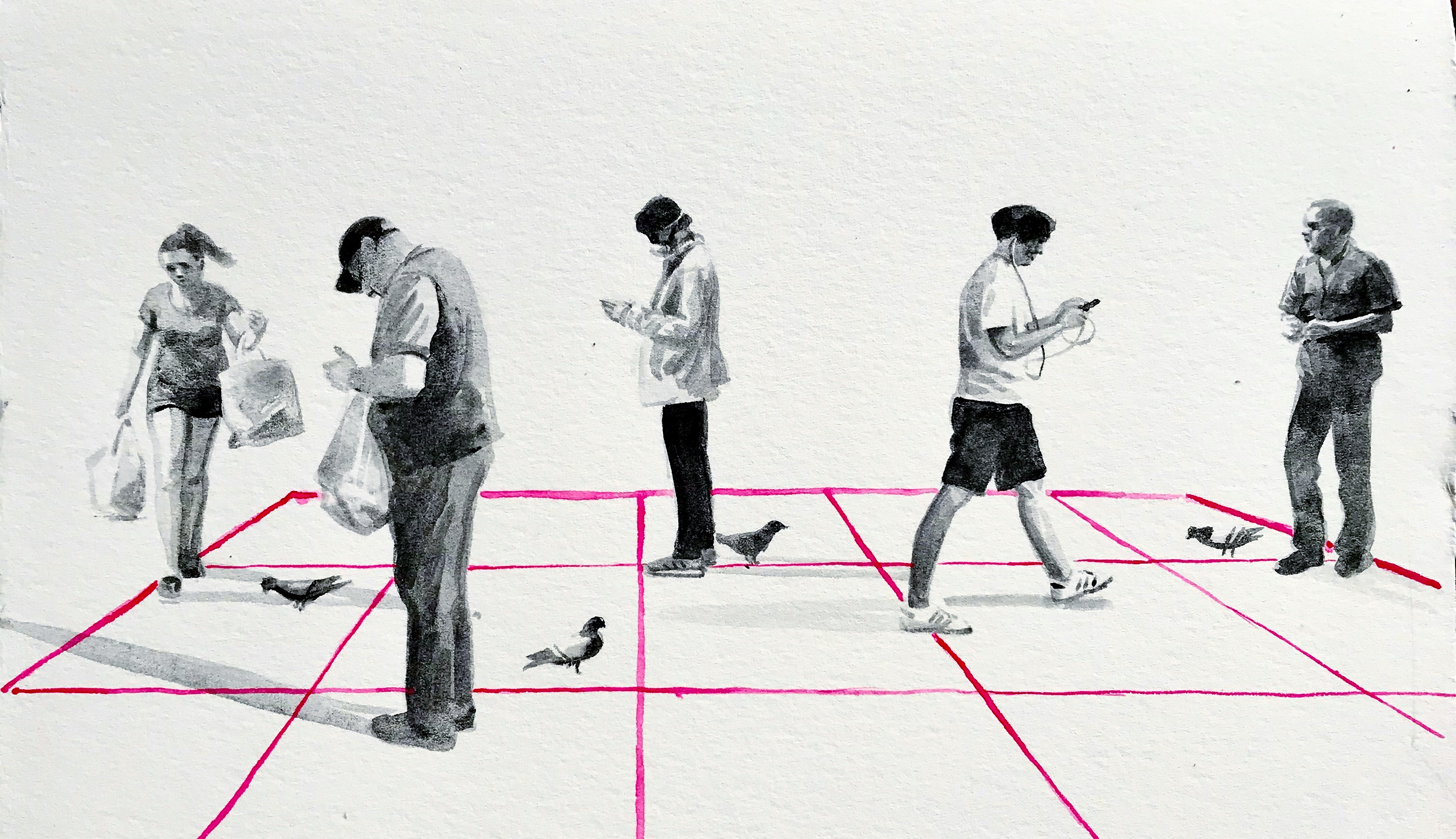
Margaret Ackland, Social Distancing # 3 – Stay Part, 2020. Watercolour on paper, 19 x 28 cms.
In another work, we see people busily going about their activities, jogging, shopping, or incessantly checking their mobile phones. This evidences a search for the new choreography that we have been told will express our consideration for others. Suddenly our personal boundaries are being pushed out and our physical edges take on new meaning. We need to find a distance that is clearly more than one breath away. Alert for coughing, and the slipstream of joggers and getting our tongue around that new phrase ‘respiratory aerosols’. The bright pink lines of geometry represent that process of retraining needed to find the correct level of distance between us and the other. Such is the evidence of this discipline that even the pigeons seem to be following the lead. We are all re-crafting our world with our eye not on things, or even people, but the illusive and moving spaces of the in-between.
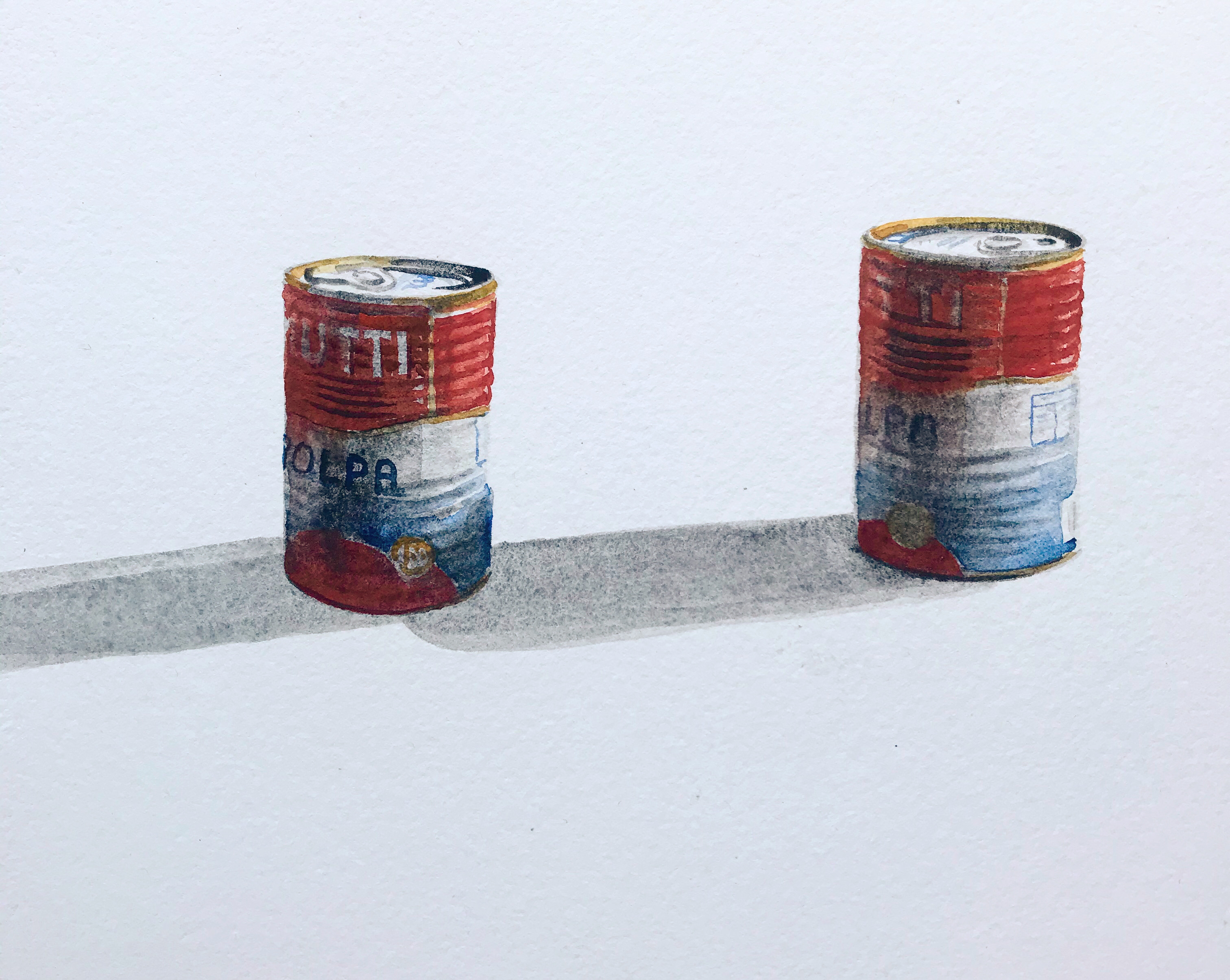
Margaret Ackland, Social Distancing, 2020. Watercolour on paper, 19 x 26 cms.
Presumably on the kitchen bench, two cans of imported Italian tomatoes have sorted out their positioning. A larger-than-would-be expected distance between them accentuates this awareness of space. How did we not see this before, this negative space, this void, this shadow, that allows what is present to pop out into our visual awareness? In taking the time to look at these two objects in space, we become acutely aware of the space that is enveloping and giving frame to what has firm edges and solid shape. After a while, the two elements of what is and what is not play a game of grabbing our attention, taking it in turns to hold our awareness. Our eyes remind us that we live in this space, and that we are not the can of tomatoes! Life does not consist of firm edges, but also welcomes the shadows and empty spaces that are full of lively potential, or of nothing at all. How restful and yet also how exhilarating are these possibilities.
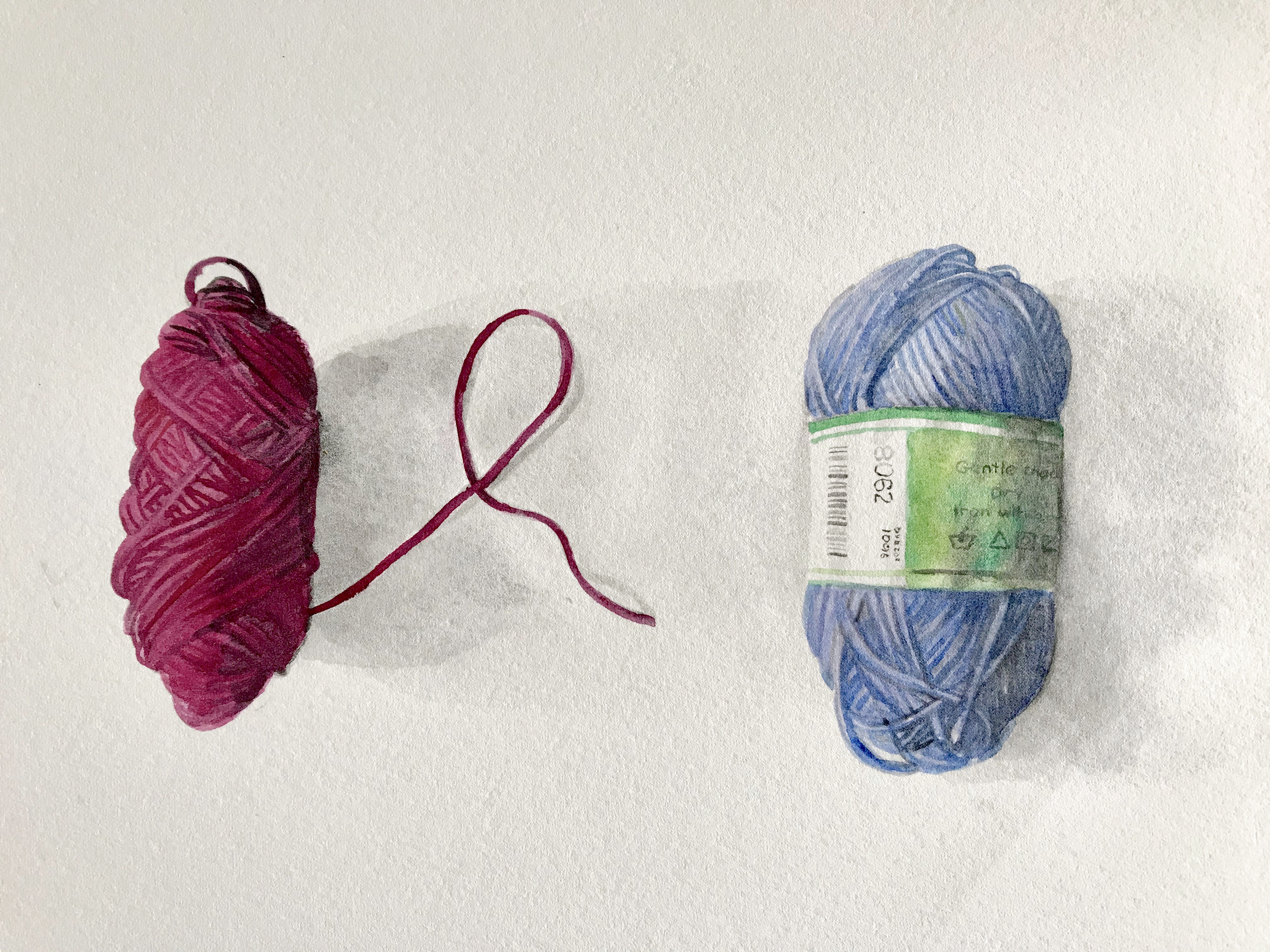
Margaret Ackland, Social Distancing #6 – Stay Inside, 2020. Watercolour on paper, 20 x 28 cms.
A space of potential is explored in a final watercolour, as two skeins of wool lie next to each other, with one strand rather seductively unravelling into the void between. Is this accident, or comedy, or fate, or chance, that a thread relaxes so easily into such a place. In the emptiness of this space, I begin to see my mind at work looking for meaning, connecting threads, cause and effect, patterns, portents, powers. I fill such empty spaces with signs that confirm my own anxieties, wants, desires, and hungers. In my mind, I can see this tendency to draw endless lines over the surface of existence. I am looking for meaning on every surface to reflect back to me my freedom or my struggle. And then I become amused by the meanings that a single twine of thread keeps generating in my mind; it shows me how furiously the wheels are turning to keep the world from dissolving into nothing. And yet there is nothing to be anxious about. In the end, there is nothing, and there is nothing I can do about it.
Living with space. Living in space. Who knew there was so much space! What I find in these humble and small works are scenes of the ordinary that have taken on the gravity of something keenly observed and considered. They carry the weight of significance and the attention to detail that is found in acts of contemplation. They carry an aura of devotion. This is the stance we would adopt in front of a religious icon, or a work of great spiritual significance. These works carry a sense of gravitas usually reserved for images inviting a form of devotion, where looking is rewarded by an experience of grace. This is a form of looking that leads to life, where my own insignificance is held in the gaze of another where I sense my own existence as a gift. These fine moments of looking become the empty spaces where we experience what we might term at this time ‘a choreography of grace’.
℘℘℘℘
Margaret Ackland is a Sydney-based artist. The works referred to in this article are currently being exhibited online through Flinders Lane Gallery, in Melbourne.
ROD PATTENDENIS AN ARTIST, ART HISTORIAN, AND THEOLOGIAN INTERESTED IN THE POWER OF IMAGES. HE LIVES AND WORKS ON AWABAKAL LAND.
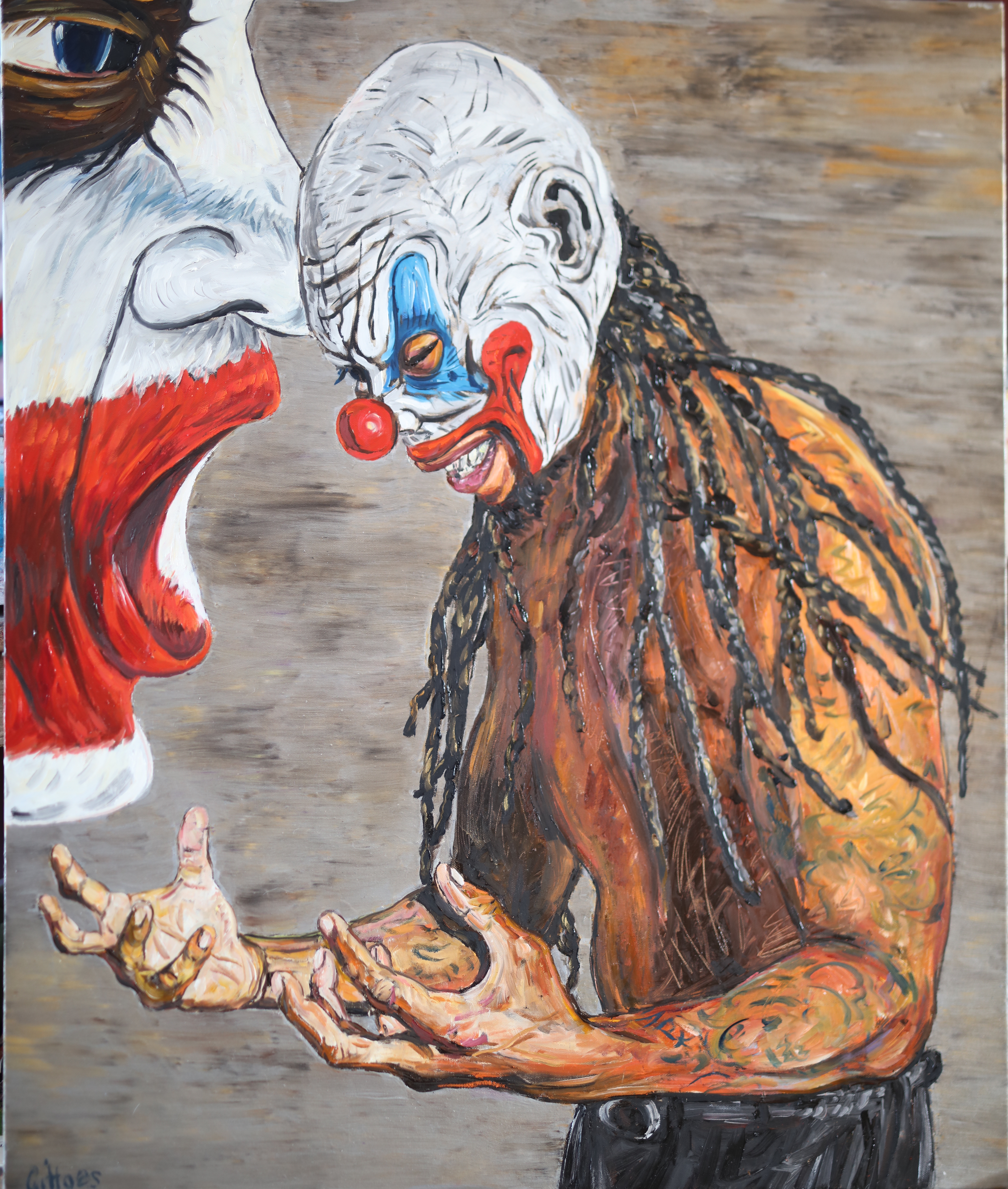
George Gittoes, Great, 2017–19. Oil on canvas, 92 x 76 cms, collection of the artist.
Artist George Gittoes has spent considerable time working as a filmmaker in poor urban communities in the USA. Over the last few days, he has been sharing with me by email and phone his responses to what is happening in the USA this week. He has sent me the text below where he distils his response in a painting he completed in 2019. – Rod Pattenden
I met Elliot Lovett in Baghdad in 2003. He had just come in from a combat mission and joined in the freestyle rap competition called the Bull Ring, beside the pool of what had been Uday Hussain’s Palace. Elliot’s rhyming verses began to sculpt images in my mind with the genius of a Picasso re-configuring form to match images evoked by the bombing of Guernica. Instantly, I felt protective of Elliot’s genius and said, ‘Let me talk to your officers and have you excused from frontline duties – your talent is too great to be risked’. Elliot laughed back, and said, ‘George, it is more dangerous in Brown-sub Miami where I come from. I joined the army because it is safer’.
I followed Elliot back to Miami to make my film Rampage, which would test this challenging statement. Sadly, Elliot’s even-more-talented-poet-brother Marcus was shot and killed while we were making the film. Elliot asked me to come back again in 2017 to be with his community while they campaigned to oppose Donald Trump’s election. Elliot said: ‘We need to make a video clip and call it ‘Ya all don’t hear me’. He wanted the rap musicians to wear white clown masks and perform in front of a huge street mural depicting Trump with his face painted like Batman’s Joker, taking a knife to the Statue of Liberty.
All the rappers crammed into a hotel room to watch the election results with Hellen Rose (my partner) and I. They could not believe that Trump had won and would be their new President. Elliot commented: ‘He will say anything because he is crowd-pleaser, like a clown’.
As well as poetry, Elliot sees bodybuilding as an art form and uses his amazing physique to make symbolic poses that are art. He explained that the following day he wanted to take one of the clown masks out onto the street and ‘show what it means to a black person hearing the slogan “Make America Great Again”‘.
His performance, which I drew and photographed, was like a scream and I did one painting called that – The Scream – but for Elliot the most powerful image he wanted to evoke was standing with empty hands outstretched and looking down at them through the white clown mask and saying ‘Great!’ Saying it Elliot’s way, the word took on the opposite meaning; like when you have had a bad day and both tyres of your car have been punctured on the side of a highway in heavy rain and you reach for your mobile phone to call for help and discover the battery is flat and you say, ‘Great!’
Elliot has the double disadvantage of being an artist and black. In our society artists are discriminated against for being different. Growing up as an artist in conformist Australia helps me to understand the suffering of African-Americans and Indigenous people. Our film White Light gives a voice to the people of segregated Southside Chicago – a community which, literally, has a church on every corner and every one of them is full on every Sunday. The uplifting voices of Gospel singers can be heard, evoking the suffering and prayers of a people who have been victimised since slave days. To see Trump holding up a Bible to these truly-spiritual people was the deepest of all insults, at this time of crying out for change ‘at last’.
In the first four minutes of White Light, the police are seen approaching Harith Augustus, a much-loved hairdresser and barber as he peacefully walks up to his shop. Within seconds they have shot him dead on the road. The police never gave an explanation and were never punished. If it was possible to fly to the US, Hellen and I would be on the next plane to be with our friends, out protesting for change and an end to such injustice.
(George Gittoes’ recent film White Light features this song ‘Off the Chain’. In many ways, it provides the soundtrack for understanding the current unrest in the USA.)
℘℘℘℘
George Gittoes AM is a highly-recognised Australian artist, who for more than four decades has documented some of the world’s most serious conflicts. He has been recognised for his humanitarian and peacemaking efforts and has been awarded an Order of Australia (AM) as well as the prestigious Sydney Peace Prize 2015. A painter and printmaker, Gittoes is also an award-winning documentary filmmaker who has worked in places such as Afghanistan, Iraq, Pakistan, and, more recently, the suburbs of Chicago. He is the recipient of several major art awards and his work is included in public collections nationally and internationally. George Gittoes lives and works on the land of the Wodi Wodi people, of the Dharawal nation.
Ben Quash, Professor of Christianity and the Arts at King’s College London, gave an online lecture this week titled ‘Imaginative Hope: Why Art Matters In Times Of Crisis’. Now the good folk over at Morphe Arts, who sponsored the event, have made it available.
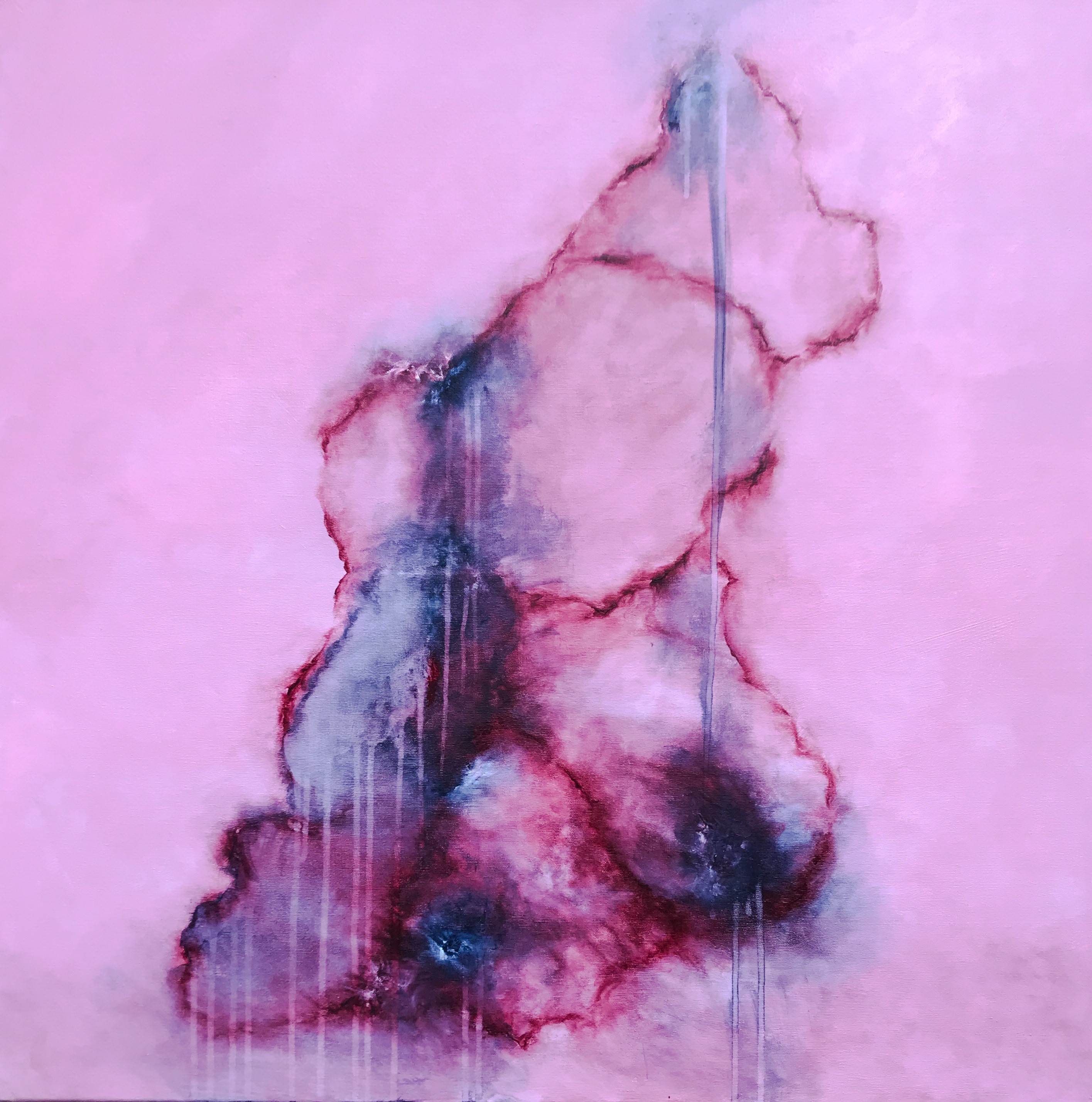
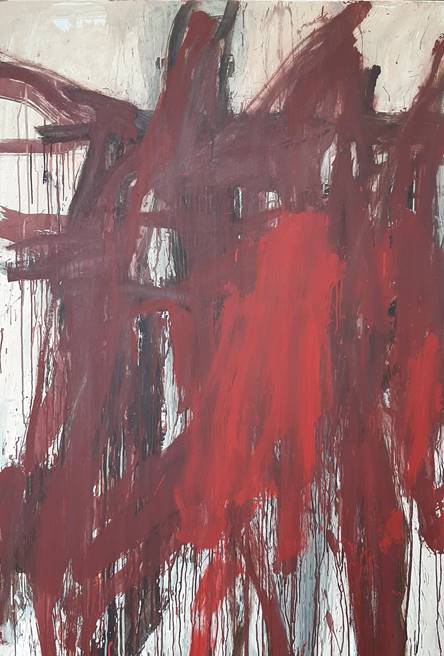
Douglas Purnell, ‘C-V 1’, 2020. Acrylic on canvas, 180 x 122 cm. Private collection, Sydney.
This painting is human in scale, 180cm x 122cm. Like everyone in the world at the moment, I am living in the time of the Covid19 Pandemic. I have chosen to make a series of paintings that reflect life in the present for me, and, and the experience of ‘lockdown’ where my days begin and end in my studio. The works are beyond my words. I hope they somehow address the mystery that surrounds us.
℘℘℘℘
DOUG PURNELL IS A PASTORAL THEOLOGIAN WHO IN HIS RETIREMENT IS FOCUSING ON A COMMITMENT TO A FULL-TIME STUDIO PRACTICE OF PAINTING THAT EXPLORES THE NATURE OF ABSTRACTION AND MARK MAKING. HE WAS FOR 17 YEARS THE DIRECTOR OF THE BLAKE PRIZE FOR RELIGIOUS ART. HE LIVES, WORKS, AND PLAYS ON THE LAND OF THE BURRAMATTAGAL PEOPLE.
What kind of time is this? And what might such a time mean for artists and their work?
Beyond the very real financial hit that many artists are currently taking, a great many of us, artists included, are welcoming this abnormal moment to ask other questions – existential questions, and questions about our regular habits and commitments, for example. It is suggested that to try to carry on with business as usual, however tempting and well-intentioned that might be, would be to forego a rare opportunity to reimagine and re-embody other modes of our living. Others are turning to all kinds of creative endeavours. Others still – including artists – are asking whether now is really the time to make art at all?
Of course, we’ve been here before. This is hardly the first time in our history that such questions have been asked.
In the aftermath of WWII, where the dominating backdrop was clearly otherwise than it is today, the philosopher Theodor Adorno, in his Negative Dialectics, raised the question of whether the traumas of Auschwitz mean that ‘we cannot say anymore than the immutable is truth, and that the mobile, transitory is appearance’. It is not, he insisted, a case of an impossibility of distinguishing between eternal truth and temporary appearances (Plato and Hegel had already showed us how that could be done); it’s just that one cannot do so post-Auschwitz without making a sheer mockery of the fact:
After Auschwitz, our feelings resist any claim of the positivity of existence as sanctimonious, as wronging the victims: they balk at squeezing any kind of sense, however bleached, out of the victims’ fate. And these feelings do have an objective side after events that make a mockery of the construction of immanence as endowed with a meaning radiated by an affirmatively posited transcendence.
Put more plainly, our emotional responses to horrors of such magnitude ought to outweigh all our attempts to explain them. It was this conviction too that led Adorno to state famously (in his essay ‘Art, Culture and Society’) that ‘to write poetry after Auschwitz is barbaric’, and that ‘the task of art today is to bring chaos into order’. The line between explanation and intelligibility has been severed. In the wake of such, we are left with the possibility of Adorno’s ‘negative theodicy’, a kind of theodicy in which the old intellectual and philosophical distance is impossible. If we are to make any headway at all in recognizing how the Nazi death camps succeeded in the destruction of biographical life, and reorientate our thinking in response, Adorno argues, we must learn how to regard Auschwitz as the culmination of a trajectory embedded in the history of western culture in the wake of the Enlightenment. In other words, there can be no genuine acknowledgement of the Holocaust that does not begin with the realization that ‘we did it’.
Today, our questions may be otherwise. For some of us – for those, for example, trying to discern (or create) lines between unbridled capitalism, ecological disaster, and global pandemics – perhaps they are not so.
In his latest post for The Red Hand Files, musician Nick Cave responds to a series of questions about his own plans for this time during the corona pandemic. His reflection is worth repeating here in full:
Dear Alice, Henry and Saskia,
My response to a crisis has always been to create. This impulse has saved me many times – when things got bad I’d plan a tour, or write a book, or make a record – I’d hide myself in work, and try to stay one step ahead of whatever it was that was pursuing me. So, when it became clear that The Bad Seeds would have to postpone the European tour and that I would have, at the very least, three months of sudden spare time, my mind jumped into overdrive with ideas of how to fill that space. On a video call with my team we threw ideas around – stream a solo performance from my home, write an isolation album, write an online corona diary, write an apocalyptic film script, create a pandemic playlist on Spotify, start an online reading club, answer Red Hand Files questions live online, stream a songwriting tutorial, or a cooking programme, etc. – all with the aim to keep my creative momentum going, and to give my self-isolating fans something to do.
That night, as I contemplated these ideas, I began to think about what I had done in the last three months – working with Warren and the Sydney Symphony Orchestra, planning and mounting a massive and incredibly complex Nick Cave exhibition with the Royal Danish Library, putting together the Stranger Than Kindness book, working on an updated edition of my “Collected Lyrics”, developing the show for the Ghosteen world tour (which, by the way, will be fucking mind-blowing if we ever get to do it!), working on a second B Sides and Rarities record and, of course, reading and writing The Red Hand Files. As I sat there in bed and reflected, another thought presented itself, clear and wondrous and humane –
Why is this the time to get creative?
Together we have stepped into history and are now living inside an event unprecedented in our lifetime. Every day the news provides us with dizzying information that a few weeks before would have been unthinkable. What deranged and divided us a month ago seems, at best, an embarrassment from an idle and privileged time. We have become eyewitnesses to a catastrophe that we are seeing unfold from the inside out. We are forced to isolate – to be vigilant, to be quiet, to watch and contemplate the possible implosion of our civilisation in real time. When we eventually step clear of this moment we will have discovered things about our leaders, our societal systems, our friends, our enemies and most of all, ourselves. We will know something of our resilience, our capacity for forgiveness, and our mutual vulnerability. Perhaps, it is a time to pay attention, to be mindful, to be observant.
As an artist, it feels inapt to miss this extraordinary moment. Suddenly, the acts of writing a novel, or a screenplay or a series of songs seem like indulgences from a bygone era. For me, this is not a time to be buried in the business of creating. It is a time to take a backseat and use this opportunity to reflect on exactly what our function is – what we, as artists, are for.
Saskia, there are other forms of engagement, open to us all. An email to a distant friend, a phone call to a parent or sibling, a kind word to a neighbour, a prayer for those working on the front lines. These simple gestures can bind the world together – throwing threads of love here and there, ultimately connecting us all – so that when we do emerge from this moment we are unified by compassion, humility and a greater dignity. Perhaps, we will also see the world through different eyes, with an awakened reverence for the wondrous thing that it is. This could, indeed, be the truest creative work of all.
Love, Nick x
Like Cave, Adorno too challenges us to ‘take a backseat and use this opportunity to reflect on exactly what our function is – what we, as artists, are for’ – and to lean into ‘other forms of engagement’ that such uncertain and time-altering times render (almost) unavoidable. It is certainly a time to consider our responsibility to and involvement in all kinds of violence, for example.
The only philosophy which can be responsibly practiced in face of despair is the attempt to contemplate all things as they would present themselves from the standpoint of redemption. Knowledge has no light but that shed on the world by redemption: all else is reconstruction, mere technique. Perspectives must be fashioned that displace and estrange the world, reveal it to be, with its rifts and crevices, as indigent and distorted as it will appear one day in the messianic light. To gain such perspectives without velleity [fancy] or violence, entirely from felt contact with its objects – this alone is the task of thought.
Is not what might be true for ‘philosophy’ and ‘thought’ not also true for art? Redemption, the ‘messianic light’, exposes the incongruity between the world as it appears now and the world as it might be. That exposure – birthed and sustained by profound and counterintuitive hope, hope born not of trust in markets or in a change of conditions but which is the wholly unanticipated gift of the God of life – serves as both a judgement upon all that threatens and overcomes life, and as a promise that there is a love that is stronger than death.
That exposure also brings new possibilities for artists – in their freedom – to find their banjos, their pens, their brushes, their shoes, their voices, their humanity, etc. etc.
Human poiesis (and theology too, for that matter) can be – and in this world ought to be, as Jonathan Sacks put it in To Heal a Fractured World: The Ethics of Responsibility – a form of protest ‘against the world that is, in the name of the world that is not yet but ought to be’. It can like placing oneself right in the midst of a broken world – something like the way that the cellist Vedran Smailović placed himself in Sarajevo’s partially-bombed National Library in 1992 – and refusing to accept that the way things appear is the way that things must or will be.
℘℘℘℘
JASON GORONCY IS A THEOLOGIAN, ARTIST, AND FOLK FESTIVAL TRAGIC WHO LIVES AND PLAYS ON WURUNDJERI LAND.









 Art/s and Theology Australia