Articles

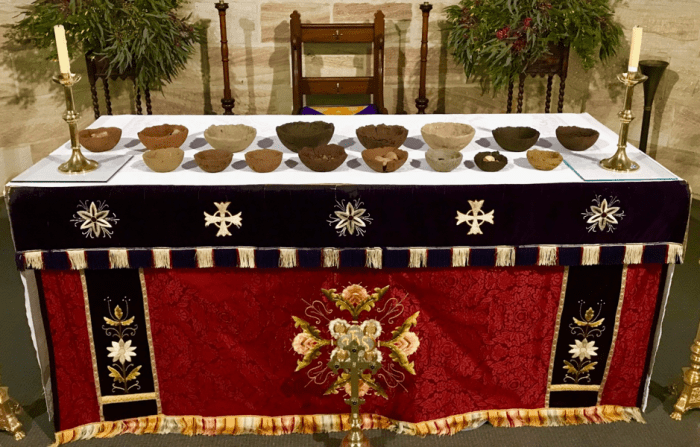
Sixteen Earth Bowls

Picture1
Penny Dunstan, Dirt/Soil/Earth installation, 2018. Altar/d at Adamstown Uniting Church. Photograph by John Cliff.

I am standing on the river flats of the Hunter River at Warkworth (-32.490620,151.028671: paddock reference). It’s a narrow flat valley slashed through with a slow meandering river resting in a deep sinuous trench. The soil under the drought-browned pasture is black. It crumbles easily in my hand. In the distance, there’s a mob of kangaroos grazing on the remaining plant roots. Across the river, there’s an old farmhouse that in times past belonged to a breeder of stock horses. I stayed there once as a guest but the family has long since moved out. Now it belongs to a mine with an overburden wall that rises up like a frozen tidal wave, forever threatening the house and the surrounding river flats.

Here, soil is a commodity. Soil is not as valuable as the coal that lies underneath it if we think in short term economics. But thinking intergenerationally, these black-soiled river flats should be preserved. One day, once again, humans may need them to grow food.

How shall I talk about the absolute importance of soil to human civilisation? Soil, along with air and water, is one of our most fundamental natural resources. Soil grows food for us and earth-others. It grows trees and grasses and fungi and a host of micro-lifeforms that we never see but are dependent upon to survive. A teaspoon of a well-cared-for soil can contain up to one billion bacteria, several meters of fungal filaments, several thousand protozoa, and scores of nematodes. Soil contains vast quantities of carbon and is a holder of surface water.

In the transitional zone between open-cut mining and rehabilitated post-mining landscape, soils are a carpet of hope rolled out to pacify the requirements of legislation. Mines managers assume soils will be resilient and cover up the mountains of Permian stone piled high. The small lives contained in soil often don’t transition well from pasture to the manufactured lands via heavy machinery, trucks, piles, bulldozers, and ploughs. It is asking a lot of one of our most valuable resources to cover up the sins of avarice.

Michael Northcott (theologian and ethicist) puts the problem this way:

… the earth and we are in co-creaturely relationship and … when we neglect the beneficence of God’s good earth and the prudential use of what God has granted to us, and subject nature … to our devices and desires, we not only frustrate the capacity of our fellow creatures to give God praise; we also put at risk the very services that the earth renders us.

Picture2
Penny Dunstan, Merriwa soil bowl in Sixteen Earth Bowls 2018, installed at the Hyatt Canberra for the National Soils Conference. Photograph by the author.

Making earth bowls is a way of thinking about my ethical responses to soil use in a post-mining landscape. It is a way of thinking with my heart and not just my head. As I work with each Hunter Valley topsoil, I come to understand each as an individual, a special part of God’s creation. Each soil behaves according to its own chemical nature and historical past when I fashion it into a bowl shape. Some hold their shape, and some don’t; or perhaps, is it that some won’t? The agency (or will) of the soil is expressed by the way the bowl keeps form. Soils with good health often crack or crumble. Sad soils, those mistreated and overworked, stay where they are put.

Each bowl is made from a Hunter Valley topsoil, except for one. The grey bowl is mudstone doing its best to impersonate soil. It’s having trouble as it hasn’t been to the surface of the earth for 250 million years. Of all the soils, this one is the most sterile. This is the soil that will be found on the surface when we run out of topsoils rescued from mining. It is a legacy that our grandchildren will not thank us for.

Picture3
Penny Dunstan, Sixteen Earth Bowls, 2018. Installed at Holy Trinity Church, Merriwa for the Festival of the Fleeces. Photograph by the author.

So here is a question: What were those earth bowls doing on the altar? And on a white linen cloth? This is where you, the reader, come in. Art should make you question the world. Are those bowls made of dirt (plus all those beasties) that we should sweep out of the door and into the bin? Or are they made of soil that we should at least put on the garden, but really, they have no place in church? Or are they made of earth to be examined, to be questioned, to be listened to as earth-others?

These soils, full of tiny lives, are responsible for growing our food, making our air and storing atmospheric carbon. Our very lives as humans on the earth depend on them. By fashioning these soils into bowls and placing them in sacred places, I hope to remind us to honour the earth that we stand upon, that earth that speaks to us by pushing back at our feet. Soils deserve care and nurture, as they reciprocate to care and nurture us. Tangled in the web of earth understandings is a call to think about an intergenerational issue such as postmining land rehabilitation and building housing estates on prime agricultural soils. When we care for soils, we are in fact caring for ourselves and our descendants.

℘℘℘℘

Penny Dunstan is a soil scientist/agronomist and artist with particular interests in anthropogenic landforms and the human/land dialogue that arises when humans create the world. Her transdisciplinary PhD research investigated post-coalmining rehabilitated land at one mine site in the Hunter Valley, through fine art, human geography, and soil science. She has presented and published in a wide variety of forums including Hunter Valley Rehabilitated Mine Lands, National Soil Science Association, Institute of Australian Geographers, and Creative Arts forums in Australia and overseas. Penny is an accomplished artist who regularly exhibits work that details aspects of the Upper Hunter interactions with the Anthropocene. She works within and with Wonnarua country.

Holy, Honest Confluences

Screen Shot 2019-09-30 at 7.57.03 pm

Inspired by ancient and continuing traditions of spiritual contemplation, and curated by artist and academic Dr Rebekah Pryorholy, honest confluences considers the complex personal and communal relationships between humans, and between humans and other living beings and things, in order to respond to the following key questions: 

  • What does it mean to be autonomous (that is, self-determining)? 

  • What does it mean to belong to a community (that is, a group of living beings that comprise, for example, a household, a family, a love relationship, an ecosystem, a neighbourhood, a religious community, a species, etc.)? What does this belonging look/feel like? And, what does it mean to not belong?

  • Is it even possible to be autonomous and belong? If so, what might this look/sound/feel like?

At a time when complex legal, ethical and social questions concerning communities (for example, religious communities and their relations to power and ‘freedom of thought, conscience and religion’ more broadly, culturally and linguistically diverse communities and their multiple histories, and ecological communities challenged by present and imminent climate change impacts) challenge and implicate us all, holy, honest confluences returns us to our own bodies and relations in search for answers. 

More details here.

Vision, Voice, and Vocation

Vision, Voice, and Vocation_ Arts and Theology in a Climate for Change

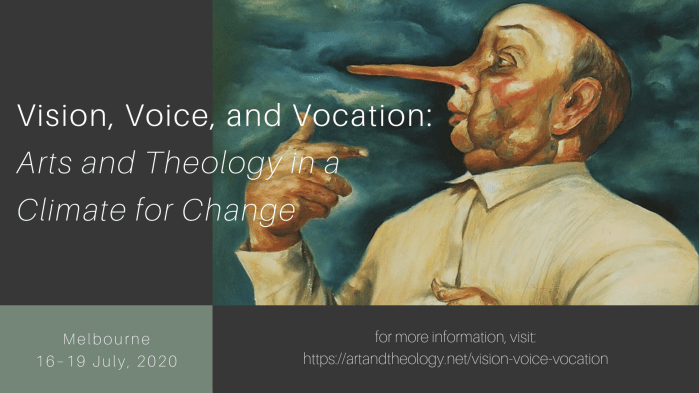
We are very excited to announce that Art/s and Theology Australia will hold its first conference on 16–19 July next year.

This four-day event will provide a unique conversation space for artists, performers, creatives, academics, and activists, to consider the vital role of the imagination in today’s complex climates – social, cultural, environmental, political, racial, religious, spiritual, intellectual, etc.

It will also invite conversation around further questions: What kinds of change? What are the grounds and manner of hope, transformation, and resilience? What might the arts and theology have to contribute to such discourse and action, if anything? How do we attend to the margins of this discussion, and speak and act more holistically as communities of change?

More details here.

Please:

  1. save the date
  2. help spread the word
  3. get in touch if you would like to offer an academic paper or creative presentation

To Tea and Be, or Not to Tea and Be?

IMG_1601

In The Book of Tea (1906), written by Japan’s Kakuzō Okakura and later published in English in the United States as a guidebook to be read in the lounge rooms of New York socialites, Okakura says of tea: ‘(I)t has not the arrogance of wine, the self-consciousness of coffee, nor the simpering innocence of cocoa’. He doesn’t give a succinct description of tea (the book is 116 pages long) but the title alone is enough for us to know he was seriously committed to his tea.

Perhaps if I was to extend Okakura’s comment to include tea I might say it has the ‘calm presence of a negotiator, and the quiet confidence of a healing balm’. Tea was used by the suppressed Japanese Church as a subversive Communion drink, to end wars, and to bring reconciliation.

IMG_1624.jpeg

I am a lightweight theologian and a heavyweight practitioner of the worship arts. As a pastor and curator of worship, my commitment is to the local communities of Christians who gather for worship from week-to-week or from time-to-time, more or less regularly; to those followers of Jesus, or those not yet, who gather at festivals and conferences.

These are the people I want to help sustain in their following of Jesus in their worlds; or introduce them to that possibility. My purpose is always to design space and liturgy that will offer the potential for liminal moments in which they might engage heart, soul, mind, strength with the Trinitarian community of God.

My most recent projects have been iterations of a tea ceremony. Originally designed to be one chapel of a dozen or so at the annual Festival One held outside of Auckland in Aotearoa-New Zealand, ‘Tea & Be’ brought together my enjoyment of tea drinking and my belief that God primarily calls us to being – in relationship with the Godhead – rather than to doing. My generalised overstatement of this to my community is to say that God doesn’t care about anything you do, only about who you are becoming and being, in relationship with God.

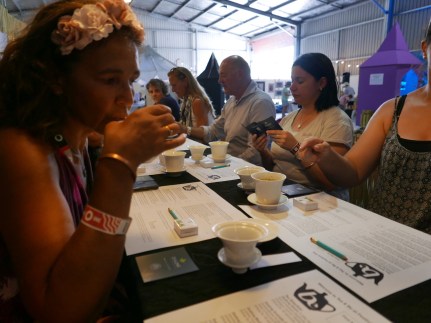
‘Tea & Be’ invited people to pre-register in groups of 14 (with no more than 3 people known to you) for a 45-minute session of tea and conversation. Places at the long narrow table were set out with high-quality teaware, and a placemat that described the six teas on offer suggested some conversation starters and offered a place to journal responses. A small block placed on the placemat allowed each participant to display ‘Talk’ or ‘Be’ sides and so control their active participation in one or the other mode.

After a 10-minute introduction to the history of tea, its use as Communion when Christianity was suppressed in Japan, how to use the teaware, slurping, and other aspects of the session, people were invited to observe the texture and smell of the high-quality loose-leaf tea they had chosen; then, following a Prayer for Tea, to drink and converse with those around them. The style of teaware made it possible to also try teas chosen by others.

IMG_1633.jpeg

In the week before the festival, I wondered if the concept was crazy and if anyone would turn up. Others felt similarly! By one third of the way into the festival, all 23 sessions were fully signed up and people not registered turned up hoping to take the place of aregistered non-starter. More than 300 people were served.

All used tea leaves and dregs were poured into a tall glass phial and stood as a visual reminder of the conversations that had taken place around the table. Placemats were hung on the exterior fence of the chapel for anyone to read the journal notes and tea choices made by participants. Written and verbal responses were very moving. People found something going on beyond the individual elements of a cup of tea and a conversation with someone they didn’t know. God was present, and for many people that encounter with the other and the Other was very significant.
P1030765.jpeg

Why? I am not sure, but wonder if it was the mixture of informal ritual, permission given to slow down and just be during a busy and noisy festival, opportunity for deeper connection with another person/people (or perhaps the opportunity of a connection for some), hints at eucharistic/table re-imagining, being served, and it all offered in a safe space.

My tea crew was keen to maintain the concept, and since festival we have reframed it to work in several worship services, conferences and gatherings with numbers up to 110. The ritual continues to evolve and be shaped by our experience of it.

My answer to the title question is an unequivocal “yes!” to Tea & Be.

℘℘℘℘

Mark Pierson is a reject from the Baptist denomination and has pastored/curated the Rhythms of Grace community under the independent Upper Room Church in Newmarket, Auckland, for the last four and a half years. He is author of The Art of Curating Worship: Reshaping the Role of Worship Leader. He very ocassionally posts something on his website, where an expanded account of ‘Tea & Be’ can also be found. In January 2020, ‘Tea & Be’ sessions in a range of styles will be offered at Festival One, and in July 2020 at a gathering of pastoral leaders exploring ways to understand and sustain artists in the congregations.

Neighbours, Enemies, Friends

image001.jpg
Bob Booth, I am Your Neighbour, 2010. Oil on canvas.

The story of the Good Samaritan is a familiar one, so much so that its very mention tends to celebrate a comfortable kind of religion as listeners reassure themselves of their place in the story. We should be reminded that in its original context it was a story that was utterly shocking to its first hearers. It dramatically crossed boundaries that were simply inconceivable for those listening. If this parable had been taken seriously, it would have upended cultural and religious conventions that had been carefully policed and reinforced. It is a story that has drawn many artists to re-invigorate in fresh ways both its attraction and its threat. For artist and priest Bob Booth it is a story worth the effort of exploring its potential to upset allegiances and to re-examine values and ethical actions in the contemporary world we inhabit.

Booth takes us into the drama of the story by placing the viewer just above the action, taking in the injured figure, helper and the passers-by. The composition allows our eye to sweep around the scene taking in both human actors and the compressed space of the landscape. Our eye comes to rest, after making this aerial survey, firstly on the hand of the fallen man and then to the hand of the ‘Samaritan’ with a finger decidedly pointing in our direction. We are drawn in, complicit, involved viewers, who are close enough to lend a hand and yet remaining fixed outside the picture plane. It is both a simple and yet complex composition that has been carefully crafted to include us in its sweep. The brush strokes and coloration serve to heighten its dramatic focus and its sensual textured surface emphasises a tender and compassionate moment. This painterly seduction only heightens the tension the viewer feels about a decision on whether to get involved.

The fallen man is somewhat reminiscent of a Christ figure, partly naked with a white cloth over his legs. What is utterly unfamiliar is the facial features of the helper and the skull cap that marks him out as a follower of Islam. Muslim men will often wear the white Taqiyah (Arabic for skull cap) as a sign of respect. This is worn especially during the five periods of prayers required each day. Bob Booth comments: ‘Had the parable of the Good Samaritan been presented in Australia today, I think that there would have been every chance that a Muslim would have taken the title role. I sometimes wonder how we manage to read this parable in church without causing a riot!’ The shock of this painting is appropriate to its original intentions to cross over the sharp divide of social enmity found between Jews and Samaritans. While they shared common ancient traditions, they were passionately divergent about the physical location of the most holy place to worship. Such enmity is echoed in contemporary ways as we have witnessed the terrible acts of violence in New Zealand and then in Sri Lanka during the first half of this year.

Underlying the disturbing shock of this story of hospitality and compassion is the boundary-breaking words and actions of Jesus in upsetting the religious conventions of his day. In the material actions of touching the untouchables, speaking to women in public, challenging religious leaders, breaking the Sabbath, feasting rather than fasting, Jesus enacts a more passionate and generous vision of who God might be. Bob Booth takes this as evidence that Jesus had his eye not on the rules and regulations of religious formalism but on something completely in opposition to such strictures. ‘It seems to me that Jesus was intoxicated with an audacious thought of goodness and beauty, a joy that was set before him for which he would endure anything’. This familiar story is therefore not so much about kindness or the virtues of middle-class niceness, but rather a way of seeing other human beings as being made in the image of God. It is in the encounter with strangers, or even perhaps with enemies, that we find our heart expanded and we see the possibilities of God’s grace at work in the world.

Reposted from ArtWay.

℘℘℘℘

ROD PATTENDEN IS AN ARTIST, ART HISTORIAN, AND THEOLOGIAN INTERESTED IN THE POWER OF IMAGES. HE LIVES AND WORKS ON AWABAKAL LAND.

Review: ‘Vessels: Theology and the Arts Symposium’

66683917_10158610995701982_9022041562204340224_o.jpeg

Why do we as humans crave acceptance and the space to be seen and heard? That was the initial driving force behind wanting to bring together like-minded individuals who share an interest in the interdisciplinary field of theology and the arts. It was out of sheer frustration and loneliness that I decided to do something about finding my theological/artistic tribe. So earlier this year, on the weekend of 12–14 July, the Anglican Parish of Woy Woy hosted ‘Vessels: Theology and the Arts Symposium’.

The goal of this symposium was to draw together theologians, practicing artists, clerics, philosophers, and poets to explore the relationships, intersections, and challenges that exist when the arts and theology come together. The three-day forum offered participants a multimodal and experiential platform to encounter the interdisciplinary interactions between the creative arts and theological theory. Over the three-day event, seventy participants listened to and interacted with five extraordinary keynote speakers, and a further seventeen short paper presentations. Additionally, those involved had the opportunity to participate in three creative workshops, listen to poetry performances, an interactive prayer space, and engage with the artworks displayed in the exhibition.

The organisation of a symposium, however, is an interesting adventure. I would first like to thank all the keynote speakers – Glenn Loughrey, Dorothy Lee, John McDowell, Rod Pattenden, and Chris Bedding – who, thanks to their wonderful contribution, and their commitment to continuing the conversation in the interdisciplinary space, enabled many others to experience a wide range of creative theological intersections. From Chris Bedding’s Pirate Faith to John McDowell’s analysis of theology and the art of popular cinema. From the confronting truths of Glenn Loughrey’s investigation of the impact of neo-colonialism and nostalgia on the perception of Aboriginal art and spirituality to the poetry of Dorothy Lee and her exploration of the transfiguration in the Gospel and poetry. To, finally, a reflection on what’s next by Rod Pattenden with his exploration of the tensions that exist between art and theology. These contributions gave us much food for thought and conversation.

Throughout the process of developing the program for the ‘Vessels’ symposium, liturgy and music was an important consideration. As I believe it is in our communal expression of praise and worship through liturgy where we are immersed at the intersection between human creativity and the grace of God. As such it was imperative to reflect on and create a liturgical space where the participants felt that the worship was not separate from the proceedings, but a natural part of the experience. The driving force behind the liturgical landscape of the event was the consummate teacher, composer, and musical liturgist Michael Mangan. Michael worked with the St Luke’s community, made informed musical choices and contributed significantly to the liturgical style of the event. His passion for liturgical music and liturgy is palpable, and one cannot but be impressed with his skills at bringing a community into the worship space.

It takes courage to walk into a theological space that is for many, outside their comfort zone. I have been asked on a number of occasions: Are you wanting to be an artist or a theologian, because surely you cannot be both? I believe, that for me, I cannot be one without the other. It is who I am, and who I am becoming. In light of this observation looking at the creative arts theologically is not just an academic pursuit, but it is in fact deeply practical in consequence and orientation. My thanks go to all participants who proposed and presented short papers, workshops, interactive prayer spaces, artworks, and poetry performances. It is heartening to hear so many people adding their voices and creative skill to this growing area of inquiry. The diversity of the creative input at this symposium was astonishing, and it highlighted the wonderful contributions of people in the fields of ecclesiastical ornamentation, poetry, philosophy, and many other disciplines.

67328181_346754672669810_1696084994667053056_o.jpeg

I would like to make special mention of Rebekah Pryor, without whom this event would not have been as well organised. Rebekah is responsible for the professional curation of the exhibition, artist statements, exhibition catalogue, and co-convener. Working with Rebekah on this project was incredibly beneficial, as creative collaboration is key to having the opportunity to challenge oneself and take on board exciting perspectives and ideas.

It is my hope that from this event further conferences, communities, grants, prizes, and conversations are initialised. I now believe I have found my tribe, and I look forward to the next event.

℘℘℘℘

ALEXANDRA BANKS IS A PHD CANDIDATE IN THE FACULTY OF THEOLOGY AT ST FRANCIS’ THEOLOGICAL COLLEGE, CHARLES STURT UNIVERSITY.

Book Launch: On Arrivals of Breath

Readers of ATA are warmly invited to the launch of Anne Elvey’s new collection of poetry and prayer-like poems, On Arrivals of Breath. This will take place in Melbourne on Tuesday 15 October 2019, and in Sydney on Tuesday 22 October 2019. Details below.

Launch flyer - Melbourne - 4_Page_1.jpgLaunch flyer - Sydney_Page_1.jpg

Launch flyer - Sydney_Page_2.jpg

Faith: Love doesn’t come in specific sizes and shapes

He is a man fully present to himself. In the botanical gardens he wears a neat, close-brimmed hat and weaves through the crowd following a child. Deftly he catches her up, bringing her back into the gathering for the wedding ceremony. He is bearded and his body is compact, perfectly formed and compellingly small. He has such gravitas and is utterly himself. Later you will meet him and his partner, the mother of the doll-like child. While you are making introductions he will beam up at this woman who is beautifully round in ways that redefine the delights of a shapely waist and abundant breasts.

Her dress has a firm bodice and flares confidently in a full-skirted flounce. The floral fabric speaks happiness wrapped close to the heart of this woman. Her gaze carries such warmth that you feel immediately cosied. She gleams. Her dear friend is getting married. They did their doctorates together in a far place, and she has come to witness this wedding. Now we have seen the brides arriving and we are filled with delight.

That night you will see the man and the woman dancing. There is a live band, the music calls and people dance on the deck. The man has removed his hat and from behind you notice his upturned head and the fringe of hair that circles it. As the pair twirl you see them in profile, a picture of rapture so binding that you want to hold this moment, let the sweep of their love suffuse you. 

There is an easy grace in their dance-hold. They are not new to this posture and they inhabit it with the familiarity of old dance partners. This couple are young, perhaps in their 30s – yet old enough to have arrived into themselves in this way. Their physical difference might have once isolated them, made them “other”, the non-standard versions of shape and height. Here, now, they are so clearly content that their wholeness speaks love for themselves as well as each other.

So much is lost when beauty is homogenised to replications of tall men and slim women. It is also damaging. Celebrating only narrowly defined ranges of human loveliness is a form of un-love and a silent erasure. Constant exposure to the supposed perfection of celebrity stereotypes is designed to find us wanting. Jesus of Nazareth often responded to people whose lives were enacted outside the embrace of communal approval. He spoke with them and named them as faithful. By implication the harmful other-ing of their communities was faith-less. His censure to gendered power and religious entitlement remain provocations to this day.

[Reposted from The Sydney Morning Herald]

℘℘℘℘

JULIE PERRIN IS A MELBOURNE WRITER, ORAL STORYTELLER, AND ASSOCIATE TEACHER AT PILGRIM THEOLOGICAL COLLEGE, UNIVERSITY OF DIVINITY. SHE KEEPS A WEBSITE, AND HER MOST RECENT BOOK IS TENDER. SHE LIVES AND WORKS ON WURUNDJERI LAND.

‘Jesus in Australian Art’

This richly-illustrated lecture will explore the ways in which the figure of Jesus Christ has appeared in the history of Australian Art. Some of these images will appear familiar and confirm the roles of Jesus as teacher and healer. Some of the images can be found in Churches while others appear in the private studios of artists who have been drawn to the figure of Christ as a source of inspiration. Other images will be surprising as they arise in unexpected place with artists outside the Christian faith who nevertheless bring insights about the search for spirituality in Australia. Some of these images arrive with a sense of shock as they break open expectations about who Jesus is in the complexity of our contemporary culture. This fascinating overview will explore how the image of Jesus has found a home within Australian culture while also turning to challenge its comfortable illusions.

Rev Dr Rod Pattenden is an art historian and theologian interested in the power of images. He considers that looking at art helps us see more clearly the culture we inhabit and what shapes our faith, hopes, and desires in this complex postmodern era. Rod has written and lectured widely on art and spirituality in Australia and for many years was the Chair of the Blake Prize for Religious Art. He is currently minister of the Adamstown Uniting Church where he leads a vibrant arts and community development ministry.

WHEN: Thursday 12 September 2019 at 7:30pm

LOCATION: St Cuthbert’s Anglican Church, Cnr Darlington and Hillsden Roads, Darlington, WA 6070

TICKETS: Here

The Mediatory Power of Textless Music in Christian Worship

Ricercare_a_6_from_The_Musical_Offering

In many places of Christian worship throughout Australia, at any given worship service, music will play a significant role in the facilitation of worship. Music will be utilised to accompany text, it may function as a cue or fill, and it will provide possibly a soundtrack for audio-visual presentations, prayers, and other worship rituals. But how often does music stand alone – as textless? Can textless music function as a corporate worship act? Can, for example, the contemplation of a Bach fugue or an improvised guitar solo during worship mediate Christian experience, meaning-generation, and transformation? If so, how? And to what do we ascribe music’s mediatory power?

If one adopts a logocentric model of divine revelation, whereby knowledge and experience of God’s self-communication is reduced to what can be articulated verbally and propositionally, the validity and value of textless music would tend to be, understandably, questionable. (Such questionability would relate probably also to other non-verbal art forms and poetic modes of language). Within such a model, music might be seen as useful within worship only when tied – handmaiden-like – to song lyrics. Within this model, it is difficult to see how music could function beyond highlighting and heightening what is otherwise believed to be expressible clearly and precisely through texts. However, experience shows that textless music does ‘speak’ to people in ways which exceed and precede words.

Views of divine revelation whereby human receptivity to God’s self-communication is seen as encompassing and originating potentially in all dimensions of human existence and experience (including the senses and the emotions) are more conducive to the use of textless music (and other art forms) within worship. However, when textless music in worship does elicit some form of meaning, we can grapple for ways to come to terms theologically with such meaning. Such meaning is extremely precise in terms of neurophysiological responses, affects, and the field of meaning-generating possibilities elicited by those responses and affects. However, such meaning is also fundamentally vague in the sense that it is indeterminate. How can such meaning qualify as Christian? How can it facilitate our transformation into the community of Christ?

Christian discourse can sometimes appear to imply that divine word and power is siphoned (magically?) through music (and music-maker) from divine source to human recipient in a linear, direct, unidirectional way – like the music is some sort of hollow conduit. At times, the discourse seems to evoke images of music (and music-maker) as an empty container being temporarily inhabited by divinity. These images represent understandings which are not only highly problematic theologically, but ultimately restrictive and unhelpful. They can deny, paradoxically, both the radical transcendence of God and God’s immanence in the world. They reflect a ‘god-of-the-gaps’ mentality which sets up a false dichotomy between ‘spiritual’ and ‘material’ processes. They ignore (among much else) the dynamics of human anthropology, subjectivity, and receptivity; context; and musicological dimensions including the specific musical properties and structures of particular musical pieces and performances.

A model of divine revelation which is helpful for grounding understanding of the mediatory role of textless music (and other art forms) within worship is symbolic mediation (Avery Dulles presents this model in Models of Revelation). God’s self-communication is mediated via entities (verbal and non-verbal) functioning as symbols. This model recognises originating divine source and initiative in God’s self-communication, but it also acknowledges that human receptivity to God’s self-communication is constructive (it constructs). This means the myriad and diverse particularities of anthropological, social, cultural, and historical contexts, and, importantly, the specific materiality of mediating symbols are crucial to Christian experience, meaning-generation, and transformation.

Entities function as symbols when they manifest, via their own constitution, realities distinct from themselves (such as when a harsh vocal tone manifests and thus refers to anger). At the same time, entities functioning as symbols do not reduce those realities to themselves (anger is not equivalent to or exhausted by a harsh vocal tone). Symbols could be likened to prisms which refract white light in myriad, diverse colours, shapes, intensities, and angles according to the prisms’ own constitution. The refracted light is the light (in one sense or another); it is the means whereby the light is manifest in particular ways; but the refracted light does not exhaust the light’s possibilities.

For Christians, Christ is the preeminent symbol (incarnation) of God’s self-communication. Christ’s humanity – his life as a whole – and the Christ event in particular, mediates divine life, character, and purpose. Christ is divine; Christ’s humanity and the Christ event is the means whereby the divine is manifest; but mediation of the divine through Christ is a continuing, progressive, inexhaustible process. (I am not claiming equivalence between Christ’s symbolic function and that of other symbols. Rather, within the Christian tradition, Christ as symbol of the divine is the condition whereby, and paradigm through which, all other entities functioning as symbols of the divine can, respectively, do so and be investigated.)

Christian worship symbolically mediates Christ and the Christ event (like a symbol within a symbol) according to a particular range of acts, words, feelings, physical items, etc. (which function as symbols). For example: the material constitution of bread and wine manifests the dissolution and change inherent within Christ’s death and resurrection; the public reading of Scriptural narratives, exhortations, and poetry opens up windows on specific aspects of divine realities; and union and communion during worship is a realisation of Trinitarian union and communion. Such symbols are the realities to which they refer (in one sense or another); they are the means whereby these realities are manifest in particular ways; but they are not equivalent to these realities – the realities transcend the symbols.

Textless music belongs to a special group of symbols (including other art forms) within worship which can offer potentially new and deeper levels of mediation of Christ and the Christ event due to their nonconventionality and multivalence. The specific properties and structures (as heard by listeners) of a piece of textless music enable the piece to function symbolically when they are perceived as manifesting particular qualities. These qualities are not determinate in meaning but they are full of possibility for, and thus condition, meaning-generation. When these qualities are brought into mutual dynamic relation with particular symbols of the worship context, meaning of a determinate nature can emerge. Such meaning may take the form of concrete experiences, thoughts, images (sensory and conceptual), ideas, behavioural responses, and mindset changes which can constitute Christian insight and transformation.

Imagine a piece of textless music mediating qualities which could be described as profoundly mystical, calmly ecstatic, expressively warm, and deeply interior. This piece is performed during a Christmas Eve service. Due to the unique convergence of and interaction between these qualities and the mediation (through worship symbols) of events surrounding, and notions pertaining to, Christ’s birth, new experiences and insights could emerge regarding the Incarnation and the ramifications of the Incarnation for the world and worshippers’ individual lives. It is impossible to predict exactly what might emerge, and outcomes would differ for each worshipper, but this explication shows that the specific musical properties and structures of the piece (along with dimensions of human subjectivity and the Christian tradition) are constructive of what is communicated of the divine. The specific musical properties and structures are (in the sense of being recruited as part of) the realities to which they refer; they are the means whereby such realities are manifest in specific ways; but they are not equivalent to these realities – these realities transcend the musical properties and structures.

Textless music thus functions as a symbol within a symbol (the entire worship event) within a symbol (Christ/the Christ event). This symbol scheme does not connote a simple top-down or bottom-up hierarchy. The symbolic power of textless music is not merely determined by other symbolic layers nor does it invent Christian experience and meaning. Rather, the symbolic power of textless music interacts in potentially dynamic and unpredictable ways with/within these other symbolic layers to enlarge, purge, or even disrupt what is (has been in the past and will be in the future) mediated by these other symbolic layers. Such dynamism and unpredictability is not equated with the work of the Spirit (as if the Spirit is only ‘present’ when such dynamism and unpredictability is clearly at play), but dynamism and unpredictability is seen here as one of multiple modes in which the Spirit can be at work (perhaps another mode can be a musician’s daily and sometimes painful surrender to the physical and mental discipline required for attaining musical expertise).

Space limitations preclude (much-needed) further explication of the musical-liturgical meaning-generating process including the bases on which relations are established between musical properties and structures; qualities; and experiences, thoughts, and ideas. However, at the very least, it is hoped that a picture is being painted here which begins to cut through, on one hand, dismissive attitudes towards the mediatory power of textless music, and on the other hand, banal, esoteric explanations of such power. Perhaps if we can catch a glimpse of the beautifully confounding conjunction of precision, complexity, and seeming inexhaustibility involved in God’s self-communication, people involved in the facilitation of Christian worship may be enabled to embrace increasingly the rich and infinitely-expansive possibilities that textless music can open up for Christian experience, meaning-generation, and transformation.

℘℘℘℘

Jennifer Wakeling is a musician, educator, and researcher in the fields of music theology and worship theology. She has submitted her PhD thesis entitled ‘Divine Resonance: Meaning-Generation via Instrumental Music within Christian Worship’. She lives in Kau-in Kau-in, Ningi Ningi country.