In my head was an ocean of thoughts, And monologues of indistinct voices Floating, trying not to drown
In my depths of silence. Faceless entities broke through my mouth And spoke to the wall with my eyes closed.
But no sleep— just teleportation Through nostalgia’s portal. No amount of noise was enough
To pull my eyes back to life. I hoped to doze off and dive Into the waves of my mind
In the light’s absence. Here, The darkness was the screen Framing the invisible
Like a monochrome photograph. So, I swiftly clapped and clasped My hands to trap the elusive entities.
In poetry’s mystical conjuring. I hoped to wake in a dream Where my mind becomes a small room
Peopled with voices urging me To keep going, without showing me The way. Sometimes, I listen
To dying whispers Singing life into my ears. Like Milton, dark is the sight I wield
In the socket of my skull, but not My foresight of the road ahead. Sometimes, I feel like a seer
Who has seen it all, but To what end? Through this tunnel I go, making the narrow path
My only map in and out Of my hallucination, because I must chase this shadow.
I keep running after this tail of mine That leads my head In a soothing cycle of trance.
℘℘℘℘
Tukur Ridwan is a Nigerian writer and the author of three poetry chapbooks. He serves as a poetry mentor with the SprinNG Writing Fellowship, and, in March 2018, he won the Brigitte Poirson Monthly Poetry Prize. His work has appeared in publications such as Aké Review, Poetry Potion, Coalition Works, Stripes, Engendered, Afrocritik, and ArtisansQuill, among others.
Fasterfaster even faster Fly the wheels of industry – turningturning Hurry hurry keep moving never stopping All is synchronization regimentation
We the workers cannot stop The machines ever smarter ever smarter swallow us Faster faster ever faster humming like insects The machines talk to each other, a frenzied tune
We workers cannot sing sweet songs anymore Our music is crushed like grapes by the sharp blades Of the machines that command that control us
Only the whispers of a few old men resound in these Haunted halls -- muttering bbbbbbbbb ggggggggg Endlessly screeching tzzjxzprtz! myzzxltwz! unintelligible Lamentations – for the dead.
℘℘℘℘
Norma Felsenthal Gerber is an educator, journalist, and photographer whose work spans literature, public affairs, and the visual arts.
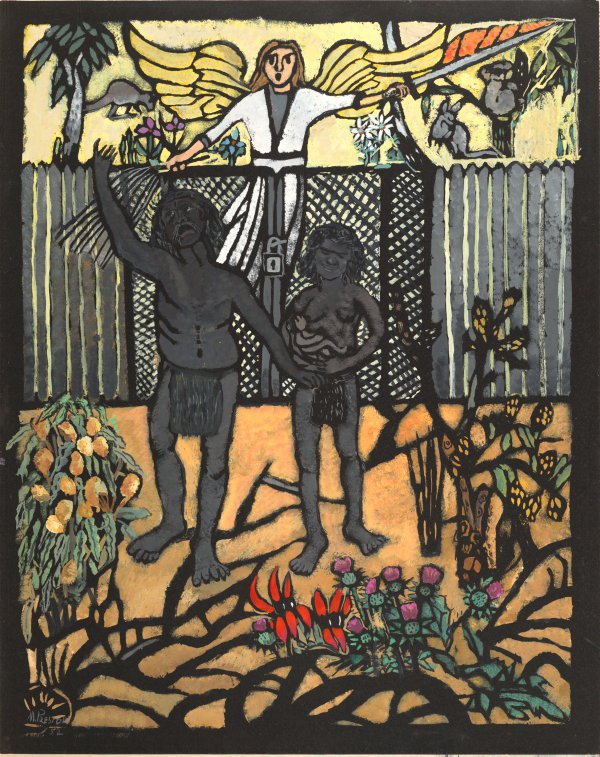
Margaret Preston, The Expulsion, 1952. Colour stencil, gouache on thin black card with gouache hand colouring, 60.5 x 48.5 cm. Art Gallery of New South Wales, Sydney, Australia.
The Bible and Visual Culture unit is dedicated to the critical study of how biblical texts, themes, and figures are interpreted, adapted, and reimagined through visual media—from ancient mosaics and manuscript illuminations to contemporary film, television, video games, advertising, and public art. These visual interpretations have shaped, and continue to shape, the ways biblical texts are received, interpreted, and contested within the wider cultural imagination.
The unit is intentionally interdisciplinary, drawing on art history, film and theatre studies, media studies, musicology, gender studies, trauma studies, postcolonial criticism, and more. Whether examining biblical motifs in cinema, exploring representation in public art, or analyzing the commodification of biblical imagery in advertising, it highlights the interpretive power of the visual and its capacity to illuminate aspects of biblical reception.
We warmly invite established scholars and PhD candidates to submit a proposal on any topic related to the visual reception, interpretation, or representation of biblical texts—historical or contemporary, theoretical or methodological. Presentations will be thirty minutes, including discussion.
Given our location in Adelaide, we particularly welcome papers that engage with Australian art featured in Australian galleries, museums, and public spaces. How have Australian artists interpreted biblical narratives? What role does biblical imagery play in Australia’s visual culture, from colonial-era works to contemporary Indigenous perspectives? This meeting offers a unique opportunity to explore these questions in context.
Paper proposals should be submitted here and should include your name, institutional affiliation, paper title, and an abstract of approximately 250 words. Proposals may be submitted at any time before 15 January 2026. All presenters must register for the SBL International Meeting. Further details about the Adelaide meeting are available on the SBL website.
Amanda Dillon and Jason Goroncy Coordinators, Bible and Visual Culture Unit
Gods are like clouds, rain, rainbows; you can see &feel but can’t touch God chatting in the forest, among the trees, God is justice, not books Light shines, out in the darkness The subconscious energy guides your body The void within you drives you to express. You have given life to me, you have given joy to me You gave what was behind me You will give what’s ahead of me Her ways are many, her ways are mysterious Her interpretations are many, her meaning is one She’s an editor, changes my manuscript Holding your voice deep within Filling with feelings of pleasure to treasure There’s a certain slant of light, there’s a certain slant of sight Thanks to the morn, thanks to the noon Thanks to the flower, thanks to the valley This blessed life, this blessed grace To act, to find, to feel, to live Poems are written by bores like me But only God’s grace showers freely
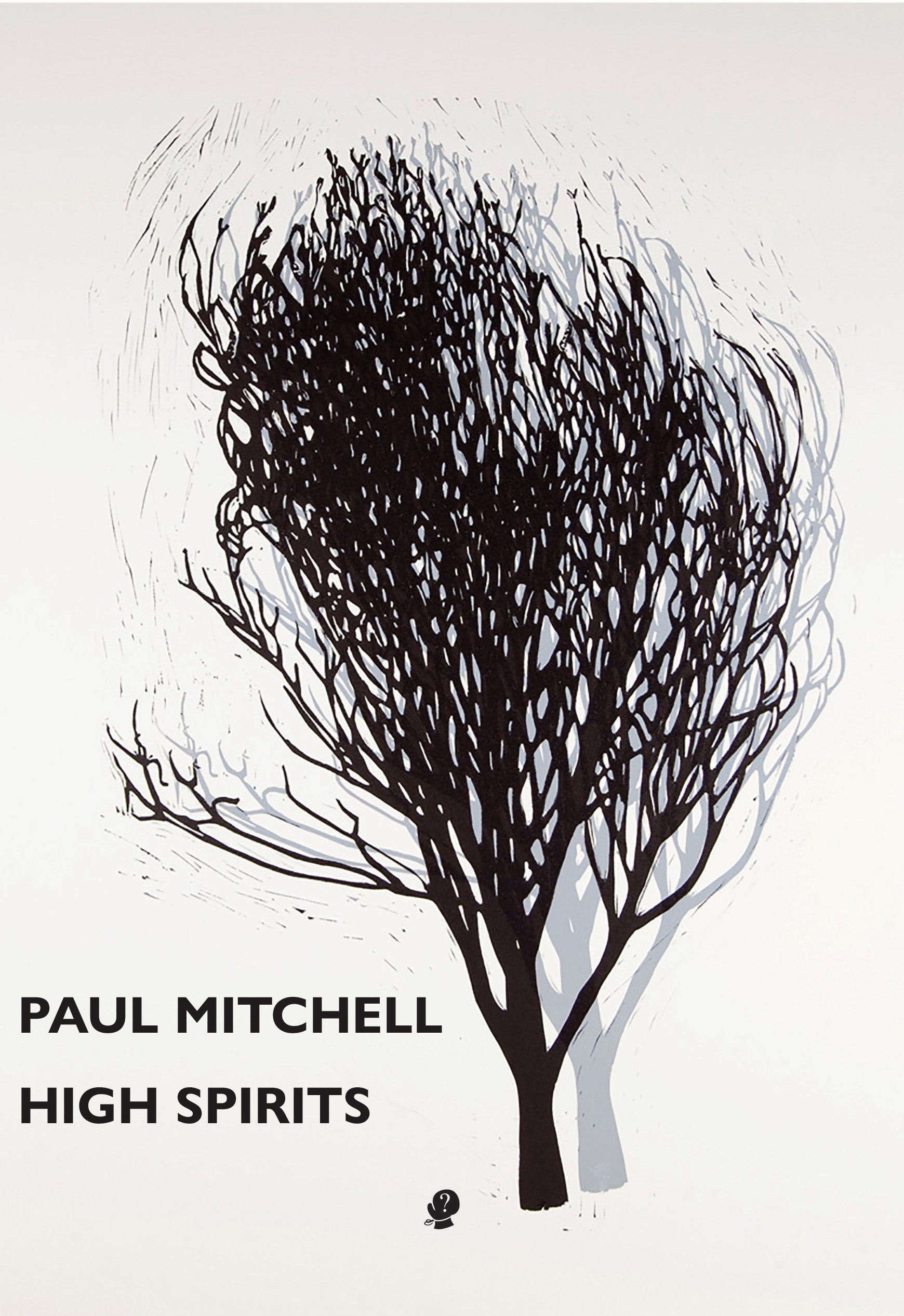
Paul Mitchell, High Spirits. Puncher & Wattmann, 2024.
In an era when poetry often retreats into obscurity or dissolves into mere confession, Paul Mitchell‘s High Spirits offers something refreshingly different. Reviewed by Jason Goroncy in TEXT Journal, this collection demonstrates how poetry can be both deeply personal and universally resonant, spiritually grounded yet artistically sophisticated.
Mitchell’s work achieves a delicate balance where the spiritual illuminates the mundane without overwhelming it, where the sacred emerges from careful attention to the world as it is. His poems capture the texture of daily life – family dynamics, the rituals of domestic existence, even conversations about Bunnings that blend seamlessly with apocalyptic imagery – while extending beyond the personal to encompass broader cultural and environmental concerns.
One thing that distinguishes this collection is Mitchell’s conversational tone that feels like overheard conversations with a particularly thoughtful friend – accessible without being casual, profound without being pretentious. Whether satirising Australian suburban masculinity in ‘Weekend Warriors of the Apocalypse’ or writing an epistolary meditation to Franz Kafka, Mitchell demonstrates remarkable range and wit.
The collection’s fundamental conviction is that the world is enough – not through complacency, but through hard-won wisdom. Mitchell’s terrific humour never cheapens the gravity of human experience but illuminates it from unexpected angles, finding epiphanies of grace amid chaos.
In a cultural moment characterized by cynicism and fragmentation, High Spirits suggests that careful attention to the ordinary might reveal it to be, if not perfect, then sufficient – and perhaps, in its sufficiency, sacred.
Danny Barbare’s award-winning poetry has been published widely, most recently in the Birmingham Arts Journal, Pennsylvania Literary Journal, Blue Unicorn, California Quarterly, and many other online and print publications. He lives with his wife and his sweet dog Oliver, a Boston Terrier, in Simpsonville, South Carolina.
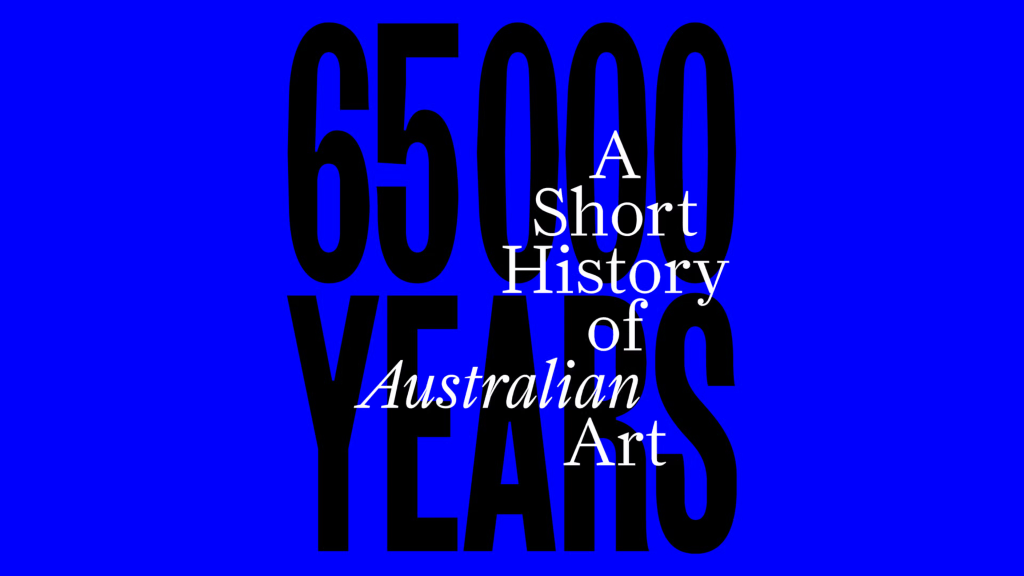
What comes to mind when you think of Australian art? Maybe Arthur Boyd or the Heidelberg School. Perhaps Albert Namatjira?
Just as Indigenous history has been hidden, misrepresented or denied, so has the art movement within this talented community. Indigenous art has been overlooked or suffered appropriation as dot paintings have appeared on everything from sun hats to stubby holders.
To see authentic and incredible works by indigenous artists over centuries, enjoy the free exhibition at the Potter Museum of Art at the University of Melbourne.
With more than 400 artworks and cultural objects, the exhibition was curated by Professor Marcia Langton AO, Judith Ryan AM, and Shanysa McConville.
When I attended on a gloomy Melbourne winter day, Professor Langton was just conducting a tour for a group of young Indigenous artists. Apart from her intimate knowledge of the exhibition, she detailed the history of the Indigenous art ‘movement’. From bark paintings to sketches on paper to multimedia, and from traditional to contemporary artistic styles, all were represented. Along the way, the ‘incarceration’ art confronts, as do many of the more recent pieces addressing the continued white colonialisation. What a joy to hear indigenous languages being spoken by these visitors as we contemplated the pain and continuing lack of recognition of First Nations people.
The multimedia presentations showcased the talent of mostly young artists, exploring traditional practices, the intersectionality with transgender issues, and the cruel irony of young indigenous students on a mission singing a version of ‘This Land is Your Land, This Land is My Land’, back in the 1950s or 60s.
Most confronting is the third floor, where the dark history of the Eugenics movement is displayed, including the part played by the University of Melbourne’s School of Medicine. Young medical students from country areas were encouraged to search for Indigenous skeletons to add to the collection. These remains cannot be accurately returned to Country because their original locations were not recorded.
Beautiful, confronting, and educational, this exhibition is not to be missed.
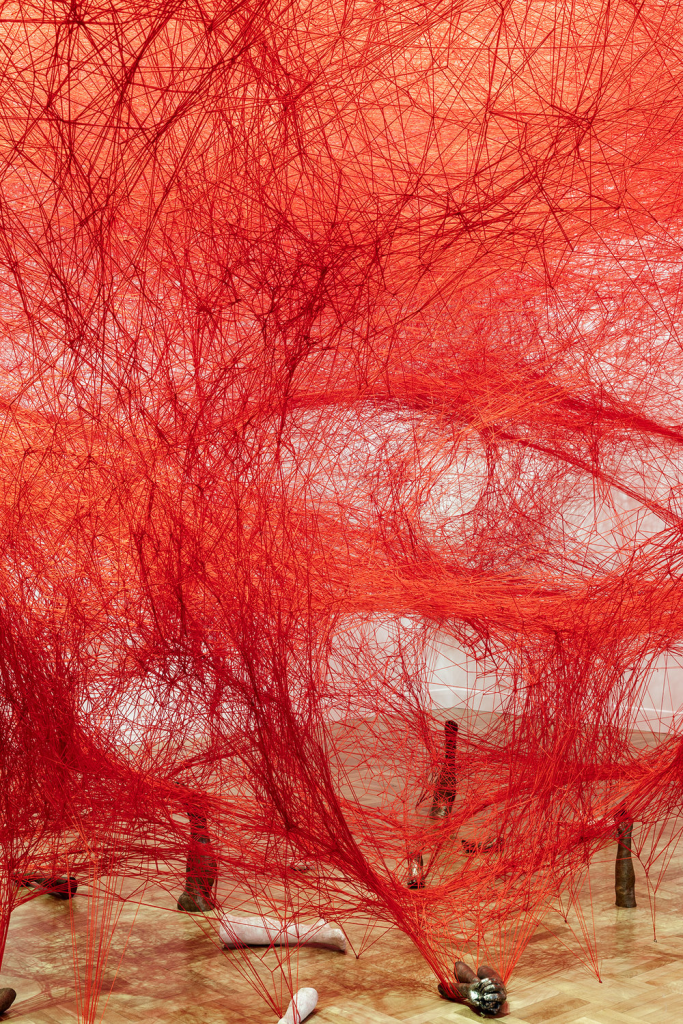
Chiharu Shiota, Absence Embodied, 2018. Bronze, plaster, and red wool. Art Gallery of South Australia, Tarntanya– Adelaide, Kaurna Country.
in wind & flame they felt acknowledgement
fill that room stronger
than any wind felt before these gales of rushing promise
Spirit sent flames astounding
light dazzling all who were there not speechless but into
all speech forever one tongue
of many flaming voices moving all, filling all, powering all
with surge of bright burning
receiving His love of dove descended blaze.
℘℘℘℘
Ed Higgins is an American poet and short fiction writer whose work has appeared in various print and online journals. Ed is Asst. Fiction Editor for Brilliant Flash Fiction. He has a small organic farm in the United States of America, where he raises a menagerie of animals, including a rooster named StarTrek.
We had been at Bethany again; crowds following us everywhere we went, stirred up into frenzies of hysteria for the healer, the exorciser, the teacher I had come to know and love as friend, to trust as embodiment of Holy One Themself.
The leaders were threatening to kill Lazarus now, too. Their fear sending an electrical charge through the crowd that amped up the hysteria.
The plots to kill Jesus: of course, we were aware of them. Jesus himself had spoken of his death; of being bread we would eat – if you can imagine! Of being lifted up. We hardly understood what all that could mean. If the stories tell us Moses did not ‘die’ but ascended to heaven, why would Jesus equate his lifting up with death? And then to also claim to be Son of Humanity, Son of God, Messiah?
I trusted him, but all that turned me inside out.
So I stopped thinking about it at all, and focused on here and now. That, I could understand.
And it made sense to me that when Jesus entered the city, it would be something of an event, an arrival. Crowds were following him already, of course, and there were also crowds gathering in the city for the festival; the atmosphere built to crazy, almost euphoric, excitement. When people heard Jesus was heading into the city, some started pulling down branches from palm trees and waving them, forming a kind of guard of honour around him and us. Someone started a chant – Hosannah! Hosannah! Hosannah!
Blessed is the one who comes in the name of Holy One! They cried.
Blessed is the king of Israel!
Oh, yes! This was more like it. James, John, Judas, all of us were pumped at this claiming of Jesus as king! Hosannah! We joined in the cries, took the branches people offered us, sang the prophet’s affirmation loud! Blessed is the One who comes in the name of Holy One! Blessed is our king!
This was the messiah the prophets foretold. This was the change the stories anticipated – ride into town and kick out the oppressors! A new reign, at last!
Ooh, let’s get a horse for you to ride on, I turned round to Jesus. A HORSE! I had to shout right into his ear. A king should enter in style.
But Jesus caught sight of a young donkey, and went and sat on that.
I’ll ride this, he said.
You’ll ride that? John told him he thought he would squash the poor thing. James thought he would squash his own dignity.
Jesus met our discouragement with his own quote from the prophets:
Do not be afraid, daughter of Zion,
Look, your king is coming,
riding on a donkey’s colt.
And he turned the beast onto the road, and continued on the way into town, the crowds cheering with delight, amusement, but hardly any understanding.
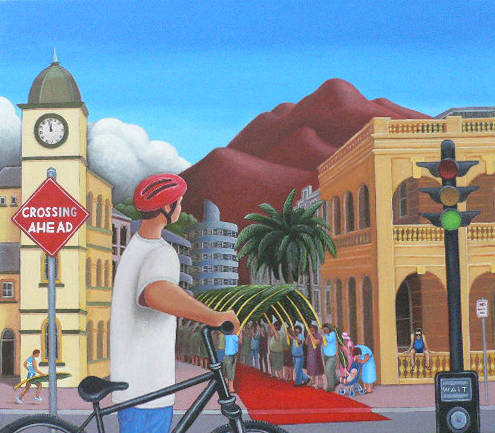
Jan Hynes, Entering the City, 2008.
And I thought, Oh-kaay … he’s still saying ‘king’ … but the bottom had fallen out. I felt hollow all of a sudden. The shouts of the crowd became a dull hum. The world started to blur. I stood still. Frozen in incomprehension.
This is not triumph.
Days later – days that felt like years – I stood before an empty tomb. And then, then, I remembered.
I remembered: ‘I am the resurrection and the life. Those who believe in me, even though they die, will live’.
I remembered Lazarus walking out of his tomb.
I remembered: ‘When you have lifted up the Son of Humanity, then you will realise that I Am; that I do nothing on my own; the One who sent me is with me, has not left me alone’.
I remembered my own I will lay down my life for you. I remembered three times I do not know him. I would always remember that cock crow.
I remembered I am your Way to Holy One. I am truth. I am life.
I remembered I am not alone. Holy One is with me, and I am with Holy One.
I remembered we will not leave you alone.
I am coming to you.
I will love you.
We will make our home in you.
I remembered abide in me.
I remembered you see me now, but for a while you will not. I remembered, and then, you will see me again.
It was after the procession and all that followed that I again remembered my own words, remembered my trust in him: ‘Lord, to whom can we go? You have the words of eternal life.’ I remembered, ‘We have come to believe and know that you are Holy One of God’.
You are Holy One.
But while the crowds chanted Hosannah!, proclaimed Jesus to be the king I wanted him to be, I stood still, my body knowing what my mind did not yet understand:
That he will leave us
That he will come again
And until then, I woke as from a dream, and ran to catch up with the tail of his parade.
℘℘℘℘
Sarah Agnew is a storyteller, poet, and minister with the Uniting Church in Australia, in placement with Christ Church Uniting, Wayville, on Kaurna Land in Adelaide. Sarah’s poetry, liturgy, and other writing, including the Lenten Study with Psalms, Through the Valley, can be found at sarahagnew.com.au.
 Art/s and Theology Australia