Articles

Jesus Dreaming: A Theological Reaction to Michael Galovic’s Creation of Lights in the Heavens

Creation of the Lights in Heavens - Galovic.jpg
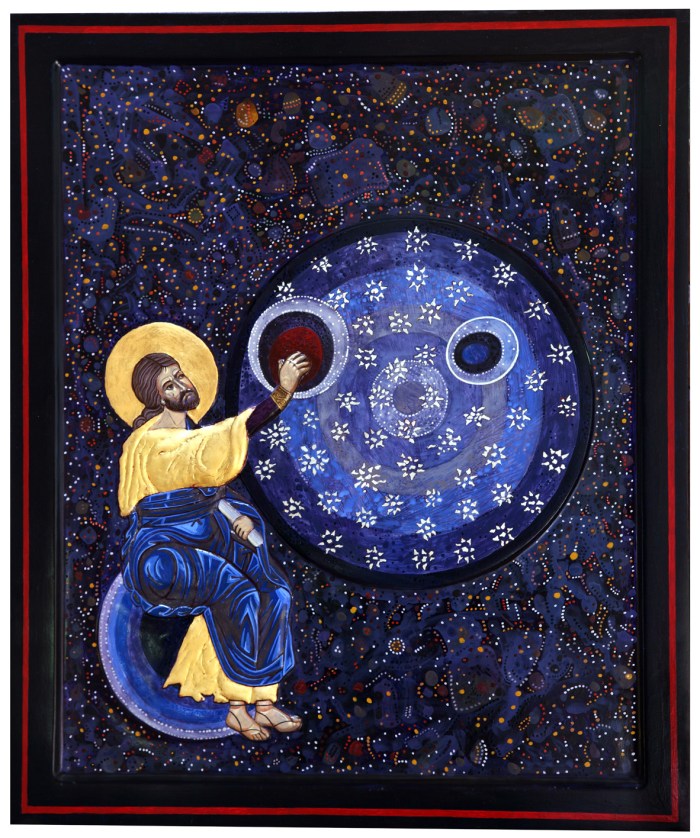
Michael Galovic, ‘Creation of Lights in the Heavens’ (nd)

The religious historian Mircea Eliade wrote of the ‘eternal return’; the religious belief that liturgy and prayer can put the believer in touch with the ‘mythical age’, the time when the foundational events of their faith occurred. In the words of institution in the eucharist, we do not merely remember what Jesus said and did, we make his saving death and resurrection present to us now. We live in the mundane world where ordinary time passes, but there is another time – the ‘Great Time’ or Eternity that existed before the world began, that will exist after it ends and, moreover, that surrounds us now.

For Christians, our access to eternity is the person of Jesus Christ. He is our connection with God the Father. It is through Jesus that the Holy Spirit is sent to us. Our recurring prayer is ‘the Lord be with you’. Moreover, through Jesus we access all of Salvation History. Since he is the second person of the Trinity, he is present wherever the Holy Trinity is acting.

The first theologian to write of this was the Apologist, Justin Martyr, who died in 165CE. St Justin wrote in his Dialogue with Trypho of what we now call ‘Christophanies’ – manifestations of Christ in the Old Testament. He wrote:

Permit me, further, to show you from the book [sic] of Exodus how this same One, who is both Angel, and God, and Lord, and man, and who appeared in human form to Abraham and Isaac, appeared in a flame of fire from the bush, and conversed with Moses.

‘Angel’, which means ‘messenger’, is no longer a term we use with reference to the Lord Jesus, but Justin, with his understanding of Jesus as the visible manifestation of the godhead and the Word of the Father, reads the Exodus stories of messengers and voices as referring to Jesus.

Hence, when the Hebrew Scriptures refer to God creating through his word – ‘He spoke and they were made’ (Ps 33:9) – Christian commentators on the scriptures saw this as the Logos-Christos, the second person of the Trinity, in action. For the fourth day of creation, the Genesis text reads:

Then God said, ‘Let there be lights in the expanse of the heavens to separate the day from the night, and let them be for signs and for seasons and for days and years; and let them be for lights in the expanse of the heavens to give light on the earth’; and it was so. God made the two great lights, the greater light to govern the day, and the lesser light to govern the night; He made the stars also. God placed them in the expanse of the heavens to give light on the earth. (Gen 1:14–17)

For the strictly monotheistic Hebrews, it is the one God who set the lights of heaven. But the Church Fathers, reading the sacred text through the lenses of their Trinitarian faith, see the Word of God at work.

Christian artists charged with depicting eternity, creation, and heavenly things wanted to make it abundantly clear that their subject matter was in no way mundane, or earthly. The artistic convention that the icon tradition developed was to set their figures against a golden background. Unlike the earthly realm, the holy figures appeared amidst an even gleaming light.

Mosaicists achieved the effect by making glass tesserae with gold foil on one side. It was an expensive and complicated process, and it is amazing to see the huge extent to which it was employed in some of the great cathedrals of the world.

One such cathedral is that at Monreale, Cefalù, Sicily, Italy. It is one of the great masterpieces of the twelfth century. The ceiling, walls, and apse are ablaze with Byzantine icon-style images set in a field of gold. Still photographs do not do justice to the way the background changes as you move and as the light source alters.

Monreale_creation_earth.jpg
Monreale Cathedral, ‘Creation of Moon, Sun, etc.’. (12th Century) Source: Wikipedia Commons

Monreale is the obvious influence on Michael Galovic. Icons influenced the mosaic of creation in the Cathedral, and now Galovic’s icon is a homage to that masterpiece. Given that he is working in a different medium, Galovic is remarkably faithful to his model. The circle of the heavens, the concentric shades of blue, even the placement of the stars is exact; though note that Galovic has omitted one particular star above the arm of the Christ. This could be a gesture of humility on the part of the artist – the disciple is less than the master – as well as an aesthetic choice to focus the interaction between the face of Christ and the light of the Sun.

The precision of the imitation adds impact to Galovic’s innovation. He, an expert at icon gilding, has taken away the gold of eternity and replaced it with something thoroughly Australian.

A common subject in Australian Aboriginal art is the Dreamtime, the time [sic] of the origins. A lizard may be depicted as the totemic ancestor figure who shaped the landscape. Dots, curves, and circles represent the Dreamtime before [sic] the mundane world came to be.

In Galovic’s icon, it is as if the Australian Dreamtime has replaced the Byzantine gold of eternity. His backdrop is more confused and chaotic than the gleaming tesserae of Monreale. There are dots, curves, the beginning of patterns, jumbled in an inchoate mass.

Galovic has not merely juxtaposed two artistic conventions, he has chosen a subject familiar to them both and he gives an authentically-Australian reading and re-writing of the Monreale mosaic. The ellipse that represents the moon in the mosaic is subtly dotted, alerting the viewer to how much this shape belongs to the ancient Australian artistic tradition as much as it does to the Byzantine culture.

Literally standing out from the background and distinct from creation is the figure of the Logos-Christos, seated on the cosmos (again outlined in subtle dots). Galovic has carved this figure in light relief from the same piece of wood which is the base of this icon. The halo is the only remaining gold and it is as if the newly-created sun is shining on the folds of the fabric of the over-garment. It is Jesus at work in creation, placing the sun in the circle of the heavens, and drawing us into the ‘eternal return’.

℘℘℘℘

Merv Duffy is Acting Principal at Good Shepherd College in Auckland.

Rosemary Valadon: A Sensual World

This documentary, which recently aired on the ABC’s Arts Channel, looks at the life, influences, and work of multi-award winning painter Rosemary Valadon. The artist explores a space for feminine self-actualisation as well as a distinctive spirituality. Valadon won the Blake Prize of Religious Art in 1991 with a work that drew criticism for its lush sensual nature. While offering a survey of her art practice, this beautifully-crafted film is framed by the seasonal changes evidenced in the place where she lives and works, the remote rural community of Hill End. This frames the influences on her life as she recounts the stories of her upbringing, her experiences as a mother, dealing with a diagnosis of breast cancer, and the joys of renewed success and interest in her work. It’s a delightful survey that evidences a rich and lived sense of spirituality.


 ℘℘℘℘

Rod Pattenden is an artist, art historian, and theologian interested in the power of images. He lives and works on Awabakal and Worimi land.

Divine rhythms

ABC’s Compass program recently aired a fascinating show about three artists – Nicholas Ng (musician), Maria Mitar (musician), and Yorgo Kaporis (dancer and choreographer) – preparing their work for performance at The Sydney Sacred Music Festival.

Prayers of a Secular World: A Review

Prayers_FC_HR1Prayers of a Secular World. Edited by Jordie Albiston and Kevin Brophy; introduction by David Tacey. Carlton South: Inkerman & Blunt, 2015. 160pp, ISBN: 978-0-9875401-9-5

Way back in 2015, so three Prime Ministers ago, Inkerman and Blunt published a new anthology of work, a beautiful little book by an impressive range of some 80 mostly-Antipodean poets, some very well known, others hardly at all. The collection, Prayers of a Secular World, was edited by Melbourne poets Jordie Albiston and Kevin Brophy, and is introduced, fittingly so, with a brief essay by David Tacey on the religious nature of secularism. The latter helps to orient the reader to some of the terrain they are about to enter.

In their call for submissions, the editors said that they were ‘looking for poems of wonder and celebration, poems that mark the cycle of the day – dawn, midday, evening, night – the seasons, the progression of planets, the evolution of weather; poems of becoming – first steps, first words, transitions, epiphanies and inspirations; poems of belief and of doubt, pleas for protection, poems of remembrance and blessing, of forgiveness and redemption, poems of gratitude’. Short of the sternest editorial policing, such an invitation almost guarantees, more than most edited collections I think, the kind of hotchpotch smorgasbord of aptitude evident in the volume’s final form. Still.

The book’s title – which echoes Donna Ward’s claim, in Australian Love Poems, that ‘poems are prayers of the secular world’ – appears, at first glance, to promote the somewhat late-Victorian idea that poets are the new priests. But the pages therein are marked by a welcome avoidance of such presumption, their words occupied with patterns of time and of place, of dying and of encountering the world anew, and with the sounds of landscapes mostly suburban, where the majority of its readers, no doubt, dwell and pass through. In a review published in The Australian, Geoff Page noted of the title: ‘They are certainly not be [sic] “prayers” in the intercessory sense but they are contemplative and very likely to widen and diversify the metaphysical sensibilities of all but the most hardened of fundamentalists – who, no doubt, already have their own (more limited) rewards in view’. This is a point worth repeating, especially perhaps for those uncomfortable, in Tacey’s words, with the notion that ‘the transcendent doesn’t happen elsewhere, apart from the world, but is a dimension of the world’. Still, the publisher’s description of the book as ‘a meditation on living in a post-religious world’ strikes me as very odd – odd not only as a sketch of the book’s content, but also odd in terms of its assessment of things. Observers of the cultural landscape of our day might well inquire what world exactly is being spoken of here.

There is, for many, the perennial temptation to will oneself into a kind of authenticity. Such efforts are an expression of a romanticism that either refuses or forgets to weave into the solidest realities a knowledge of its loss. The result is, as the poet Christian Wiman has observed, a ‘soft nostalgia’. There are here, happily, a good number of notable exceptions to what might otherwise be merely another unwelcome example of such, of groping disorientated by a handful of tamed Emersonian ghosts trying to iron out the highs and lows of life apparently naïve to the view that our being of dust does not equate to an uncritical defence of some pathetic form of natural theology. In this volume, poems by Chris Wallace-Crabbe, Andrew Lansdown, Fiona Wright, Robyn Rowland, Debi Hamilton, Ron Pretty, Anne Elvey, Michelle Cahill, and David Brooks, for example, serve this end particularly well. So do, I think, these two contributions:

‘Da Barri Barri Bullet Train’, by The Diwurruwurru Poetry Club with Mista Phillip

we bin get up with mista an habim gooda one feed
we bin jumpin da mudika
an millad bin go lunga bush
mimi an kukudi bin come too
an dey bin singim kujika
dey bin learnim us mob
for sing im kujika
we likim learn for sing us mob kujika
wen us mob bin lyin down in da darkes
darkest night I bin look da barri barri
e bin movin really really like da bullet train
I bin hold ma mimi really tight
da fire us mob bin make next ta millad mob
poking tongue like a big one king brown
an millad mob listen noise one side na water
must e bin da buffalo drinkin water
den us bin listen da croc bin snap da buffalo
da gnabia out there too
an he bin make us mob so frightn
but ma mimi bin sing out
hey you mob stop all da noise
ma mimi bin start to sing
da song na us mob country
sing in da old language
dem old people did sing
an make millad mob so shiny an strong
an I bin lyin da listen na mimi
I bin feel really really safe
den I musta bin go sleep

And

‘Eucalyptus Regnans’, by Meredi Ortega

for Brandi

that was some fiery trajectory you took, moving to Kinglake
to be among giants and clouds
I recall you dying once before
…….. .. run down at the crossing, going home for lunch

but you’re on Yea oval, among the nightied and discalceate
and you’re okay
road posts gone
all delineators and signs, the way forward and way back
…….. ..only black stags, ash deafening

one charred fence post
and your old weatherboard like a kind of gloating, it falls to you
…….. ..to be the lucky one
better to believe in regnans than luck, they have what it takes
martyrdom, lofty sentiments
…….. ..all crown and nimbus and resurrection

up on the mountain, no one knows if lyrebirds
are mimicking silence
…….. ..volunteers go into the wasteland, leave songs out
musk and fern and siltstone tunes

it rains and then some
…….. ..and the green is giddying
stags wash white, their millioned saplings serry
…….. ..knit roots, squeeze out the other then each other
ashes move up the escarpment and up
to the yellow-raddled cockatoo, yellow-eyed currawong, to the sun
and you are in the very dawn of things

℘℘℘℘

Jason Goroncy is a theologian, artist, and try-hard poet who lives and plays on Wurundjeri land.

‘The Architect’

The Architect.jpg

The Melbourne Theatre Company recently staged ‘The Architect’, a play written by the Australian writer, director, and dramaturg Aidan Fennessy, and directed by Peter Houghton.

It is a particularly-confronting presentation of the issues surrounding the impending death of a terminally-ill woman, Helen (Linda Cropper), who desires to ‘architect’ her own death – with dignity and under her control.

While presented as a serious and confronting issue, Fennessy has introduced a ‘perfect foil’ in the character of Helen’s husband John (Nicholas Bell), and Helen’s carer Lennie (Johnny Carr), a rugged straight-shooting Aussie who introduces both typical humour and real concern.

Family matters and secrets long carried by Helen and John, and by their son Jeremy (Stephen Phillips), as well as by Lennie, the external third party, are brought out into the open. Death can do that. Theatre can help bring it home.

The play is a convergence of two matters in no way uncommon to the experience of those facing death – great humour and deep questioning. This convergence invites the audience to reflect on their own judgements about what constitutes a good death, and what they might themselves wish for in such a circumstance. The closing scene is particularly gripping and challenging.

Outstanding performances by all four characters, and particularly by Linda Cropper, brought a standing ovation from an audience of mostly older people.

From the middle of next year, eligible Victorians will be able to end their own life under the provisions made possible through the Parliament’s Voluntary Assisted Dying Bill (2017). ‘The Architect’, therefore, is a well-timed production, and a welcome reminder of the ways that the arts can and do stir, inform, and shape the public imagination. It sits also within a growing body of Australian theatre attending to death matters. One upcoming example of such is Triage’s Death Trilogy, the first part of which, ‘The Infirmary’, the creation of Katerina Kokkinos-Kennedy and Clair Korobacz, opens within the next week at Arts House.

 ℘℘℘℘

Ken Tabart is a retired civil engineer who lives and plays on Wurundjeri land. (With Jason Goroncy, a theologian and artist who also lives and plays on Wurundjeri land.)

Shopping for a Self: Imagining Spirit in Liquid Times

Mesiti Still

Having faith used to be all about belonging. This involved finding yourself through shaping your self-worth at work, through family and relationships, and your affiliation to the group, club, or church where you lodged your formal membership. Spiritual identity was about finding your place, and living out its promise while struggling with its limitations. The hero in this kind of world was one who learnt to make do. If you were a troublemaker it was only to make changes enough so that even the stranger could join in the inherent welfare of belonging. Having a place under the sun was the goal of both the good life and the good faith, of firm citizenship, and the blessings of belief.

Belonging, however, is no longer what it used to be. In his recent study of religion in Australia, Gary Bouma points to a radical shift that has occurred in the horizon of the great Australian search for meaning. Bouma states that ‘religion and spirituality in Australia is about hope, the production and maintenance of hope through actions, beliefs, practices and places’.[1] He sees hope as being the means of linking an individual to wider connections of meaning. Hope motivates, sustains, and generates the search for a quality of life; it has a moving dynamic quality that is not found in older models of belonging. Here, hearts are on the move looking for experiences and connections to enhance the quality of their felt experience.

Clearly, this does not make for good church membership, as people on the move do not serve well on the committees that monitor the by-laws of belonging; there simply isn’t time! Having worked for ten years as a University Chaplain I am familiar with the search for hope expressed on campus. It is the thirst motivating the lives of many of the young people that I have the privilege to work with. Sometimes debilitated by choice, they struggle to find the substance of a life that is worthwhile, nourishing and worthy of their efforts; in short, something worth living for. They negotiate the frenzy of options thrown up by a consumer society, only to be looking rather more intently for the more ecstatically-charged moments that hope should be worthy of. All searches, however, require discernment, and here we are in new territory because the answers of traditional religion don’t quite work in terms of new social realities.

We currently face a world of fluid connections, a sea of social networks, that are negotiated by hand-held devices and internet connections. This new world does not reward belonging, but it does, however, like to go shopping! In consumer worlds, we not only buy products, surrounded by the promise of experiences, power, and fulfilment, but ultimately, we are shopping for a self. This is a sense of identity that comes into being through our ability to create an image of our self to live by. David Lyon uses this term ‘shopping for a self’ to describe the manner in which people create a sense of self in a consumer society.[2] Here, the emphasis is not so much on authority found in institutions or texts, but as a consumer people are concerned with questions about what is good for me, and where does this path lead, and will it create hope within the complex world that I live.

This situation creates at best discerning individuals looking for what works and makes sense, for seekers rather than believers. People shift allegiance, change group, find what they are looking for rather than staying put with what they’ve got! Authenticity is a big value amongst people who become discerning about the nature of spirituality. This process tends to create a more holistic way of thinking and in turn a more critical consciousness about the process of shopping and the inherent limitations of living in a consumer society. Such discernment might lead people to do without, to change their lifestyle and live with less impact on the earth, because they see themselves implicated within the systems that seek ‘to serve’ them.

The downside of this situation is the possibility that people fall in love with the products themselves, forming a plastic and easily discarded shell of spirituality that is traded in on a daily basis for the latest fad or new experience. This endless cycle of consumption of images of the self is one that is explored by the sociologist Zygmunt Bauman. In a string of books, he has turned his attention to the global conditions of our consumer world. Reading his books is not at all cheerful, as he tends to write with a disturbing awareness of the possibilities he explores. Bauman rather gloomily calls this period one of ‘liquid times’, because he believes that the stable structures we depend on to negotiate boundaries and to provide clear forms are simply melting faster than they can be maintained.

Bauman confronts most potently when he proposes that: ‘In the society of consumers no one can become a subject without first turning into a commodity’.[3] This is the chilling possibility that not only are we shopping for a self, but we are also literally selling ourselves; otherwise we are invisible in a world of things that people desire. This would explain, it seems, our obsession with fashion, image, fame, and the necessary presence on the web and the attendant necessity to blog ourselves into life! We are continually under pressure to re-invent ourselves based on the always-shifting conditions of identity. Spirituality at its worst then, becomes about a trading in trinkets of belief, and the purchasing of power through image control. This is not just simply about appearances, but more fundamentally about how we see ourselves, who we are, and where our hope lies.

To consider the dilemmas of this situation one needs the skills of seeing, of being able to circumvent the blindness of being within a culture, because things seem so natural. Travel always wakes us up to this kind of culturally-induced blindness. Such blindness, unfortunately, is particularly prone to people who believe passionately and love fully. It is part of the danger of living with a sense of faith, that can at times inculcate blindness to particular moral and ethical implications of human freedom and the will to hope. It is not hard to find people of passionate belief and kindness who are (well in my mind) simply stupid and ignorant, and who unwittingly unleash violence in the community. Spirituality or faith is no guard itself against such blindness.

Good shopping, it seems, requires eyes to see. To demonstrate that, I want to turn to the winning work for the 2009 Blake Prize for Religious Art by Angelica Mesiti. In an historic turn, the Prize was won by a work based in new digital technology rather than the more traditional expectation of a painting or sculpture. The award was met with mixed responses ranging from perceptions of deep insight to that of cynical derision from sections of the media. But art awards are often like that! It is a race where the favourite never wins.

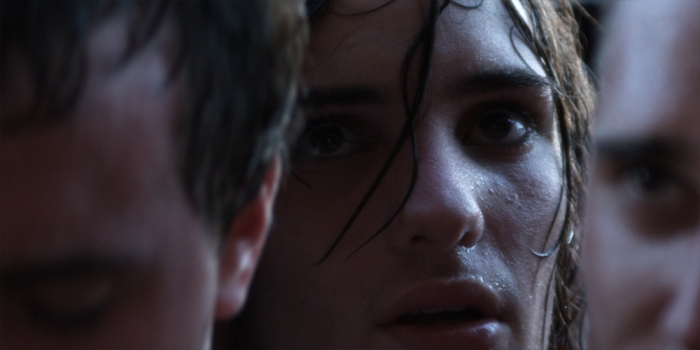
Mesiti filmed her 10-minute video work at ‘Big Day Out’, the annual music fest held in the heat of the January long weekend. It depicts in slow motion on high-density film the response of members of the crowd, up close and intimate, in a world of ecstatic passion and at times darker, nearly tribal behaviour. The work plays out moments of rapture, delight, and frenzy as well as a sense of anxiety, and even loss. It offers a mirror about what rapture looks like in the context of youth culture. These are young people rehearsing their hopes, passions, and dark anxieties. The work is powerful because of its proximity, its visceral and intimate nearness to such strong emotion. It is rapturous and unsettles viewers not used to such strong responses.

Rapture (excerpt) from Bonnie Elliott on Vimeo.

As water, sweat, and saliva splash across the surface of the screen, rainbowed with colour, we are left to contemplate our own youthful passions and what turns us on to life, or maybe more stubbornly what simply keeps us going. As an audience we are not party to the information about where the work began, we just meet this crowd of faces, slow motion in the contemplative environment of the art gallery. We are moved to answer the place where such feelings arise for us in our own lives. In this way I have found the work to be quite subversive; on walking into the exhibition I have been consistently struck by the audience to the work, who gather around with a consistent look of wonder. Wonder, after all, is a pre-condition for hope. Perhaps the recovery of wonder raises good questions about discerning the nature of hope in our time.

For the subjects of this work, the young people of today, I find there is much to be encouraged by. While some cling to formulations, there are many who are exploring the gamut of life with gusto, intelligence, and passion. They exhibit a sophisticated understanding of how images work, and the means to negotiate life in a consumer culture. They are anxious to define what life is worth living for, and find faith refreshing and without the baggage that I associate with people of my generation. These young people give me hope and help me see. This is because they are finding resources and wisdom to live a life of spiritual nourishment in these times of anxiety and change. It is always the role of the young to see visions, as it is the role of my generation to keep dreams alive.

[1] Gary Bouma, Australian Soul: Religion and Spirituality in the Twenty-First Century (Port Melbourne: Cambridge University Press, 2006), 30.

[2] See David Lyon, Jesus in Disneyland: Religion in Postmodern Times (Cambridge: Polity, 2000), 73ff.

[3] Zygmunt Bauman, Liquid Times: Living in an Age of Uncertainty (Cambridge: Polity, 2007), 1.

 ℘℘℘℘

Rod Pattenden is an artist, art historian, and theologian interested in the power of images. He lives and works on Awabakal land.