The editors of Sacrum et Decorum, a peer-reviewed international journal dedicated to the history and study of sacred art, invite submissions for a special focus on sacredChristian art in Australia and Aotearoa New Zealand. They welcome contributions that engage with the intersection of Christian (broadly interpreted) visual culture and the distinctive colonial, postcolonial, and multicultural contexts of the region.
Topics of interest include, but are not limited to:
Church architecture and interior decoration
First Nations and Māori visual traditions’ encounters with European missionary art
The reception and adaptation of European sacred art traditions in Australia and New Zealand
Religious street art
Individual artists, craftspeople, and workshops engaged in sacred art production
Stained glass, iconography, sculpture, metalwork, and devotional objects
Contemporary sacred art and evolving liturgical aesthetics
Sacrum et Decorum is published in both Polish and English and is indexed in DOAJ, ERIH PLUS, EBSCO, and other major academic databases. It is an open-access publication, and authors retain full copyright under a Creative Commons CC BY 4.0 licence.
The journal welcomes original, previously unpublished scholarly articles making a substantive contribution to the field. In addition to full research articles, shorter contributions – including reviews, source materials, and artists’ reflections on their own practice – are also invited. Submissions in English are particularly encouraged.
Full author guidelines, technical requirements, and submission information are available at the journal’s website.
Mandorla Art Award 2022. Theme: Metamorphosis (Isaiah 43.19)
In describing the winning artwork for this year’s Mandorla Art Award, the judges said:
The prophetic imagination invites us to lay aside old ways of being and sources of authority, and to imagine new futures.
Claire Beausein, Chalice, 2022. Wild silkworm cocoons stitched together with silk thread, and museum insect pins on cotton rag paper. 125 x 71 cm. Winner of the St John of God Health Care Acquisitive Prize, $25,000.
Claire Beausein, who divides her time between Broome and regional Victoria, formed her work by stitching together over 600 wild silkworm chrysalises gathered from the wild in Indonesia. Chalice is a powerful work that draws you in close to experience the glorious sheen on the work and the lace effect of the shadow and to stand away from it and see the possible image of a face that some have described as the face of Christ. Claire began her exploration with thoughts of a shroud which symbolises the metamorphosis of the human person into eternal life. From there, her thoughts developed into a search for wild cocoons. The colour range is from gold to very pale yellow, and they are carefully patterned. Claire described the process of putting the artwork together as a meditative act. Some of the silk thread used to assemble this work is intentionally visible on the surface but much of it is hidden as is so much of our spiritual development. Our various spiritual metamorphoses in life are often hidden from sight but seen in effect and in our witness to what has occurred within. The work is suspended by museum pins, reminiscent of the moths and butterflies displayed as collections, standing away from the cotton rag paper background. The curved shape of the lower edge speaks of the shape of a chalice which holds the wine to be transformed and the gold colour also speaks of sacred vessels. Claire speaks of the ‘gravitas of profound change with the fragility of lace’. These opposites are in tension as in our spiritual lives.
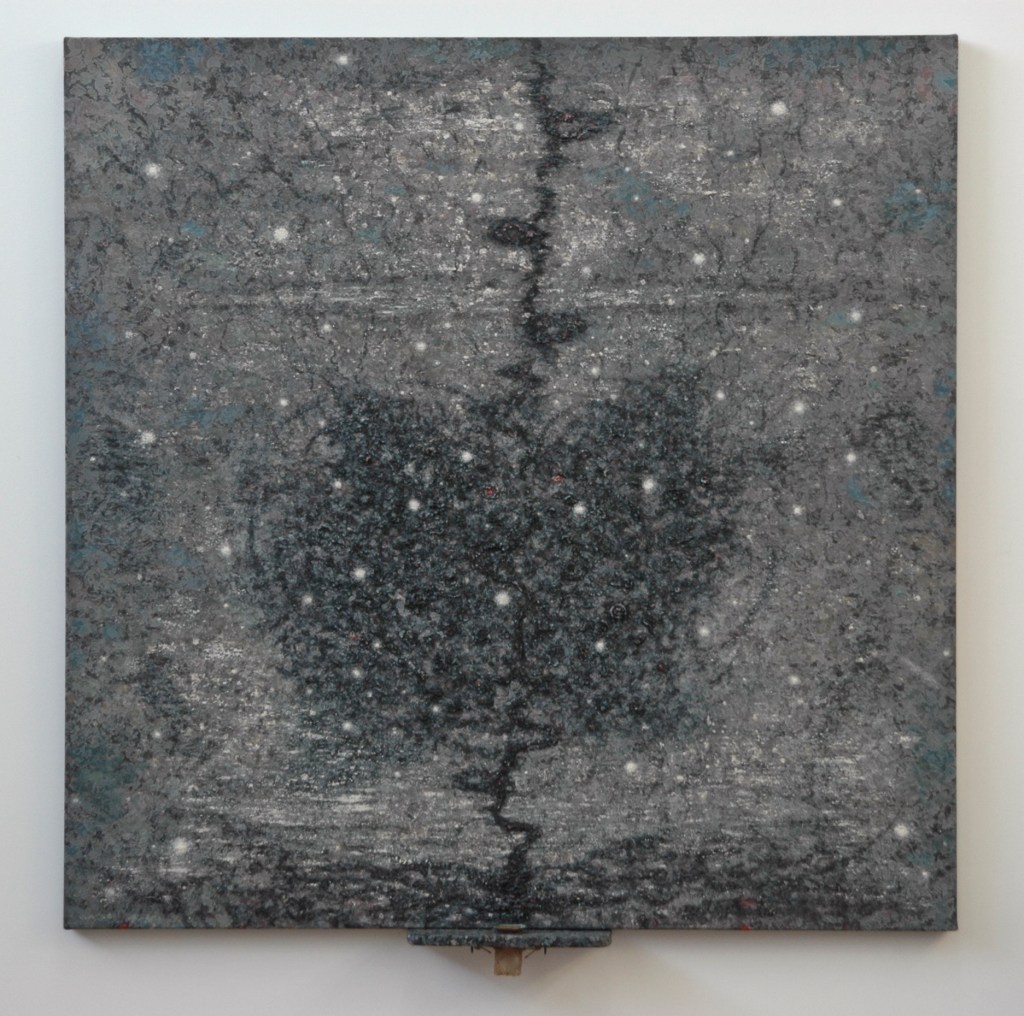
Michael Iwanoff, fromlittlethings, 2022. Acrylic, mineral sands, ask, grass tree resin, copper, water, linen, seeds, on wood and cotton duck. 144 x 137 cm. Winner of the Patricia Toohey Painting Prize, sponsored by MercyCare, $5,000.
Michael Iwanoff’s work, fromlittlethings, evokes the endless nature of change in all of creation, including within ourselves. He describes it as a ‘poetic meditation on the transformative seed each of us is able to sow into our awareness, experience and life’. The whole of creation is in the process of continual transformation, metamorphosis, as Paul says: ‘We know that the whole creation has been groaning in labour pains until now’ (Rom. 8.22). When the work of God is finished, when the whole of creation has been returned through the glory of Christ, we shall all be one in God. What is required is to wait in hope. In fromlittlethings the hope is symbolised by the seeds held in a small bag at the base of the painting, hanging from a mantle on which there is a small copper bowl from which water evaporates. There is so much in the work that is symbolic of all manner of change, some of which we are subjected to and some that naturally flows from our very nature. In the judges’ description, they spoke of the painting holding themes of ‘homecoming, journey, and acceptance’. There is a cosmological level too in the semblance of stars, and at different angles one catches a small glittery flash of light. In Michael’s description, he speaks of ‘this metamorphosis that is honoured and that so exquisitely grows the joy of being’.
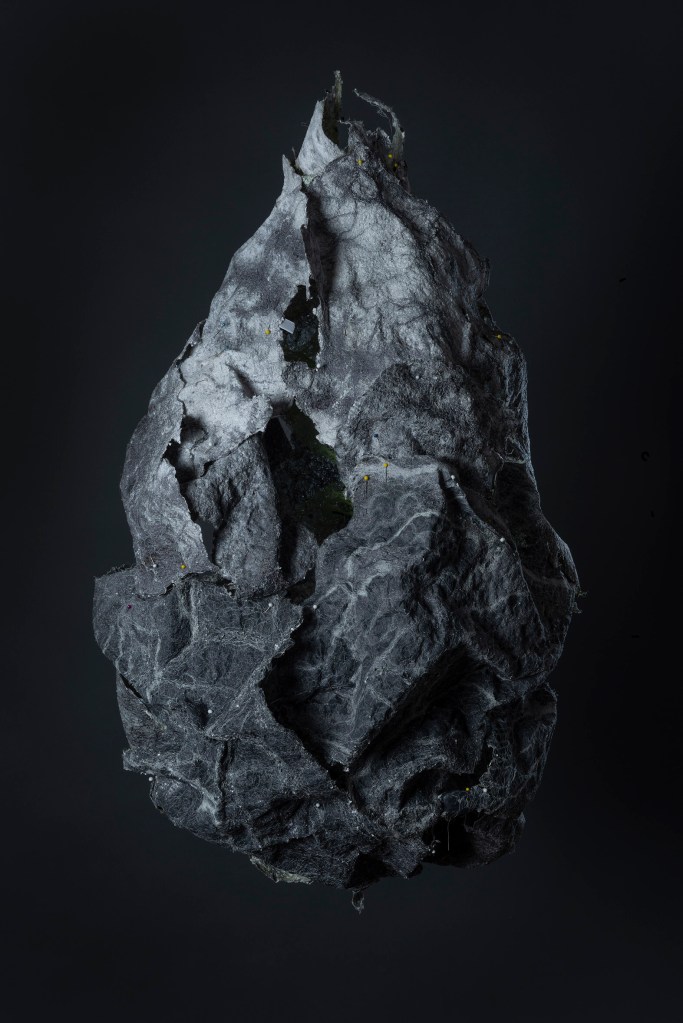
Susan Roux, Terre Verte, 2022. Photographic paper, Canson paper, PET thread, body thread, and aluminium, 120 x 60 x 50 cm. Photograph by Eva Fernandez. Winner of the Highly Commended Prize, sponsored by the Catholic Archdiocese of Perth, $5,000.
Terre Verte, a particular green pigment, is revealed in the central section of Susan Roux’s free-hanging work. She begins her description with: ‘Adrift in rivers that divide and bind lands, I chart a home anew’. Susan’s original material for this work was a series of maps which symbolise the journey upon which she has personally embarked, and the journey of life that we all travel. The maps were washed and dried and stitched on a sewing machine using a completely free form of working the material. It is an extremely laborious way of building a fabric but the effect is rich and unpredictable. For Susan, it is also a deeply meditative way of working. There are structural wires inside that speaks of our own physical structure, our skeletal strength that is unseen but completely necessary for our embodied life. As the judges said:
Viewed from a distance the piece is reminiscent of a rock, geode, or even a distant universe, evoking an almost geological sense of time-scale and transformation.
Inside, however, the terre verte, the green thread used in free stitching on a material that is then washed off the stitching leaving a lace effect, is burgeoning forth. Life and creation continue in the green, growing heart of her work. This is the sense of Spirit, of re-creation, that Susan seeks. The metamorphosis marks many places in our journey. The great metamorphic actions in scripture include Abram’s journey west, the exodus from Egypt, the exile in Babylon and the return, and, of course, the life, death, and resurrection of Jesus. For Christians, there are many changes along the way, but the greatest is our baptism where we are changed into a new creation in Christ.
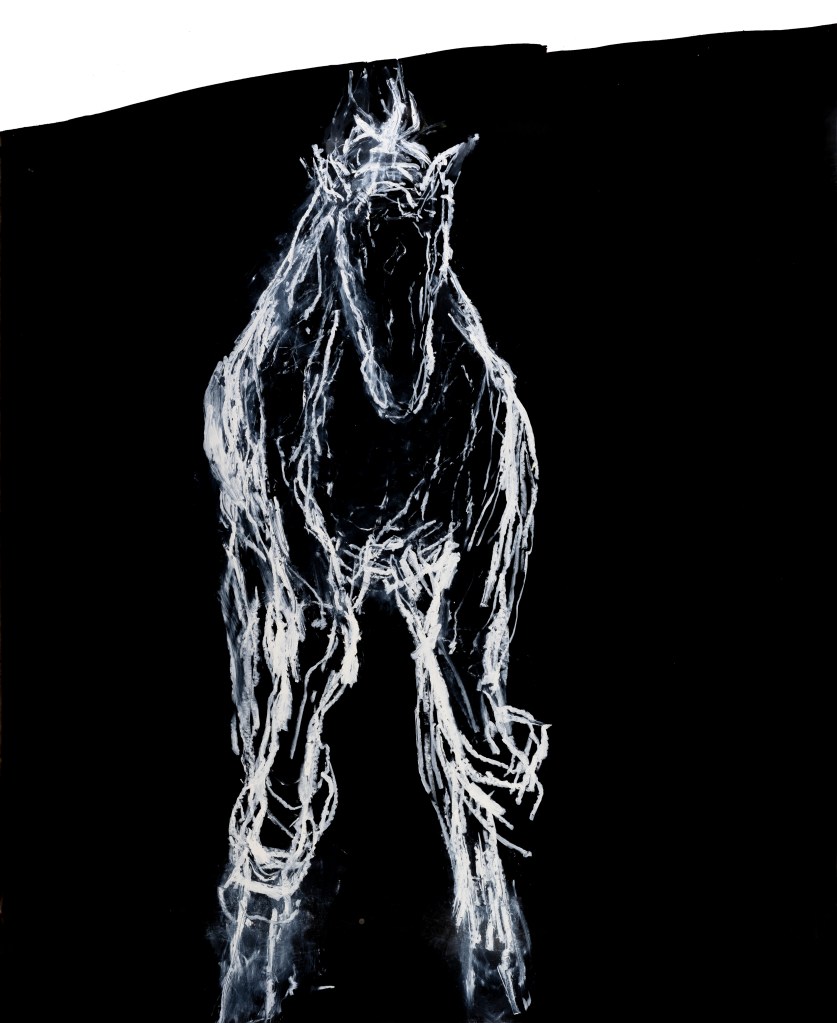
Angela Stewart, The Rider, 2022. Oil on Cibachrome archival photographic paper, 122 x 101 cm. Winner of the Highly Commended Prize, sponsored by the Anglican Diocese of Perth, $5,000.
Angela Stewart’s artwork confronts you from the full distance across the gallery in the opening exhibition. There is a sense of compulsion and a desire to know the story. Her artist’s statement centres around grief, death, silence, love, loss, helplessness. Two years ago Angela’s son, a horseman, died. This artwork depicts the growth from out of the loss, the metamorphosis that grief insists upon. She will never be the same, but the horse is the symbol of the strength needed to get out of the depths of loss. It is a powerful work. In the Hebrew scriptures, the images of horses are important. If you had a horse, you went into battle with a better chance of survival than if you were on foot. In Psalm 33.17, however, we hear that the ‘war horse is a vain hope for victory, and by its great might it cannot save’. If we rely only on the things around us, the things we wrap our humanity and strength in, then we will not be rescued from our distress. It is these times that trust in the Lord is required and a time for us to move through the grief, as Angela says, to ‘recalibrate, begin, breathe, the horse, the rider, my son’. The judges’ comments say this succinctly:
The insistence of the image to be expressed captures the unstoppability of the prophetic voice – of the Divine voice – arising in unexpected places, disturbing and comforting, undeniable. This technically accomplished work plays with the inversion of light and dark, and evokes movement and disquiet with multiple images, ragged edges, and lines pulsing with energy.
The array of artworks for the 2022 Mandorla Art Award each offer us a way in which to view the theme of Metamorphosis – a profound or radical change. ‘I am about to do a new thing; now it springs forth, do you not perceive it?’ (Isaiah 43.19). In times of discontinuity, faith becomes an important ingredient, and this has been evident in times of radical change. With the pandemic, we have all experienced the need for change, and war and climate change continue to impact us all. Yes, we need to change and the challenge is to make it positive on the large scale as well as the small. The artists chosen as finalists gave expressions of metamorphosis that are both challenging and beautiful.
℘℘℘℘
Dr Angela McCarthy is Chairperson of the Mandorla Art Award. She lives and works on Whadjuk country.
There is always pleasure in looking. Things catch our eye. They lure us in and awaken memory, and in turn arouse desire. Looking at art is not just an exercise of intellect and imagination but it also activates our sense of embodiment, our connection with other physical things. This is especially so with works of sculpture that intersect with social spaces marked by human habitation and meaning. Sculpture has a long social history in providing gestures of past grandeur, markers of civic pride and powerful emblems of future hope. In more recent times, sculpture has activated the realm of both architecture and landscape to shape and understand the human imagination as embedded in the natural environment. Such artistic gestures help us touch the world through our eyes and grasp a sense of belonging in the world we inhabit.
Braddon Snape’s work demonstrates a knowing confidence in dealing with the tradition of an artist working in three dimensions. In his case, it involves a somewhat gruelling physical and mental rigour in turning materials into things that resonate in our visual imagination. Since 2014, Snape has been working with a unique approach involving the welding of steel sheets together and inflating them into a variety of forms with compressed air. These works literally express the process of inspiration, with the breath of a pneumatic pump giving them a unique presence and personality. Imitating puffed-up pillows, paper bags, wine bladders, that are leaned, strung, and manipulated in ways that work against the expectations of minimalist sculpture to be true to form and materials, these works are poetic, inferential, and incite the peripheral imagination.
Working with these same materials, this new body of work provides an exciting if not visually exhilarating turn. The liquid and refractive surfaces of these new works serves to blur and destabilise their orientation towards the viewer. They seem to be literally unzipping the firm signs of their manufacture as steel sheets and appear to be spilling out into the surrounding space articulating both the light and the air. Not just mirrors, but a transformation of the movement of air and light particles into a liquid dance. This is like a moment of rapture, or even rupture, where things that have been held in, come spilling out in an ecstatic release. Breathing bodies understand such states as the rhythm of expiration and inspiration, the slow release of breath. It is the state also of wonder, where clear boundaries are transcended, not as an idea, but as a felt sense of delight!
Braddon Snape, Allusive Object (3 Chamber Strip), 2021. Welded and mirror-polished inflated stainless steel with accompanying acrylic rectangle wall painting, 38 x 110cm \ 150 x 30 x 27cm.
There is great pleasure, mixed with a measure of anxiety, in looking at these works. I want to measure, categorise, establish boundaries, define understanding, while all the time the work is moving in the other direction, spilling out in excess. And then I remember what it is like to hover in the in-between spaces of existence, like hovering on a threshold or on the brink of a discovery. It is the fluid space of negotiating the collapse of edges, and the rush and ecstatic joy of letting go and finding release. Here, I want to reach for the geographies of the spiritual to explain this moment of ecstatic potential; the empty space between the fingers of Michelangelo’s God and Adam on the Sistine Chapel ceiling, or the tension of edge and centre in the shining white stone of a Zen Garden, or the stark light and dark shadow on a walk around the water-worn edges of Uluru. In these works, boundaries are let loose, no longer seeking definition, but allowing for the excess of freedom and visual ecstasy.
Art has long carried this alchemical impulse to apprehend moments of transformation and change, like observing the moment when ice turns into water, and then setting out to turn lead into gold. The dance of particles that surround the liquid surfaces of these mirrored steel pieces allow for such imagining. Surface and depth merge, inside turns out, and the proper boundaries of definition and classification are left aside for the liquid transformations where art spills out into life.
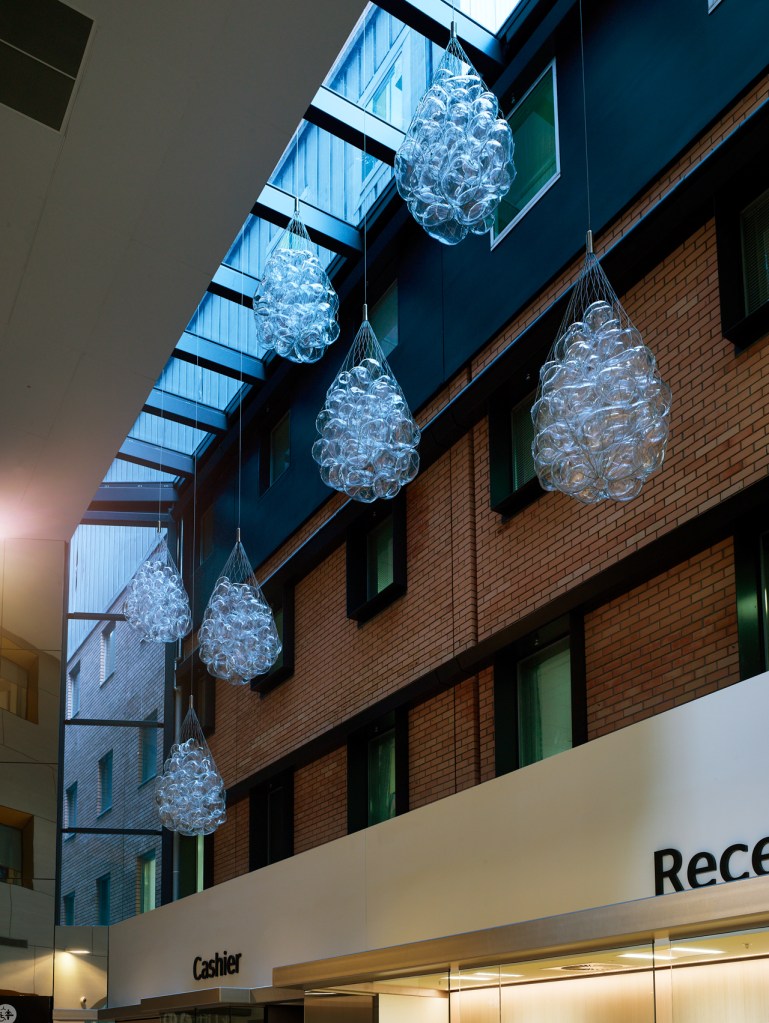
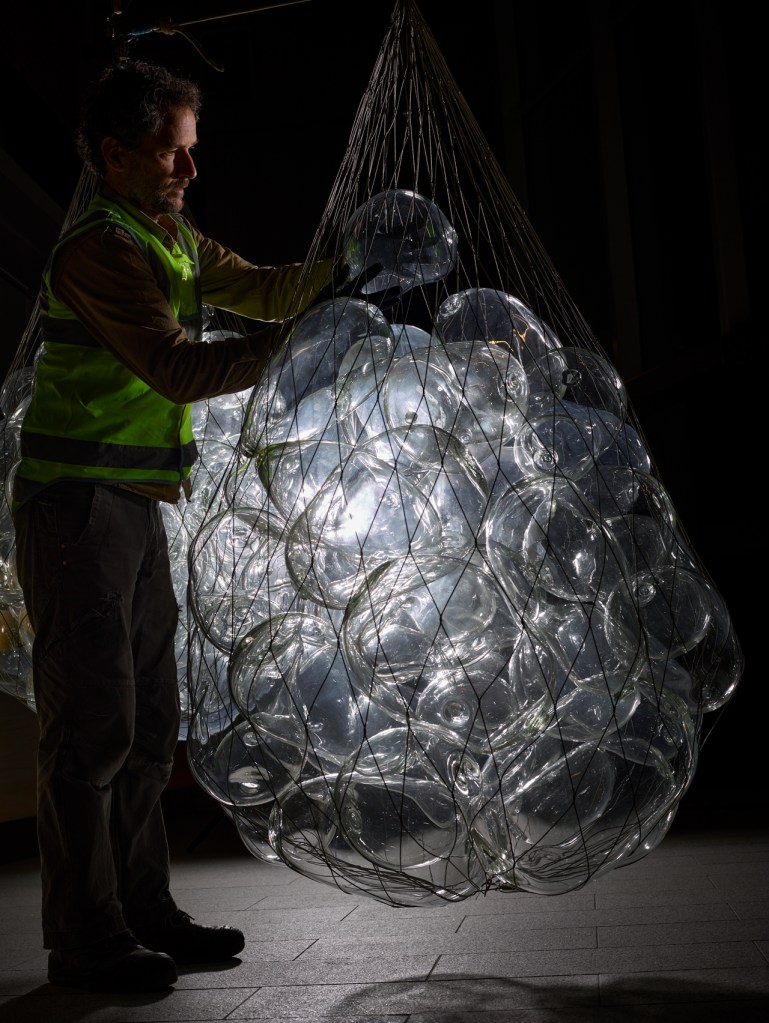
Keith Dougall, Catching Your Breath, 2020. Suspended sculptural form incorporating the breath of 300 patients, visitors, and staff of the Royal Hobart Hospital, sealed into individual unique glass breath bubbles and suspended in seven woven stainless-steel nets.
Those entering the Royal Hobart Hospital each day do so with a variety of reasons that range from the mundane to the more pressing issues of life or death. It is an entranceway marked by fear and anxiety, as well as by compassion, kindness, and love. Perched high above these anxious concerns in the vast space of the atrium are seven large nets containing what seem like bubbles or spherical glass balls, floating as if on an invisible sea or cloud of air. This installation is the work of glass artist Keith Dougall, who has worked with hundreds of staff, patients, and a team of technical assistants to create a work – Catching Your Breath – that invites an instant sense of compassion and empathy. Installed in 2020, this public art project engages the viewer with a profound sense of delight and playfulness. Set within this vast entry lobby, its clear sense of wonder is enough to take your breath away.
The work has an immediate impact and lifts the eyes of the viewer up into the space to consider its construction and to foster curiosity about its meaning. Dougall is an experienced glass artist with a considerable body of work, from individual art glass pieces to major public commissions. As a glass blower who uses his own breath to form work out of molten glass, he has extended his practice to incorporate the breath of others as the basic metaphor explored by this work. When each glass bubble was formed in the studio, they were provided with a small entry hole, where later, patients, family members, and staff were invited to supply their own breath, when the work was then finally sealed up. The overall installation consists of containers for this gift of life, inspiring, expiring, in the rhythm of life-giving breath.
The artist explains: ‘The work symbolises the fragility and resilience of breath and life. The suspension of the work is a metaphor for the support and care that staff and family provide the patient, lifting them up in their time of need’. Behind the stunning presentation of the work high above the heads of those who enter the hospital lies a complex process of manufacture and preparation that amplifies the work’s achievement as a community arts project. As people filled each vessel with their breath, many of their stories were recorded on video and became part of the documentation of the work through a dedicated website. One, therefore, takes in the work and the history of its formation as a part of a whole process based in compassion and understanding that gives life to people. Here is a representation of the nets of connection that surround individuals as they come into the hospital environment, where every breath, and every heartbeat, is closely monitored.
The breath of life is a metaphor strongly present in the Christian tradition. We remember that God forms creation through the agency of breath, and in turn breathes life into the clay of creatures, including the creation of human beings. This fundamental connection was clearly in the mind of the artist who works each day breathing life into inert glass forms that became vessels of delicate fragility and profound beauty. Perhaps this is the role some artists are energised by, through breathing life into material things, through imagination and transformation remaking the world into a habitation for wonder and human kindness. This work is one of embodied spirituality and community connection that successfully celebrates the role of a health care institution and the fundamental human values of love and compassion that lie at the heart of all healing and wholeness.
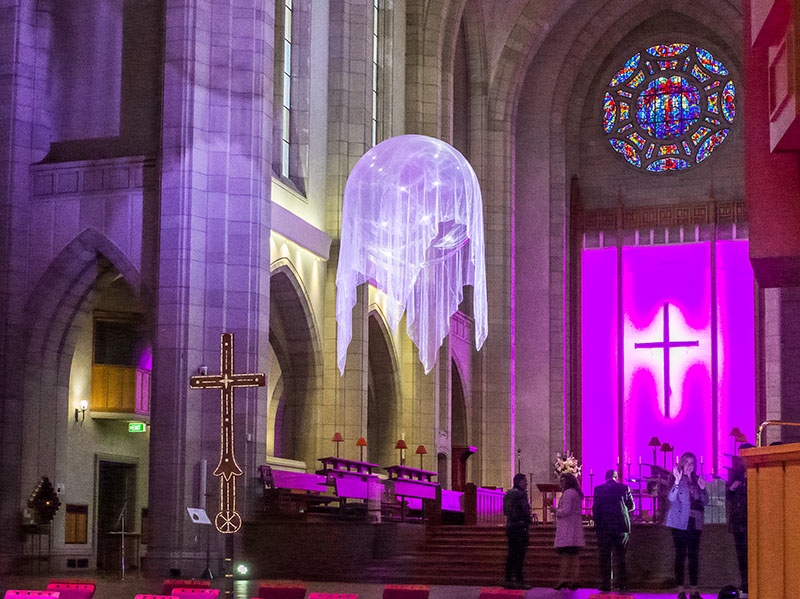
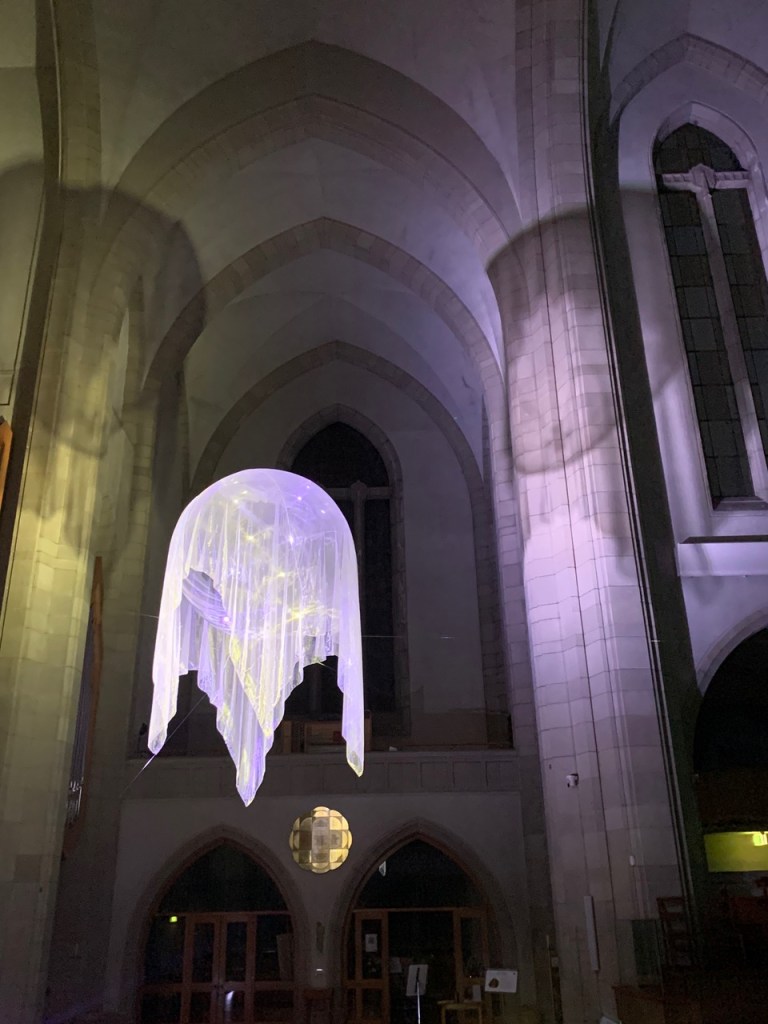
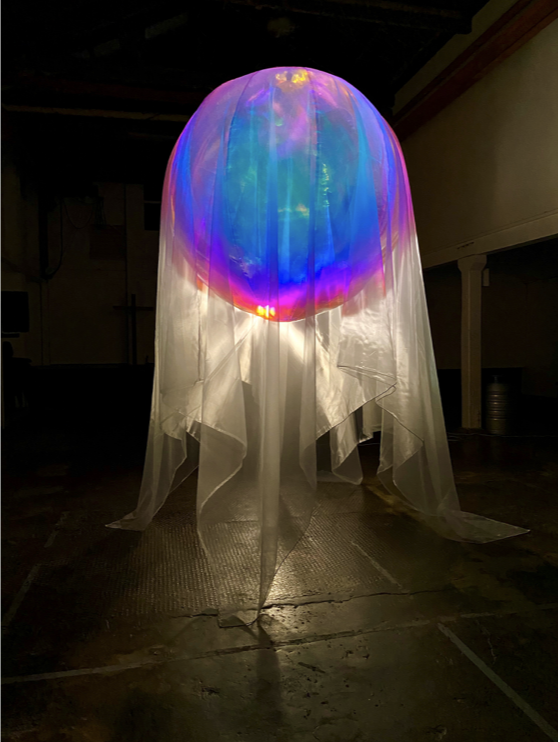
Awakenings IVpremiered for Artweek Auckland 2020 at the Holy Trinity Cathedral in Parnell Auckland. It is an installation artwork that offers an immediate and potentially sustained encounter. A large levitating partially concealed object of uncertain substance is illuminated in a field of white and gold coloured light. It speaks of the unknowable and unfathomable spiritual mystery and beauty of natural phenomena, and acts as a threshold into the terrain of the numinous. The concept of the numinous speaks to the realms of our experience which cannot be quantified, explained, or contained – our intuition, and our feeling-states; our connection to the cosmos, and, for some, a sense of the divine. I am interested in the intersection of art with spiritual experience, and aspire to create installations that activate spaces for audiences that offer a possible awakening to wonder. This exhibition aims to explore relationships between abstraction, colour, light, and space, contributing to the conversations around the connections between abstraction and spiritual experience.
Holy Trinity Cathedral, Parnell,
Karen Sewell – Awakenings IV, 2020
The circle is the primary geometric symbol in this work and relates to sacred geometries which have long and rich histories dating back to 2000–1001 BCE in Egyptian and Mesopotamian cultures. The circle or sphere is a universal symbol with extensive meaning. It represents the notions of totality, wholeness, original perfection, the Self, the infinite, eternity, timelessness, life, and all cyclic movement. Sacred geometries, termed by Galileo ‘the language of the universe’, are trans-cultural existing in nature, architectural structures (in particular sites of worship) and art. The music of the spheres, harmonics, and music are related to the planets and their distance from one another and the sun. The sphere can evoke the heavens. The veiling of the sphere references the shroud, the veil between the seen and unseen realms, between the heavens and the earth.
Awakenings IV, 2020. Installation from custom pvc sphere, helium, air, organza mesh, light, 2 x 2 x 6 m. Holy Trinity Cathedral, Parnell, Auckland, New Zealand.
℘℘℘℘
Karen Sewell is a visual artist who lives and works in Tāmaki Makaurau, Auckland. Sewell graduated with a Master of Fine Arts (Honours) in 2016 from Whitecliffe College of Arts and Design. She is interested in the intersection of art with spiritual experience and aspires to create artworks that activate spaces for participants to be able to experience liminal moments of awareness of the unseen and unknown. Sewell works across multiple media specialising in installation practice. Her work has been selected for multiple awards, winning The Trusts Award in 2011 and is represented in private collections including The James Wallace Arts Trust. Sewell has exhibited work across New Zealand with a highlight being Awakenings IV at the Holy Trinity Cathedral in October 2020. Her work is represented in private collections including The James Wallace Arts Trust. In addition to her creative practice, Sewell founded The Bonfire and now facilitates this national artist network. The aims of The Bonfire are to assist and support the thriving of other artists, through online blog posts and face to face regular meet-ups involving workshops, retreats and events.
Karen Sewell, Awakenings I, 2020.Installation, Helium balloon, organza mesh, mirror, soft resting elements, 2.5m x 2.5m x 3.5m. Photograph supplied by artist.
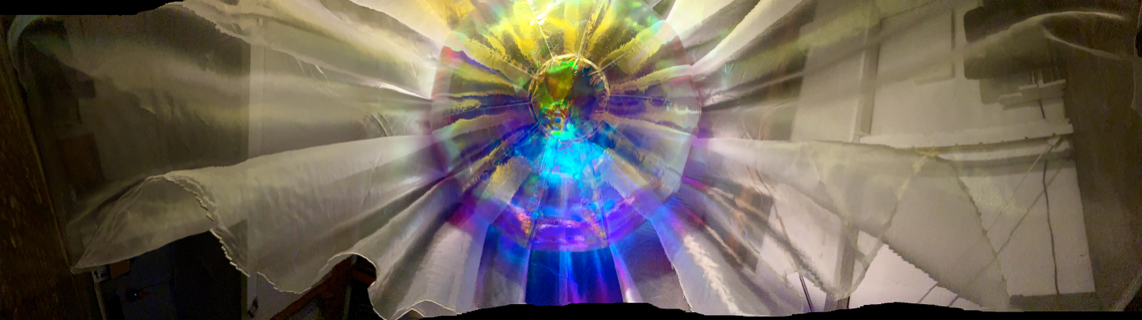
Just days before New Zealand went into full level 4 lockdown due to the COVID-19 virus, my husband Graham and I spent an evening in a warehouse in Central Auckland, shooting this work titled Awakenings I. What we experienced that evening was surprising, strange, and otherworldly. As we worked in the dark with a video light, the huge transparent rainbow PVC balloon and organza mesh transformed. It became a levitating partially-concealed object of uncertain substance radiating dancing, shifting fields of colour and light that changed as we moved around and under it. The immediate encounter evoked a sense of wonder, acting for us as a threshold into an experience of the numinous.
Since that evening, I’ve wondered at the timing of this work; of how God might want to be at work in me, and in others during lockdown; of the possibilities waiting for us to be awakened to in these unusual circumstances.
‘Numinous’ means something mysterious, awe-inspiring, or supernatural; unknown or unknowable. It speaks to everything within the realm of our experience which cannot be quantified, explained, or contained. Our intuition, and our sweeping feeling-states. Our connection to the cosmos, and sense of the divine. The German theologian Rudolf Otto, in his book The Idea of the Holy (1923), explains it as a ‘non-rational, non-sensory experience or feeling whose primary and immediate object is outside the self’.
Karen Sewell, Awakenings I, 2020. Installation, Helium balloon, organza mesh, mirror, soft resting elements, 2.5m x 2.5m x 3.5m. Photograph supplied by artist.
Artistically, my interest is in the intersection of art and spirituality. This interest has led me to seek and receive inspiration (often through prayer and contemplation) and then to mediate the creation of spaces for audience/participants to engage with and within. The spaces are an effort to open up the potential for a viewer/participant to explore and experience the terrain of the numinous, including an awakening to a sense of wonder, and liminal moments of encounter with the divine.
Karen Sewell, Detail of Awakenings I, 2020. Installation, Helium balloon, organza mesh, mirror, soft resting elements, 2.5m x 2.5m x 3.5m. Photograph supplied by artist.
A sense of awe and wonder is closely linked to our deep feelings and emotions, and is excited by something strange and surprising. With my work, I aim to provide a sense of awe and at the same time create a calm atmosphere, a sense of a place to just ‘be’; to observe, to explore, to create, to be present in the moment, to just breathe. It can be about connecting us with nature, with others, with our feelings, and developing a sense of things unknown outside of ourselves.
As Albert Einstein once put it:
The most beautiful thing we can experience is the mysterious. It is the source of all true art and science. S/He to whom the emotion is a stranger, who can no longer pause to wonder and stand wrapped in awe, is as good as dead – his/her eyes are closed. The insight into the mystery of life, coupled though it be with fear, has also given rise to religion. To know what is impenetrable to us really exists, manifesting itself as the highest wisdom and the most radiant beauty, which our dull faculties can comprehend only in their most primitive forms – this knowledge, this feeling, is at the center of true spirituality.
Karen Sewell, Detail of Awakenings I, 2020. Installation, Helium balloon, organza mesh, mirror, soft resting elements, 2.5m x 2.5m x 3.5m. Photograph supplied by artist.
℘℘℘℘
Karen Sewell is a visual artist who lives and works in Auckland, New Zealand. She is interested in the intersection of art and spiritual experience. She works across multiple media including sculpture, installation, painting, drawing, and photography, specialising in installation practice. She was the recipient of the Premier Award in the Waitakere Trust Art Award in 2011, and has exhibited work across New Zealand, with a highlight being Wonder Tree, 2019 at Splore Festival in February 2019. In addition to her creative practice, Sewell founded The Bonfire and now facilitates this national artist network. The aims of The Bonfire are to assist and support the thriving of other artists, through online blog posts and face-to-face regular meet-ups involving workshops, retreats, and events.
What kind of time is this? And what might such a time mean for artists and their work?
Beyond the very real financial hit that many artists are currently taking, a great many of us, artists included, are welcoming this abnormal moment to ask other questions – existential questions, and questions about our regular habits and commitments, for example. It is suggested that to try to carry on with business as usual, however tempting and well-intentioned that might be, would be to forego a rare opportunity to reimagine and re-embody other modes of our living. Others are turning to all kinds of creative endeavours. Others still – including artists – are asking whether now is really the time to make art at all?
Of course, we’ve been here before. This is hardly the first time in our history that such questions have been asked.
In the aftermath of WWII, where the dominating backdrop was clearly otherwise than it is today, the philosopher Theodor Adorno, in his Negative Dialectics, raised the question of whether the traumas of Auschwitz mean that ‘we cannot say anymore than the immutable is truth, and that the mobile, transitory is appearance’. It is not, he insisted, a case of an impossibility of distinguishing between eternal truth and temporary appearances (Plato and Hegel had already showed us how that could be done); it’s just that one cannot do so post-Auschwitz without making a sheer mockery of the fact:
After Auschwitz, our feelings resist any claim of the positivity of existence as sanctimonious, as wronging the victims: they balk at squeezing any kind of sense, however bleached, out of the victims’ fate. And these feelings do have an objective side after events that make a mockery of the construction of immanence as endowed with a meaning radiated by an affirmatively posited transcendence.
Put more plainly, our emotional responses to horrors of such magnitude ought to outweigh all our attempts to explain them. It was this conviction too that led Adorno to state famously (in his essay ‘Art, Culture and Society’) that ‘to write poetry after Auschwitz is barbaric’, and that ‘the task of art today is to bring chaos into order’. The line between explanation and intelligibility has been severed. In the wake of such, we are left with the possibility of Adorno’s ‘negative theodicy’, a kind of theodicy in which the old intellectual and philosophical distance is impossible. If we are to make any headway at all in recognizing how the Nazi death camps succeeded in the destruction of biographical life, and reorientate our thinking in response, Adorno argues, we must learn how to regard Auschwitz as the culmination of a trajectory embedded in the history of western culture in the wake of the Enlightenment. In other words, there can be no genuine acknowledgement of the Holocaust that does not begin with the realization that ‘we did it’.
Today, our questions may be otherwise. For some of us – for those, for example, trying to discern (or create) lines between unbridled capitalism, ecological disaster, and global pandemics – perhaps they are not so.
In his latest post for The Red Hand Files, musician Nick Cave responds to a series of questions about his own plans for this time during the corona pandemic. His reflection is worth repeating here in full:
Dear Alice, Henry and Saskia,
My response to a crisis has always been to create. This impulse has saved me many times – when things got bad I’d plan a tour, or write a book, or make a record – I’d hide myself in work, and try to stay one step ahead of whatever it was that was pursuing me. So, when it became clear that The Bad Seeds would have to postpone the European tour and that I would have, at the very least, three months of sudden spare time, my mind jumped into overdrive with ideas of how to fill that space. On a video call with my team we threw ideas around – stream a solo performance from my home, write an isolation album, write an online corona diary, write an apocalyptic film script, create a pandemic playlist on Spotify, start an online reading club, answer Red Hand Files questions live online, stream a songwriting tutorial, or a cooking programme, etc. – all with the aim to keep my creative momentum going, and to give my self-isolating fans something to do.
That night, as I contemplated these ideas, I began to think about what I had done in the last three months – working with Warren and the Sydney Symphony Orchestra, planning and mounting a massive and incredibly complex Nick Cave exhibition with the Royal Danish Library, putting together the Stranger Than Kindness book, working on an updated edition of my “Collected Lyrics”, developing the show for the Ghosteen world tour (which, by the way, will be fucking mind-blowing if we ever get to do it!), working on a second B Sides and Rarities record and, of course, reading and writing The Red Hand Files. As I sat there in bed and reflected, another thought presented itself, clear and wondrous and humane –
Why is this the time to get creative?
Together we have stepped into history and are now living inside an event unprecedented in our lifetime. Every day the news provides us with dizzying information that a few weeks before would have been unthinkable. What deranged and divided us a month ago seems, at best, an embarrassment from an idle and privileged time. We have become eyewitnesses to a catastrophe that we are seeing unfold from the inside out. We are forced to isolate – to be vigilant, to be quiet, to watch and contemplate the possible implosion of our civilisation in real time. When we eventually step clear of this moment we will have discovered things about our leaders, our societal systems, our friends, our enemies and most of all, ourselves. We will know something of our resilience, our capacity for forgiveness, and our mutual vulnerability. Perhaps, it is a time to pay attention, to be mindful, to be observant.
As an artist, it feels inapt to miss this extraordinary moment. Suddenly, the acts of writing a novel, or a screenplay or a series of songs seem like indulgences from a bygone era. For me, this is not a time to be buried in the business of creating. It is a time to take a backseat and use this opportunity to reflect on exactly what our function is – what we, as artists, are for.
Saskia, there are other forms of engagement, open to us all. An email to a distant friend, a phone call to a parent or sibling, a kind word to a neighbour, a prayer for those working on the front lines. These simple gestures can bind the world together – throwing threads of love here and there, ultimately connecting us all – so that when we do emerge from this moment we are unified by compassion, humility and a greater dignity. Perhaps, we will also see the world through different eyes, with an awakened reverence for the wondrous thing that it is. This could, indeed, be the truest creative work of all.
Love, Nick x
Like Cave, Adorno too challenges us to ‘take a backseat and use this opportunity to reflect on exactly what our function is – what we, as artists, are for’ – and to lean into ‘other forms of engagement’ that such uncertain and time-altering times render (almost) unavoidable. It is certainly a time to consider our responsibility to and involvement in all kinds of violence, for example.
The only philosophy which can be responsibly practiced in face of despair is the attempt to contemplate all things as they would present themselves from the standpoint of redemption. Knowledge has no light but that shed on the world by redemption: all else is reconstruction, mere technique. Perspectives must be fashioned that displace and estrange the world, reveal it to be, with its rifts and crevices, as indigent and distorted as it will appear one day in the messianic light. To gain such perspectives without velleity [fancy] or violence, entirely from felt contact with its objects – this alone is the task of thought.
Is not what might be true for ‘philosophy’ and ‘thought’ not also true for art? Redemption, the ‘messianic light’, exposes the incongruity between the world as it appears now and the world as it might be. That exposure – birthed and sustained by profound and counterintuitive hope, hope born not of trust in markets or in a change of conditions but which is the wholly unanticipated gift of the God of life – serves as both a judgement upon all that threatens and overcomes life, and as a promise that there is a love that is stronger than death.
That exposure also brings new possibilities for artists – in their freedom – to find their banjos, their pens, their brushes, their shoes, their voices, their humanity, etc. etc.
Human poiesis (and theology too, for that matter) can be – and in this world ought to be, as Jonathan Sacks put it in To Heal a Fractured World: The Ethics of Responsibility – a form of protest ‘against the world that is, in the name of the world that is not yet but ought to be’. It can like placing oneself right in the midst of a broken world – something like the way that the cellist Vedran Smailović placed himself in Sarajevo’s partially-bombed National Library in 1992 – and refusing to accept that the way things appear is the way that things must or will be.
℘℘℘℘
JASON GORONCY IS A THEOLOGIAN, ARTIST, AND FOLK FESTIVAL TRAGIC WHO LIVES AND PLAYS ON WURUNDJERI LAND.
Paul Roorda, Pocket Bible, 2008. Leather from discarded bible, personal identification cards, credit cards, and cash, 8.9 x 11.4 x 11.4 cm.
The very material of this ‘Pocket Bible’ serves to provide an initial punchline for this work. It makes a direct connection between the felt texture of the sacred book in our hands and the polished familiarity of a wallet. It provides an unexpected and visceral connection between what we hold to be sacred and secular, and in a direct manner the kind of power we might hold in our hands. It’s also a male thing. It exposes the fetishlike manner in which men hold their wealth and social power through this often-beaten, sweat-ridden carrier accessing wealth, identity, membership, community, affections, and allegiances. I have to confess it makes me aware of the nervous fondling that goes on each day as I check for its place in my pocket. It is a constant devotion to this container of my social power. Lose your wallet you lose your life!
While this work has clear and initial visual impact, it also burrows down into essential questions about allegiances and affections that tell us who we are, and who we are becoming. These are the indications about what drives us, particularly for men, driven in some cultures to focus on success and social status. In contrast to the slim wallet containing the essential operational tools of identity for men, the seemingly bottomless mystery of handbags offers far more resourcefulness, providing anything from a first aid kit to a handy tool for fixing any household problem. In some cultures male power is found through individuality, while female identity is often expressed through collaboration, finding friends. Such generalizations based on gender roles are under rapid change as individuals attach themselves to smartphones with the promise of far greater control over their sense of self. History now becomes personal as individuals mark their progress through photographs documenting every fashion ensemble, every meal, and every cute dog they encounter on this journey towards an always beautiful future.
The artist, Paul Roorda, expresses well the multiple implications of this work. He comments:
How do we identify ourselves? By our religion, our citizenship, gender, etc., or by our financial status and power in the marketplace? At what point does the church become over-involved in financial matters? Do the tables need to be turned over once again? Or can sacred and profane identities, powers, and institutions live happily bound together?’
Money, power, and devotion have long been a challenge for religious institutions who seek to provide the tools to find freedom and yet require allegiance and financial support. The visual questions posed by this tender wallet of devotion leaves the viewer with the questions that need to be held without easy resolution, so that freedom might be maintained and that humans do not become slaves to their deeply loved idols. An understanding of money is found most clearly when in the company of a sense of gratefulness, rather than through any consideration of power or control.
The binding together of the operational means of identity, such as credit cards, memberships, and driver’s license, with the holy pages of Scripture, provides an object that exposes the anxious questions that arise in trying to straddle the realities of these two very different worlds. What belongs to God and what belongs to Caesar, is an age-old question that is never finally resolved. This work serves to hold open such anxiety as an ongoing question about where our affections really lie. It invites us to acknowledge the tension between living in the world and living by the words of Jesus. It invites us to lay open an awareness of the seductions that are present through living in a consumer society, and the manner in which our affections and allegiances are always being shaped towards products that need to be purchased. In an age where freedom is heavily marketed, where uniqueness has a cult following, we find ourselves somewhat all alike in our dependence on things sold to us as agents of life. Consumption is not the same thing as living a full life. This work provides a space for potential wisdom in making the better choice.
ROD PATTENDENIS AN ARTIST, ART HISTORIAN, AND THEOLOGIAN INTERESTED IN THE POWER OF IMAGES. HE LIVES AND WORKS ON AWABAKAL LAND.
Paul Roorda is a Canadian artist who transforms found materials to create two-dimensional art, sculptures, and outdoor site-specific installations that examine the relationship between religion, medicine, science, and environmentalism. He has exhibited extensively with solo exhibitions in Canada, the United States, and Germany and has been awarded grants from the Ontario Arts Council and the Canada Council for the Arts. Paul Roorda was a finalist for the 2016 K.M. Hunter Artist Award in Ontario. He was Artist in Residence for the City of Kitchener, Ontario, in 2007 and at GlogauAIR in Berlin in 2012 and 2015.
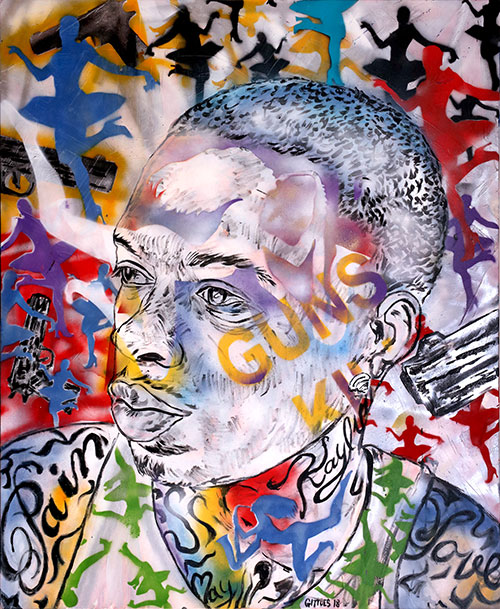
George Gittoes, Soljah, Love and Pain, 2019. Stencils, oil on canvas. 152.5 x 122.5cm. Artist collection.
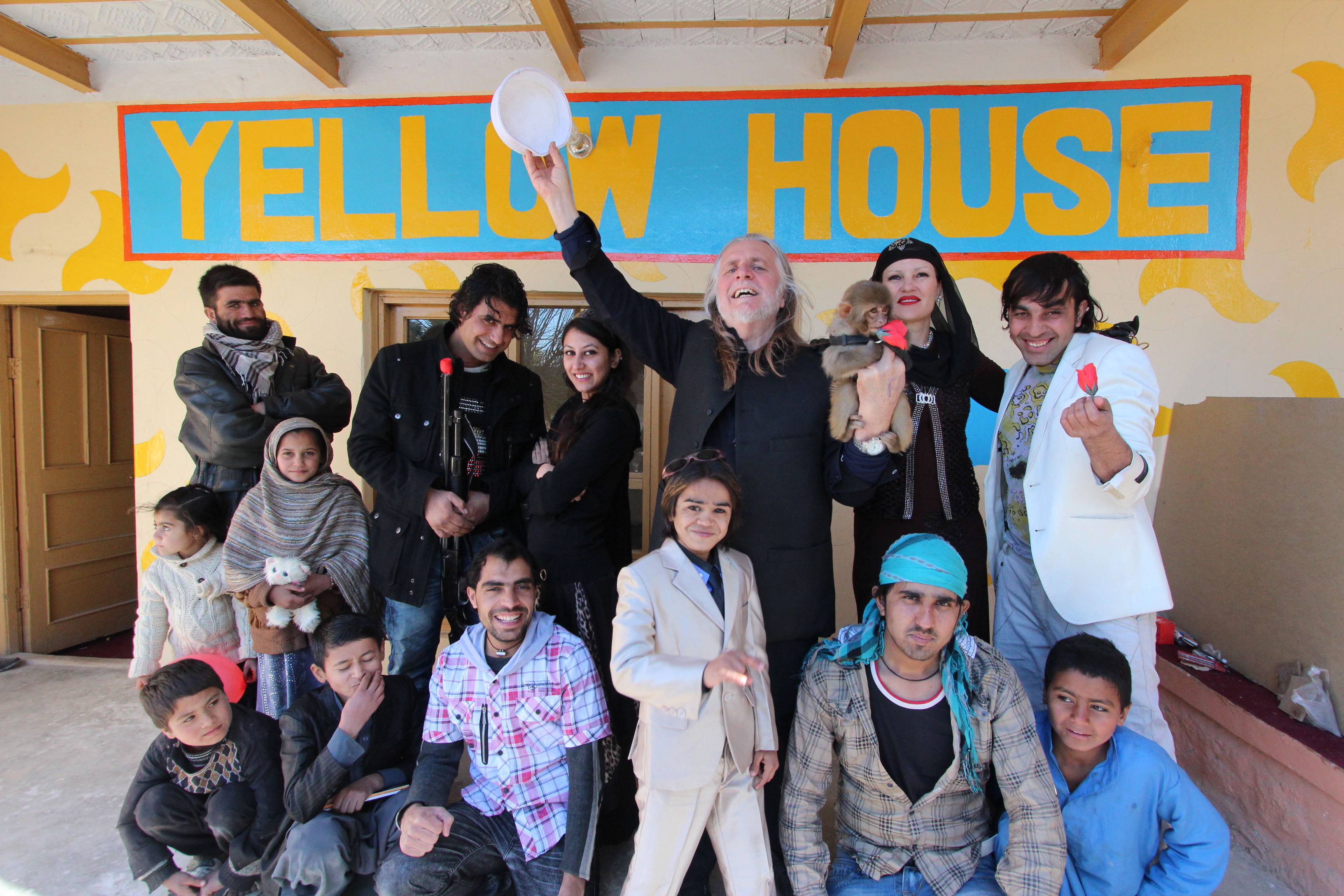
For the last two years I have been working on the exhibition ‘George Gittoes: On Being There’ which opens at the Newcastle Art Gallery on 8 February 2020. It has been a wonderful opportunity to work alongside a unique artist who is more at home in a war zone than the usual haunts of inner-city cafes favoured by creatives! This exhibition covers fifty years of Gittoes’ artistic production from the heady days of his involvement in the Yellow House artist community in Kings Cross, through his documentation of the working conditions of the steel mills of Newcastle, to his work in the field in war zones, the creation of another Yellow House in Jalalabad, Afghanistan and his most recent sojourn in South Side Chicago, a place which has the worst statistics for gun violence in the USA. In each situation, Gittoes has sketched, painted, photographed, and, more recently, produced feature-length documentaries about what it is like to be there, in a way that draws in viewers to consider the ethical and moral dilemmas of what it means to be human in these difficult and limiting environments.
Rather than the usual structure of an artist survey, this exhibition offers a unique opportunity to get under the skin of what motivates this artist. It seeks to address the questions about why he goes to such inhospitable places to make art and why he puts his life at risk. His answer is as simple as it is profound: ‘I feel privileged to have been able to spend much of my life creating beauty in the face of the destruction of war. I have been waging a personal war against war with art’. These works offer insights into the manner in which Gittoes works and how he sees, what catches his attention, and how this shapes his responses through his art-making. Against the backdrop of dangerous and emotionally charged contexts, Gittoes is drawn to empathise with the human person, as a site for bravery, resilience, hope, and despair, inviting our involvement as compassionate participators in a world that has moral and spiritual implications.
During 1969–1970, Gittoes was involved with the creation of the Yellow House artist community. Through his Puppet Theatre, Gittoes was able to play out the human dramas of heaven and hell, and life in between, using his skills in storytelling and the making of an extraordinary range of puppet creatures. His deeply imaginative work made a sharp response to the Vietnam War and contains some of the strongest responses to the war found in Australian art. Gittoes speculated at the time about how he could take the Yellow House experience, of incubating a creative artists community, to Vietnam, in the midst of this terrible war. In many ways, his life work has been to play out that possibility. Since 2011, Gittoes has worked regularly in the eastern part of Afghanistan, setting up the Yellow House Jalalabad. Here he linked with local filmmakers and actors renewing his earlier experiences of artistic collaboration. This process is documented in the award-winning film Love City, Jalalabad, which highlights the possibilities for hope in making art in such an unlikely context.
Through the Yellow House, Gittoes leaves aside the usual goals of western artists to highlight their own originality and prefers to embed himself in communities of creative people. Here, collaboration and the trust that is afforded to each person’s own gifts and creativity is highly valued. Gittoes’ work in Afghanistan has had a major impact on the film industry in that country incubating actors, directors, and technicians who are following through on their own projects in a country with a rich artistic heritage. Here we see culture as a form of renewal that provides stable images for a possible future. The results of this manner of working returns art-making to a community base that is concerned with the common good, the search for justice, and the creation of hope. It is a profoundly different model of valuing creativity that reaffirms the role of art to form the future as a social experience. One might say that the making of community might be the most profound art form practised by humans.
Gittoes most recent collaboration has been with the Yellow House South Side Chicago, an experience that is presented in his latest documentary White Light released in 2019:
This film explores his encounters with the communities of Englewood in South Side Chicago, and uncovers the social impact of gun violence through the stories of both victims and perpetrators. It is a film filled with tragedy, pathos, and hope, developed while living and working together with the local residents. White Light is his most beautiful and evocative film, yet it is filled with the harsh social impact of gun violence. It is a moving and deeply empathetic narrative that uncovers the vitality of human beings looking for conditions that will allow them to reach their full potential. Gittoes focuses on the stories of young lives who through the means of their own creativity deeply yearn for a life that is better.
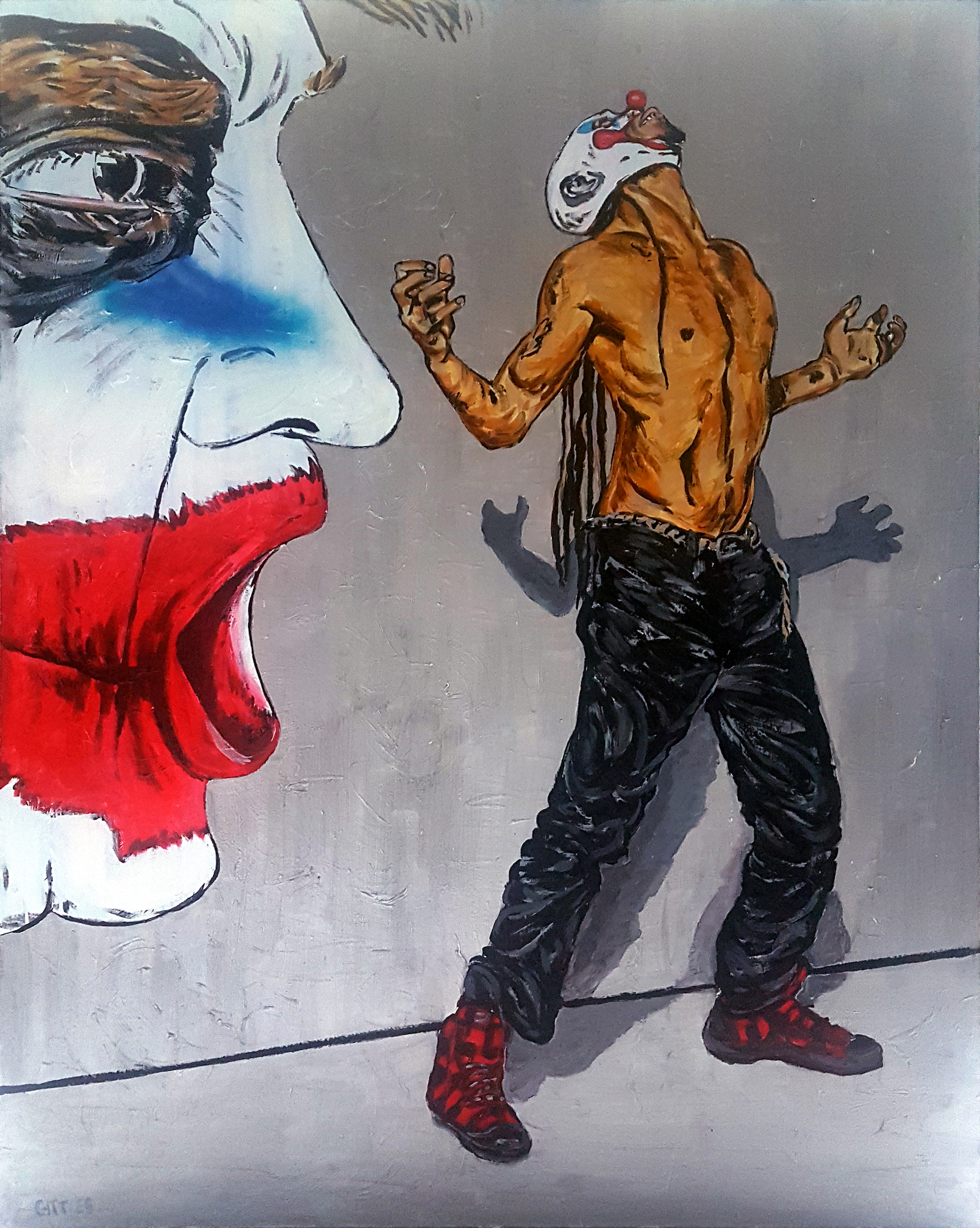
George Gittoes, The Scream. 152.5 x 121.9 cm.
One of the paintings produced during this period is ‘The Scream’, which is his take on the anxieties of our current time. This work examples his capacity to provide a prophetic perspective on the history that is unfolding around us. The work was based on a street mural that depicts the yawning face of Donald Trump as it looms over the poverty and violence of the inner city. The scream is echoed as despair or protest by the lone African-American figure in a mask, which allows for the possibility that they see things differently, and look towards a different future. The prophetic imagination uncovers the structures that create injustice, it works to unsettle the status quo, and to question the myths we accept for what is considered normal. Prophecy works towards an alternative future based on justice where every creatures matters. This is deeply echoed in the Christian tradition and Gittoes takes us to the churches and activists who live this out on the streets of South Side Chicago. This frightening and disturbing image is linked to the emergence of hope in the darkest of situations.
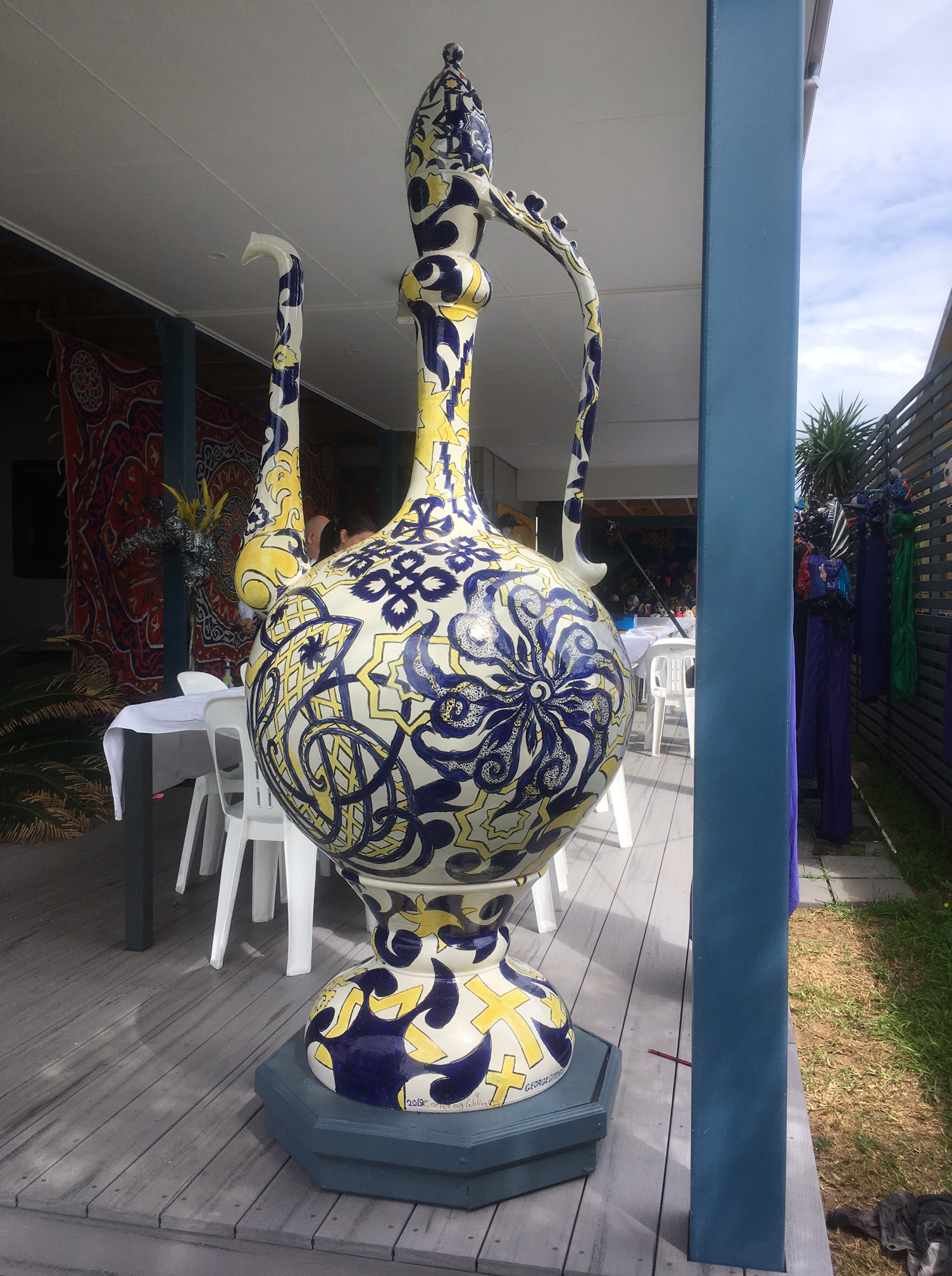
The final work in the exhibition is a stunning 2.5-metre high ceramic form based on a traditional Afghani ewer. A collaboration with ceramicist Cameron Williams, Gittoes has decorated it with symbols from both Muslim and Christian traditions. Here both east and west come together in an act of potential hospitality. The work is entitled ‘To Cleanse the world of war’, it brings together into an imaginative conversation, cultures that are more often seen at enmity. The work evokes the ritual of welcome through the washing of hands and the serving of refreshments. it also offers a perspective that religion might contain resources for healing, understanding, and reconciliation. Religion is often considered in the popular imagination to be the problem, and yet religious faith from both Muslim and Christian traditions offer deep inspiration for mutual understanding and the solving of common problems that rob us of a peaceful future.
George Gittoes provides an extraordinary record of an artist willing to create in the face of chaos and potential destruction. While Gittoes might be a prophet, he is certainly a provocateur, alive to the ethical and spiritual dimensions of what it is to be human. Gittoes is also alive to the positive resources that religion and culture provide. This exhibition will give privileged access to his process through paintings, prints, visual diaries, field drawings, photography, and film. Through these works, we experience an amazing human journey that holds out the hopeful power of creativity in the face of prejudice and fear. This is a magnificent visual record of a creative imagination that provides a visual resource for the difficult times in which we live.
George Gittoes: On Being There is on exhibition at the Newcastle Art Gallery (8 February – 26 April 2020) and will travel later in the year to Casula Powerhouse Art Centre (opening 26 September) and Wollongong Art Gallery (opening 28 November).
℘℘℘℘
ROD PATTENDENIS AN ARTIST, ART HISTORIAN, AND THEOLOGIAN INTERESTED IN THE POWER OF IMAGES. HE LIVES AND WORKS ON AWABAKAL LAND.
It was the flickering sparkle, like diamonds, that caught my eye. An ensemble of delicate jewel-like containers laid out on a small table. Not crystal but salt, and miraculously held together in fragile delicate forms like containers. They held no other function than to set out a table for beauty and light. The light flickered like fire in my eye as I moved around this display and as I drew in close, I held my breath, fearing its moisture laden content would shatter the magic of this fragile salt ensemble. I had been invited to be on the judging panel for Australia’s Blake Prize for Religious Art and this work had caught my full attention. Salt containers, a collection of tears, the spilling over of grief that marks the human journey. Here was an expression of the lament that is so much a part of the human experience and the global world in which we live. So much sadness, violence, and reconciliation, a never-ending cycle. How do we contain and understand such suffering?
Carl Jung has said, ‘The most outstanding properties of salt are bitterness and wisdom … Tears, sorrow, and disappointment are bitter, but wisdom is the comforter in all psychic suffering.’ This delicate ensemble of salt forms invites the viewer to value and make sacred the experience of tears in grief, as an accepted part of the human journey and therefore a place where God is. Rather than seeking an escape from our suffering and the pain we feel for others who also suffer, here is an honouring of the place of compassion. There is bitterness and also wisdom, and a spirituality that is embodied, earthed and compassionate that does not make us insular but interconnected. Far from being a sign of weakness, tears remind us that the journey of life is undertaken in a leaky boat. We cannot isolate ourselves from the complex and fluid dimensions of life, we float upon such a sea.
Rebekah Pryor is an artist wise to the learning found through ritual and sacred space. This work echoes the complex human experience of grief and wise containment. It is part of a larger project where she is seeking to visualise in particular the experience of the mother. In Christian imagery this is often limited to images of women who are models of obedience and passivity, well robed in blue and silent in their transcendent beauty. This work activates the role of mother to contain not only her own grief but the grief that results from being a nurturer and holding the pain of others. She writes, ‘Saltcellars is a motif of maternal lament. It is part of a larger body of work that seeks to critique traditional images of the mother in Christian religious art and generate new “icons“ that might more fully, ethically represent real maternal experience’. She adds, ‘Saltcellars suggests that bitterness and wisdom exist at once in a woman’s maternal experience. Her body feels both’.
In seeing this work we also feel it in our own body. On the edges of our seeing there are always tears, washing clean our capacity to see what is going on around us. While God might ‘wipe the tears from our eyes’ (Revelation 21.4), I think tears also enable us to see ethically and morally in a world awash with spin, illusion and the seduction of images which try to tell us that we are living in a culture where heaven is now on earth. Instead of this portrayal of a perfect world, tears remind us that the world is a sorry place. It is grief that dissolves the false promises of such cultural tropes. We have not arrived and lament is the prophetic response. This work invites us into a space that looks to me like a sacred space. God the mother sheds tears for this creation and for humans in their habitation of this planet. There is wisdom here that invites a re-orientation to nurture this vulnerable world and to see a God exercising the power of compassion. Life, after all, is worth crying for.
℘℘℘℘
Rebekah Pryoris a visual artist, curator, and academic living and working on Boon Wurrung and Wurundjeri country. Her artistic and research practice is interdisciplinary and currently explores the spatial and iconic potential of the body via a range of media and disciplines, including philosophy of religion, feminist theory, feminist theology, and architecture. Rebekah was a finalist in the 65th Blake Prize in 2018 and currently works in research and teaching in the Faculty of Arts, The University of Melbourne.
ROD PATTENDENIS AN ARTIST, ART HISTORIAN, AND THEOLOGIAN INTERESTED IN THE POWER OF IMAGES. HE LIVES AND WORKS ON AWABAKAL LAND.












 Art/s and Theology Australia