The Only Christ I Know

He was there, I was there
And no one else besides

His body blacked
And yellowing

Riven-red and starved
Who are you I said

I am
Who you are

And my body at once opened
Bright with its own scars

℘℘℘℘

Chris Green is Professor of Theology at Southeastern University in the USA. He is the author of several books, including Surprised by God and The End is Music, both published by Cascade Press. He is also a visual artist.


A Studio Reflection

Doug Purnell - Echoes (59cm x 59 cm acrylic on paper).jpg
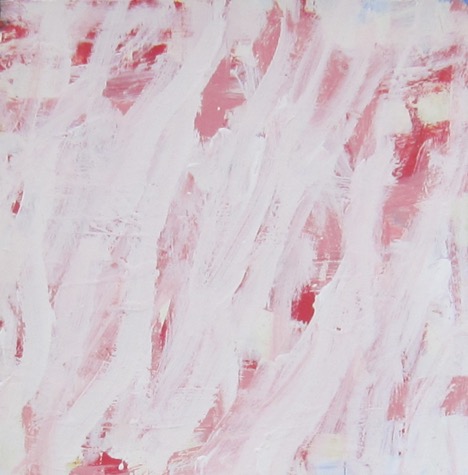
Doug Purnell, ‘Echoes’ (59cm x 59cm. Acrylic on paper)

I have been trying to articulate how for me as a pastoral theologian the primary text is lived experience. I hold that in conversation with received tradition (which I am asking a lot of questions about), through an act of the imagination, the work of artists, and seeking to discern the voice of God breaking into our world in fresh ways. That is what I feel called to as artist, so I am not trying to represent surfaces, but, with integrity, to create works that are open to the mystery of what is beyond our immediate grasp.

I want to share with you an experience of working alongside my two granddaughters in my art studio. Before they arrived, I cleaned up the mess and made a space for them to work. On the beach last week, I had found a 3–4” long and perfectly formed shell. So I put it out for them, gave them a big piece of board (about 70 x 70 cms) and a pencil, and asked them to draw a big picture of the shell. Pollyanna is 10 and Darby 7. They made their drawings and I put out some paint. I put out a couple of buckets filled with brushes of all sizes and shapes, including dish mops and scrapers. Pollyanna began with a big 7 centimeter brush, painting the background in multiple colours, and Darby began painting the shell. Intriguingly, the shells remained part of their composition, but were not the focus of their action. They began to play with the paint and the brushes and the mark making, and they both came up with interesting paintings. The shells were there, as part of the whole, but were not the main focus.

They wanted to do more paintings. Darby, who I always think has the mind spirit of the artist, found a tennis ball in one of the nearby boxes and asked if she could put paint on it. Then she wanted a large box so that she could put the paper in the box and roll the tennis ball covered in paint around in the box, ‘to see what happened’. She quickly changed to bouncing the paint-soaked tennis ball on the paper lying in the box, and forming a quality pattern in the bouncing of the ball. Pollyanna had her go, again having painted the background first. Nice, splurty, round marks. Then Pollyanna found a rubber wheel with corrugations in the rubber. I suggested making prints on the paper with it, and they were off on another stream of creating. I became intrigued with how they had begun with a specific task – to draw the shell – and had, in a short time, moved into a playful extension that was free, expressive, energetic, and poetic.

Later in the day, I was watching a documentary from 1973 on Painters Painting. Barnett Newman was ruminating on whether painting focuses on the objects painted as the subject of the painting, and whether the subject of a painting could be more than the objects within it. He talked about Cezanne’s apples. Are they the subject of the painting, or simply objects within the painting? He saw them as being like cannon balls, and the painting was much more than the objects depicted within it. What my granddaughters did yesterday was to begin their paintings with an object – the shell. And quickly their processes moved from the shell as the object and subject of the painting to the painting as a process that was more than depicting the shell. That transition – from an object being depicted, to a painting being created – was a very significant step that seems to reflect my own processes as an artist. I sit in the landscape for solid periods. I look and draw and scribble and play and reflect on the object of the landscape. And then I come back to my studio and I play, and I hope that by engaging the process I might make works that go beyond the object of land or face or whatever. It was intriguing to observe and reflect on their processes.

℘℘℘℘

Doug Purnell is a pastoral theologian who in his retirement is focusing on a commitment to a full-time studio practice of painting that explores the nature of abstraction and mark making. He was for 17 years the director of the Blake Prize for Religious Art. He lives and paints on Gadigal land.

Reading: a shortcut to compassion

Testament.jpeg

You could argue that the most important value in life is compassion. You could also argue that the most painless way of growing compassion is by reading other people’s stories.

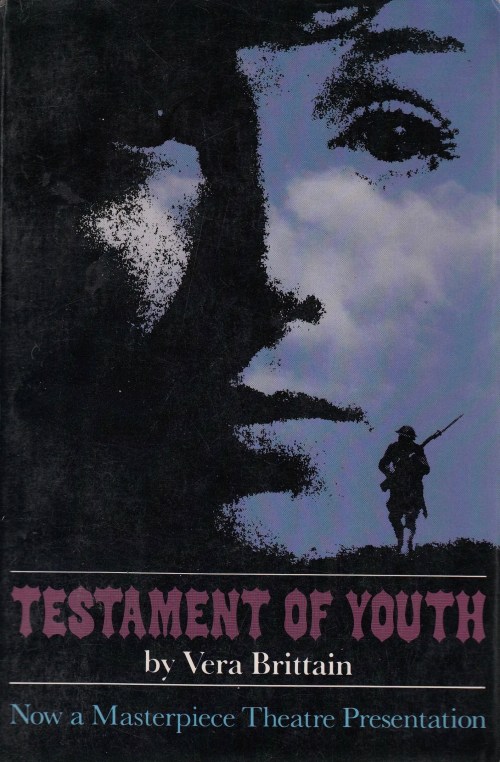
An ancient copy of Testament of Youth, the 1933 best-seller by Vera Brittain, has sat on my bookshelf for decades, surviving any number of culls of varying degrees of brutality, maybe because I knew at some level that this was a classic that I really should read one day. But it wasn’t until my interest had been sparked by seeing the latest movie version of this tale that I got around to picking it up.

This memoir of the years between 1914 and 1925, the decade containing World War I, cannot be rushed. It was written in an era when, harsh and full as life was, a writer seemed to have all the time in the world to explain things in great detail. It’s not for one minute boring, it just takes a while to read it.

Brittain tells the story of her harrowing war experience. A bright young woman who fought fiercely for the right to attend Oxford, her sheltered upper-middle-class English world was thrown into chaos by the war. All the people she was close to were killed and she worked for years as a highly capable VAD (Voluntary Aid Detachment) nurse in various wartime hospitals, including right behind the front lines in France.

Brittain went on to become a well-known novelist, poet, and public speaker; feminism and pacifism were the causes dear to her heart. She belonged to that generation that believed, for a little while, that they could shape the world so that it learnt the lessons of the ‘War to end all Wars’ which turned out, of course, to be nothing of the sort. At the end of the book, she laments the fact that more horrific conflict is on the horizon, that her children will be exposed to carnage of the sort she hoped to never witness again.

Brittain grew up at the end of the Victorian period, in a world of extraordinary privilege. Reading accounts of such lives, I always marvel at the leisure and boredom of the existence of comfortably off women whose job was simply to organise servants and go visiting. I look at my life and that of my peers, both women and men – we hold down jobs, bring up children, run households and fulfil community commitments without any assistance from servants whatsoever. Not that I would swap – Brittain’s struggle was largely one to escape precisely such a set up.

Nothing enables me to live in worlds other than my own more than good writing. Brittain’s devastation as one after another of her beloved peers are killed is heart-rending. She talks about her ‘doomed generation’, and they were. I cannot begin to imagine the weight of grief upon grief that most people suffered in those years, although several contemporary situations compare – families of asylum seekers the world over, certain Indigenous communities, nations like Syria and the Sudan in an ongoing state of conflict. I belong to a generation who has never had to live through war. My parents’ generation, on the other hand, lived not only a through war but through six long years of the terror of fearing that barbarism might well take over the world. We live in complicated times, with pressures our forebears cannot imagine, and the threat of global-warming is the greatest our planet and our race has ever known, but I cannot begin to imagine the sheer courage that women and men living through a war needed simply to get up each morning and face what had to be faced.

Testament of Youth is refreshing because it is a women’s war book, so, to this reader is infinitely more interesting than the many war tales penned by men. The experiences of women at home, making do despite war time shortages and waiting for the dreaded telegram that would tell them of the death of their husband/lover/father/brother/son are way beyond anything I have had to endure. The lives of nurses on the front lines were inhumanely exhausting and distressing as they dealt with daily carnage without benefit of much in the way of medical supplies or even clean water.

Another striking thing in this long tale is the very different style of relationships young people engaged in and the way letters formed the basis of how they became close. Brittain falls deeply in love with a young man and they become engaged, but they have only had a dozen or so times actually together, most of these accompanied by a chaperone. But the letters they wrote, sometimes several a week! A large part of her book consists of quotes from letters to and from her parents, her adored brother and her fiancé. They are long, poetic, honest, deep, philosophical, yearning. There was time to write this way, back then, war notwithstanding. Her brother Edward regularly scribbled pencilled notes from the trenches that made their way safely to his family; at one point he complains that it takes a day and a half for his letters to travel from the front line in France to his family in London. Australia Post eat your heart out!

They poured out their very souls in these letters, in a way that I suspect contemporary lovers rarely do with their instant messaging and their moving in together five minutes after they ‘hook up’. The sheer longing for each other in these epistles is a world away from the instant gratification we have come to expect in everything, including sex. I’m not wishing myself back there exactly – I do wonder how marriages panned out when these heightened times were over and a couple had to settle down to jobs and housework and the daily irritations that are a part of a long love. But the contrast with current practices is staggering.

Testament of Youth is a long, slow read, so exquisitely written that I wanted to savour every page. I loved Brittain’s acerbic humour and her fierce, unapologetic feminism (impressively, even after marriage, she kept the name of her family or origin) which is captured in such passages as this one, which litter the volume:

…all girls’ clothing of the period appeared to be designed by their elders on the assumption that decency consisted in leaving exposed to the sun and air no part of the human body that could possibly be covered in flannel. In these later days, when I lie lazily sunning myself in a mere gesture of a bathing suit on the gay plage of some small Riviera town – or even, during a clement summer, on the ultra-respectable shores of southern England – and watch the lean brown bodies of girl-children, almost naked and completely unashamed, leaping in and out of the water, I am seized with an angry resentment against the conventions of twenty years ago, which wrapped up my comely adolescent body in woollen combinations, bulky cashmere stockings, ‘liberty’ bodice, dark stockinette knickers, flannel petticoat and often, in addition, a long-sleeved, high-necked, knitted woollen ‘spencer’.

They don’t write like that anymore.

Reading Testament of Youth powerfully strengthened my conviction that entering another’s world, by engaging deeply with stories not our own, brings a compassion, sympathy, learning, and wonder more effectively than just about anything else. If Hitler had read The Diary of Anne Frank. If Trump could read – really read – the stories of people desperately fleeing across the Mexican border. If Peter Dutton could immerse himself in a book written by an asylum seeker. If Scott Morrison could get into a story of someone who has never had quite enough money to buy their kids shoes or go on a decent holiday. If Harvey Weinstein could read a book about a woman who has been sexually exploited. If we could, all of us, read and weep, read and resolve to never let carnage and abuse happen again, read and feel compassion for our planet and its people. Read.

℘℘℘℘

Clare Boyd-Macrae is a Melbourne writer and editor. She lives and works on Wurundjeri land.
The Diggers’ Requiem, Tears and Blood

IMG_2411.jpegThe interview was well underway when I tuned into the car radio. A man spoke about weeping every day, how he’d got used to the weeping in the time he’d been researching the First World War. He also said he seemed to be bleeding a lot; he kept cutting or scraping himself. Tears and blood.

I pulled the car over and listened. The ABC’s Myf Warhurst was interviewing Christopher Latham, artist-in-residence for the Australian War Memorial. He is a classical musician, she was slightly out of her comfort zone. Latham was introducing ‘The Diggers’ Requiem’, which brings together the work of composers past and present. Latham had been researching music from the era of the War and had also commissioned new pieces. While I sat parked at the side of the road, a piece by Elena Kats-Chernin poured through the car speakers. It was so beautiful, I decided I would go to the performance at St Pauls Cathedral in Melbourne a couple of nights later.

It was the end of September. I went alone to St Pauls, entering the expectant quiet of the gathered crowd in the Cathedral. I wanted my experience to be unmediated. I wanted to hear for myself what the weeping bleeding man had brought together. I took my seat and waited.

The first movement was Handel’s ‘Dead March’– now arranged with four voices and a piano accordion. Such an intriguing arrival, as the four singers and the accordion player stepped up the central aisle in a dirge-like procession. The sound came like a slow-rolling wave of deep sorrow. I wept as they approached, holding before them the familiar round metal helmets of First World War soldiers, they stepped gravely forward.

The evening did not disappoint. Latham had taken a variety of compositions and woven something seamless and whole. It was a work made with love. At the end, he turned to the gathered audience and invited us to join in a chant of the words ‘Pie Jesu’, all sung on one note.

Latham made one beautiful, telling stumble. When he was conveying the words, printed in the program as ‘Grant us eternal peace’, he said ‘Grant us the strength for peace.’ Indeed.

Later, when searching for more information about ‘The Diggers’ Requiem’ and Christopher Latham, I found his own words which echo this prayer that we might find the strength for peace. Latham writes:

After 15 years of living with this music of war, I see that the musical works created in the battlefields are an attempt to leave some trace of consciousness and memory in the face of erasure, and that these pieces have something important to teach us…

I wish to harvest these beautiful flowers from the past, to give voice to these buried experiences, so that we understand more clearly the cost of war and become more resolved to achieving a lasting peace.

There have since been performances in Canberra and Sydney. And as the 100-year anniversary is now being marked, there will be full resonance for Latham’s words and music, made with tears and blood.

℘℘℘℘

Julie Perrin is a Melbourne writer, oral storyteller, and Associate Teacher at Pilgrim Theological College, University of Divinity. She lives and works on Wurundjeri land.


Altar/d

During 2018, Adamstown Uniting Church played host to the Altar/d Art Installation series curated by Rod Pattenden, who is also the minister of the Church situated in Newcastle, NSW. The title of the series was a play on the words ‘altar’ and ‘alter’, and invited responses about change, transformation, and hope. Six artists were chosen to display work in the body of the church and to take on its architectural form while continuing the interests of their own practice. In this video, Rod Pattenden highlights the features of each artist’s work and the responses they found among the ‘congregation’ of viewers. The video was produced by John Cliff.

Jesus Dreaming: A Theological Reaction to Michael Galovic’s Creation of Lights in the Heavens

Creation of the Lights in Heavens - Galovic.jpg
Michael Galovic, ‘Creation of Lights in the Heavens’ (nd)

The religious historian Mircea Eliade wrote of the ‘eternal return’; the religious belief that liturgy and prayer can put the believer in touch with the ‘mythical age’, the time when the foundational events of their faith occurred. In the words of institution in the eucharist, we do not merely remember what Jesus said and did, we make his saving death and resurrection present to us now. We live in the mundane world where ordinary time passes, but there is another time – the ‘Great Time’ or Eternity that existed before the world began, that will exist after it ends and, moreover, that surrounds us now.

For Christians, our access to eternity is the person of Jesus Christ. He is our connection with God the Father. It is through Jesus that the Holy Spirit is sent to us. Our recurring prayer is ‘the Lord be with you’. Moreover, through Jesus we access all of Salvation History. Since he is the second person of the Trinity, he is present wherever the Holy Trinity is acting.

The first theologian to write of this was the Apologist, Justin Martyr, who died in 165CE. St Justin wrote in his Dialogue with Trypho of what we now call ‘Christophanies’ – manifestations of Christ in the Old Testament. He wrote:

Permit me, further, to show you from the book [sic] of Exodus how this same One, who is both Angel, and God, and Lord, and man, and who appeared in human form to Abraham and Isaac, appeared in a flame of fire from the bush, and conversed with Moses.

‘Angel’, which means ‘messenger’, is no longer a term we use with reference to the Lord Jesus, but Justin, with his understanding of Jesus as the visible manifestation of the godhead and the Word of the Father, reads the Exodus stories of messengers and voices as referring to Jesus.

Hence, when the Hebrew Scriptures refer to God creating through his word – ‘He spoke and they were made’ (Ps 33:9) – Christian commentators on the scriptures saw this as the Logos-Christos, the second person of the Trinity, in action. For the fourth day of creation, the Genesis text reads:

Then God said, ‘Let there be lights in the expanse of the heavens to separate the day from the night, and let them be for signs and for seasons and for days and years; and let them be for lights in the expanse of the heavens to give light on the earth’; and it was so. God made the two great lights, the greater light to govern the day, and the lesser light to govern the night; He made the stars also. God placed them in the expanse of the heavens to give light on the earth. (Gen 1:14–17)

For the strictly monotheistic Hebrews, it is the one God who set the lights of heaven. But the Church Fathers, reading the sacred text through the lenses of their Trinitarian faith, see the Word of God at work.

Christian artists charged with depicting eternity, creation, and heavenly things wanted to make it abundantly clear that their subject matter was in no way mundane, or earthly. The artistic convention that the icon tradition developed was to set their figures against a golden background. Unlike the earthly realm, the holy figures appeared amidst an even gleaming light.

Mosaicists achieved the effect by making glass tesserae with gold foil on one side. It was an expensive and complicated process, and it is amazing to see the huge extent to which it was employed in some of the great cathedrals of the world.

One such cathedral is that at Monreale, Cefalù, Sicily, Italy. It is one of the great masterpieces of the twelfth century. The ceiling, walls, and apse are ablaze with Byzantine icon-style images set in a field of gold. Still photographs do not do justice to the way the background changes as you move and as the light source alters.

Monreale_creation_earth.jpg
Monreale Cathedral, ‘Creation of Moon, Sun, etc.’. (12th Century) Source: Wikipedia Commons

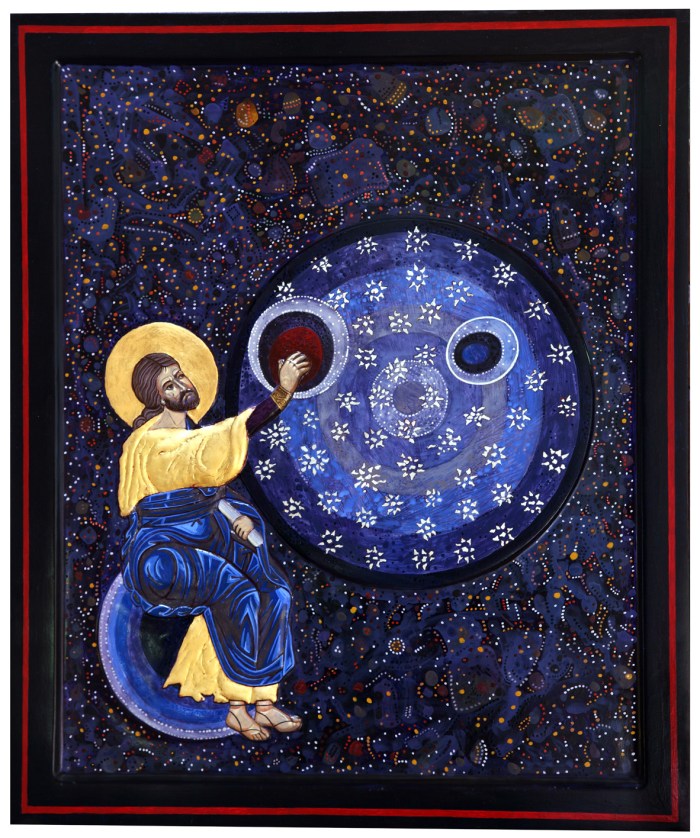
Monreale is the obvious influence on Michael Galovic. Icons influenced the mosaic of creation in the Cathedral, and now Galovic’s icon is a homage to that masterpiece. Given that he is working in a different medium, Galovic is remarkably faithful to his model. The circle of the heavens, the concentric shades of blue, even the placement of the stars is exact; though note that Galovic has omitted one particular star above the arm of the Christ. This could be a gesture of humility on the part of the artist – the disciple is less than the master – as well as an aesthetic choice to focus the interaction between the face of Christ and the light of the Sun.

The precision of the imitation adds impact to Galovic’s innovation. He, an expert at icon gilding, has taken away the gold of eternity and replaced it with something thoroughly Australian.

A common subject in Australian Aboriginal art is the Dreamtime, the time [sic] of the origins. A lizard may be depicted as the totemic ancestor figure who shaped the landscape. Dots, curves, and circles represent the Dreamtime before [sic] the mundane world came to be.

In Galovic’s icon, it is as if the Australian Dreamtime has replaced the Byzantine gold of eternity. His backdrop is more confused and chaotic than the gleaming tesserae of Monreale. There are dots, curves, the beginning of patterns, jumbled in an inchoate mass.

Galovic has not merely juxtaposed two artistic conventions, he has chosen a subject familiar to them both and he gives an authentically-Australian reading and re-writing of the Monreale mosaic. The ellipse that represents the moon in the mosaic is subtly dotted, alerting the viewer to how much this shape belongs to the ancient Australian artistic tradition as much as it does to the Byzantine culture.

Literally standing out from the background and distinct from creation is the figure of the Logos-Christos, seated on the cosmos (again outlined in subtle dots). Galovic has carved this figure in light relief from the same piece of wood which is the base of this icon. The halo is the only remaining gold and it is as if the newly-created sun is shining on the folds of the fabric of the over-garment. It is Jesus at work in creation, placing the sun in the circle of the heavens, and drawing us into the ‘eternal return’.

℘℘℘℘

Merv Duffy is Acting Principal at Good Shepherd College in Auckland.

Rosemary Valadon: A Sensual World

This documentary, which recently aired on the ABC’s Arts Channel, looks at the life, influences, and work of multi-award winning painter Rosemary Valadon. The artist explores a space for feminine self-actualisation as well as a distinctive spirituality. Valadon won the Blake Prize of Religious Art in 1991 with a work that drew criticism for its lush sensual nature. While offering a survey of her art practice, this beautifully-crafted film is framed by the seasonal changes evidenced in the place where she lives and works, the remote rural community of Hill End. This frames the influences on her life as she recounts the stories of her upbringing, her experiences as a mother, dealing with a diagnosis of breast cancer, and the joys of renewed success and interest in her work. It’s a delightful survey that evidences a rich and lived sense of spirituality.


 ℘℘℘℘

Rod Pattenden is an artist, art historian, and theologian interested in the power of images. He lives and works on Awabakal and Worimi land.

Divine rhythms

ABC’s Compass program recently aired a fascinating show about three artists – Nicholas Ng (musician), Maria Mitar (musician), and Yorgo Kaporis (dancer and choreographer) – preparing their work for performance at The Sydney Sacred Music Festival.

Prayers of a Secular World: A Review

Prayers_FC_HR1Prayers of a Secular World. Edited by Jordie Albiston and Kevin Brophy; introduction by David Tacey. Carlton South: Inkerman & Blunt, 2015. 160pp, ISBN: 978-0-9875401-9-5

Way back in 2015, so three Prime Ministers ago, Inkerman and Blunt published a new anthology of work, a beautiful little book by an impressive range of some 80 mostly-Antipodean poets, some very well known, others hardly at all. The collection, Prayers of a Secular World, was edited by Melbourne poets Jordie Albiston and Kevin Brophy, and is introduced, fittingly so, with a brief essay by David Tacey on the religious nature of secularism. The latter helps to orient the reader to some of the terrain they are about to enter.

In their call for submissions, the editors said that they were ‘looking for poems of wonder and celebration, poems that mark the cycle of the day – dawn, midday, evening, night – the seasons, the progression of planets, the evolution of weather; poems of becoming – first steps, first words, transitions, epiphanies and inspirations; poems of belief and of doubt, pleas for protection, poems of remembrance and blessing, of forgiveness and redemption, poems of gratitude’. Short of the sternest editorial policing, such an invitation almost guarantees, more than most edited collections I think, the kind of hotchpotch smorgasbord of aptitude evident in the volume’s final form. Still.

The book’s title – which echoes Donna Ward’s claim, in Australian Love Poems, that ‘poems are prayers of the secular world’ – appears, at first glance, to promote the somewhat late-Victorian idea that poets are the new priests. But the pages therein are marked by a welcome avoidance of such presumption, their words occupied with patterns of time and of place, of dying and of encountering the world anew, and with the sounds of landscapes mostly suburban, where the majority of its readers, no doubt, dwell and pass through. In a review published in The Australian, Geoff Page noted of the title: ‘They are certainly not be [sic] “prayers” in the intercessory sense but they are contemplative and very likely to widen and diversify the metaphysical sensibilities of all but the most hardened of fundamentalists – who, no doubt, already have their own (more limited) rewards in view’. This is a point worth repeating, especially perhaps for those uncomfortable, in Tacey’s words, with the notion that ‘the transcendent doesn’t happen elsewhere, apart from the world, but is a dimension of the world’. Still, the publisher’s description of the book as ‘a meditation on living in a post-religious world’ strikes me as very odd – odd not only as a sketch of the book’s content, but also odd in terms of its assessment of things. Observers of the cultural landscape of our day might well inquire what world exactly is being spoken of here.

There is, for many, the perennial temptation to will oneself into a kind of authenticity. Such efforts are an expression of a romanticism that either refuses or forgets to weave into the solidest realities a knowledge of its loss. The result is, as the poet Christian Wiman has observed, a ‘soft nostalgia’. There are here, happily, a good number of notable exceptions to what might otherwise be merely another unwelcome example of such, of groping disorientated by a handful of tamed Emersonian ghosts trying to iron out the highs and lows of life apparently naïve to the view that our being of dust does not equate to an uncritical defence of some pathetic form of natural theology. In this volume, poems by Chris Wallace-Crabbe, Andrew Lansdown, Fiona Wright, Robyn Rowland, Debi Hamilton, Ron Pretty, Anne Elvey, Michelle Cahill, and David Brooks, for example, serve this end particularly well. So do, I think, these two contributions:

‘Da Barri Barri Bullet Train’, by The Diwurruwurru Poetry Club with Mista Phillip

we bin get up with mista an habim gooda one feed
we bin jumpin da mudika
an millad bin go lunga bush
mimi an kukudi bin come too
an dey bin singim kujika
dey bin learnim us mob
for sing im kujika
we likim learn for sing us mob kujika
wen us mob bin lyin down in da darkes
darkest night I bin look da barri barri
e bin movin really really like da bullet train
I bin hold ma mimi really tight
da fire us mob bin make next ta millad mob
poking tongue like a big one king brown
an millad mob listen noise one side na water
must e bin da buffalo drinkin water
den us bin listen da croc bin snap da buffalo
da gnabia out there too
an he bin make us mob so frightn
but ma mimi bin sing out
hey you mob stop all da noise
ma mimi bin start to sing
da song na us mob country
sing in da old language
dem old people did sing
an make millad mob so shiny an strong
an I bin lyin da listen na mimi
I bin feel really really safe
den I musta bin go sleep

And

‘Eucalyptus Regnans’, by Meredi Ortega

for Brandi

that was some fiery trajectory you took, moving to Kinglake
to be among giants and clouds
I recall you dying once before
…….. .. run down at the crossing, going home for lunch

but you’re on Yea oval, among the nightied and discalceate
and you’re okay
road posts gone
all delineators and signs, the way forward and way back
…….. ..only black stags, ash deafening

one charred fence post
and your old weatherboard like a kind of gloating, it falls to you
…….. ..to be the lucky one
better to believe in regnans than luck, they have what it takes
martyrdom, lofty sentiments
…….. ..all crown and nimbus and resurrection

up on the mountain, no one knows if lyrebirds
are mimicking silence
…….. ..volunteers go into the wasteland, leave songs out
musk and fern and siltstone tunes

it rains and then some
…….. ..and the green is giddying
stags wash white, their millioned saplings serry
…….. ..knit roots, squeeze out the other then each other
ashes move up the escarpment and up
to the yellow-raddled cockatoo, yellow-eyed currawong, to the sun
and you are in the very dawn of things

℘℘℘℘

Jason Goroncy is a theologian, artist, and try-hard poet who lives and plays on Wurundjeri land.