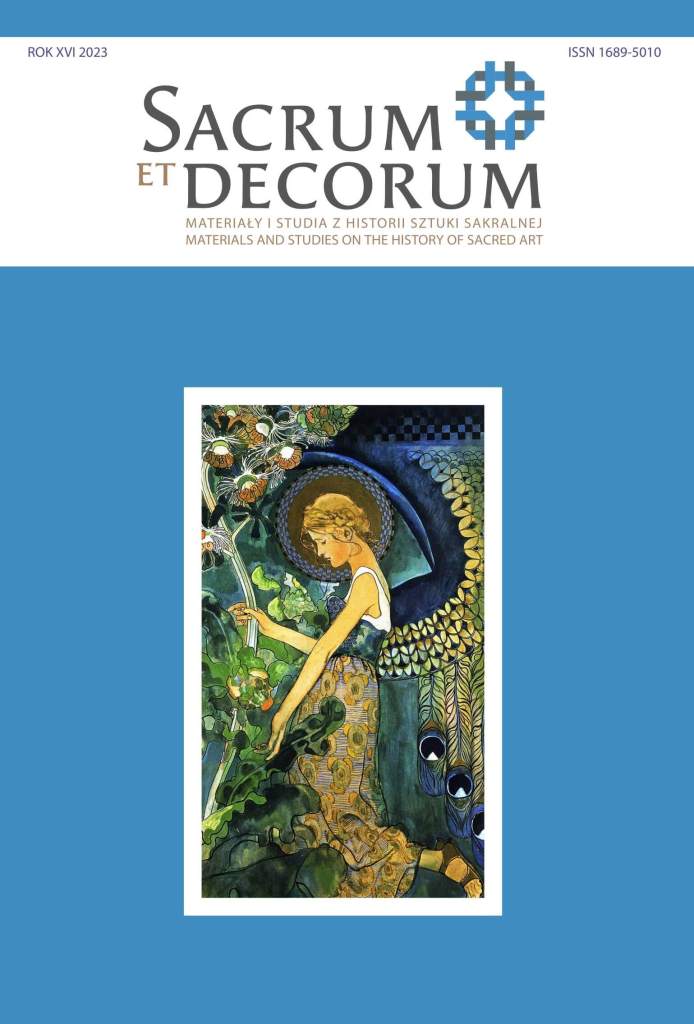
The editors of Sacrum et Decorum, a peer-reviewed international journal dedicated to the history and study of sacred art, invite submissions for a special focus on sacredChristian art in Australia and Aotearoa New Zealand. They welcome contributions that engage with the intersection of Christian (broadly interpreted) visual culture and the distinctive colonial, postcolonial, and multicultural contexts of the region.
Topics of interest include, but are not limited to:
Church architecture and interior decoration
First Nations and Māori visual traditions’ encounters with European missionary art
The reception and adaptation of European sacred art traditions in Australia and New Zealand
Religious street art
Individual artists, craftspeople, and workshops engaged in sacred art production
Stained glass, iconography, sculpture, metalwork, and devotional objects
Contemporary sacred art and evolving liturgical aesthetics
Sacrum et Decorum is published in both Polish and English and is indexed in DOAJ, ERIH PLUS, EBSCO, and other major academic databases. It is an open-access publication, and authors retain full copyright under a Creative Commons CC BY 4.0 licence.
The journal welcomes original, previously unpublished scholarly articles making a substantive contribution to the field. In addition to full research articles, shorter contributions – including reviews, source materials, and artists’ reflections on their own practice – are also invited. Submissions in English are particularly encouraged.
Full author guidelines, technical requirements, and submission information are available at the journal’s website.
No painting can be adjudged, can reveal its true meanings, can expose the deeper insights and sensitivities of the artist, unless one physically confronts and breathes in the paint. The message is in the medium. All that I am able to do is run my eye attentively over computer images of the successive panels of Kyrie Eleison, draw attention to one or two more obvious themes, and supplement my a priori reading of the paintings by inferences drawn from my many years of friendship with Michael Galovic.
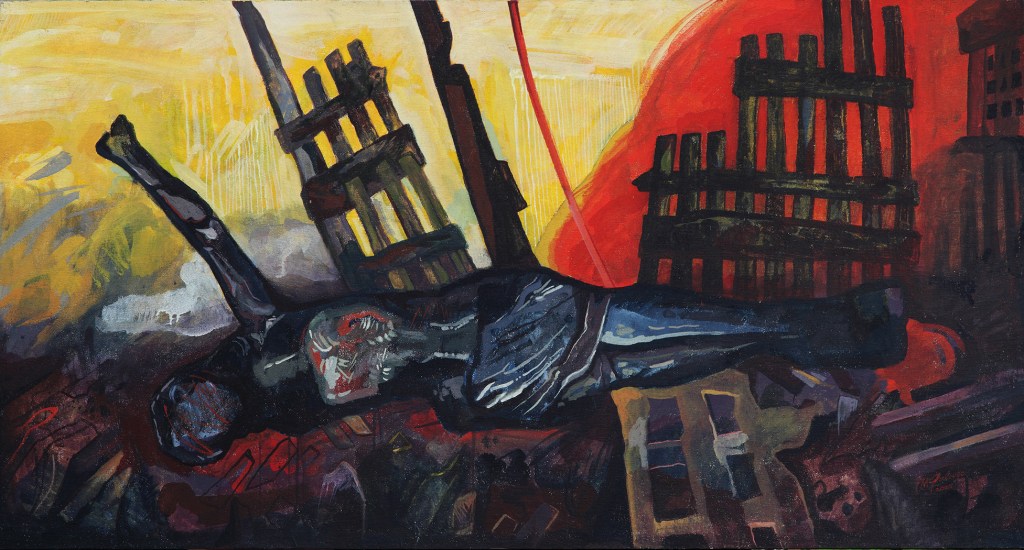
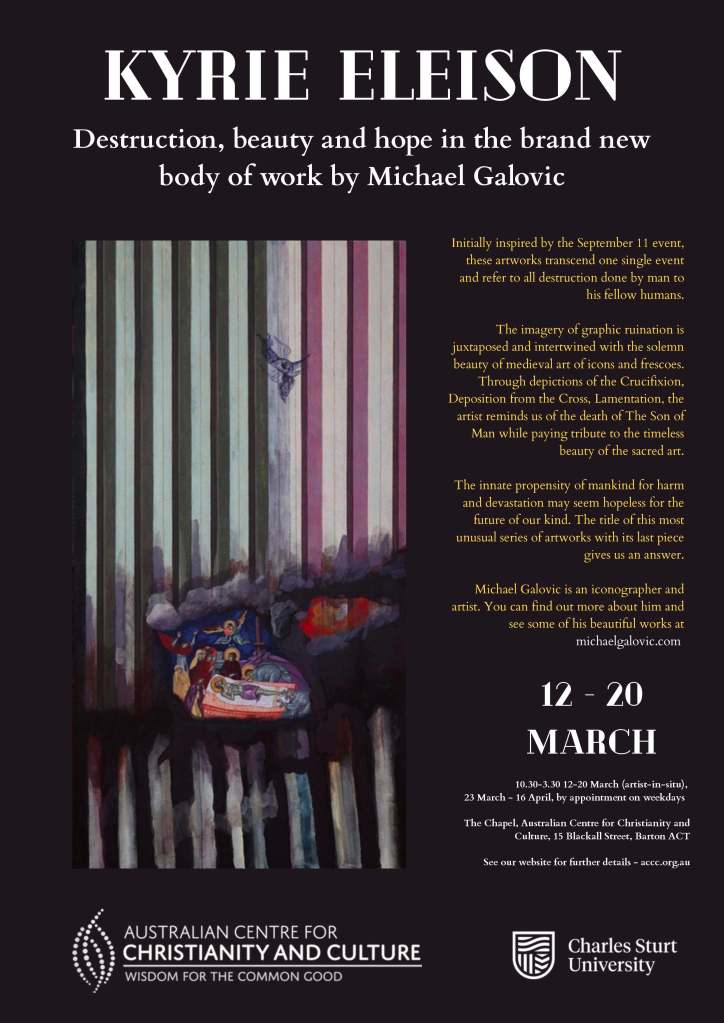
Inspired by the unforgettable photographic images of the Twin Towers, Michael was moved to give iconographic expression to his meditations around the catastrophic event in the form of a series of eight interconnected, moving, and challenging panels. Drawing on living water from the well of Eastern Orthodox iconography, each successive panel links images of the devastated World Trade Centre to the Gospel narrative of Christ’s passion and resurrection, episode by episode. Michael’s conviction clearly was that it is only through the salvific Paschal Mystery that spiritual meaning can be ascribed to the otherwise totally meaningless incident.
But, as with Holy Scripture, one needs to delve deeper into the narrative to expose the sensus plenior, the fuller sense, that lies beneath the surface of the imagery. Unless I am much mistaken, what lies beneath the surface is a vision of “things-to-come” that Michael shares with countless Christians around the globe. To reduce this vision to its barest bones, it is that of an impending (in fact, it has actually started) worldwide catastrophic collapse of cultures and institutions, ecclesiastical as well as secular, accompanied by massive extinction of biological species, and the ravaging, or even the extreme elimination, of entire human populations. But this widely shared vision is not one of despair but of hope; not hope in the “but there is still time” with which climate scientists seem to feel it their duty, even if contrary to their convictions, to conclude their dire warnings, but hope, of faith, that a new universal order will emerge amongst a remnant humanity.
Michael Galovic, Kyrie Eleison, 2025. 170 x 80 cm.
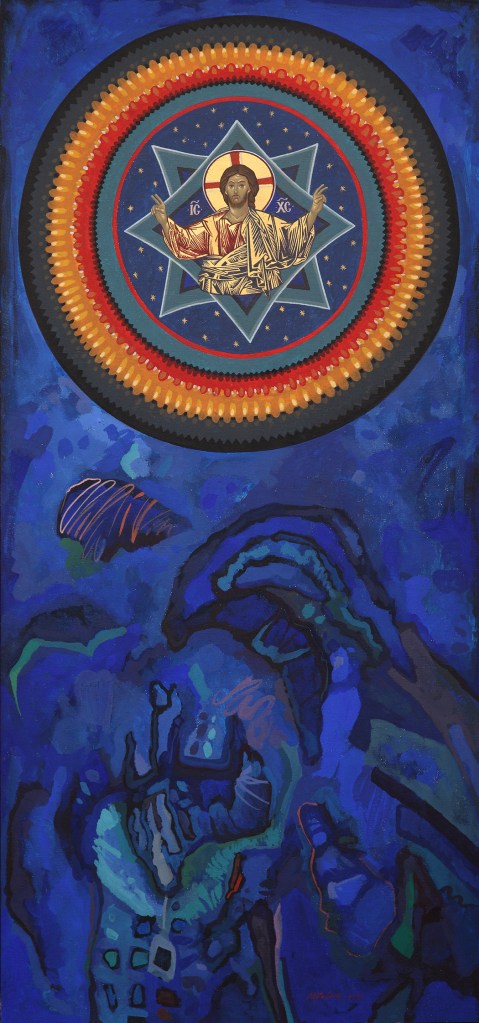
In its Christian form, it is the conviction that the New Jerusalem will be centred on the Cosmic Christ, through whom, in the power of the Divine Breath, the Holy Spirit has drawn people to himself from the beginning of the Homo sapiens story. The eternal Logos, the Word,and the Incarnate Christ, Jesus of Nazareth, are one and the same, but the Word has come to the hearts of countless millions of seekers before the Incarnation and amongst those who have heard nothing of the gospel, even today. The cosmic Christ is the universal Christ, the saviour for all. The age of the cosmic Christ, to those who share this vision, will not be long coming.
Galovic’s Kyrie Eleison series is defined by the first and last panels, from the fall of the towers to the icon of the cosmic Christ. Each of the intervening six panels is centred on a cluster of symbols that invite the viewer to meditate on Galovic’s apocalyptic vision, first from one angle, then from another. Obviously, the symbols were selected and grouped because, for Galovic, each symbol has a particular meaning. But symbols are polysemous, and indeed frequently carry opposite connotations. This means that each panel, in its unique way, can simultaneously convey or connect with the meanings of both horror and doom, and with the promise of a new order arising from a devastated world.
But why, one might ask, does Galovic ground the whole series in the destruction of the World Trade Centre on 9/11? Galovic’s Kyrie, though he constantly refers back to 9/11, is not about 9/11 per se. He simply uses 9/11 as a type (in the biblical sense) of catastrophic events with worldwide consequences in general. He could, to take a couple of examples, equally have chosen the nuclear holocaust of the people of Hiroshima and Nagasaki in 1945, or the ongoing genocide of the Palestinians of Gaza, to anchor the series. The obvious answer to the question is that it was the impact, and by no means does that exclude aesthetic impact, of those unforgettable photos of the destroyed Twin Towers that gripped his attention. It was indeed those naked, silvery pinnacles of steel rising from the sea of wreckage that were to haunt Galovic and led to a series of 9/11 paintings that predate Kyrie.
Even the view from in front of a computer screen is more than sufficient to tell one that Galovic’s Kyrie Eleison is a work with a desperately urgent message for our times. In my opinion, it is both a triumph for Galovic as an iconographer and for the flexibility of the Serbian iconographic tradition, which has been his mentor since childhood, that has enabled him to interpret the apocalyptic signs of our times in a brilliant sequence of iconographic images of the unfolding heart-rendering stages of the paschal mystery.
℘℘℘℘
Guy Freeland, a lecturer at St Andrew’s Greek Orthodox Theological College, Sydney, lives and works on the lands of the Dharug people.
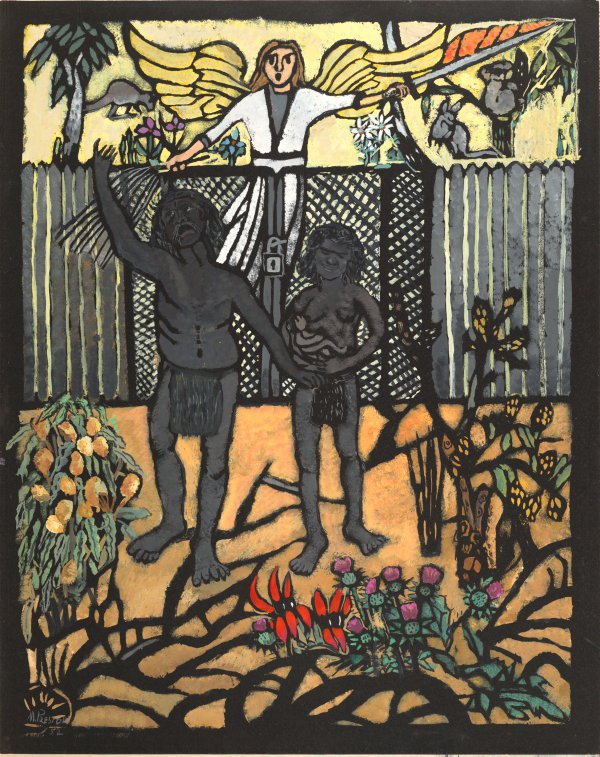
Margaret Preston, The Expulsion, 1952. Colour stencil, gouache on thin black card with gouache hand colouring, 60.5 x 48.5 cm. Art Gallery of New South Wales, Sydney, Australia.
The Bible and Visual Culture unit is dedicated to the critical study of how biblical texts, themes, and figures are interpreted, adapted, and reimagined through visual media—from ancient mosaics and manuscript illuminations to contemporary film, television, video games, advertising, and public art. These visual interpretations have shaped, and continue to shape, the ways biblical texts are received, interpreted, and contested within the wider cultural imagination.
The unit is intentionally interdisciplinary, drawing on art history, film and theatre studies, media studies, musicology, gender studies, trauma studies, postcolonial criticism, and more. Whether examining biblical motifs in cinema, exploring representation in public art, or analyzing the commodification of biblical imagery in advertising, it highlights the interpretive power of the visual and its capacity to illuminate aspects of biblical reception.
We warmly invite established scholars and PhD candidates to submit a proposal on any topic related to the visual reception, interpretation, or representation of biblical texts—historical or contemporary, theoretical or methodological. Presentations will be thirty minutes, including discussion.
Given our location in Adelaide, we particularly welcome papers that engage with Australian art featured in Australian galleries, museums, and public spaces. How have Australian artists interpreted biblical narratives? What role does biblical imagery play in Australia’s visual culture, from colonial-era works to contemporary Indigenous perspectives? This meeting offers a unique opportunity to explore these questions in context.
Paper proposals should be submitted here and should include your name, institutional affiliation, paper title, and an abstract of approximately 250 words. Proposals may be submitted at any time before 15 January 2026. All presenters must register for the SBL International Meeting. Further details about the Adelaide meeting are available on the SBL website.
Amanda Dillon and Jason Goroncy Coordinators, Bible and Visual Culture Unit
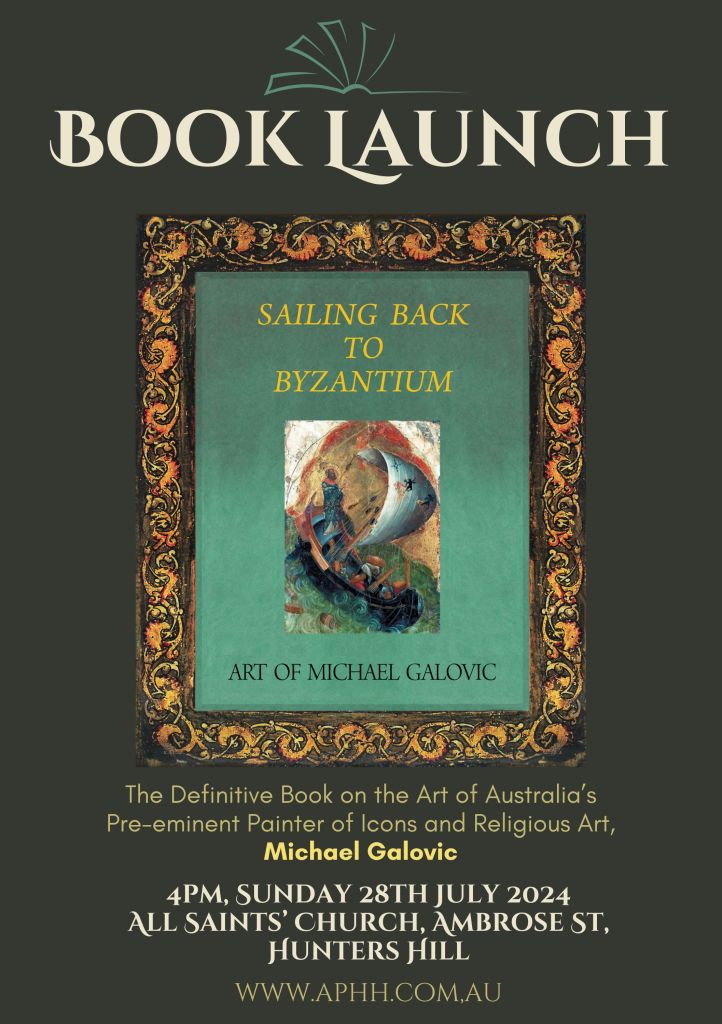
Sailing Back to Byzantium: Art of Michael Galovic. Melbourne: Yarra and Hunter Arts Press, 2024.
This lavish, large-format publication on the work of iconographer Michael Galovic is a welcome addition to the coverage of the arts and spirituality in Australia. It is a beautiful book, an art work in itself. In around 260 pages, it surveys the work of one of Australia’s most well-known painters of icons, covering traditional themes, innovative new work, and important commissions around the country.
Born in Belgrade, Michael Galovic arrived in Australia in 1990 and set about sharing his cultural knowledge through small exhibitions and workshops. The 2006 publication Icons and Art provided a visual overview of the first 15 years of his art production. This new and more generous publication covers the next 17 years, providing an overview of this important innovator and translator of the Orthodox tradition.
The book is divided into sections covering such themes as the Annunciation, the Son of Man, Theotokos, and angels, more innovative themes such as Uluru as an icon, and more experimental ideas that explore the nature of spirituality in multicultural Australia. These are supported by 24 short writing sections that address issues of technique, history, and theological themes. These are provided by the artist as well as a range of authors from art historical or theological perspectives. This enriches the book as a wider resource in understanding the role of the icon as a source of spirituality and the role that vision has in informing spiritual responses.
What is clear is the immense skill and labour that is needed to follow this ancient tradition and to make each work come alive through a fresh illumination rather than appearing as a tired copy. Galovic is a keen student of the past and pays great respect to traditional techniques. He has, however, also allowed himself to experiment with fresh ideas and approaches and has found inspiration in a wide variety of sources, including modern art and the art of Indigenous Australians.
The extensive range of commissions has allowed him to enliven the worshipping spaces of a wide variety of churches, chapels, and schools and to renew this tradition as a lively and contemporary form of seeing faith. This book provides rich resources for understanding this tradition and for appreciating this artist and his life’s work.
The book will be launched at an event in Sydney on Sunday, 28 July, at All Saints Church Ambrose St, Hunters Hill, at 4pm. It is available from the artist through his website. It would be a great addition to a personal library, a beautiful gift, or an important resource in a school or college library.
℘℘℘℘
REV DR ROD PATTENDEN IS AN ART HISTORIAN AND THEOLOGIAN FROM AUSTRALIA. HE HAS WRITTEN WIDELY ON THE ARTS AND CREATIVITY. HE LIVES AND WORKS ON AWABAKAL LAND.
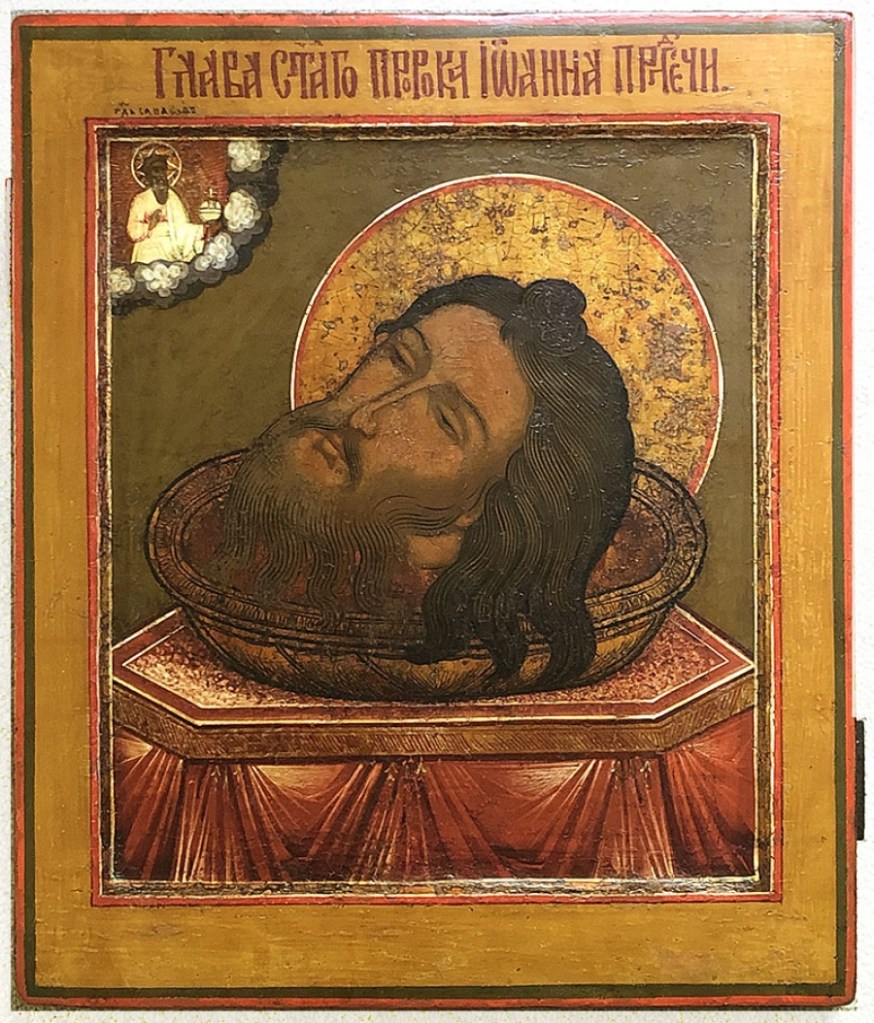
The Severed Head of St. John the Forerunner, c. 1870s. Egg tempera on silvered and gessoed wood, 31 x 26 cm. Private collection.
There’s a timely reflection by Seung Heon Sheen over at Transpositions on the relationship between AI-generated art and iconography, with implications for how we might consider the relationship between an artist and their work more generally. It draws on relevant texts from the iconoclast controversies of the eighth and ninth centuries. Here’s a snippet of the argument in nuce:
… any ‘icon’ generated by a ML algorithm would be inherently idolatrous since the relationship between the image and the archetype would be severed. That is, although the works produced by a human iconographer and an AI ‘iconographer’ may be outwardly similar, inwardly they would be radically different due to the disparity in the process of their creation. A human iconographer faithfully contemplates and depicts the archetype; an AI abandons the archetype and merely replicates its images. And if this is so in the case of iconography, it implies a danger of idolatry in involving AI in religious art or employing it for religious purposes.
Danylo Movchan is a Ukrainian artist who lives and works in Lviv. Below is a photo of an icon written by Movchan, his response to Russia’s bombing yesterday of a Ukrainian children’s hospital and maternity ward, in the city of Mariupol.
Господи помилуй.
Danylo Movchan, НАПАД (ATTACK) 9.03.2022, 2022. Size and medium unknown. Lviv, Ukraine. Artist’s collection.
I first met Michael Galovic through an icon painting workshop in the mid-1990s. His religious art not only covers a vast range of icons that draw upon his deep understanding and respect for the form from its earliest origins through to the present day but also covers contemporary work.
Michael’s most recent project has been a very challenging and self-imposed task. Its focus has been primarily on the representation of ‘the Celestial Ranks’, predominantly as shown in Orthodox art, but also with examples from late medieval, early Renaissance, and Islamic art. Each of the many wonderful images expresses what would seem almost inexpressible: non-corporeal beings made manifest. The exhibition based on this work, and which is currently on display between 9–19 March at the Australian Centre for Christianity and Culture, Canberra, also highlights both the meaning and the beauty of the variety of portrayals, whether it be in terms of the images’ backgrounds or in such elements as the stunning array of angels’ wings. The icons in the exhibition illustrate a journey that is both geographical and through time.
My focus here, however, will be predominantly on his representation of two of the most significant and defining events in Christianity – the Annunciation and the Resurrection – as portrayed in the icon of ‘The Myrrh-bearing Women’, as well as the concept of the Trinity. Each image deepens one’s understanding of the religious art of the past and present, as well of a sense of tradition, while also expressing the perception and perspective of its creator:
In terms of the Orthodox tradition, icons are perceived, Annemarie Weyl Carr observed, as participating in the divine:
As angels and saints are images of God, icons, in turn, are images of them and so participate in the emanation of their sanctity. The crucial synapse between divinity and created matter was bridged by the incarnation.[2]
The richness and variety of the icons is expressed through new iterations that nonetheless remain firmly grounded within the Orthodox tradition. The icons of the past were not mechanical copies of previous work. The tradition evolved not through meticulous repetition but through observing and understanding the symbolism and underpinning theology inherent in the creation of the icon. Each is also influenced by the time, background, and perception of the person making it.
To appreciate the beauty and theology of an icon is ultimately to be able to appreciate the immanence of God in creation:
He fathers-forth whose beauty is past change: Praise Him.[3]
The Icons of the Annunciation
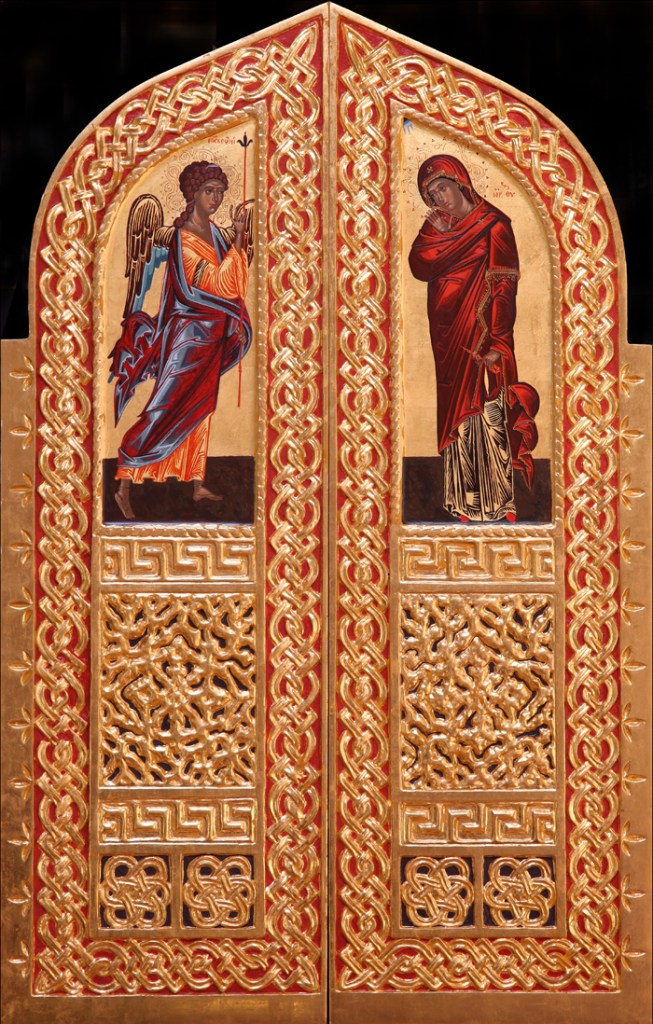
Michael Galovic, Royal Doors, 2021. Egg tempera and gold leaf on gessoed board, 95 x 60 cm. Artist’s collection.
Michael noted that his ‘Royal Doors’, an image of the Annunciation, is a work that has been 47 years in the making. This gives some sense of the process: it takes enormous patience in feeling one’s way into the image, as well as an understanding of the level of experience and technical skill needed to do such a work justice. It is a testament to Michael’s commitment to creating an image that brings alive the moment of the Incarnation in all its vividness and freshness. There is a wonderful balance between the sense of movement in the depiction of Gabriel, conveyed by both the pose and dynamism of the contrasting highlights, and the Theotokos’ acceptance, shown in her gently-bowed head and hand gesture.
It is difficult just to convey a sense of the intricacies of the craftsmanship required in the creation of this wonderful depiction of the Archangel Gabriel and the Theotokos. It began with the painstaking application of multiple layers of gesso to the intricately-carved wooden surface and then the gilding of the entire piece. This was followed by the meticulous translation of the drawn images onto the surface, with some parts being carefully embossed or stippled, as can be seen in the exquisite halos.
The actual painting of the image with egg tempera was a further level of challenge, with each layer needing to be completely dry before the next layer was attempted – often a matter of days, rather than hours.
The impermeability of the gold also makes it an exceptionally challenging surface on which to paint. The difficulty of the challenge is underscored by Eva Haustein-Bartsch’s comment, in her description of the Royal Door in the Recklinghausen Ikonen-Museum, that ‘what is completely unusual and probably unique about this door are the images painted on it over a gold background’.[4]
Michael has created a truly outstanding depiction of the imagery frequently used on ‘Royal Doors’, bringing together many theological and technical aspects of iconography to delineate the entry to the sanctuary, considered in Orthodox theology to be ‘Heaven placed on earth’, as it contains the consecrated Eucharist, the manifestation of the New Covenant.
Michael Galovic, The Annunciation 2, 2021. Egg tempera and gold leaf on gessoed board, 35 x 45 cm. Artist’s collection.
The second Annunciation, in a more contextualised setting, also captures the moment of the Archangel Gabriel’s first addressing Mary. There is the same sense of movement as in the ‘Royal Doors’ in the placement of the feet, with the role of messenger indicated both by the rod
being carried and the hand gesture indicating speech. Mary’s gesture here is one of enquiry – ‘“How will this be”, Mary asked the angel, “since I am a virgin?”’ (Lk 1.34)
This icon again highlights that Michael’s work, while maintaining the theology and often the form of earlier icons, by no means consists of making a mechanical copy of an earlier image! The vivid light blues on a deeper blue background sweep through from the tips of Gabriel’s wings to the sleeve of his under-gown with the same tones used in a static mode in the pillar beside Mary. This contrast is repeated in the lower part of the icon, with the rippling effect of Gabriel’s hem counterpointing the ‘stillness’ of Mary’s undergarment.
Another beautiful detail is the way in which the beam of light, with its image of the dove representing the Holy Spirit, is transparently overlaid on the red cloth. Each detail is indeed meticulously placed and adds to the viewer’s understanding and reception of the image, with the draped red cloth indicating that the scene is taking place in an interior. The colour flows through to Mary’s cushion, the thread she is holding and her ‘royal’ footwear. This image again emphasises the way in which the same image (that of the Annunciation) can both take inspiration from the past and create a new and vivid image. This is what keeps the tradition alive and relevant.
Michael Galovic, The Annunciation 3, 2022. Egg tempera and gold leaf on gessoed board, 38 x 29 cm. Artist’s collection.
The inspiration for the third Annunciation in the series came from a faded and almost unreadable copy of an Annunciation from sixteenth-century Russia, and which had deteriorated to the point that, while the basic structures could be made out, that was about all. Michael always enjoys a challenge.
The image is also a very unusual one in that it shows darkened apertures in both the buildings and the holes in the ground, especially the fissure appearing between Mary and the Archangel. This could conceivably be highlighting the significance of Christ’s incarnation through referencing those icons of the Crucifixion where there is a dark aperture beneath the cross, into which Christ’s blood flows, signifying the redemptive nature of his death. The Crucifixion is inherent in the Annunciation.
The dark spaces dramatically highlight the wonderful luminosity that Michael has achieved in the depiction of both Gabriel and Mary. It, possibly more than any other icon in the exhibition, illustrates the concept of feeling one’s way into the image. It required a deep understanding, much thought and subsequently a painstakingly slow application of layer upon layer of semi-transparent egg and pigment washes to create the tonality that brings the image to life.
Michael Galovic, The Blue Annunciation, 2021. Egg tempera and gold leaf on gessoed board. Artist’s collection.
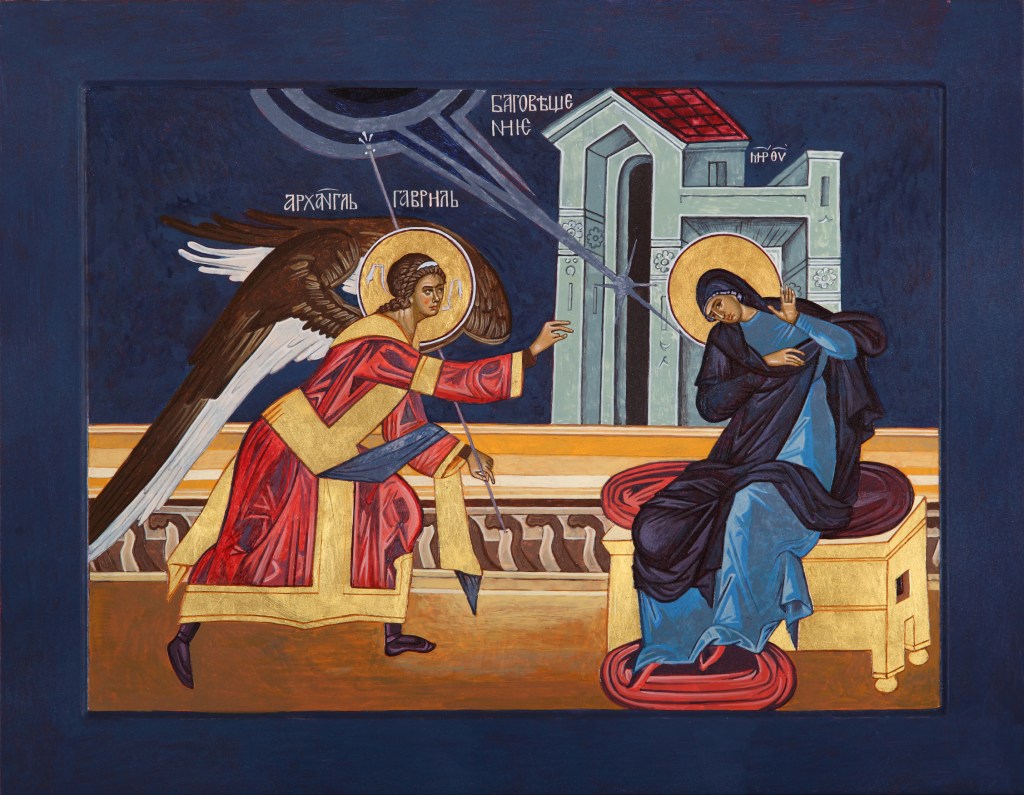
The fourth Annunciation is based on a fresco with a suitably-Aegean blue providing a background against which the figures and architecture stand out vibrantly, capturing the moment of the Incarnation.
These four images exemplify both the richness and diversity of traditions over at least four centuries and the value of bringing them alive in varied and beautiful iterations in the twenty-first century. While each highlights the role of the Archangel as the servant and messenger of God, as identified by the armband, and captures the contrast between movement and stasis, the nuances in the portrayal of Gabriel and Mary and the treatment of the backgrounds, ranging from the ‘uncreated light’ of the ‘Royal Doors’ to the texture and abstraction demonstrated in the three following images, exemplify the beauty, scope, and continuing significance of Iconography.
At the still point of the turning world. Neither flesh nor fleshless;
Neither from nor towards; at the still point, there the dance is …[5]
Michael Galovic, The Myrrh-bearing Women by the Tomb, 2022. Egg tempera and gold leaf on gessoed board, 45 x 35 cm. Artist’s collection.
Michael Galovic, Angelic Exuberance, 2021. Egg tempera and gold leaf on gessoed board, 70 x 50 cm. Artist’s collection.
From the Annunciation to the Resurrection
Gabriel’s role as messenger is also highlighted in the icon of ‘The Myrrh-Bearing Women by the Tomb’, a diaphanously-rendered image of the women visiting Christ’s tomb. The delicacy and aptness of the detail, such as the fruitfulness of the trees, illustrates the richness in the variety of the use of imagery in the context of the Resurrection.
‘Angelic Exuberance’ is another vivid expression of the Resurrection – a dynamic and powerful iteration of a golden Archangel Gabriel that captures the light and joy of the event in a contemporary image that also evokes a continuing tradition: that of the White Angel, which is a detail of one of the best-known frescoes in Serbian culture, situated in the Mileševa Monastery.
Michael Galovic, The Assembly of Angels, 2021. Egg tempera and gold leaf on gessoed board, 45 x 35 cm. Artist’s collection.
‘The Assembly of Angels’ also includes the Archangel Raphael, whose name means ‘God has healed’. In conjunction with the image of Christ it highlights, for me, the nature of redemption through the Incarnation. The Christ Child is framed by an intricate rainbow-like aureole or medallion. The golden brightness in the central band of the medallion gives a wonderful vividness and focus to the work. This icon, in conjunction with its vibrancy highlighted through the angels’ garments and royal footwear, nonetheless seems to be set beyond time with a neutral background that portrays the figures as if floating in space. This feeling of weightlessness is enhanced by the folded position of the wings.
Michael Galovic, The Holy Trinity, 2022. Egg tempera and gold leaf on gessoed board, 38 x 29 cm. Artist’s collection.
It seems fitting that the final image considered should be that of ‘The Holy Trinity’, which radiates calmness and certainty, as well as embodying a significant aspect of the development of portrayals of the Trinity. The process of the ‘three angels’ form for representing the Trinity began with icons of the hospitality of Abraham, which illustrated the visit of the three angels, in human guise, to Abraham.
This is a beautiful and elegant composition, based on a work by arguably the best Serbian iconographer – Zograf Longin. It is an icon that expresses the tripartite nature of God as expressed in the New Testament while highlighting the continued relevance and significance of the Old. Michael has dedicated a year to the completion of this project – one that needed fifty years practice and deepening of understanding for its making. He has brought alive the beauty and theology of differing traditions and forms in a way that is truly breathtaking.
℘℘℘℘
Kerrie Magee has an academic background in medieval studies and education. Her interest in, and respect for, icons began in her mid teens and has continued ever since. She has been painting under Michael Galovic’s tuition for over 20 years. She has worked in teaching and gifted education. She lives on Wallumettagal Country.
Michael Galovic is one of Australia’s leading icon painters and has been commissioned by churches and individuals around Australia to celebrate the tradition of holy pictures in new and dynamic ways. Galovic trained at the Belgrade Academy of Arts as a contemporary artist while also learning the many technical steps of using egg temperas and gold leaf, required by the careful process of preparing an icon. He arrived in Australia in 1990 and has since that time had many solo exhibitions in Australia and overseas including in Europe and the USA. While continuing the tradition of iconography he has also extended his approach to include insights from the Australian landscape, indigenous spirituality and more universal depictions of the presence of God in creation. He is a careful technician able to enliven the demanding requirements of the tradition while also offering visual innovations that explore the cultural convergence required of a multi-cultural Australia. His work is always visually rich, finely detailed with a great depth of colour and form. A skilled and insightful artist exploring the spiritual through his art. (Dr Rod Pattenden). Michael lives and works on the land of the Darkinjung people.
[2] Annemarie Weyl Carr, ‘How Icons Look’, in Imprinting the Divine: Byzantine and Russian Icons from the Menil Collection (Houston: Menil Collection, 2011), 23.
What kind of time is this? And what might such a time mean for artists and their work?
Beyond the very real financial hit that many artists are currently taking, a great many of us, artists included, are welcoming this abnormal moment to ask other questions – existential questions, and questions about our regular habits and commitments, for example. It is suggested that to try to carry on with business as usual, however tempting and well-intentioned that might be, would be to forego a rare opportunity to reimagine and re-embody other modes of our living. Others are turning to all kinds of creative endeavours. Others still – including artists – are asking whether now is really the time to make art at all?
Of course, we’ve been here before. This is hardly the first time in our history that such questions have been asked.
In the aftermath of WWII, where the dominating backdrop was clearly otherwise than it is today, the philosopher Theodor Adorno, in his Negative Dialectics, raised the question of whether the traumas of Auschwitz mean that ‘we cannot say anymore than the immutable is truth, and that the mobile, transitory is appearance’. It is not, he insisted, a case of an impossibility of distinguishing between eternal truth and temporary appearances (Plato and Hegel had already showed us how that could be done); it’s just that one cannot do so post-Auschwitz without making a sheer mockery of the fact:
After Auschwitz, our feelings resist any claim of the positivity of existence as sanctimonious, as wronging the victims: they balk at squeezing any kind of sense, however bleached, out of the victims’ fate. And these feelings do have an objective side after events that make a mockery of the construction of immanence as endowed with a meaning radiated by an affirmatively posited transcendence.
Put more plainly, our emotional responses to horrors of such magnitude ought to outweigh all our attempts to explain them. It was this conviction too that led Adorno to state famously (in his essay ‘Art, Culture and Society’) that ‘to write poetry after Auschwitz is barbaric’, and that ‘the task of art today is to bring chaos into order’. The line between explanation and intelligibility has been severed. In the wake of such, we are left with the possibility of Adorno’s ‘negative theodicy’, a kind of theodicy in which the old intellectual and philosophical distance is impossible. If we are to make any headway at all in recognizing how the Nazi death camps succeeded in the destruction of biographical life, and reorientate our thinking in response, Adorno argues, we must learn how to regard Auschwitz as the culmination of a trajectory embedded in the history of western culture in the wake of the Enlightenment. In other words, there can be no genuine acknowledgement of the Holocaust that does not begin with the realization that ‘we did it’.
Today, our questions may be otherwise. For some of us – for those, for example, trying to discern (or create) lines between unbridled capitalism, ecological disaster, and global pandemics – perhaps they are not so.
In his latest post for The Red Hand Files, musician Nick Cave responds to a series of questions about his own plans for this time during the corona pandemic. His reflection is worth repeating here in full:
Dear Alice, Henry and Saskia,
My response to a crisis has always been to create. This impulse has saved me many times – when things got bad I’d plan a tour, or write a book, or make a record – I’d hide myself in work, and try to stay one step ahead of whatever it was that was pursuing me. So, when it became clear that The Bad Seeds would have to postpone the European tour and that I would have, at the very least, three months of sudden spare time, my mind jumped into overdrive with ideas of how to fill that space. On a video call with my team we threw ideas around – stream a solo performance from my home, write an isolation album, write an online corona diary, write an apocalyptic film script, create a pandemic playlist on Spotify, start an online reading club, answer Red Hand Files questions live online, stream a songwriting tutorial, or a cooking programme, etc. – all with the aim to keep my creative momentum going, and to give my self-isolating fans something to do.
That night, as I contemplated these ideas, I began to think about what I had done in the last three months – working with Warren and the Sydney Symphony Orchestra, planning and mounting a massive and incredibly complex Nick Cave exhibition with the Royal Danish Library, putting together the Stranger Than Kindness book, working on an updated edition of my “Collected Lyrics”, developing the show for the Ghosteen world tour (which, by the way, will be fucking mind-blowing if we ever get to do it!), working on a second B Sides and Rarities record and, of course, reading and writing The Red Hand Files. As I sat there in bed and reflected, another thought presented itself, clear and wondrous and humane –
Why is this the time to get creative?
Together we have stepped into history and are now living inside an event unprecedented in our lifetime. Every day the news provides us with dizzying information that a few weeks before would have been unthinkable. What deranged and divided us a month ago seems, at best, an embarrassment from an idle and privileged time. We have become eyewitnesses to a catastrophe that we are seeing unfold from the inside out. We are forced to isolate – to be vigilant, to be quiet, to watch and contemplate the possible implosion of our civilisation in real time. When we eventually step clear of this moment we will have discovered things about our leaders, our societal systems, our friends, our enemies and most of all, ourselves. We will know something of our resilience, our capacity for forgiveness, and our mutual vulnerability. Perhaps, it is a time to pay attention, to be mindful, to be observant.
As an artist, it feels inapt to miss this extraordinary moment. Suddenly, the acts of writing a novel, or a screenplay or a series of songs seem like indulgences from a bygone era. For me, this is not a time to be buried in the business of creating. It is a time to take a backseat and use this opportunity to reflect on exactly what our function is – what we, as artists, are for.
Saskia, there are other forms of engagement, open to us all. An email to a distant friend, a phone call to a parent or sibling, a kind word to a neighbour, a prayer for those working on the front lines. These simple gestures can bind the world together – throwing threads of love here and there, ultimately connecting us all – so that when we do emerge from this moment we are unified by compassion, humility and a greater dignity. Perhaps, we will also see the world through different eyes, with an awakened reverence for the wondrous thing that it is. This could, indeed, be the truest creative work of all.
Love, Nick x
Like Cave, Adorno too challenges us to ‘take a backseat and use this opportunity to reflect on exactly what our function is – what we, as artists, are for’ – and to lean into ‘other forms of engagement’ that such uncertain and time-altering times render (almost) unavoidable. It is certainly a time to consider our responsibility to and involvement in all kinds of violence, for example.
The only philosophy which can be responsibly practiced in face of despair is the attempt to contemplate all things as they would present themselves from the standpoint of redemption. Knowledge has no light but that shed on the world by redemption: all else is reconstruction, mere technique. Perspectives must be fashioned that displace and estrange the world, reveal it to be, with its rifts and crevices, as indigent and distorted as it will appear one day in the messianic light. To gain such perspectives without velleity [fancy] or violence, entirely from felt contact with its objects – this alone is the task of thought.
Is not what might be true for ‘philosophy’ and ‘thought’ not also true for art? Redemption, the ‘messianic light’, exposes the incongruity between the world as it appears now and the world as it might be. That exposure – birthed and sustained by profound and counterintuitive hope, hope born not of trust in markets or in a change of conditions but which is the wholly unanticipated gift of the God of life – serves as both a judgement upon all that threatens and overcomes life, and as a promise that there is a love that is stronger than death.
That exposure also brings new possibilities for artists – in their freedom – to find their banjos, their pens, their brushes, their shoes, their voices, their humanity, etc. etc.
Human poiesis (and theology too, for that matter) can be – and in this world ought to be, as Jonathan Sacks put it in To Heal a Fractured World: The Ethics of Responsibility – a form of protest ‘against the world that is, in the name of the world that is not yet but ought to be’. It can like placing oneself right in the midst of a broken world – something like the way that the cellist Vedran Smailović placed himself in Sarajevo’s partially-bombed National Library in 1992 – and refusing to accept that the way things appear is the way that things must or will be.
℘℘℘℘
JASON GORONCY IS A THEOLOGIAN, ARTIST, AND FOLK FESTIVAL TRAGIC WHO LIVES AND PLAYS ON WURUNDJERI LAND.
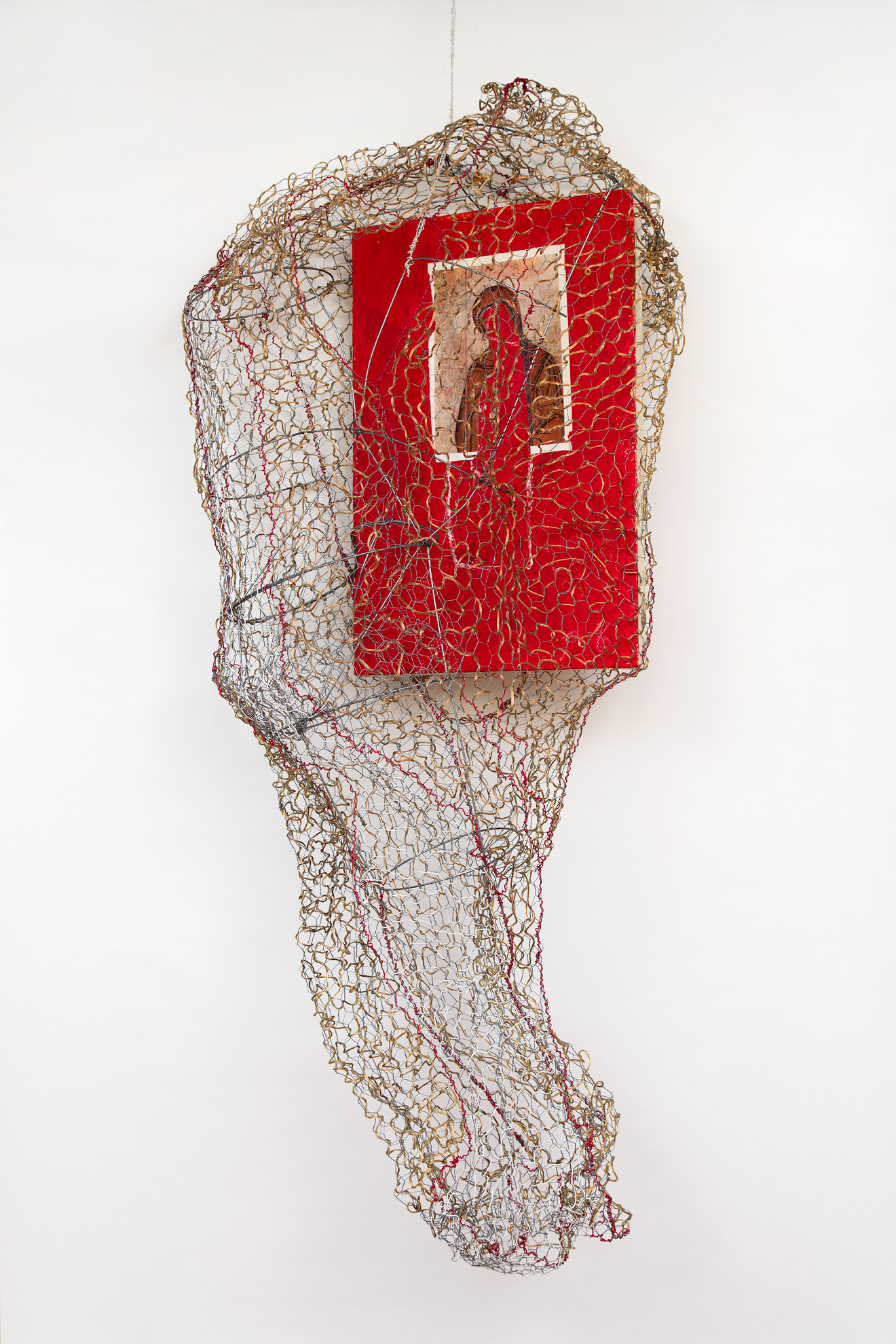
Alfonse Borysewicz, ‘Full of Grace’ (2017–18), 84 x 34″. Oil & Wax on Linen with Riza Cage.
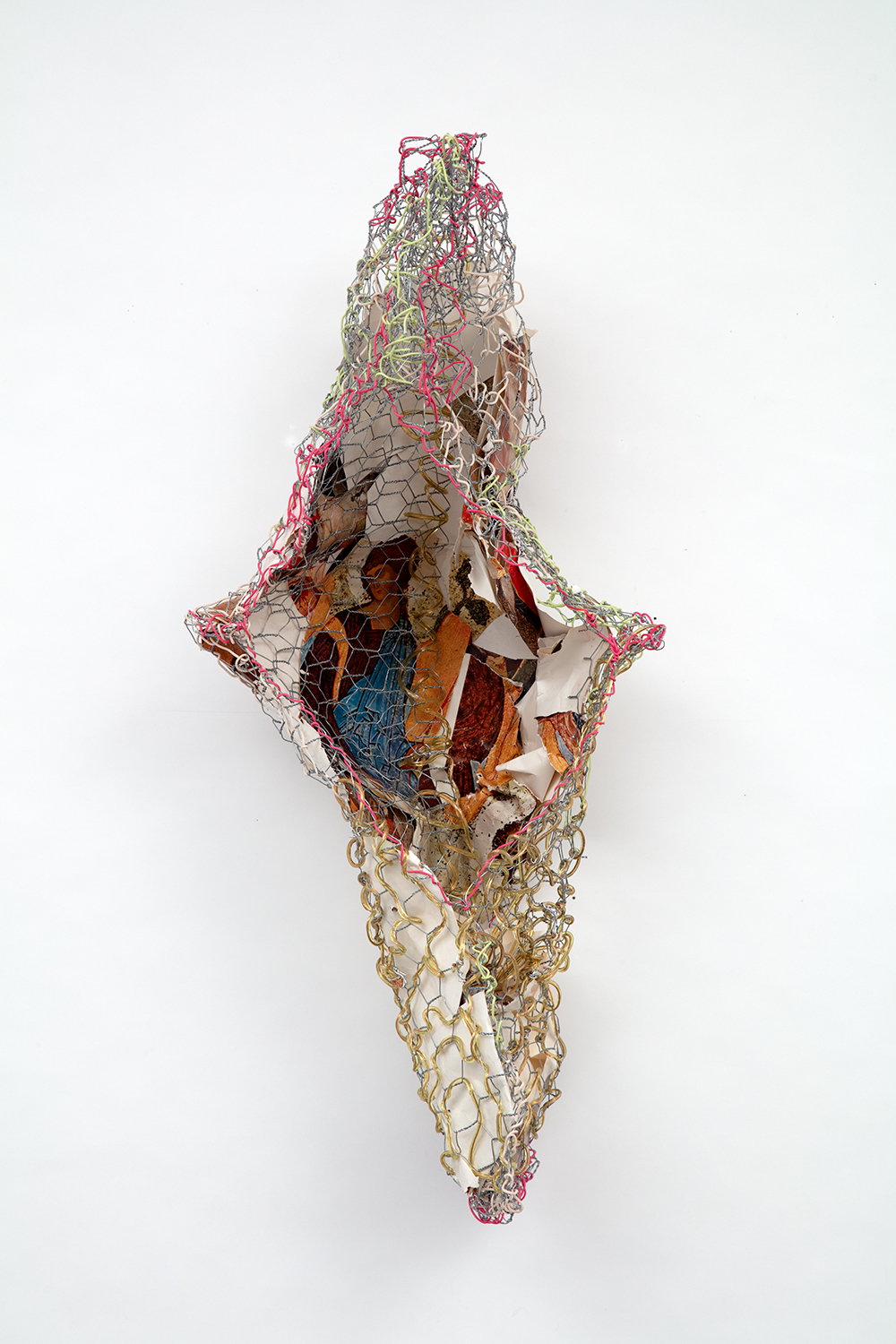
Two years ago, a friend asked me to make a sculptural piece for her dance company. All of us involved in New York City had limited means and space, as artists are pushed out of this-once art capital. As such, I began to create these shapes out of chicken wire mesh with tomato wire stakes as its armature (the garden), wrapped with electrical/lamp/cable wire (offering a gold leaf like light and hue). Eventually, I filled these voids with paintings of mine and/or crumbled up pages from discarded icon books, thinking of the “throw away culture” so poignantly revealed in Pope Francis’s Laudato Si and of my own attempts to rescue and to recycle these images.
Icons have traditionally employed metal coverings with stones and emeralds, Rizas, to protect the sacred image. Same here. Recently, I met a Ukrainian woman at my art opening who didn’t appreciate what I was doing with her tradition of sacred icons. Slowly, I walked her through my creative process and offered her the possibility that I was not only rescuing these images but liberating them from discarded books, bringing them out into the open. She nodded and had a change of view. As evidenced in Star, a light for us to follow in this Advent season.
Also brought to my attention by various strangers (this is why the viewer is so important in the visual arts) was the realization that these Riza sculptures which to me reveal the sacred icon image outside of book form, as well as my own renderings, were in the shadows – literally, cages – that echo the tragedy unfolding in my own USA, the dystopia of incarcerating immigrant adults, families and children.
Alfonse Borysewicz, ‘Star’ (2018), 30 x 12″. Collage with Riza Cage.






 Art/s and Theology Australia